
Nicole Prévost Logan
Chekhov will never die!
This winter four of his plays appeared on the Paris stages: two short one-act plays (“The Swan” and “The Bear”) at the Studio de la Comédie Française, “Three Sisters” at theTheatre de la Colline and “The Cherry Orchard” at the Theatre de l’Ile Saint Louis-Paul Rey. I chose the latter.
The first time I saw a play by Chekhov was at the Moscow Art Theater (MXAT) in downtown Moscow in the mid 1960s. The production and the reception by the public were electric. In those days, theater was the only possible evasion from a drab and controlled life for Soviet citizens. The audience knew by heart and relished every single line beautifully spoken by the adulated actors. Period clothes, settings and furnishing provided an authentic reconstitution of life in a run-down country estate.
What is amazing is that Anton Chekhov’s plays, written under the Tsarist regime, lasted through the Soviet era, although he depicted members of the idle bourgeoisie, about to disappear from the surface of the earth. Other playwrights were not so lucky. Some of the controversial plays – Bulgakov’s for instance – did not make it through censorship and were suddenly removed from Moscow stages.
Chekhov’s universal message explains why his plays still attract huge audiences around the world — in different languages and re-adapted by directors. His “inward-looking” realism came from a traditional line of dramatic art founded by Constantin Stanislavsky (1863-1938), one of the greatest founders of theater staging and philosophy of all times.
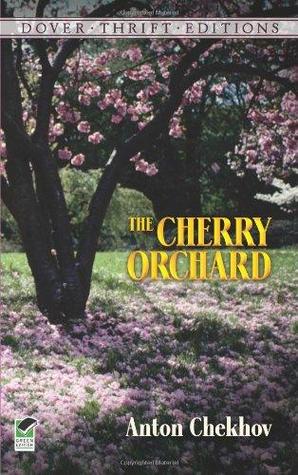 ‘The Cherry Orchard,’ created at MXAT in January, 1904, was Chekhov’s last play. Six months later he died in his Yalta “white house.” Obliged to live far away from Moscow, in the warmer climate of the Crimea because of his tuberculosis, it was hard for him to give long-distance stage directions to his high-spirited wife, actress Olga Knipper.
In the play, Liubov Andreevna Ranevskaya, her daughter Ania, age 17, and adopted daughter Varia, age 30, just returned to Russia from five years spent in France. The family was crippled with debts and the creditors were forcing the sale. A retinue of servants, some of them providing a light touch of vaudeville, and penniless hangers-on, are part of the large household.
The main character is Ermolai Alekseevich Lopakhin, full of energy, ideas, and, apparently money. He is trying to convince Liubov Andreevna to sell the estate with the cherry orchard to a developer who will build small houses for vacationers. But she is not interested in money; if things do not work out, she will return to Paris and live off an inheritance. Lopakhin was a slave or “soul” owned by the Liubov’s family. This former muzhik is now rich and ambitious.
His antithesis is Petr Sergueevich Trofimov, the eternal student who lives in a world of noble ideas, philosophy and poetry. He tells Lopakhin, “Soon you will be a millionaire. Sharks are needed also.” Such archetypes exist in many countries.
The Theater of Ile St Louis is the smallest theater in Paris with only 50 seats. The full cast of 12 characters barely fitted on the tiny stage and looked like giants. The set was limited to two benches and the period clothes to the slim laced-up boots of the women. When, at the end of the play, the spectators heard the chain saw felling the cherry trees and noticed the very old servant forgotten in the locked-up house, the emotion was intense.
I went on feeling that emotion while walking along the rushing grey waters of the Seine river.
Editor’s Note: This is the opinion of Nicole Prévost Logan.
 About the author: Nicole Prévost Logan divides her time between Essex and Paris, spending summers in the former and winters in the latter. She writes a regular column for us from her Paris home where her topics will include politics, economy, social unrest — mostly in France — but also in other European countries. She also covers a variety of art exhibits and the performing arts in Europe. Logan is the author of ‘Forever on the Road: A Franco-American Family’s Thirty Years in the Foreign Service,’ an autobiography of her life as the wife of an overseas diplomat, who lived in 10 foreign countries on three continents. Her experiences during her foreign service life included being in Lebanon when civil war erupted, excavating a medieval city in Moscow and spending a week under house arrest in Guinea.

 Potapaug Audubon presents “Preserving Plum Island” on Thursday, April 7, at 7 p.m. at Old Lyme Town Hall, 52 Lyme St., Old Lyme, with guest speaker Chris Cryder, from the Preserve Plum Island Coalition.
 Last December’s ‘Summit on Climate Change’ in Paris produced impressive developments in tackling one of the world’s most complex problems.