Registration Begins for Summer Dance Programs at Eastern Connecticut Ballet in East Lyme

Registration for all Summer Dance classes at Eastern Connecticut Ballet has begun.

AREAWIDE – Eastern Connecticut Ballet’s Summer Dance program will help all young dancers to grow and improve. The school for classical ballet training is offering many different workshops at its East Lyme studio in July and August with options of taking a single or multi-week program.

The youngest dancers (ages 3½-6) may enroll in a Storybook Magic Adventure featuring ballet, jazz and special crafts. The Petite Dancer Workshop (ages 6-8) is designed to bridge the gap between the young children’s program and the graded classical ballet program. Older children (ages 8-12) will build their skills and have fun in the Young Professional Summer Workshop.

More experienced students will benefit from the Intermediate/Advanced Workshop and/or the Summer Intensive, “In Balanchine’s Footsteps.”

Headlining the guest faculty for the Intensive is New York City Ballet’s extraordinary principal dancer Sara Mearns, described by Alastair Macaulay of the New York Times as “the great American ballerina of our era.” “In Balanchine’s Footsteps” will also be taught by Pennsylvania Ballet principal Amy Aldridge and Gloria Govrin, ECB Artistic Director, master teacher and former New York City Ballet soloist. These distinguished artists were either students of Balanchine or members of companies in the Balanchine tradition. To round out the program, students will enjoy jazz with Broadway veteran Mary Ann Lamb and modern dance with Paul Taylor Company member Eran Bugge.

“There’s no better way for a young dancer to learn than from master teachers who were either students of Balanchine or members of companies that embrace his style and choreography,” said ECB executive director Lise Reardon.

In addition, teens and adults may take classes in ballet and jazz on summer evenings. A full schedule, costs and registration form are available at easternctballet.com. Register by April 8 and receive a $15 discount. For inquiries, call 860-739-7899 or visit ECB at 435 Boston Post Road in East Lyme.

Take Chester Historical Society’s Creative Challenge with 1950s Manicure Sticks

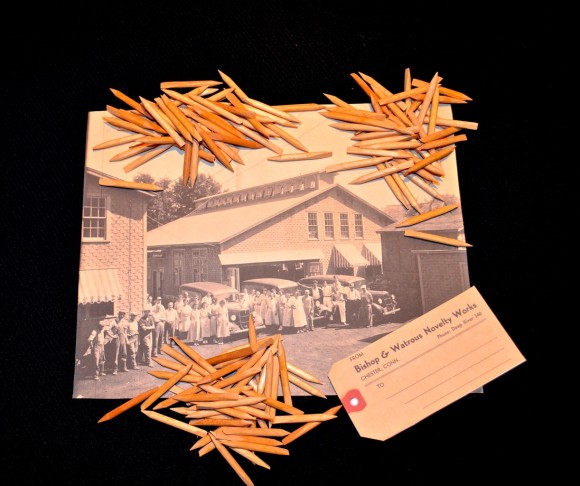
The Chester Historical Society invites you to take its Sticks Challenge based on these “orange sticks” made by the Bishop and Watrous Novelty Works around 1950. More information at the Chester Gallery, 860-526-9822. Photo by Skip Hubbard

The Chester Historical Society invites you to take its Sticks Challenge based on these “orange sticks” made by the Bishop and Watrous Novelty Works around 1950. More information at the Chester Gallery, 860-526-9822. Photo by Skip Hubbard

AREAWIDE – The Chester Historical Society is inviting anyone who likes a challenge to participate in its sixth Creative Challenge linking Chester history and art.

This spring, those accepting the 2016 Sticks Challenge will be given a bagful of short wooden manicure sticks, made from Florida citrus trees and shaped at the Bishop and Watrous Novelty Works on Maple Street around 1950.

As with last year’s Hooked Again! Challenge based on hooks from Chester’s M.S. Brooks factory, this spring’s Sticks Challenge is for area artists, sculptors, photographers, engineers, jewelry designers, and all others with a creative mind.

The sticks are available at Chester Gallery in Chester Center (860-526-9822). The artists’ entrance fee of $30 includes a bagful of the sticks and two tickets to the Sticks Challenge Silent Auction & Reception on Saturday, April 9 from 5:30 to 7:30 p.m. at the Chester Meeting House.

All proceeds from the silent auction help the Chester Historical Society preserve Chester history and maintain the Chester Museum at The Mill.

For more info on the Historical Society and this year’s Creative Challenge, visit www.ChesterHistoricalSociety.com or Facebook.com/ChesterCTHistoricalSociety

Old Lyme’s Open Space Commission Hosts Talk on Sea Level Rise, Salt Marsh Advance

The Town of Old Lyme’s Open Space Commission invites all interested parties to a workshop by Adam Whelchel, PhD, Director of Science at The Nature Conservancy’s Connecticut Chapter.  The workshop will be held on Friday, March 11, at 9 a.m. in the Old Lyme Town Hall.

The title of Whelchel’s workshop will be, “Salt Marsh Advancement and Sea Level Rise in Old Lyme Parcel by Parcel — Introducing the New Coastal Resilience Online Tool.”

The workshop will review:

  • Where and how much conflict will there likely be in the future between the existing built environment (roads, schools, churches, neighborhoods, businesses) and daily tides?
  • Where and how much salt marsh advancement will there be?
  • Where and how much salt marsh advancement occurs on existing protected and unprotected open space?

Rev. Robinson of Saint Ann’s Suffering From Stage 4 Kidney Failure, Needs Transplant, Seeks Donors

Reverend Canon Mark Robinson of Saint Ann's, Old Lyme.

Reverend Canon Mark Robinson of Saint Ann’s, Old Lyme.

The Reverend Canon Mark K. J. Robinson, Rector of Saint Ann’s Church in Old Lyme, Conn., has been diagnosed with stage 4 kidney failure and is on short term disability leave until he receives a transplant and recovers.  He has enrolled with the National Kidney Registry to become eligible for a donated kidney from any source.

The preferred choice is a living, matching donor.  Another option is for Rev. Robinson to receive a kidney through an exchange of kidneys between various matching donors and recipients.  Rev. Robinson ‘s transplant team is prepared to transplant him as soon as a suitable match is found, which will take place at Yale-New Haven Hospital in New Haven, Conn.

Because of the many factors involved, it is difficult to find a suitable kidney donor.  The Mentoring Corps for Community Development (MCCD) in Old Lyme is assisting Rev. Robinson in this effort and would appreciate your considering this life-saving gift.

Anyone who might be willing to be a kidney donor for the Rev. Robinson or would be willing to participate in an exchange for his benefit should contact the Transplant Coordinator’s Office at Yale-New Haven at 866 925 3897.  Please indicate that you are calling in regard to possibly donating a kidney for Mark Robinson.  

The Coordinator can answer any questions about the process, such as the risks, the tests required to determine the match, and the expected recovery period for the donor.  All costs associated with the preliminary tests and the operation are all covered by Rev. Robinson ’s insurance.  

The transplant unit will not accept donors who are overweight or who have been exposed to hepatitis, have had malaria, been treated with radiation, or who have been on dialysis.  Also, in most cases donors must be under 65 years old.

If you have any questions, contact Michael Perks by e-mail at mperks1@aol.com or by phone @ 860-434-7732.  The MCCD group’s website is at www.mentoringcorps.org.

Thank you for considering this opportunity to assist someone in need.

Op-Ed: Hains Park Boathouse Options Could Save Funds While Also Supporting Rowing Program Needs

As an engineer and rower, I frequently look at form and function and have provided several suggestions to the Hains Park Boathouse Improvement Committee (HPBIC).  When developing a project, each feature should be considered for its benefit and its cost. The newest Boathouse plan for Hains Park in Old Lyme favors form over function, and is less sensitive to disruptions and cost.  What is not known by those missing the Boathouse Committee meetings is that less expensive proposals have been raised that were able to meet the rowing program “needs” that did not “tear down” the existing, structurally sound Boathouse, which has one 28 ft. wide bay and one 16 ft. wide bay. 

However, these proposals were dismissed by the majority of the Committee because they said the rowers need three 22 ft. wide bays with an associated increase in aisle width between boat storage racks from the existing 4-5 ft. to 10 ft. (although an 8 ft. minimum is recommended by the US Rowing Association.)  Creative proposals to rearrange the boat storage layout recommended as a no-cost option by the boat rack supplier to achieve wider aisles with the existing 28 ft. and 16 ft. bays  – with use of a single line of “rolling racks” in the larger bay (see photo below) – plus the addition of a third 22 ft. wide bay, were summarily dismissed.   
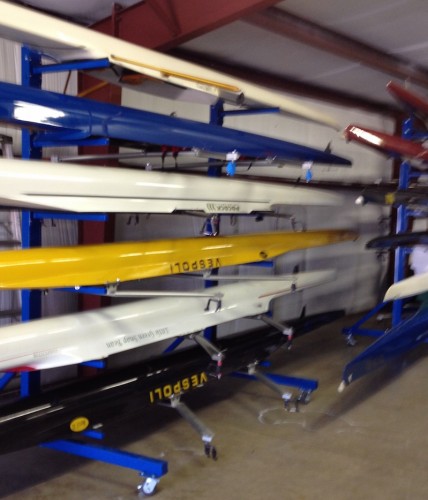
The author suggests that rolling boat racks similar to those shown in this photo would offer a cost-effective alternative in relation to the Hains Park Boathouse construction.

This image shows an example of the boat racks suggested by a supplier as a cost-effective alternative in the design of the Hains Park Boathouse. Photo submitted.

For example, all of the boat storage needs and 10 ft. wide aisles can be accommodated by placing one line of rolling racks and two rows of fixed racks in the 28 ft. bay, and one row of fixed racks in the 16 ft. bay, plus two new sets of fixed racks in an “addition” (attached or detached) to the existing Boathouse.  In the lowest cost option I proposed, a new boat shed (22 ft. x 84 ft.) would be built next to the existing Boathouse.  Given that it is pre-engineered by a company specializing in storage structures, it can be constructed very quickly with limited disruption to the existing facilities, with an estimated cost of  less than $200,000 – including ties to the existing structure.   

The primary reason given for dismissing all of the more cost-effective “addition” options was that they would be 6-8 ft. wider than the new Boathouse proposal (at 66 ft.) and so they would not allow the replacement basketball court to remain next to the Boathouse.  However, the committee now proposes moving the basketball court to a different area of the park both because of the Boathouse’s larger footprint and to save one maple tree.  Thus, moving the basketball court is no longer a reason to reject consideration of any of the more cost-effective “addition” options.   

Even if one allotted another approximate $150,000 to extend the back of the existing Boathouse for added flex-space, changing areas, and small storage/office spaces, the “addition” options have the potential to save hundreds of thousands of dollars over tearing-down the existing Boathouse and re-constructing “new.” 

Currently, the majority of the committee is pushing to proceed with committing $670,000 on just Phase 1 of project (which includes the new Boathouse) before they have estimated a “total project cost” for the “total project plan”, which includes public toilet upgrades, pavilion, and the remaining site work.  Thus, there is a significant risk that the full project cost with the new Boathouse plan may not come in within the $883,000 budget (comprising the $478,000 STEAP grant and $405,000 from Old Lyme taxpayers.) 

At this point, seriously considering more innovative boat storage options that save the existing Boathouse is recommended.  The rolling racks that can save the existing boathouse and significantly reduce the need for Old Lyme tax dollars should also be seriously evaluated or investment should be made in features that expand the functions of this park for the benefit of all.

Editor’s Note: The author , Stephen P. Dix, is a Professional Engineer who has been working with the Town of Old Lyme in various capacities for over 25 years, primarily supporting their Sewer Avoidance Program.  More recently he teamed up with Lombardo and Associates to propose a more cost-effective solution that included  water reuse.  Previously, he served as Technical Director for Infiltrator Systems in Old Saybrook for 10 years following an appointment at West Virginia University as Director for the EPA’s National Small Flows Clearinghouse.  Dix is recognized for his research in the science of soil-based treatment systems with publications and patents in this area.  He currently runs his own consulting firm that helps environmental corporations develop new technology; the firm also trains engineers and professionals in this field.