Lyme Ambulance Association Offers Free CPR Class, Saturday

Lyme Ambulance Association (LAA) is offering a free ‘Hands-Only CPR’ class for Lyme residents on Saturday, Feb. 6, from 9 to 11 a.m.

The class will take place at Hamburg Fire Station on Rte. 156 in Lyme.

Pre-registration is required.

For further information or to register, call (860) 434-5667.

Although the class is free, donations are always appreciated since the LAA is a non-profit, self-supporting organization.

Editor’s Note: our apologies for incorrectly stating initially that this course was being run by the Lyme Fire Company.

Romance Novels Featured in LVVS February Sale

AREAWIDE – Literacy Volunteers Valley Shore (LVVS) has announced that February’s monthly book promotion gives all aspiring cupids an opportunity to shine.

Romance novels are the special feature of the month. Pay just $1 for five selected paperbacks or $1 for all hardcover romance novels.

The book sale is located in the LVVS offices in the lower level of the Westbrook Public Library, 61 Goodspeed Drive. Hours are Monday through Thursday, 9 a.m. to 2 p.m., and Friday 9 a.m. to noon.

All book sale proceeds benefit the LVVS tutoring programs. For more information, email info@vsliteracy.org or call 860-399-0280.

Reading Uncertainly? ‘Worrying: A Literary and Cultural History’ by Francis O’Gorman

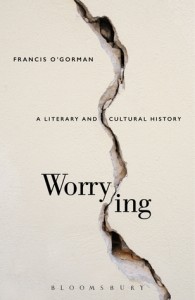
Worrying_“What if … ?” This is the key question that confronts all worriers, their dominant question about an ever-uncertain future. Professor O’Gorman, who teaches at the University of Leeds (U.K.) readily admits he is a worrier, and, in this slim volume (163 pages) he deftly probes, with humility plus good humor, the various definitions, strategies, relevant observations, advantages, and consolations, concluding with some fatalism that there may be little he can do about his condition. He actually begins with his end, “If we can’t ‘cure’ worry, we can venture to understand it – for better or worse.”

Here is his definition: “Worry is a form of fretfulness, of mental uncertainty and persistently tremulous bother,” the “fretful evaluations of the options in our life.” English has many synonyms: fretting, anxiety, bother, concern, fidgeting, doubt, nervousness, apprehension, and perplexity. Rodgers and Hart expressed them well in their hit song from Pal Joey (1940), “Bewitched, Bothered, and Bewildered.”

The dictionary’s verb is defined as “to feel uneasy or concerned about something,” but it also has an alternative “to pull or tear at something, as with the teeth.” It is when normal worry disintegrates into the dog’s work that we become concerned.

So is worry abnormal? For many of us it is a compulsive habit, “part of the fabric of life,” as O’Gorman argues, but too often seen as anti-social. He suggests: “Life is overflowing with opportunities to fret!”

For some of us who are trying to manage organizations facing numerous “risks,” “worry’s primary concern is about an uncertain future or, more exactly, about a future that has some element of the uncertain in it.” Our problem is that one “worry leads to another, and consequential worries.”  And that is unhealthy as too many of us have a “fixed belief that there is, today, something risky about tomorrow.” We end up fearing, not relishing, the future.

Indeed, “daring to be happy is a risk” in itself to a worrier.

Dr. O’Gorman suggests that “worry” also breeds ritual: routines, religions, compulsive habits, not all pleasant.  “The fundamental tenets of the major world religions will look delusional to the skeptic atheist, while seeming the brightest of reality to the believer.” So who is right? What is sanity? The author suggests a re-statement of Descartes’ mantra: “I worry; therefore I am.”

His arguments are ripe with the pertinent and often amusing citations of an enormous range of writers: Bronte, T.S. Eliot, George Eliot, the Bible, Shakespeare, Trollope, Kipling, Auden, Woolf, Joyce, Hardy, Darwin, Gladstone, Descartes, Homer, Mill, Sebald, Boswell, Frost, and, above all, Bach. Plus, of course, numerous academics.

Is reason an antidote for worry? “Reason can gather information. It can enumerate the issues. It can search out matters pertinent to the problem in hand. But the worrier’s reason is notoriously bad at suggesting a way forward.” “Worry’s a kind of mental risk assessment that regularly fails to result in an action plan …”

O’Gorman elaborates, “Our reasoning mind has come, in the contemporary world, to be bogged down in debilitating conditions of fretful decision-making and persistent blame, the grim and politicizing consequences of the apparently innocent and cheering pleasures of choosing.” And, “We run through options, assimilating and listening for the give-away signs of ideas we haven’t listened to. We’re always alert to the snuffling in the undergrowth of bristly problems we’ve not already imagined. We’re analysts who are genuinely good at analyzing even if we take little pleasure in our gifts and frequently fail to adjudicate on the most likely outcomes.”

What is the alternative? Should we all become Doctor Panglosses who exist in this, the most perfect, world? O’Gorman does offer the idea that the “arts” (painting, poetry, and especially music) can divert the worrier, but not permanently. They are, to him, a temporary distraction.

His book was a temporary but thoroughly engaging distraction for me, a non-worrier. I think like Alfred E. Neuman, the cover cartoon character for MAD Magazine, who persistently stated, “What? Me worry?”

I’m also reminded of the classic folk song of the Carter Family, first sung in 1930, “It takes a worried man to sing a worried song.” The last line is the best: “I’m worried now but I won’t be worried long!”

Editor’s Note: Francis O’Gorman, Worrying: A Literary and Cultural History, Bloomsbury, London 2015.

Felix Kloman_headshot_2005_284x331-150x150About the Author: Felix Kloman is a sailor, rower, husband, father, grandfather, retired management consultant and, above all, a curious reader and writer. He’s explored how we as human beings and organizations respond to ever-present uncertainty in two books, ‘Mumpsimus Revisited’ (2005) and ‘The Fantods of Risk’ (2008). A 20-year resident of Lyme, he now writes book reviews, mostly of non-fiction that explores our minds, our behavior, our politics and our history. But he does throw in a novel here and there. For more than 50 years, he’s put together the 17 syllables that comprise haiku, the traditional Japanese poetry, and now serves as the self-appointed “poet laureate” of Ashlawn Farms Coffee, where he may be seen on Friday mornings. His wife, Ann, is also a writer, but of mystery novels, all of which begin in a bubbling village in midcoast Maine, strangely reminiscent of the town she and her husband visit every summer.

Letter from Paris: Marmottan Monet Museum Offers Rare Glimpse of Villa Flora’s ‘Enchanting Times’

Nicole Prévost Logan

Nicole Prévost Logan

It is a well kept secret that Switzerland’s private foundations own a wealth of  art works.  Swiss law does not require them to be registered commercially and offers them favorable tax and legal conditions, creating thus a “paradise” for art collectors.  The Villa Flora, in Winterthur near Zurich, is one of the richest of these family foundations.  Since the museum is under renovation this winter, its contents found a temporary home at the Marmottan Monet museum in Paris and currently form the Villa Flora exhibition subtitled, “A Time of Enchantment.”

In 1898  Hedy Hahnloser inherited from her father, a well-to-do textile  industrialist, a large house and moved in with Arthur, her husband.  For a short time, Arthur practiced ophthalmology in the clinic he installed on the property but soon the couple became fully engaged in the passion of their life, which was to create long-lasting friendships with painters and to collect their works.

Over the years, the rambling house was turned into a studio and an art gallery — every available space was used to place the paintings.  Hedy had always been interested in arts and crafts and in the English movement by that name.  She decorated her house’s parquets and wainscots with the geometric designs characteristic  of the 1897 “Viennese Recession” led by Gustav Klimt.

A trip to Paris in 1908 was for the couple a total immersion into the frantic artistic scene of the French capital.  Braque and Picasso were experimenting with cubism, while the Fauvist movement was at its pinnacle.  The natural flair of the Hahnlosers in selecting art work was sharpened by their contacts with art merchants like Ambroise Vollard and Gaston Bernheim.

During that trip they met and struck up a friendship with Felix Valloton (1865-1925), who became a close friend, spent much time at the Villa Flora and also introduced them to the artistic circles of Paris.  They remained friends until his death.  For the Swiss couple to welcome artists and hold Tuesday coffees became a way of life.

One can compare their creative and welcoming home with the boarding house in Old Lyme, Conn., where Florence Griswold invited American Impressionists.  Or consider Gertrude Stein and her brother Leo who, like Arthur and Hedy, opened their “salon” on 27 rue de Fleurus to artists and writers.  And in yet another example, in the late 19th century, Russia also had its own artist colonies, which grew around enlightened members of the nobility.  The best known was Abramtsevo, near Moscow, created by  the industrialist Savva Mamontov.

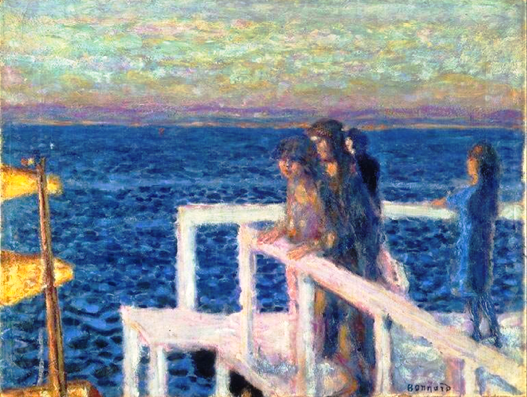
Pierre Bonnard, Débarcadère (or L’Embarcadère) de Cannes, 1928-1934

Pierre Bonnard, Débarcadère (or L’Embarcadère)
de Cannes, 1928-1934

The Hahnlosers’ collection contained works by Cezanne, Van Gogh,  Manet, Renoir, Matisse, Toulouse-Lautrec, the symbolist Odilon Redon and many others. But it is the abundance of  Nabis’ art, which made  it quite unique.

It was a post-impressionist movement in the mid 1890s.  “Nabi” means prophet in Hebrew and Arabic.  The leading members of this group — Maurice Denis, Felix Vallotton , Pierre Bonnard, Edouard Vuillard — considered themselves as the prophets of a new era in the arts.  Each one had his distinctive style, but there was always a message behind their way of depicting reality, whether it was religious, intellectual or emotional.  They were versatile artists, working in oil, and also lithography, wood cuts, satirical drawings, and book or poster illustration.

Vallotton stylized his subjects and used the technique of  “aplats” or flat areas of contrasting colors with sharp outlines.  There is a feeling of enigmatic  emptiness in his works. “La Charette” or cart drives away on a deserted dirt road, two slender umbrella pines contrast with the darker mass of trees bordering the road.

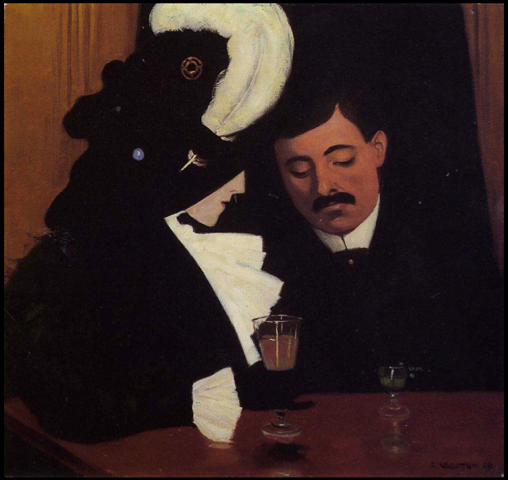
man&woman
Le provincial,” pictured above, shows a couple in a cafe.  One barely sees  the profile of the elegant woman wearing a huge hat.  The feather on the hat and the ruffled blouse are the only bright notes in this scene of a non-communicating couple in the male chauvinistic society at the turn of the 20th century.

Vallotton’ masterpiece is “La Blanche et la Noire”  (The White and the Black).  A white woman is lying, unabashedly naked, on a bed while a black woman is staring at her with insolence and a sort of inappropriate familiarity, a cigarette is sticking out of  her mouth. The painting is reminiscent of  the “Olympia” by Manet but with a different underlying story.

At the opposite end of the spectrum, Bonnard’s paintings have an effusive and warm quality.  His colors are luminous, his brush strokes seem unbridled, full of life.  He is inspired by the intimacy of domestic scenes — “Le Tub” is a picture within a picture thanks to the mirror placed at the center of the composition.   A plunging angle reveals Marthe, his wife and beloved model, near the tub.

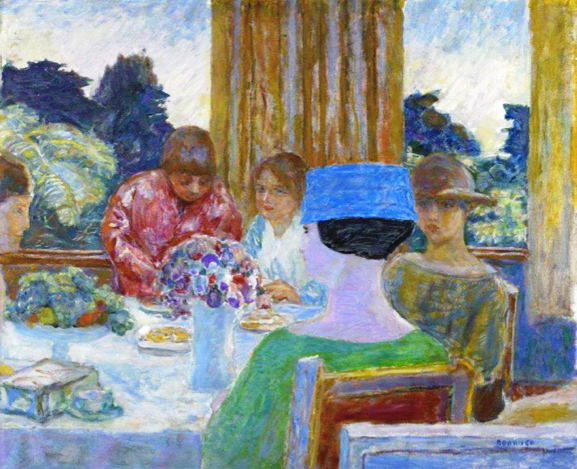
Pierre Bonnard, Le Thé, 1917

Pierre Bonnard, Le Thé, 1917

Bonnard cherished his villa in the Var, not far from Cannes.  “Le Thé” is a peaceful scene of young women having tea . He plays with an array of hat colors.  The vegetation seems to overflow into the porch.  On “Le Debarcadère” or pier,  young people lean over a railing, as if frozen in the contemplation of the rough Mediterranean waters.

This is indeed a rare opportunity to see an exceptional private art collection created by two extraordinary citizens, who according to the exhibition’s guide, lived their lives by following a simple mantra, “Living for art. Collecting. Such was the raison d’être of [this] couple.”

Nicole Prévost LoganAbout the author: Nicole Prévost Logan divides her time between Essex and Paris, spending summers in the former and winters in the latter. She writes a regular column for us from her Paris home where her topics will include politics, economy, social unrest — mostly in France — but also in other European countries. She also covers a variety of art exhibits and the performing arts in Europe. Logan is the author of ‘Forever on the Road: A Franco-American Family’s Thirty Years in the Foreign Service,’ an autobiography of her life as the wife of an overseas diplomat, who lived in 10 foreign countries on three continents. Her experiences during her foreign service life included being in Lebanon when civil war erupted, excavating a medieval city in Moscow and spending a week under house arrest in Guinea.



Old Lyme Selectmen Express Strong Opposition to Proposed Rail Project

Updated 02/01, 17:37 — We are trying to keep up to date with all the commentary occurring regarding the NEC high-speed railtrack proposals.

Old Lyme First Selectwoman Bonnie Reemsnyder

Old Lyme First Selectwoman Bonnie Reemsnyder

Old Lyme First Selectwoman Bonnie Reemsnyder submitted the following letter dated Jan. 13, 2016 to the Federal Railroad Administration (FRA) regarding the Northeast Corridor (NEC) Draft Plans:

“To Whom it May Concern,

My name is Bonnie Reemsnyder, First Selectwoman of the Town of Old Lyme. I have come here today to express my concern with and opposition to the Alternative 1 of the draft EIS for the NEC plan to improve rail service.

First and foremost, this plan would decimate the heart of our community. The path of the railroad would completely change according to this plan, cutting through the heart of our community. We are a small town with very little “central community” area, and what we do have is extremely important to our history, economy, character and sense of community. This plan would impact our only commercial area, which houses our grocery store, pharmacy and many small businesses. Our village center, which is directly off of the commercial area, houses the Lyme Academy of Fine Arts, as well as the famous Florence Griswold Museum and the Lyme Art Association. All are sites of historic significance and the individual organizations have worked diligently to continue with their legacy and maintain the physical structures. It is beyond comprehension that these buildings would be considered of little importance as this project moves forward.

But the plan also impacts many properties along the way, as it is an entirely new track, cutting through several neighborhoods, not to mention wetlands, open space and areas of archaeological significance. Our community maintains our character through strict zoning regulations, considerate planning, and support of our historic treasures, including the museums, colleges, library and various art organizations.

I am equally concerned that the Federal Rail Administration did not contact the First Selectman’s office personally to solicit feedback and comment. Hearing about plans that have a major impact on our community through the grapevine is unacceptable.

I am vehemently opposed to Alternative 1 of this plan and urge you to look at other, more reasonable solutions for reducing time travel between major cities. Thank you for your time.”

Old Lyme Selectwoman Mary Jo Nosal

Old Lyme Selectwoman Mary Jo Nosal

Old Lyme Selectwoman Mary Jo Nosal submitted the following letter also dated Jan. 13, 2016 to the Federal Railroad Administration (FRA) regarding the Northeast Corridor (NEC) Draft Plans:

“To Whom it May Concern,

My name is Mary Jo Nosal, Selectwoman from Old Lyme, CT. It is with great concern, anxiety and in total opposition to the Tier 1 draft EIS for NEC, Alternative 1 that I comment.

It appears that this Alternative focuses on meeting some of the regional goals of the NEC by addressing the chokeholds along the southern part of the existing route. However, by adding new track through the heart of our town our local needs are not addressed and therefore the objectives of the Tier are not met.

Specifically, the proposed section of new track from Old Saybrook to East Lyme, CT will adversely affect our entire community, will cut-off the established tourism lifeline of our region and will not provide a meaningful improvement in efficient rail service.

No data was provided in the EIE to demonstrate that our local commercial, residential and environmental concerns were considered.

A new track through Old Lyme provides no local economic benefit or advantage to local commuters or residents, while the extreme destruction it will cause to an environmentally sensitive area is irreversible.

As proposed, Alternative 1 will be strongly opposed by the community.”

Old Lyme Selectman Arthur 'Skip' Sibley

Old Lyme Selectman Arthur ‘Skip’ Sibley

Old Lyme Selectman Arthur “Skip” Sibley submitted the following letter dated Feb. 1, 2016 to the Federal Railroad Administration (FRA) regarding the Northeast Corridor (NEC) Draft Plans:

“To whom it may concern,

My name is Skip Sibley and I’m writing to you both as a citizen and an Old Lyme Selectman. I echo the comments already submitted by my two fellow BOS colleagues: Ms. Bonnie Reemsnyder & Ms. Mary Jo Nosal. I strongly object to the proposal as outlined in “Alternative 1”, in which the current train tracks would be relocated through the center of Old Lyme.

Additionally I find it incredible that a $30 million study using taxpayer dollars was already conducted producing a 1000 page report without any correspondence to the impacted towns. It was only a “tip” given by an outsider that Old Lyme even became aware of this initiative by the NEC corridor agency. I’m glad that an extension was given for folks to post their comments.

The rail path for Alternate option # 1 cuts through the heart of our historic district, potentially causing a devastating impact to residents, businesses, museums and schools. And I can’t imagine the damaging impact it would have on our environmentally sensitive areas.

Before moving forward in your plan and spending more dollars, I strongly encourage that a public hearing be scheduled so that other concerned citizens could voice their opinions as well. Please keep me informed on my request.”