‘Waves’ on Show at Cooley Gallery

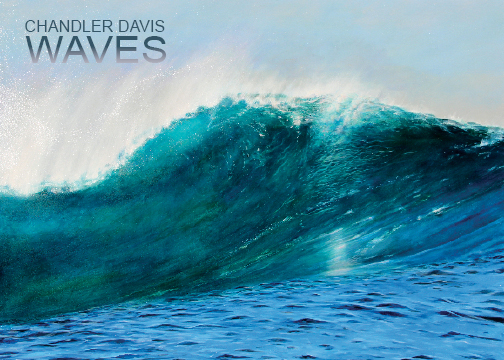
The signature painting by Chandler Davis of his 'Waves' exhibition at The Cooley Gallery.

The signature painting by Chandler Davis of his ‘Waves’ exhibition at The Cooley Gallery.

The Cooley Gallery in Old Lyme is kicking off its spring season with an exhibition of fresh, new wave paintings by Chandler Davis. Waves opens Thursday, April 2.

In the exhibition, the artist returns to his original inspiration of the ocean. Eight large wave paintings of luminous water in a variety of weather and light conditions depict some of the many moods of the ocean. From the depths of Chandler’s imagination and brush comes this remarkable series of waves — reality and abstraction combine to capture the light, motion, and energy of the sea.

Chandler is a missionary for the natural world and, in particular, the sea. He built an international reputation as an artist with his large-scale mollusk sculptures. Some of these can be seen down the street in Old Lyme on the grounds of the Bee and Thistle Inn (www.beeandthistleinn.com ). Chandler’s nautili, conches and mussels, rendered at “human” scale, are significant. A gargantuan mussel at eye level commands consideration, which is exactly the reaction Chandler desires.

If contemporary sculpture is your passion, there is more in Old Lyme at Gil Boro’s Studio 80+ Sculpture Grounds at 80 Lyme Street.

Founded in 1981 and located in the heart of historic Old Lyme, the Cooley Gallery specializes in fine American paintings from the 19th, 20th, and 21st centuries, including the Hudson River School, American Impressionism, and select contemporary artists.

Regular gallery hours are TuesdaySaturday10am to 5pm. Call (860) 434-8807 or visit www.cooleygallery.com  for additional information.  The Cooley Gallery is located at 25 Lyme Street, Old Lyme, CT 06371.

CT River Museum Hosts ‘New Deal’ Art Exhibition

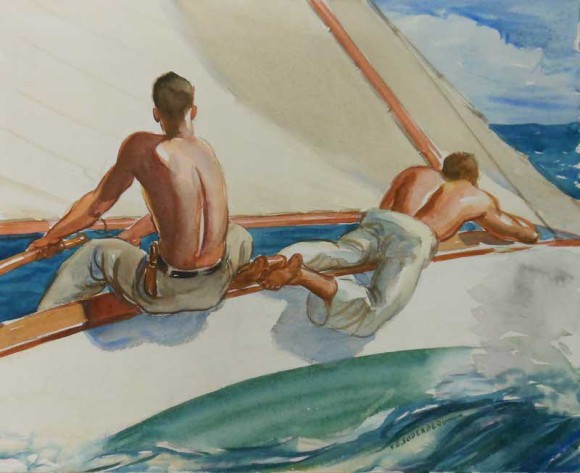
The Connecticut River Museum’s spring exhibit, New Deal Art Along the River, will open April 2nd. This painting, On the Rail by Yngve Soderberg is a watercolor on paper on loan from the Lyman Allen Art Museum. Photo courtesy of Lyman Allen Art Museum.

The Connecticut River Museum’s spring exhibit, New Deal Art Along the River, opens April 2. This painting, On the Rail by Yngve Soderberg is a watercolor on paper on loan from the Lyman Allyn Art Museum. Photo courtesy of Lyman Allen Art Museum.

During the depths of the Great Depression, the federal government created work relief programs to put unemployed Americans back to work. President Franklin D. Roosevelt’s “New Deal” programs provided all types of jobs – including opportunities for out-of-work artists. The Federal Art Project (1935 – 1943) paid artists to paint murals and easel art, sculpt, and teach art classes. Their art was always located in a public place such as a school, library, or government building so that all Americans had access to it for inspiration and enjoyment.

The subject matter for much of this artwork is known as the “American Scene” – showcasing regional history, landscapes, and people. The Connecticut River Museum’s new exhibit has selected artwork that represents artists from the Connecticut River Valley, or that depicts views of regional or maritime traditions of the Connecticut River and coastline.

“These paintings offer us a glimpse at Connecticut from sixty years ago,” says Museum Curator Amy Trout. “We think of that time as being dark and depressing, but these paintings show us a vibrant time and place.”

The exhibit contains 20 works of art ranging from pastels, etchings, watercolors, and oils. There are also examples of bas relief work from Essex sculptor Henry Kreis who designed the state’s Tercentenary medal and coin in 1935 under the Civil Works Authority (CWA) funding. The paintings come from area museums such as the Lyman Allyn Art Museum, Mystic Arts Center, Connecticut Historical Society, and the Portland Historical Society, among others.

Even though these paintings were originally intended for public viewing, many have found their way into museum storerooms and are rarely seen. “It’s important to get them out on display and remind people of the wonderful legacy that was left to us. It gives us a chance to talk about Connecticut during the 1930s and appreciate the art that gives us greater insight into that period,” says Trout. The artists are also relatively unknown. Many continued in the field of art after the Depression, but few achieved great fame. “They needed to make a living, so many became commercial artists, illustrators, or teachers.”

The exhibition opens Thursday, April 2.

The Connecticut River Museum is located at 67 Main Street, Essex and is open daily from 10 a.m. through 5 p.m. and closed on Mondays after Columbus Day. Admission is $8 for adults, $7 for seniors, $5 for children age 6-12, free for children under 6.

For more information, call 860-767-8269 or go to www.ctrivermuseum.org.

Panel Discussion Commemorates 50th Anniversary of Landmark Women’s Rights Decision

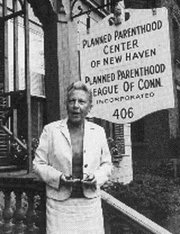
Civil rights pioneer Estelle Griswold stands outside the offices of Planned Parenthood in New haven, Conn.

Civil rights activist and feminist  Estelle Griswold stands outside the offices of Planned Parenthood in New Haven, Conn.

The Shoreline League of Democratic Women (SLDW) has announced it will host a  panel presentation and discussion Commemorating the 50th  Anniversary of Griswold v. Connecticut.  The event will be held at 7 p.m., Thursday evening, April 2, Westbrook Library (Lower Level), 61 Goodspeed Drive, Westbrook, CT  06498.

Guest panelists include Connecticut State Representative Kelly Luxenberg and Susan Yolen, VP for Public Policy and Advocacy for Planned Parenthood of Southern New England. This event is free and open to the public.

In 1965, Estelle Griswold of Executive Director of Planned Parenthood League of Connecticut and Yale Physician and Professor Dr. Buxton challenged the State’s interference in a woman’s right to access birth control, and by extension a woman’s right to privacy over her own body.  Upon opening a clinic in New Haven, they were both promptly arrested and appealed to the Supreme Court. Winning a 7-2 victory, they established case law that would ensure women this basic human right across the United States.

Fifty years later, the SLDW shines a light on Griswold and Buxton, and remembers the rights we take for granted today were often hard won, but are inalienable.

The SLDW (http://www.sldw.org) is a chapter of the Connecticut Federation of Democratic Women (CFDW), which is a chapter of the National Federation of Democratic Women. The SLDW continues to seek membership from women who live in Old Lyme, and Lyme as well as Clinton, Madison, Guilford, Branford, Killingworth, Old Saybrook, Essex, Westbrook, Chester and Deep River. Meetings are held monthly from September through May.

The SLDW is dedicated to educating its members about political and social issues important to women of all ages in the Valley-Shore area. Women in the local district are encouraged to join the SLDW and participate in the organization’s valuable work in the community. Members can be involved in any capacity, whether it is 30 minutes a month, or 30 minutes a year. As a part of the SLDW educational charter, members will be notified of important pending state and national legislation.

For more information, email sldworg@gmail.com or contact Kathleen Skoczen at 860-669-7034 or Belinda Jones at860-399-1147. Visit the SLDW website at http://www.sldw.org.

RiverQuest Offers Osprey/Eagle Cruises in April

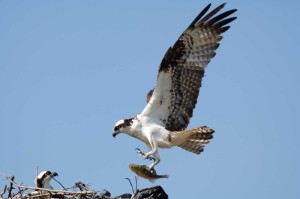
An osprey, returned from his winter spent in the southern hemisphere, feeds his young on the nest.

An osprey, returned from his winter spent in the southern hemisphere, feeds his young in the nest.

Late March into early April is when the Osprey returns to Connecticut from its southern wintering grounds. It is a wonderful sign that spring is here …

The Osprey is a large bird of prey (raptor) with a wingspan up to 6′ that eats fish, hence, it is sometimes referred to as the fish hawk. Connecticut Ospreys migrate south in late August through late September to areas where their food supply will not be affected by frozen rivers and lakes, sometimes as far south as Argentina. Ospreys of breeding age, at least three-years-old, are returning north now to start a new nest or to re-establish and re-build a nest they may have used in previous years.

Ospreys nest along the edges of the lower Connecticut River, from the mouth of the river in Old Lyme/Old Saybrook up river as far as Middletown. There will be activity on the many man-made nesting platforms at the Roger Tory Peterson Preserve near the mouth of the river in Old Lyme and on several other nesting platforms on the river, in “natural” tree settings and on the top of each of the navigational day markers that indicate the river channel. It is also hoped there will be Ospreys nesting on the new Osprey platform placed on the 101-year-old East Haddam Swing Bridge.

A great way to see this nesting activity is by boat. RiverQuest, an eco-tour vessel located at Eagle Landing State Park in the Tylerville section of Haddam is offering several cruises to the general public throughout April to view and learn about the Osprey and other wildlife that may be spotted, including hawks and another famous raptor, the American Bald Eagle.

After disappearing from Connecticut in 1948, the Bald Eagle has made a return and there are several active eagle nests on the river. It will be possible to view two of these nests from RiverQuest and very possibly, see one or more of the local resident Bald Eagles.

Other areas of interest that will be seen on the cruise include the Goodspeed Opera House, Gillette Castle and the Chester/Hadlyme Ferry. The cruises are about 2.5 hours in length and cost $40 per passenger (no children under 10-years-old.) There will be complimentary coffee and tea and a limited supply of binoculars on loan for the cruise.

To learn more about these informative cruises and/or reserve your spot with the easy on-line booking system, visit ctriverquest.com or phone 860-662-0577.

A Letter From Paris: A Look at Little (But Oh, So Powerful) Luxembourg

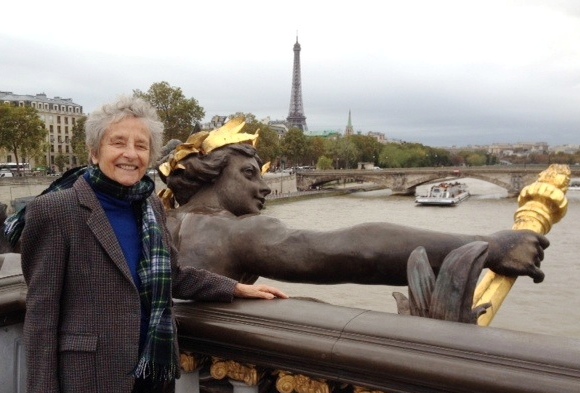
Nicole Prévost Logan

Nicole Prévost Logan

Although Luxembourg is a minuscule country, with only 476,000 inhabitants, it is one of the world banking powerhouses occupying second place with 2.4 trillion euros under its management. It is one of the founding members of the European Union (EU) and has been an active participant at every step of its construction. How did this happen?

The capital occupies a spectacular site on a rocky ridge overlooking the precipitous ravines of the Petrusse and Alzette rivers. From the Roman streets (Cardo and Decumanus) intersecting in the Marchė aux Poissons (fish market) to the all-glass museum of contemporary art designed by I. M. Pei, a visitor to Luxembourg can admire many periods of architecture including the ducal palace built in a rare 15th century Spanish-Moorish style.
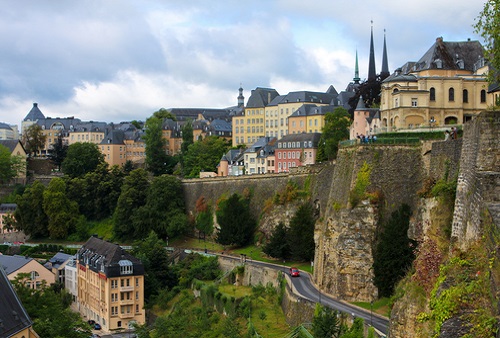
Luxembourg's Ville Haute has a stunning location

Luxembourg’s Ville Haute has a stunning location.

After centuries of domination by neighbors, including France, the Netherlands and Belgium, the 1839 Treaty of London granted the Grand Duchy of Luxembourg both its independence and definitive borders. Grand Duke Henri is the incumbent ruler of the reigning Nassau-Weilbourg dynasty .

The vocation of Luxembourg was at first to be an impregnable fortress. In 963, Count Sigefroi chose the rock of Bock to build a fort. When, in 1684, Napoleon laid siege to the town, he turned to his renowned military architect Vauban to expand the fortifications, which are still visible today, with ramparts, towers, tunnels, bastions and casemates (military blockhouses), all dug out of the cliffs.

Luxembourg has also enjoyed another vocation — to be chosen sometimes as the ruler of Europe. In 1308, Count Henry VII was elected King of Germany by the Prince Electors and soon afterward crowned as head of the German Holy Roman Empire. Since December 2014, the EU President – its highest executive – is Jean Claude Juncker, former Prime Minister of Luxembourg.

Luxembourg has been closely associated with the process of unification of Europe. Robert Schuman, born of a French father and a Luxembourg mother, was among the founding fathers of Europe. In 1947, the BENELUX convention, which created a customs union, was signed between Belgium, the Netherlands and Luxembourg. In 1950, Schuman and Jean Monet from France created the ECSC (European Coal and Steel Community). In 1957, Luxembourg, France, Germany, Italy, the Netherlands, and Belgium signed the Treaty of Rome, creating the EEC (European Economic Community).

The 1985 “Schengen Space” agreement, abolishing borders within Europe, took its name from a small Luxembourg village. The ‘quartier européeen’ has sprung up as a small Manhattan on the Kirchberg plateau with the sky scrapers of the European institutions like the European Investment Bank, the European Court of Justice, and most of the 150 international banks emblematic of modern Luxembourg.

In the 19th century, the discovery of iron ore brought Luxembourg into the industrial age. On the eve of World War I, it was the sixth producer of steel in the world. But, with the decline of steel metallurgy after the 1970s, Luxembourg had to reinvent itself and turned toward financial activities, which today constitute more than 30 percent of the country’s GDP. In 2001 the “Clearstream” scandal raised the suspicion of tax evasion.

Currently the trend is toward increasing transparency in the banking business. In early March of this year, during an official visit to Luxembourg by French president Hollande, “tax optimization” was discussed. It was decided that, by 2017, the exchange of information will become automatic between the two countries.

The policy of Brussels, led by Juncker, is to launch a program of “quantitative easing” or QE (similar to the one carried by the Federal Reserve in the US), of 3,000 billion into the European economy. Countries are now scrambling to qualify for the bail-out funds by presenting their most innovative projects.
Nicole Prévost Logan

Nicole Prévost Logan

About the author: Nicole Prévost Logan divides her time between Essex and Paris, spending summers in the former and winters in the latter. She writes a regular column for us from her Paris home where her topics will include politics, economy, social unrest — mostly in France — but also in other European countries. She also covers a variety of art exhibits and the performing arts in Europe. Logan is the author of ‘Forever on the Road: A Franco-American Family’s Thirty Years in the Foreign Service,’ an autobiography of her life as the wife of an overseas diplomat, who lived in 10 foreign countries on three continents. Her experiences during her foreign service life included being in Lebanon when civil war erupted, excavating a medieval city in Moscow and spending a week under house arrest in Guinea.