Our French correspondent Nicole Prévost Logan was in Paris last Wednesday when the horrific shootings at the Charlie Hebdo office occurred and for the subsequent days of terror in the environs of Paris. This column reflects her thoughts on the tragedy. She writes:
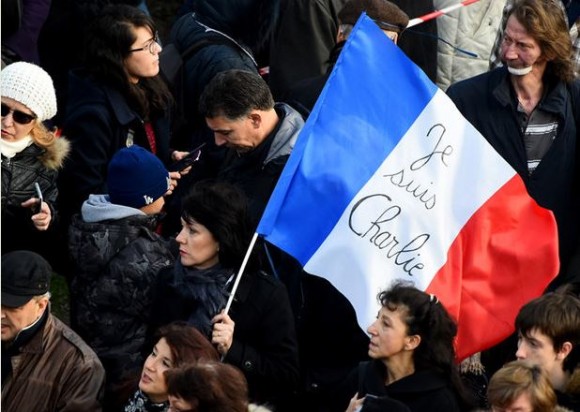
They were a talented, irreverent, friendly and humorous bunch of cartoonists and journalists. They were like family. We knew them by name. Charb, Cabu, Wolinski (Stéphane Charbonnier, Jean Cabut, Georges Wolinski) and the others were also incredibly courageous. Round the clock they had to be protected by police and body guards. In 2011, their office was blown up in an explosion. Charb, leader and editor-in-chief of the Charlie Hebdo weekly satirical newspaper, was on the ‘Wanted’ list of Al-Qaeda as someone to be eliminated.
On Wednesday, January 7, at noon, I was walking by the Bastille, near my apartment, when police cars, ambulances, Red Cross vehicles, fire trucks – their sirens howling – seemed to be converging on the square. Strange, I thought. When I met my daughter for lunch, she told me that the entire editorial board of Charlie Hebdo had been shot. Being “connected” with her smart phone, she was able to follow every minute of the crisis
The crisis lasted for three days with the pursuit of the two Kouachi brothers by tens of thousands of police and special forces. Two more attacks (related, as it turned out later) occurred in Montrouge and Porte de Vincennes with the taking of hostages by a third terrorist Amedy Coulibaly. Seventeen people died during the 72 hours, including four Jewish hostages who had been held in a Kosher supermarket.
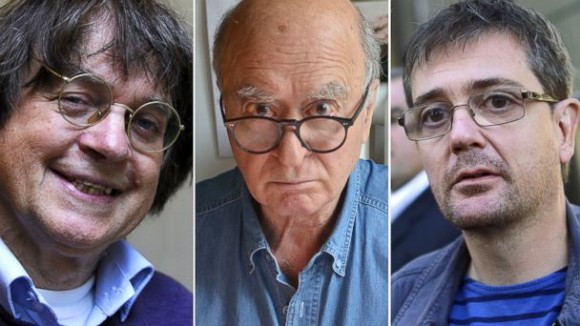
From left to right, Charlie Hebdo victims Cabu, Wolinski and Charb.
The emotion in France was intense. The French have always relished Charlie Hebdo’s iconoclastic derision aimed at everyone … women, Jews, Moslems, blacks, no exceptions … and their making fun of politics, religion and other serious topics.
The tragic end of an entire editorial staff of a newspaper at the point of a gun in the name of a principle explains the incredible shock wave of sympathy with spread around the world in a few hours. A journalist from Los Angeles said in his grief at the talent lost that, in one throw, more cartoonists were killed than the total number existing in the US. The victims have become the heroes, for having pushed to the extreme the right to say, write or draw anything in a free democratic society.
One may quote Voltaire, “I may not agree with what you say but I will fight to death for your right to say it.” Humor rather than violence or a call to violence, this was their motto. This weekend France became a libertarian banner and the world seemed grateful to France for doing what no one else dared to do. This attack and the planet’s reaction that it triggered can be seen as a fight for a secular state threatened by obscurantist developments, both in the regions where ISIL is taking hold and against terrorism anywhere in the world.
The French opinion from all parties, (except the Front National) is that president François Hollande managed the crisis superbly. He was on the front line at all times. He scared the police forces beyond belief when he came to the Charlie Hebdo street barely one hour after the attack, even before the area was made secure. Hollande was at the helm of the operations and gave the green light for the two final assaults to be perfectly synchronized. He addressed the nation several times, avoiding grandiloquence and photo-op opportunities.
Instead of being belligerent and declaring “at war” status, what he stressed was the national unity and the need of inclusion of the overwhelmingly moderate Moslem population (about four million or 6.8 percent of the population, by 2012 figures.) He urged the leaders of that community – imams, clergy, intellectuals and associations – to speak up and to join the march organized on Sunday. Hassan Chalghoumi, imam of the mosque of Drancy, a neighborhood with a majority of immigrants, declared on television, “What they have done is not Islam, we strongly condemn their acts.” This is important because the problem of “integration” in France (one remembers the hostility caused by the ban on the veil) is a difficult process.
For three days, men in black, super-equipped with helmets, bullet-proof vests, shields and heavy arms, occupied our television screens. We learned more about the elite groups which carried out the assaults. In Dammartin-en-Goële, it was the GIGN (Groupe d’Intervention de la Gendarmerie Nationale), part of a 400-strong military elite corps based in Versailles. At the Kosher market of the Porte de Vincennes, RAID (Recherche pour Assistance Intervention Dissuasion) is part of the police. It was the first time ever that GIGN and RAID collaborated.
A question was immediately raised: how was it possible that Cherif and Saïd Kouachi and Amedy Coulibaly, young French men with murky pasts of convictions, prisons terms, and, most of all, trips to Syria and several months training in Yemen with the most dangerous groups of Al-Qaeda (AQPA) in the Arabian Peninsula, included on the US “no fly list,” could have been overlooked by the DGSE (Direction Generale de la Securite Exterieure)? Pierre Martinet, one of the heads of the DGSE explained that the data about all these people has been collected, but they do not have the manpower to put several thousands potential terrorists under surveillance.
Gilles Keppel, a Middle East specialist and professor at Sciences Po) revealed that France has been designated as the prime enemy. There are about 1,200 French Jihadists, the largest group in Europe. The era when terrorists learnt how to fly planes is over — today the social networks have created another situation when Al-Qaeda is less an organization than a system. Private individuals make decisions, hence the difficulty in controlling them.
In an interview Monday morning, Laurent Fabius, Minister of Foreign Affairs, summarized the priorities: control the calls for violence on the internet; in prison, separate radical islamists to prevent their radicalization of other prisoners; and intensify the coordination of intelligence agencies within Europe and around the world. The Socialists are reluctant to introduce legislation comparable to the Patriot Act in the US at the expense of the rule of law.
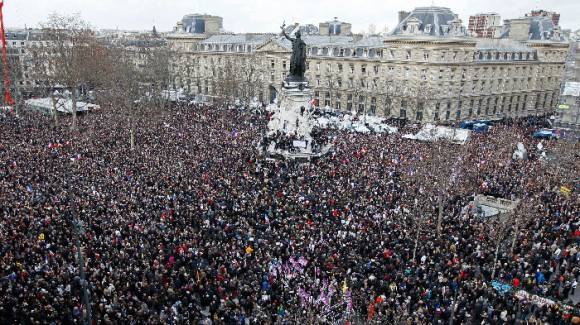
Millions gathered Sunday to pay tribute to the victims of the previous week and stand in solidarity in defence of the right to free speech.
Sunday, January 11, saw the march of the century. Forty heads of state participated in the demonstration. François Hollande led the march, accompanied by Angela Merkel and 40 other heads of state. Some commentators wondered whether Benjamin Netanyahu’s presence was politically motivated or also to defend the principle of freedom of expression.
Four million people were on the streets, almost half of them in Paris. The crowd, including many children, was calm and disciplined, sang La Marseillaise, and applauded the police – probably for the first time in French history.
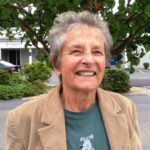
Nicole Prévost Logan
About the author: Nicole Prévost Logan divides her time between Essex and Paris, spending summers in the former and winters in the latter. She writes a regular column for us from her Paris home where her topics will include politics, economy, social unrest — mostly in France — but also in other European countries. She also covers a variety of art exhibits and the performing arts in Europe. Logan is the author of ‘Forever on the Road: A Franco-American Family’s Thirty Years in the Foreign Service,’ an autobiography of her life as the wife of an overseas diplomat, who lived in 10 foreign countries on three continents. Her experiences during her foreign service life included being in Lebanon when civil war erupted, excavating a medieval city in Moscow and spending a week under house arrest in Guinea.
 The Community Action for Substance Free Youth (CASFY) group is hosting an important workshop Tuesday, Jan. 13, at 7 p.m. at Lymes’ Youth Service Bureau (LYSB), 59 Lyme Street, Old Lyme.