Bluesman Dan Stevens Opens MusicNow’s Winter 2015 Series

Dan Stevens

Dan Stevens

The MusicNow Foundation, Inc. kicks off Nightingale‘s Acoustic Series Winter Schedule 2015 this evening at 7 p.m. in the Sheffield Auditorium of the First Congregational Church of Old Lyme with a concert by American Bluesman, “Ramblin” Dan Stevens. Doors open at 6 p.m.

There will also be an Acoustic Young Artist Showcase featuring Noah Feldman, Ethan Cash and Drew Cathcart.
Stevens will perform a mix of traditional blues, americana and originals and has entertained audiences  throughout the US, Germany, UK, Canada and Virgin Islands.  His unique style of “bottleneck” slide playing popularized by early bluesmen.
A finalist in the International Blues Challenge on Beale St. in Memphis, Tenn., and protege of the legendary Dave Van Ronk, Stevens has been lauded as a raconteur and for the authenticity of his approach.   He will be joined by The Mellow Men, featuring multi-instrumentalist Kipp “Kidd Caviar” Sturgeon and harmonica virtuoso Blunt White plus special guests.

The ‘Blues Rag’ published by the Baltimore Blues Society describes Stevens as a,”Troubadour of acoustic blues [who] has a knack for capturing the essence of the blues.”

Tickets are $10 or $5 for students.  For reservations, email gstevens@musicnowfoundation.org

Lyme-Old Lyme Education Foundation Announces New Round of Grants

The Lyme Old Lyme Education Foundation (LOLEF) has announced three Fall 2014 grant awards.

The Education Foundation is awarding $5,800 to Michelle DeSarbo, Children’s Librarian at the Old Lyme Phoebe Griffin Noyes Library, and Karen Pasiuk, K-5 Math Specialist in the Region 18 Schools to fund a three-year pilot project: a math learning center, or “Number Nook”, within the children’s section of the Old Lyme-Phoebe Griffin Noyes Library. The math learning center will serve to support both the summer and year-round math programming for  Lyme/Old Lyme students in K to 5th grade.

The foundation also gave $3,390 to Thelma Halloran, art teacher at the Lyme Old Lyme Middle School, for “Spring Into Arts”, a school-wide event held every three years at the middle school. On Friday, April 10, 2015, each student in grades 6 through 8 will be able to choose from over 20 workshops presented by professional and amateur artists from around the state. The students will be actively engaged in creating, viewing, and talking about art. The program’s goal is to inspire a lifelong interest in and appreciation for all kind of art.

Finally, Patty Cournoyer, Olivia Hersant, and Wendy Wilke, will receive $3,695 to pilot a program to reinforce the academic benefits of movement. These funds will allow them to purchase five different alternate-movement-based classroom furniture prototypes for two classrooms (one health classroom and one academic classroom). Compelling research suggests that this type of seating will increase the students’ capacity to focus and learn in a fairly sedentary environment.

The LOLEF is an independent, 501(c)(3) non-profit charitable organization established in 2006 to support and enhance public education in our community. The Foundation is governed by a volunteer Board of Directors and supported by an advisory group of members of the community. The Foundation seeks to raise and distribute

‘Celebrating Lyme’s Beauty,’ Featuring Paintings of Banningwood Preserve, on View at Lyman Allyn Through Mar. 22

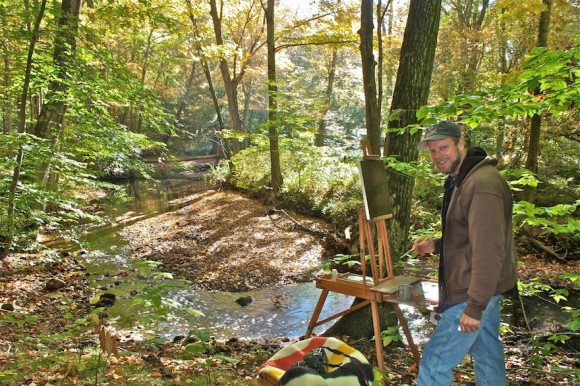
A plein air painter in Lyme Land Trust’s Banningwood Preserve in Hadlyme on Columbus Day Weekend during the 2014 Celebrating Lyme’s Beauty Paint-Out.

A plein air painter in Lyme Land Trust’s Banningwood Preserve in Hadlyme on Columbus Day Weekend during the 2014 Celebrating Lyme’s Beauty Paint-Out.

A new exhibit entitled “Celebrating Lyme’s Beauty,” which showcases new original paintings of Lyme’s Banningwood Preserve, is on view at New London’s Lyman Allyn Art Museum in its Glassenberg Gallery and open to the public through March 22.

The exhibit will feature landscapes created by artists from all over New England who participated in the “Celebrating Lyme’s Beauty Paint-Out,” an annual plein air painting event now in its fourth year that is co-organized by the Lyme Art Association, Lyme Land Conservation Trust and The Lyman Allyn Art Museum.

The Paint-Out event continues the plein air tradition established by the early American Impressionists who founded the Lyme Art Colony over a hundred years ago and used Lyme’s meadows, rivers and streams as subjects for their work.
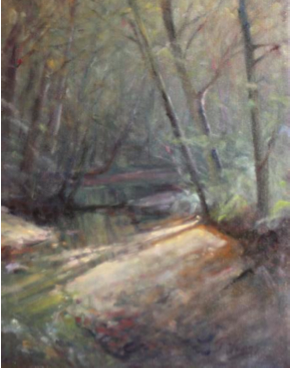
Painting of Roaring Brook by Trenton Youngs

Painting of Roaring Brook by Trenton Youngs

This year’s Paint-Out was held on Columbus Day Weekend, 2014, at the Land Trust’s newly acquired Banningwood Preserve, a 102-acre upland and flood plain landscape in Hadlyme covered with forests and fields.

The clear waters of Roaring Brook flow through the middle of the Preserve. Dramatic rock ledges, once quarried to provide stone for nearby Gillette Castle, rise over the landscape. Features include dramatic vistas, lush meadows, cedar groves, quarry pools, beaver dams and lodges, tree canopies, and an early 19th Century family burying ground with grave stones that attest to the land’s history.

Scenes of fall foliage, woodlands and streams are among the subjects depicted in this collection of works.

“This event is the result of a successful cooperative enterprise between three local non-profit organizations that have important ties to Lyme’s memorable landscape,” said Sam Quigley, Director of the Lyman Allyn Art Museum. “The greater New London County community is richer because of this partnership among these three organizations, which have different and distinct missions but which share a commitment to the beauty, art and preservation of our natural landscape.”

“The Lyman Allyn Art Museum’s permanent collection of Lyme Impressionist paintings,” Quigley continued, “provides wonderful inspiration for the participating artists; the Lyme Land Conservation Trust’s commitment to preserving Lyme’s forests and farmlands makes the Paint-Out possible; and the ability of the artists of the Lyme Art Association to capture the landscape’s natural beauty through plein air paintings will make this a very engaging exhibition.”

For more information about the exhibition, contact Rebecca Marsie at 860.443.2545 x112 or at marsie@lymanallyn.org, or visit www.lymelandtrust.org and/or www.lymanallyn.org.

The Lyman Allyn Art Museum welcomes about 25,000 visitors annually from New London, Southeastern Connecticut and all over the world. Established in 1926 by a gift from Harriet Allyn in memory of her seafaring father, the Museum opened the doors of its beautiful neo-classical building surrounded by 11 acres of green space in 1932. Today it presents a number of changing exhibitions each year and houses a fascinating collection of over 10,000 objects from ancient times to the present; artworks from Africa, Asia, the Americas and Europe, with particularly strong collections of American paintings, decorative arts and Victorian toys and doll houses.

The museum is located at 625 Williams Street, New London, Connecticut, exit 83 off I-95. The museum is open Tuesday through Saturday, 10:00 am – 5:00 pm, Sundays 1:00 – 5:00 pm; closed Mondays and major holidays. For more information call 860.443.2545, ext. 129 or visit us on Facebook or the web at: www.lymanallyn.org.

Since 1966, Lyme Land Conservation Trust has been conserving the unique and historic landscapes of Lyme, Connecticut. During those years, our rural community has shown that a small population can have a giant impact. Residents and friends of Lyme have donated land, dollars, and lots of hard work to acquire and protect almost 3000 acres of woodlands, craggy hills, working farm fields, and bird-filled marshes. For more information call 860-434-4639; email: info@lymelandtrust.org ; or visit it on Facebook or on the web at www.lymelandtrust.org

Opened in 1921 as a permanent exhibition home for the Lyme Art Colony artists, the Lyme Art Association Gallery, which is free to the public, continues to be a vibrant art center. Professional as well as developing artists mount major exhibitions throughout the year and form the heart of the Lyme Art Association, which now boasts more than 1,000 members. It offers a schedule of exhibitions and sales, affordable art classes, workshops, and a popular lecture series.

The Lyme Art Association gallery is located at 90 Lyme Street, Old Lyme, CT. It is open Wednesday through Sunday 10 a.m. to 5 p.m. For more information call 860-434-7802 or visit www.lymeartassociation.org .


Reading Uncertainly? “The Sixth Extinction: An Unnatural History” by Elizabeth Kolbert

The_Sixth_Extinction

Rats! Is there a real possibility that rats may be the species that survives the human race? Elizabeth Kolbert suggests such an outcome in her engrossing perambulation around this modest earth on which we live, since we may well be living at the start of the “Sixth Extinction.”

Science tells us the earth has experienced five earlier “extinctions,” when many living creatures, small and large, disappeared because of a major change in the earth’s constitution or because of an errant asteroid. But these five occurred approximately 450, 375, 250, 200 and 60 million years ago, in a universe that is 13.5 billion years old.

So we are minute upstarts on this planet. But, as a thinking and intensely curious species, we’ve tried to understand that long past, plus our present and a most uncertain future.

Kolbert’s question: are we creating our own Sixth Extinction?

Like Pogo, she suggests “the cataclysm is us!” “Since the start of the industrial revolution,” she writes, “humans have burned through enough fossil fuels—coal, oil, and natural gas—to add some 365 billion metric tons of carbon to the atmosphere. Deforestation has contributed another 180 billion tons. Each year we throw up another nine billion tons or so . . . . The concentration of carbon dioxide in the air today . . . is higher than at any other point in the last eight hundred thousand years. . . . It is expected that such an increase will produce an eventual average global temperature rise of between three and a half and seven degrees Fahrenheit . . . (triggering) the disappearance of most remaining glaciers, the inundation of low-lying islands and coastal cities, and the melting of the Arctic ice cap.”

Then add to that “ocean acidification.”

We know that all species on this planet are interdependent, but are humans also an “invasive species?” Yes, we seem to be collective problem solvers (much like ants, according to E. O. Wilson) but we seem to be unable to solve our biggest problem: us! “Though it might be nice to imagine there was once a time when men lived in harmony with nature, it is not clear he ever did!”

Is it possible, then, as Kolbert suggests, “ . . . a hushed hundred million years from now, all that we consider to be the great works of man – the sculptures and the libraries, the monuments and the museums, the cities and the factories – will all be compressed into a layer of sediment not much thicker than a cigarette paper?”

Kolbert visits locations all around this earth – some 11 countries – very much like Alan Weisman’s research for his Countdown, exploring current rates of extinction. One is on an island in the Great Barrier Reef of Australia, looking at the erosion of coral. Another is the decline of bats in the eastern United States. Still another is the Panamanian golden frog. Together, she says, they indicate we are a part of the Anthropocene epoch, during which we may well become extinct.

This is a sobering analysis of current practices and signs. She acknowledges the possibility that “human ingenuity will outrun any disaster that human ingenuity sets in motion.” But I’m left with the likelihood that our friend the rat, who has hitchhiked to almost every piece of this earth with us, and who successfully scavenges our debris, may survive us. As Ratty pronounced, in Kenneth Grahame’s The Wind in the Willows (my paraphrase), “Believe me, my young friend, there is nothing – absolutely nothing — half so much worth doing as simply messing about with humans.”

Her book is “one of 2014’s best” according to The Economist.

HFK_headshot_2005_284x331About the author: Felix Kloman is a sailor, rower, husband, father, grandfather, retired management consultant and, above all, a curious reader and writer. He’s explored how we as human beings and organizations respond to ever-present uncertainty in two books, ‘Mumpsimus Revisited’ (2005) and ‘The Fantods of Risk’ (2008). A 20-year resident of Lyme, he now writes book reviews, mostly of non-fiction that explores our minds, our behavior, our politics and our history. But he does throw in a novel here and there. For more than 50 years, he’s put together the 17 syllables that comprise haiku, the traditional Japanese poetry, and now serves as the self-appointed “poet laureate” of Ashlawn Farms Coffee, where he may be seen on Friday mornings. His wife, Ann, is also a writer, but of mystery novels, all of which begin in a bubbling village in midcoast Maine, strangely reminiscent of the town she and her husband visit every summer.
Local Legislators Applaud $2 Million Bond Issue to Help Purchase The Preserve

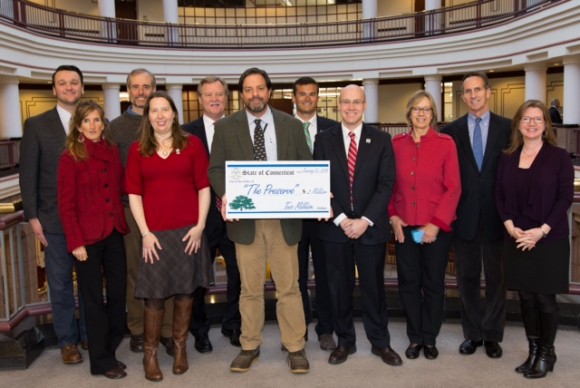
From left to right, Rep. Jesse MacLachlan, Essex resident Suellen McCuin, Chris Cryder of Save the Sound, Kate Brown of The Trust for Public Land, Sen. Paul Formica, Rep. Phil Miller, Sen. Art Linares, Rep. Devin Carney,  Rep. Terrie Wood, Jim Millard of The Trust for Public Land and Lori Fernand of The Trust for Public Land.

From left to right, Rep. Jesse MacLachlan, Essex resident Suellen McCuin, Chris Cryder of Save the Sound, Kate Brown of The Trust for Public Land, Sen. Paul Formica, Rep. Phil Miller, Sen. Art Linares, Rep. Devin Carney, Rep. Terrie Wood, Jim Millard of The Trust for Public Land and Lori Fernand of The Trust for Public Land.

Five state legislators, State Senators Art Linares and Paul Formica, and State Representatives Phillip Miller, Devin Carney and Jesse MacLachan have applauded the Jan. 12, approval of a $2 million state bond issue to assist in the acquisition of the Preserve. The Preserve property consists of 1,000 acres along the shore of Long Island Sound that is presently open space.

“This is terrific news,” said Sen. Art Linares, who represents Essex, Old Saybrook and Westbrook. “Permanently protecting this forest and wetland is critical, not only for the animal and plant species whose survival greatly depends upon it, but also for the local communities whose water supplies and recreational enjoyment of Long Island Sound and the Connecticut River could be irreparably damaged if development were to occur.  This news is the result of the determination of the many environmental champions in our region, like Rep. Phil Miller and former Rep. Marilyn Giuliano.  We also thank Gov. Malloy for his commitment to this effort.”

“I am delighted to see this vast expanse of land will be protected for future generations. Residents in southeastern Connecticut care deeply for the environment and enjoy hiking and bird watching in The Preserve, among other recreational activities.  This wise purchase by the state will ensure that future generations will be able to continue the stewardship of this land,” said Sen. Paul Formica, who represents Old Saybrook and is a member of the Energy and Technology Committee.  “I thank Rep. Phil Miller, former Rep. Marilyn Giuliano, The Trust for Public Land and the many environmental advocates from our region who have worked so hard for this funding.”

“The approval today by the Bond Commission of $2 million in funding to ensure the purchase of The Preserve shoreline property represents an important landmark decision that is certainly welcomed.” said Rep. Philip Miller (D – Essex/Chester/ Deep River/Haddam). “This will enable us to protect and preserve open space property that will benefit not only people who live in the region, but all of Connecticut’s citizens, for generations to come.”

“The funding for the Preserve will allow generations to come the opportunity to enjoy some breathtaking landscape in its unencumbered state, right here in Connecticut” said Rep. Devin Carney (R), representing Lyme, Old Lyme, Old Saybrook and Westbrook. “Many people in Old Saybrook and along the shoreline will be thrilled by the finalization of these funds. For many, it has been a long time coming – I am happy to see that all of their passion and hard work has paid off.”

“The citizens of Connecticut value the abundance of beauty within our state and want it to be protected in perpetuity,” said Rep. Jesse MacLachlan (R), representing Clinton, Westbrook and Killingworth.  “It’s wonderful to see that we
are making it a top priority to preserve the natural beauty and rural character of towns along the shoreline. Only through initiatives like these can our state’s rural areas obtain the true protection they need for years to come. I’d also like to express my sincere gratitude to all parties involved in seeing this come to fruition.”

Other Facts about The Preserve

Voters in Old Saybrook authorized the town to provide $3 million in funding to purchase a portion of The Preserve located in Old Saybrook and a small piece in Westbrook. The Trust for Public has also raised an estimated $1.2 million to cover the final portion of funding for the purchase, and the Essex Land Trust has agreed to purchase 70 acres of land in Essex that is a portion of The Preserve with the help of a $471,250 open space grant from DEEP.

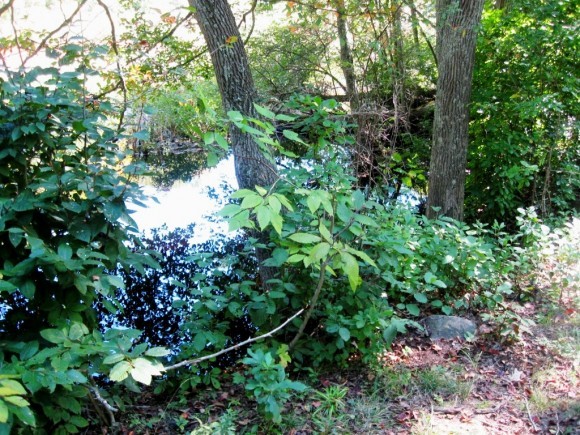
One of the numerous  vernal pools found on The Preserve.  Photo by Jerome Wilson.

One of the numerous vernal pools found on The Preserve. Photo by Jerome Wilson.

The Preserve consists of approximately 1,000 acres of land along Long Island Sound in three towns: 926 acres in Old Saybrook; 71 acres in Essex; and four acres in Westbrook. The Preserve includes 38 vernal pools, 114 acres of wetlands, more than 3,100 linear feet of watercourses, high quality coastal forest, and an Atlantic White Cedar swamp.

The dense canopy of forest and the Pequot Swamp Pond act as a critical refueling stop for many migratory birds, and the many freshwater seeps on the property are home to amphibian species such as the northern dusky salamander, spotted turtles, and box turtles. In all, more than 100 species of amphibians, reptiles, mammals, and birds thrive on this property, some of which are state-listed species of special concern and others of which are declining in other areas of the state.

In addition to its recreational and habitat resources, The Preserve provides important water quality benefits to residents.  Surface waters on the property drain to three different watersheds: the Oyster River, Mud River and Trout Brook, as they make their way to Long Island Sound.  The protection of The Preserve will ensure that storm water on the site is recharged to local aquifers.  An aquifer protection area is located just east of the Preserve and supplies an average of 200,000 gallons per day of drinking water to Old Saybrook and surrounding communities.

The Preserve also offers benefits for coastal resiliency in the face of climate change, and conservation of it will ensure lessened storm water impacts from hurricanes and other intense storms. The Preserve acts act as a sponge for storm water, releasing it slowly into the tributaries and rivers that lead to the Connecticut River and Long Island Sound, protecting downstream property owners from flooding.

Editor’s Note: This article was prepared directly from a press release issued by the House Republican Office.