

Talking Transportation: The Feds ‘Deep Dive’ Into Metro-North

Jim Cameron

It was worse than we’d ever known.  Metro-North was almost an accident waiting to happen.

That summarizes the Federal Railway Administration’s “Operation Deep Dive” report issued last week, following 60 days of probing into every aspect of the railroad’s operations.  All of this comes on the heels of collisions and derailments in the past year that have taken the lives of four commuters and two railroad workers.

The 28-page report confirms that what was wrong at Metro-North was not just old equipment but a failure of management with very misplaced priorities.  “On-time performance” was what mattered most, even at the expense of safety.

Among the report’s findings …

• Half of the personnel who dispatch and monitor the trains have less than three years’ experience, are not properly trained and are so tired they make mistakes

• The railroad’s “safety culture” was “poor.”  Safety meetings went unattended.

• Fatigue by train engineers, track workers and dispatchers may have affected performance.

• The trains themselves are in good shape, but the tracks are not.

I’ve been following Metro-North for more than 20 years, so much of this is not news to me, but just a substantiation of my worst fears.  Still, the report makes for interesting reading because it cites many examples as proof-points for these findings:

Metro-North has known for a decade that they were facing a “retirement cliff” with 20 percent of its employees — those with the most experience — reaching their 30th anniversary of employment to retire on fat pensions.  But the railroad was clearly inadequate in hiring and training their replacements.

Fatigue becomes a factor because soon-to-retire veterans grab all the overtime they can in their final year to increase their income and their railroad pensions.  They are among the oldest employees and least resilient.

Metro-North’s management wasn’t even enforcing its own rules.  The report says employees were “confused” about cell phone use on the job.  Any teenager studying for his driver’s license knows not to use a cell phone while driving, but track workers at Metro-North got away with it.

Additional funding for staff and infrastructure are important and must be found.  But turning around a culture of lax enforcement and lip-service to safety is going to take more than money.

Only a month on the job, espousing “safety is our top priority” at every turn, the new president of Metro-North, Joseph Giulietti, recently saw the first fatal accident on his watch: a track worker, eight years on the job, was struck by a train just outside the Park Avenue tunnel.  Why?

There are no quick fixes to this mess.  It took years of invisible neglect for Metro-North to slide into this abyss, and it will take years to rebuild the railroad and regain riders’ trust.

Editor’s Note: Jim Cameron has been a Darien resident for 22 years.  He is the founder of the Commuter Action Group and also serves on the Darien RTM.  The opinions expressed in this column are only his own.  You can reach him at CommuterActionGroup@gmail.com

Old Lyme ZBA to Make ‘Chocolate Shell’ Decision Tonight

The appeal by Chocolate Shell owner Barbara Crowley against the Cease and Desist order on her business serving coffee is the only item on the agenda in an Open Voting Session at tonight’s Old Lyme Zoning Board of Appeals (ZBA) Special Meeting starting at 7:30 p.m. in the Meeting Room of the Town Hall.

The members of the ZBA will vote at the end of the Open Voting Session thus determining the future of the Cafe in the The Chocolate Shell.

Letter From Paris: Mr. Putin, You Have Much To Lose

Nicole Prévost Logan

Nicole Prévost Logan

At the foot of Mount Mithridates, in eastern Crimea, stood the ancient city of Pantikapeion founded in the 7th century BC by Greek colonists.  It is where King Mithridates killed himself in 63 BC by the sword since his body was immune to poison.

In 1992, I joined the archaeological expedition from the Pushkin Museum of Fine Arts led by Dr. V. Tolstikov, head of the department of near eastern antiquities, and Dr. Michael Treister, curator, in order to publish an article in Archaeology.  That season the Russian team was researching the acropolis and a vast architectural complex with a colonnade dating from the 2nd century BC.  Below the steep cliff, one could see modern Kerch and the Russian shore of the Krasnodar region across the five kilometer-wide Cimmerian Bosporus.

The scholars from the Pushkin museum were among the many Russian, Ukrainian and foreign archaeologists who have long been researching the rich strata of  human occupation on the northern shore of the Black Sea.  They have also studied the Scythian civilization, whose “kurgans” (tombs) contained the famous gold treasures.

The Institutes of Archaeology in the major cities, like Moscow, St Petersburg and Kiev, the universities and most of  the museums, have their own expeditions.  For instance, Odessa conducts regular excavations in Olbia, one of the major “emporia”  (commercial trading post) for the export of cereals, fish and slaves to Greece and for import of Attic goods to Scythia.  On the outskirts of Sebastopol, the ancient Greek city of Chersonesus has been excavated jointly by teams from Ukraine, the University of Texas and the German Institute of Archaeology.

Archaeologists, historians and other specialists exchange the results of their finds and publish joint papers in scholarly journals.  The Center for Research on Ancient History, located in Besançon in eastern France, is an invaluable source for  the Black Sea region and has collected works from scholars, irrespective of their nationality.  Periodically, a Black Sea symposium, which attracts several hundred scientists, meets in Vani, Georgia.

After this long description of the archaeological scene in the Black Sea region, the question arises: what is going to happen to this fruitful scientific collaboration currently happening across the borders ?

What next for President Vladimir Putin?

What is President Vladimir Putin’s next move?

During our sail along the Black Sea coast in 1991 (see the Feb. 8 Sochi article posted on this site), we saw dozens of wind turbines near Evpatoria in western Crimea.  Today, Ukraine and Russia have ambitious plans to create a wind farm of 3,000 sq. km. for a grid power of 16,000 MW.  Aeolian energy is readily available in this area, thanks to the shallow waters of the Black Sea and the Sea of Azov.

On March 20, Le Monde published an article entitled, “Antonov mirrors the break between Russia and Ukraine.”  The article explains how the Ukrainian aircraft manufacturing and services company, Antonov, builds planes with technology and software from Dassault Systemes and employs 16,000 Ukrainian workers, but 40 percent of the parts utilized in production are Russian.

On March 22,  a Moscow official announced that the extension of the capital’s subway had to be put on hold since they could not take delivery of some of the construction material  ordered from the Ukraine.

In the art world, a Paris galerist told me they also were expecting difficulties in the near future.

Human, cultural and economic ties between Ukraine, Crimea and Russia are so interwoven that the break up of the Ukrainian territorial integrity and the announced sanctions from the West are bound to have serious consequences.

Vladimir Putin is supposed to be an excellent chess player.  One assumed that each one of his moves was made according to a planned strategy.  This does not seem to be true anymore.  He has won the Crimea, but what about the long term waves he is making? Problems are going to catch up with him.

HeadshotAbout the author:  Nicole Prévost Logan divides her time between Essex and Paris, spending summers in the former and winters in the latter.  She will write a regular column for us from her Paris home where her topics will include politics, economy, social unrest — mostly in France — but also in other European countries.  She also will cover a variety of art exhibits and the performing arts in Europe.  Logan is the author of ‘Forever on the Road: A Franco-American Family’s Thirty Years in the Foreign Service,’ an autobiography of her life as the wife of an overseas diplomat, who lived in 10 foreign countries on three continents.  Her experiences during her foreign service life included being in Lebanon when civil war erupted, excavating a medieval city in Moscow and spending a week under house arrest in Guinea.
Special Town Meeting in Old Lyme Tonight

A Special Town Meeting was held in Old Lyme this evening to consider the following agenda items:

  • To rescind the existing Chapter 187 of the Old Lyme code Design and Construction Standards adopted on 11/15/02 and to adopt new Design and Construction Standards for Public Improvements as recommended by the Board of Selectmen and the Planning Commission and to adopt pursuant there to an amended Chapter 144 of the Old Lyme Code Construction and Acceptance of Roads.  Copies are available in the Old Lyme Town Clerk’s office for inspection.
  • To authorize the expenditure of an amount not to exceed $148,500 for Phase I of the Rte. 156 Bike Path/Sound View Improvement Project, as recommended by the Board of Selectmen. A Connecticut Department of Transportation grant will cover a portion of this expenditure.
  • To authorize the expenditure of the sum of $13,000 for a kiosk at the Town Parking Lot in Sound View, as recommended by the Board of Selectmen.
  • To authorize the appropriation of an amount not to exceed $478,000 for the Hains Park Boathouse renovation and expansion project, as recommended by the Board of Selectmen, which project will be funded by a STEAP (Small Towns Economic Assistance Program) grant in said amount.
  • To hear an updated presentation by the Board of Selectmen and the Old Lyme Water Pollution Control Authority on the Wastewater Management Study.

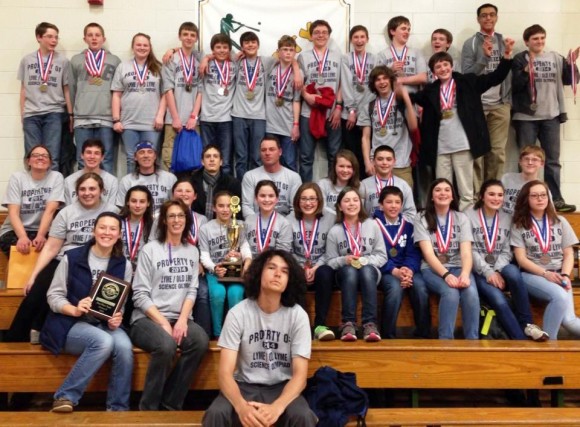
Lyme-Old Lyme Middle School Teams Share Victory in CT Science Olympiad

Lyme-Old Lyme Middle School science team members display their medals after both LOLMS teams shared  first place honors in the state tournament.

Lyme-Old Lyme Middle School science team members display their medals after both LOLMS teams shared first place honors in the state Science Olympiad.

Two Lyme-Old Lyme Middle School (LOLMS) teams shared top honors to win the Connecticut Science Olympiad for the third year in a row.  In an extraordinary performance, team members from LOLMS won a medal (1st,2nd or 3rd) in 23 of the 24 events.

The teams now move on to the national competition in Florida which takes place May 16-17.

Congratulations to science teacher Shannon Glorioso, and Lucy and Johnny Walters, who head up the after-school science program that makes this all possible.  And, of course, congratulations also to all the students who participate in the program.

Go Wildcat Scientists!