Florence Griswold History Blog Wins Merit Award

The Florence Griswold Museum in Old Lyme has received an Award of Merit for its history blog, From the Archives, from the Connecticut League of History Organizations (CLHO).  The awards committee was impressed with the quality of the website and commended the museum for bringing its historic and archival collection to the public in an innovative way that also enhances the public profile of the museum.

From the Archives is a regularly updated website about people, places, and events in the Lyme region.  Photographs, letters, maps, and documents collected in the Lyme Historical Society Archives bring the past vividly to life.  Recent posts describe two local sites known for their exquisite gardens during the early 20th century.  The blog also features a series on the early history of slavery in Lyme, which continues to remain in the shadows. The blog can be accessed and subscribed to at FlorenceGriswoldMuseum.org/Archives.

The Museum received the award on June 3 during CLHOs annual conference.  Eight Awards of Merit and five Honorable Mentions were presented in four categories.  The CLHO presents Awards of Merit to institutions and individuals who demonstrate the highest of  professional standards, and who enhance and further the understanding of Connecticut history. 

The CLHO builds connections among those who preserve and share the stories and objects of our past.  For over 50 years, CLHO has strengthened and sustained its members by sharing knowledge and experience, and promoting best practices among museums, historical societies and all who steward Connecticut’s heritage collections.

Students Create a Time Capsule Commemorating Past, Present and Future of LOL High School

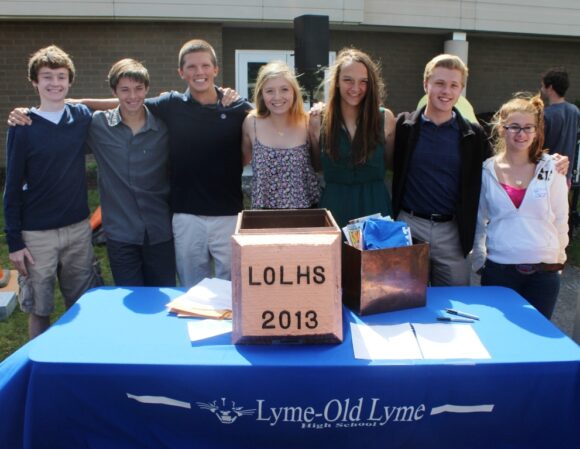
Local History Club members gather for a photo in front of the time capsule.

Local History Club members gather for a photo in front of the time capsule.

The entire student body, faculty, administrators along with board of education and building committee members gathered yesterday in front of Lyme-Old Lyme High School to prepare a time capsule for ceremonial burial.  The event was sponsored by the school’s Local History Club and its president, Alison Scott, explained that the purpose of the event was, “to connect the past with the present and the future.”

She noted that the plaque marking the spot where the time capsule is buried has been engraved with the words, “Lyme-Old Lyme High School; Time Capsule to be Opened in 2046; Established 1980 Renewed 2013.”  She explained, “We chose the date 2046 because it is 33 years from now; it was 33 years ago that the High School was built.”

After acknowledging and thanking the board of education members and building committee members who, in Local History Club Vice-President Marley Bocian’s words, “made sure we ended up with this beautiful, renovated-as-new building,” members of the club took turns explaining the contents of the capsule.  The items had been chosen from suggestions made by students at the high school and included the copper capsule that was placed in a wall when the high school was originally built.
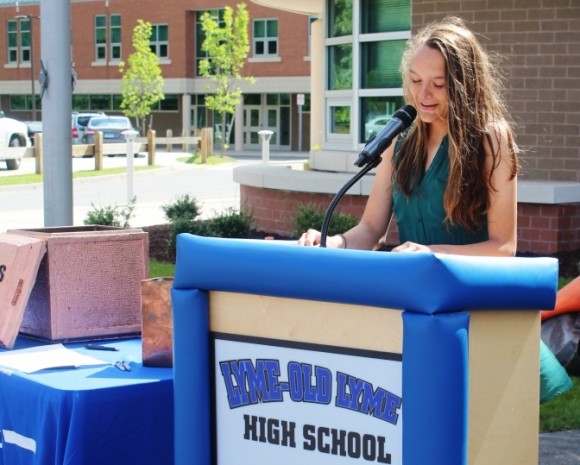
Local History Club President Alison Scott addresses guests at the time capsule ceremony.

Local History Club President Alison Scott addresses guests at the time capsule ceremony.

Local History Club Treasurer Ian James explained, “We decided that since our current building was “renovated as new,” we should put the original capsule in with the new one.  The original capsule was a little longer … but it has been retrofitted to fit in the new capsule.”  He quipped, “Kind of like the building!”  The contents of the original capsule were retained in situ and these comprised a 1981 black and white yearbook and newspaper articles about the move into the high school.

James also noted that an American flag was added to the new capsule because he questioned, “Who knows?  With all the talk about secession and/or adding another state – like Puerto Rico – our flag may take on a different look in 33 years!”
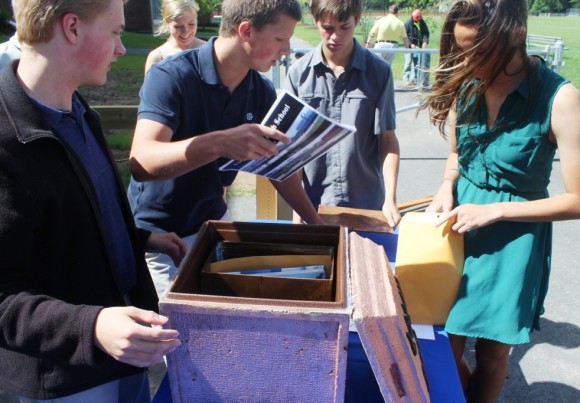
Senior Morgan White inserts a poster showing images of the high school into the capsule.

Senior Morgan White inserts a poster showing images of the high school into the capsule.

Senior Morgan White added items representing the present, “Our great, color yearbook  … and the pictures, flash drive, and CDs showing the renovation from start to finish.”  He commented, “We have heard mixed opinions about whether the flash drive and CD’s will make it another 33 years so we printed out some of the pictures just in case,” adding to laughter, “I guess we’ll all have to come back and see!”

A ‘Decades’ project for the 2000s undertaken as part of a high school program and a poster of the high school were also added to the capsule as were a copy of that day’s edition of The Day, a printed copy of LymeLine.com and some e-books.  Bocian asked rhetorically, “Who knows what things like magazines, newspapers, and books will look like in the future?”

Club member Brian Buttrick added the Old Lyme Historical Society’s (OLHS) 2013 calendar, Then and Now, that shows current and past pictures of Lyme and Old Lyme as well as a brochure of the OLHS’s Walking Tour while Club Secretary James Kolb included his own broken i-phone, a high school T-shirt and a picture of the faculty.  Regarding the phone, Kolb joked, “Hopefully, someone in the future will have a way to fix it and they will contact me to return it!”

Local History Club members have kept journals of their own personal history, brought in and discussed family antiques and artifacts, heard from our Old Lyme Town Historian, Dr. Pfeiffer, who discussed Lyme and Old Lyme’s role in history, connected with the OLHS and helped at their Vintage! event, which raises funds for a scholarship for a graduating senior from LOLHS, and held a World War II discussion and luncheon event last year.

Editor’s Note:  We are honored that the students chose to include a printed copy of LymeLine in the time capsule — thank you for making us a part of Old Lyme’s history!

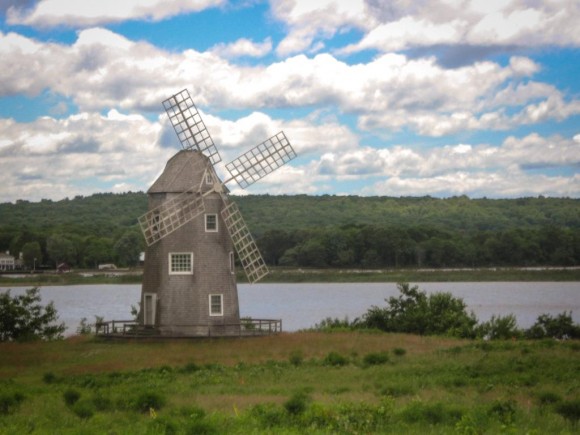
New York City Developer Puts Iconic Windmill Property in Essex Up For Sale

Want to buy a windmill for almost $2 million?

Want to buy a windmill for almost $2 million?

With a price tag of $1,925,000, New York City developer, Frank J. Sciame, Jr., is offering to sell a notable Essex landmark, the windmill at Foxboro Point.  Listing materials assert that the sale is a, “Once in the lifetime chance to own the windmill.”

They continue, “This unique waterfront [property] is one of the most recognized features on the Connecticut River.  It is comprised of multiple floors of living area including, a living room, wet bar bedroom, full bath and more.”

The listing materials also state that the property has on the third floor a master bedroom with a full bath, a second floor a kitchen, and a first floor a dining room.  There is also a full, unfinished basement with hatchway.  Real estate property taxes are listed in the materials as $15,441.

Windmill Not an Historic Building

Although many locals on the shoreline think that the windmill is a historic structure, it was actually built in 1967.  As for further details about the property, it has shingle siding, a basement water heater and is connected to public water.  It also has baseboard heating and electric sewer and septic.

The listing agent of the property is Colette Harron of William Pitt, which has an office in Essex.

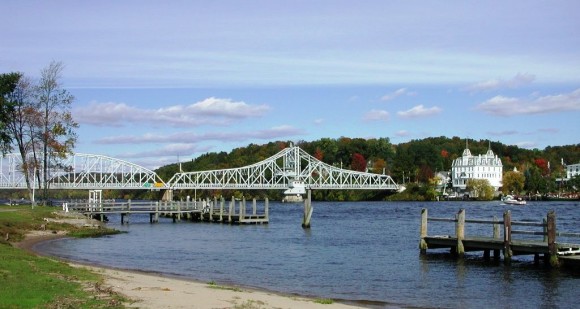
East Haddam Swing Bridge Celebrates Its Century, Saturday

NBL Oct 2002 043

The Essex Steam Train & Riverboat is joining the 100th anniversary celebration of the East Haddam Swing Bridge this coming Saturday, June 15.  Residents of Old Saybrook, Essex, Deep River, Chester and Haddam are invited to ride to the anniversary festivities aboard the Essex Steam Train & Riverboat, which is providing a free trip for 150 passengers up the Valley Railroad and across the Connecticut River to the landmark bridge in East Haddam.

This is a must-reserve event and tickets are strictly limited to 150 people.

The East Haddam Swing Bridge first opened on Flag Day in 1913.  The Towns of East Haddam and Haddam, their respective economic development committees and historical societies, and other local businesses such as the Essex Steam Train & Riverboat, organized this year’s upcoming celebration of the Bridge’s historic anniversary.

To help recapture the essence of the original 1913 grand opening, the Essex Steam Train & Riverboat is offering a unique excursion aboard their steam locomotive and Becky Thatcher riverboat to travel to the June 15 festivities.  Passengers will get to travel on the same tracks used by others 100 years ago to reach the Bridge’s original opening ceremonies.

Led by the “New Haven” steam locomotive 3025, the train will depart Essex Station at 7:45 a.m. on June 15, making stops all the way north to Eagle Landing State Park.  Once the train reaches the park, guests can hop aboard the Becky Thatcher riverboat to view the vintage automobile procession across the bridge at 9 a m.

Guests can also take a shuttle bus to East Haddam village for the anniversary ceremonies and activities starting at 9:30 a.m.  When the celebration ends, the 12:15 p.m. train will travel back down the river valley to bring all passengers home.

During the celebration, the Becky Thatcher riverboat will also offer a half hour harbor cruise from Eagle Landing at 10:15 a.m. open and free to everyone – including those who did not ride the train to the celebration.

To reserve a spot on the train, contact the Valley Railroad Company at 860-767-0103 or email valley.railroad@snet.net.

For more information, visit essexsteamtrain.com/swing_bridge.html.

Editor’s Notes: Owned and operated by the Valley Railroad Company, the Essex Steam Train & Riverboat is a unique historic attraction in the Connecticut River Valley.  The railroad has transported people in Connecticut since 1868, and the Valley Railroad Company has operated today’s well-known train and riverboat for over 40 years.

The Essex Steam Train and Riverboat takes people on exciting excursions through the unspoiled Connecticut River Valley, a place designated as “one of the last great places on earth” by the Nature Conservancy.  The steam locomotive pulls vintage coaches through the quintessential New England towns of Deep River and Chester, and the Becky Thatcher riverboat takes visitors past the undeveloped Selden Neck State Park on its way to East Haddam.  

The Essex Steam Train & Riverboat offers various eco-excursions and family themed events throughout the year.

For more information visit essexsteamtrain.com or connect with the Essex Steam Train & Riverboat on social media: facebook.com/essexsteamtrain and twitter.com/essexsteamtrain.

Outdoor Sculpture Unveiled at Florence Griswold Museum

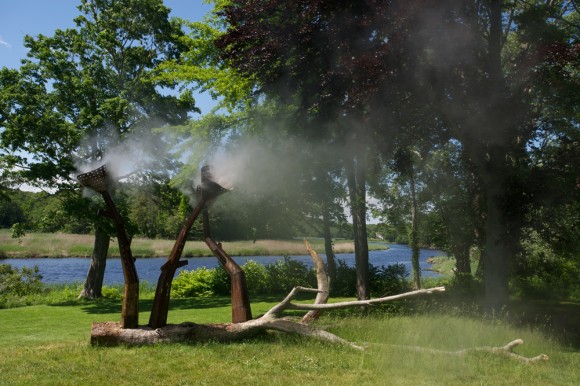
Anticipator, an outdoor sculpture made of Corten steel, water, wood and a pump, is now on view in the grounds of the Florence Griswold Museum.

Anticipator, an outdoor sculpture made of Corten steel, water, wood and a pump, is now on view in the grounds of the Florence Griswold Museum.

The Florence Griswold Museum in Old Lyme, has unveiled Anticipator, a temporary outdoor sculpture by New York-based artist Matthew Geller.  A noted sculptor in the field of public art, Geller designed a work for the Museum grounds that combines a recycled tree trunk with three “bionic” limbs forged from Corten steel.  These perforated branches emit colored light and mist through fan-like blossoms.

The tree used for the installation, a Star Magnolia that died a year or more ago, has great significance since it is documented that Miss Florence had the tree planted during the 1920s.  “It would have been hard to find a better tree than this,” stated Geller.  “Anticipator continues the bond between this landscape and the creation of art begun by the artists of the Lyme Art Colony.”

Playful, accessible, and unexpected, Anticipator offers elements of surprise that encourage visitors to interact with it and eac

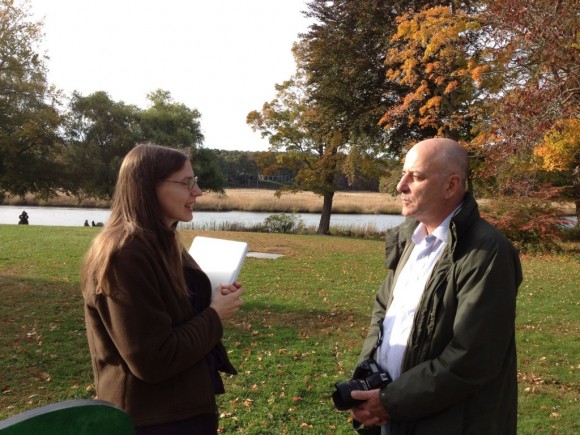
 New York-based artist Matthew Geller walked the Museum's grounds with Curator Amy Kurtz Lansing last fall to determine the best location for his outdoor sculpture, Anticipator.  Playful, accessible, and unexpected, Anticipator transforms the environment, influencing how visitors perceive light and air against the backdrop of the Lieutenant River, a subject of interest to the generations of artists who painted in and around the Florence Griswold House.


New York-based artist Matthew Geller walked the Museum’s grounds with Curator Amy Kurtz Lansing last fall to determine the best location for his outdoor sculpture, Anticipator.

h other, fostering a sense of community as they stroll the grounds.  Geller often incorporates mist into his works as a means of sparking conversation among viewers by subtly changing their surroundings.  The mist—in constant flux as it is influenced by the slightest changes in the temperature, humidity and wind—transforms the environment, influencing how visitors perceive light and air against the backdrop of the Lieutenant River, a subject of interest to the generations of artists who have painted in and around the Florence Griswold House.

The sculpture’s futuristic combination of natural and artificial forms plays off the historic site—the tree trunk has been salvaged from the grounds and the exotic blooms recall Miss Florence’s interest in non-native species, many of which she planted around her house.  A new biomechanical hybrid that is part plant and part machine, Anticipator shapes its environment in an almost animate way, introducing the elements of mist and light and eliciting feedback in return.

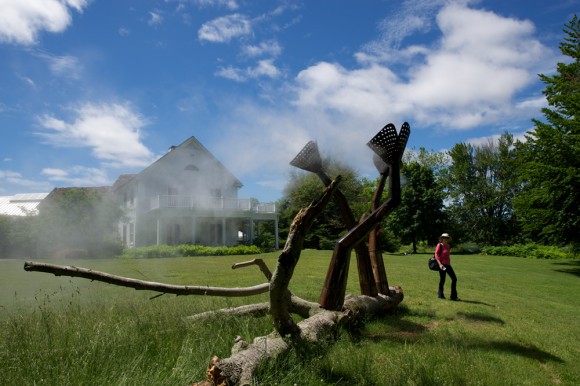
A view of Anticipator looking up towards the Museum.

A view of Anticipator looking up towards the Museum.

This sensitivity to and interaction with its environment are key aspects of Anticipator, whose title even derives in part from the heat anticipators in thermostats that turn off the furnace just before the desired temperature is reached.  A fusion of nature and technology, Anticipator strikes a balance between the two.

Anticipator has been made possible by a grant from the Institute of Museum and Library Services for The Agora Project—a two-year initiative expanding the use of the historic grounds as a site for learning and as a community-gathering place or “agora”—as it was called in ancient Greece—creating a richer experience for Museum visitors. Matthew Geller’s Anticipator is a cornerstone of the project, bringing art outdoors to inspire conversation and reflection.

For more information, visit www.matthewgeller.com or www.florencegriswoldmuseum.org