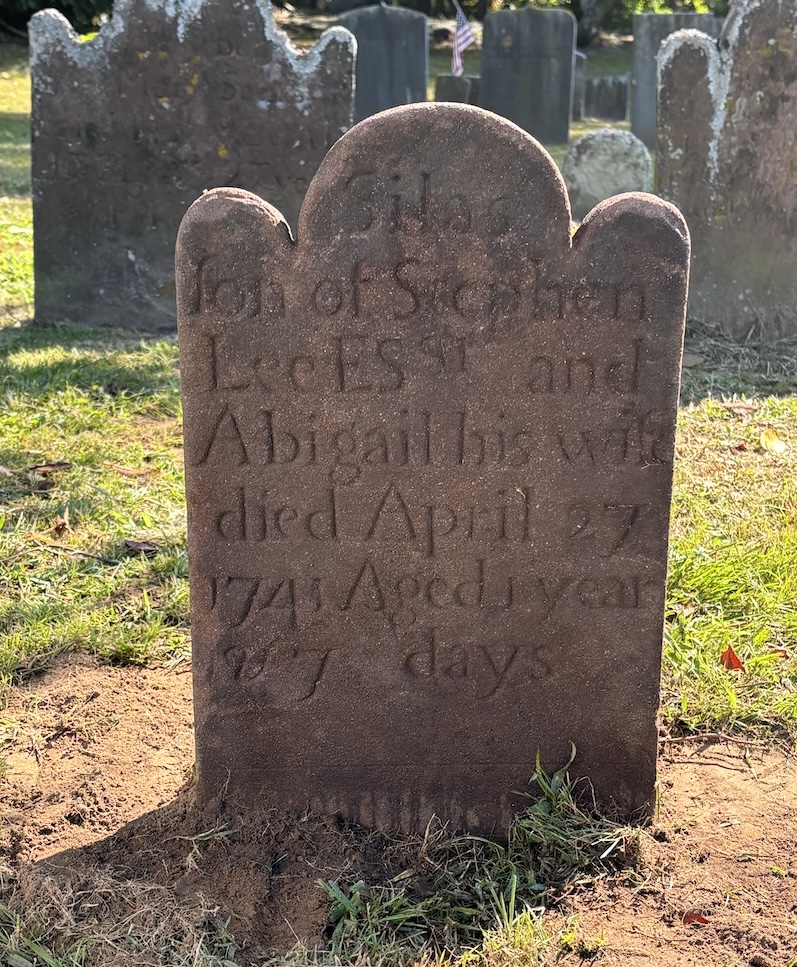
Silas Lee’s gravestone reinstalled in the Meetinghouse Hill Cemetery in Old Lyme. All photos courtesy of OLCA.
OLD LYME—On Sept. 14, 2024, the Old Lyme Cemetery Association (OLCA) reinstalled a small headstone at the historic Meetinghouse Hill Cemetery, established in 1696.
The scenic burying ground near the site of the town’s first meetinghouse is no longer active, and the inscriptions on many of its aging gravestones cannot now be deciphered. No one had noticed that the headstone for a young child, who died almost three centuries ago, was missing.
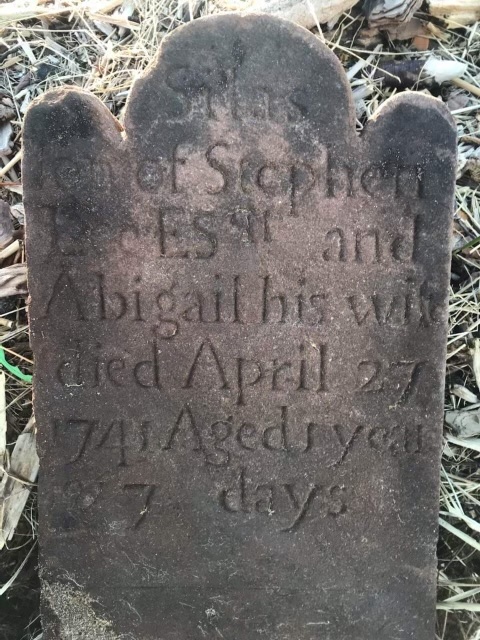
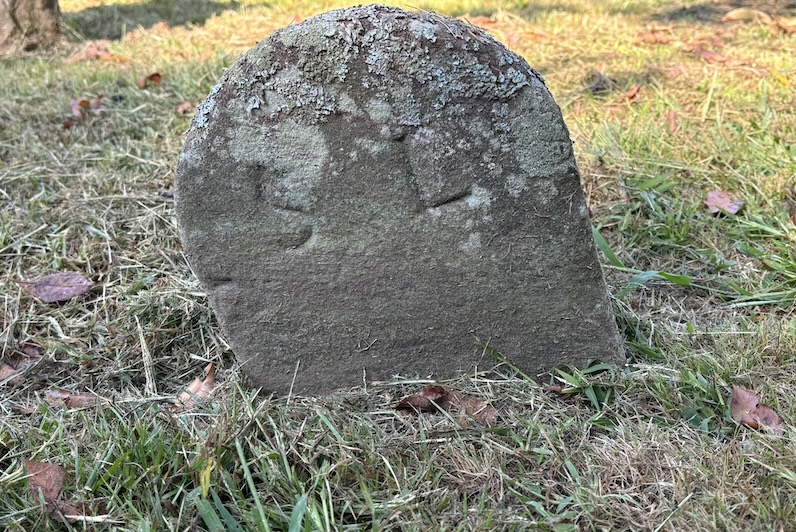
Silas Lee died at age one year and seven days on April 27, 1741.
Silas Lee’s gravestone as found on the beach in Old Saybrook.
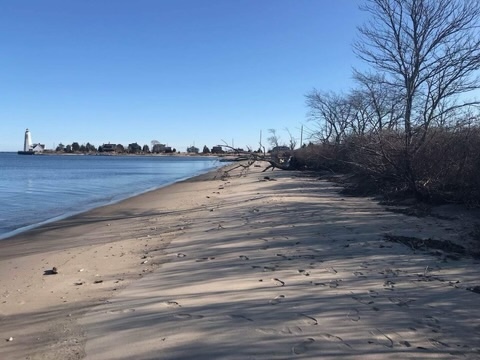
His gravestone was recently discovered by walkers looking for shells on a stretch of beach north of the inner lighthouse in Old Saybrook, across the Connecticut River from Griswold Point.
The beach in Old Saybrook where the gravestone was discovered in March 2023.
Erosion had exposed the corner of the brownstone marker protruding from a sandy bank some 18 inches below the surface of an adjoining field. Remarkably, the stone was still intact with its inscription well preserved.
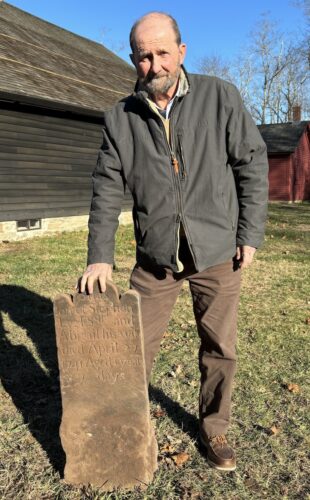
Norman Peck at the Thomas Lee House with Silas Lee’s gravestone on December 22, 2023
After its discovery, the gravestone for Silas Lee, “son of Stephen, Esquire & Abigail,” was brought to the historic Thomas Lee House in East Lyme and given to Norman Peck, a Lee descendant and president of the East Lyme Historical Society. Recognizing that Capt. Stephen Lee’s family had lived in what is now Old Lyme, Peck transferred the gravestone to the Old Lyme Historical Society whose president, Mark Terwilliger, contacted the Old Lyme Cemetery Association (OLCA.)
Silas Lee’s footstone as found in the Meetinghouse Hill Cemetery in Old Lyme.
The OLCA then identified the child’s burial site in Meetinghouse Hill Cemetery, where they found the lichen-covered markers of his family and discovered a small slanting footstone with the initials S.L. The Lee family markers likely represent the work of James Stanclift II, who with his father, carved many of the earliest brownstone monuments in Old Lyme’s burying places.
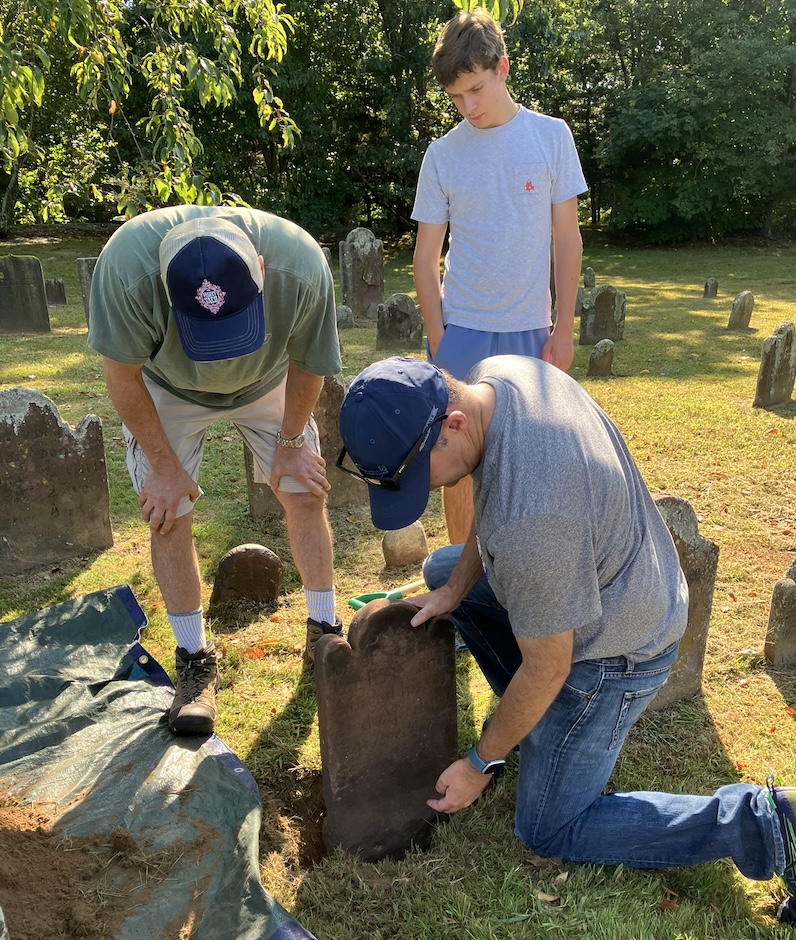
Now, Silas Lee’s headstone stands once again in its original location and his footstone has been cleaned and straightened. The mystery of how or why the headstone ended up in Old Saybrook remains unsolved.
Old Lyme Cemetery Association volunteers Connor and Patrick Gingras and David Frankel reinstall Silas Lee’s gravestone in September 2024.
The marker was still standing in the Meetinghouse Hill Cemetery in 1934 when it was recorded in the Charles R. Hale Report, an inventory of Old Lyme’s burying places published that year. While some speculate that the gravestone may have been taken as part of a teenage prank, no evidence yet supports that theory. The marker was found intact with no chips, cracks, or breaks to suggest a hasty or clandestine removal.
While the curious journey of Silas Lee’s gravestone has not been explained, the OLCA is grateful to all who helped return it to its rightful resting place in the Meetinghouse Hill Cemetery.
To learn more about the Old Lyme Cemetery Association, including how to get involved with cemetery restoration, visit https://oldlymecemeteries.org/.
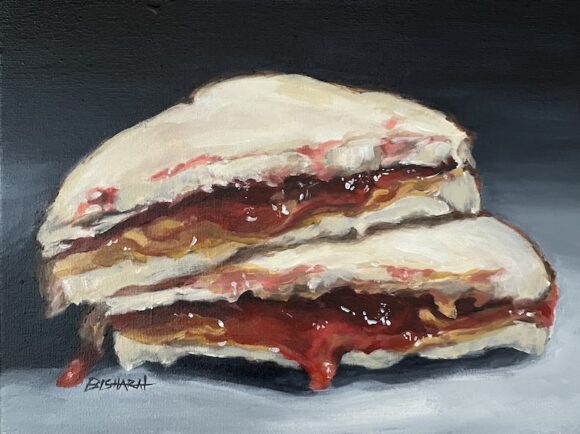
“American Royalty” by Dawn Bisharat in acrylic is one of the featured paintings in the ‘Bon Appetit’ show currently on view at the Lyme Art Association.
OLD LYME—On Sunday, Nov. 10, Lyme Art Association (LAA) will hold an Opening Reception from 2 to 4 p.m. for three new shows, Deck the Walls, Bon Appétit and a guest exhibit from the Society of Connecticut Sculptors. All are welcome and admission is free.
Deck the Walls is the LAA’s most festive exhibition. Visitors will discover a beautiful array of art to lift the spirits in various themes, sizes and mediums in this delightful show juried by Annie Wildey. This show returns each year during the holidays, just in time for gift-giving.
The LAA member show, Bon Appétit, juried by Shawn Kenney, spans still life masterpieces featuring sumptuous fruit bowls to vivid depictions of bustling farmers’ markets, Bon Appetit promises a feast for both visual and culinary senses.
All three shows are on view through Dec. 31. Additionally, starting Nov. 8 the LAA will showcase the talents of its instructors with an exhibit of their artwork.
Look for music in the galleries select weekend afternoons during the run of the shows, with a special performance by musicians from the Community Art School in Essex.
When you enter, don’t miss the Partner Wall, featuring paintings of dancers by Mike Laiuppa. A portion of the proceeds from the sale of these pieces will benefit Eastern Connecticut Ballet just in time for Nutcracker season.
After enjoying all the shows, stroll across to the Old Lyme Inn and/or the Side Door Jazz Club for cocktails, dinner or an evening of entertainment.
Finally, don’t forget to give yourself a creative treat this holiday season. This November and December the Lyme Art Association has weekend workshops for every level of artist, including beginners, taught by favorite instructors Jeanne Carol Potter, Lisa Miceli, Howard Park, Christine Ivers, and Bob Noreika.
Register early for children’s art programs on Sunday, Nov. 24 and Sunday, Dec. 22 from 1 to 3 p.m. featuring stories illustrated by award-winning artists and holiday-themed projects for each young artist to take home.
Founded in 1914 by the American Impressionists, the Lyme Art Association continues the tradition of exhibiting and selling representational artwork by its members and invited artists, as well as offering art instruction, lectures, and other public programs to the community.
The LAA is located at 90 Lyme St. in Old Lyme, CT, in a building designed by Lyme colony artist and architect, Charles Adams Platt, and located within the national historic district. Admission is free with contributions appreciated. Gallery hours are Wednesday through Sunday, 10 to 5 p.m., or by appointment.
For more information on exhibits, purchase of art, art classes, or becoming a member, visit the LAA website at www.lymeartassociation.org or call (860) 434-7802.
“The thinnest yellow light of November is more warming and exhilarating than any wine they tell of.” Henry David Thoreau
‘The English Lady’ is Maureen Haseley-Jones
Over the next few weeks, with the soil remaining above 40 degrees, it is an ideal time to divide summer blooming perennials, which have been in the ground for three years or more. Dividing perennials gives them a new lease on life and encourages more prolific bloom next season and the rule on transplanting also covers dividing.
Early spring blooming perennials such as Iris can be divided while the soil is still quite warm and, with adequate moisture, there will be enough root growth to anchor these divisions before frost heave becomes a problem.
Welcome to Fall everyone! I love the cool breezes and soft sunshine and the soil is still warm for you to plant through mid-November.
When dividing Iris cover the horizontal root divisions (the rhizomes) with just enough soil so they do not topple over, any deeper and they will not flower, and add composted manure around them when planted.
PLANTING AND TRANSPLANTING PLANTS
When planting a tree or shrub, dig a hole at least one and a half times as wide, not deep, as the root ball. An important rule to remember when planting and transplanting is not to plant the tree or shrub any deeper than it is in the container or wrapped in burlap. Or when transplanting any plant, tree, shrub and perennial is not to plant any of these plants any deeper than it was originally in the soil; planting too deep can be the death of plants.
If you are unable to dig to any depth for a plant in the case of ledge in your garden, berm up the soil on the ledge and plant so that part of the root ball is above the soil grade, mounding soil around it.
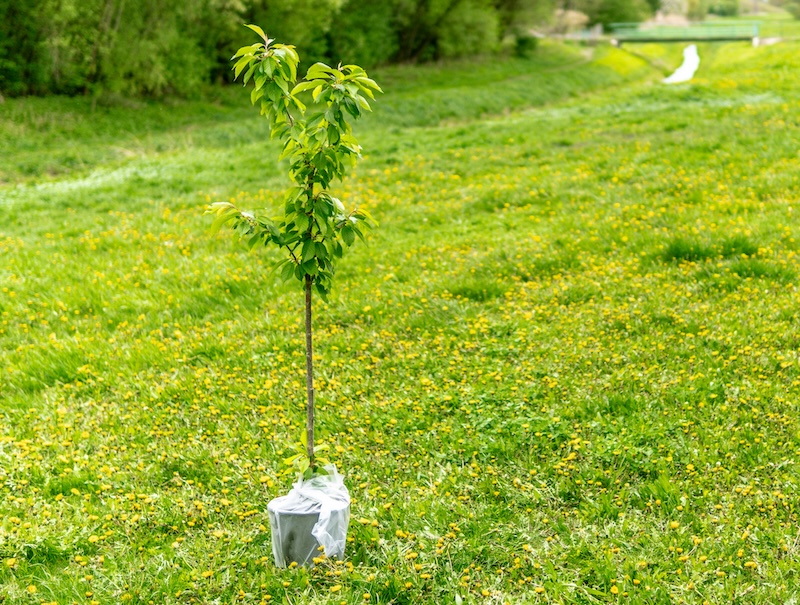
When you are planting a young tree, it is important to handle it with care. Photo by George Bakos on Unsplash.
Handle your tree or shrub by its root ball, not by the trunk or branches. After planting and transplanting add composted manure with one part compost to three parts manure. If you do not have compost, manure is excellent. Water deeply, slowly and thoroughly when planting and at least twice a week through the fall until the first hard frost, which in this area of New England is usually about the second week of November.
The following trees are not good candidates for fall planting: Birches, Larches, Gingko, Oaks, Magnolia, and all flowering fruit and flowering trees as well as the Eastern Red Cedar. These trees have fleshy roots and their feeder roots are not large when young and therefore take time to establish and are susceptible to frost heave.
Perennials that do not like to be planted in fall are: Artemisia, Lambs Ears, Foxglove, Penstemon, Anemone, Campanula, Kniphofia, Lupines, Scabiosa, Ferns and Grasses.
Plant garlic this fall – garlic is the antibiotic of the garden. Plant it under fruit trees to avoid scab and root disease, near to ponds or standing water to control mosquito larvae or pour garlic water into ponds, bird baths and fountains to deter adult mosquitoes.
WORDS OF WISDOM
At this point I want to reiterate what Franklin D Roosevelt said in 1937; ‘The nation that destroys its soil destroys itself’. America has not heeded that warning. Precious soils in this country and around the world are being destroyed by dangerous practices in industrialized agriculture and poisonous chemicals, which completely disrupts our ecosystem and poisons all living things.
HUMUS
The Humus component – good news for organic gardeners – in your own garden you can build and retain a rich, growing environment by building the Humus component. We are all carbon-based creatures as is all life on earth. Not only humans but also our soil microbes need carbon to flourish. Attracting carbon from the atmosphere is necessary to build the humus component.
To begin the process of humus – add composted manure three times through the year – early May, July and now in October/November. Manure builds soil structure and provides a rich planting environment for the following season by encouraging the millions of soil animals down below to manufacture nutrients for the roots of the plants.
Plus add mulch in the form of natural brown fine bark mulch or wood chips that you produce from your garden – aged wood chips with a combination of leaves, twigs and branches.
With manure and fine bark mulch, you are building the humus component. The manure and mulch attract carbon from the air, which builds the richest organic planting environment – the humus component.
Mulching the garden and in particular any plants planted, divided or transplanted this fall with two inches of fine bark mulch, when the ground to cools in late October, will keep warmth and moisture in the soil and protect the roots of your plants through the winter.
Humus brings many benefits to the garden.
You are probably asking what are the benefits of humus? Here are the reasons:
Humus acts like a sponge and holds 90 percent of its weight in water.
Because of its negative charge – plant nutrients stick to humus with nitrogen, calcium, phosphorus and other elements, which prevents these from washing away, and acts as nature’s slow- release fertilizer.
Humus improves soil structure making it loose and friable, which helps plant roots in the soil and makes for better access to nutrients, water and oxygen.
Humus also helps filter’ toxic chemicals from the soil, much like carbon-based water filtration systems that filter toxins from your water.
We cannot control industrialized agricultural practices – but in your own garden you can make a difference. Grow the soil and the soil will grow the plants.
Mulch and peat, which provides acidity, and is particularly important for any newly planted broadleaf evergreens installed in September. As mentioned previously, evergreens are shallow-rooted, and can heave above ground in hard frosts. I suggest that you store a few bags of topsoil and mulch in the shed or garage. When you see exposed roots after frost heave, cover them with the soil and mulch until the plant can be resettled next spring.
Now let’s look at what should be done now in the vegetable garden focusing first on cover crops. Last week I cut down the finished crops and dug them lightly into the soil.
This year, my choice for a cover crop in one area of the vegetable garden, is Alfalfa, which has 3.4 percent nitrogen content, and on the opposite side of the garden I will plant Buckwheat, which has 1.4 percent nitrogen content, which provides nectar for beneficial insects. I will then cover the seeds with organic, composted manure. There are many cover crops to choose from; I use white clover and rye grass in alternate years. In spring, when the earth is workable not too wet or cold, the cover crop is turned into the earth as ‘green manure’.
There is nothing better than your own homegrown organic vegetables – good for you and for the environment.
The less hectic pace of fall provides an opportunity to rethink your gardens. The garden’s pre-winter grooming can wait for a few weeks. You may feel that you would like a professional design, having thrown good money after bad and nothing looks right.
If that is so then contact someone that you trust to work with you to create a plan in the fall and winter, which can be phased in beginning next spring. Engage someone who will listen to your wants and stays within your budget. My son, Ian of Landscapes by Ian.com, always says, ‘It is not what you do in the garden, but how it makes you feel’.
SPRING BULBS
Early November is the time to plant spring bulbs. When purchasing Daffodils, choose early, mid-season and late blooming Daffodils, by doing so you will have a succession of bloom. Be adventurous this year and go for masses of a single color for the greatest impact. No matter how small your planting area, it is the intensity that counts, with two or three dozen red Tulips or a hundred Daffodils planted on your woodland edge.
Buying daffodils in large numbers is less expensive, it’s true the bulbs are usually smaller but that is not a problem because daffodil bulbs grow larger each year they are in the ground. Even though many say that the bulbs should be spaced six inches apart, there is no reason they cannot touch.
A sea of daffodils is always a joy to behold in a yard.
Apply some composted manure or bulb food on the soil where bulbs are planted. Wear gloves when you plant bulbs as they contain a skin irritant, which may cause a rash.
The general rule is to plant bulbs about three times as deep as the bulb is tall and with the pointed end up. This method is appropriate for most bulbs, although tulips should be planted about 12 inches down if you want to produce bloom for a second year. Daffodils should be planted no less than nine inches down, which is below the frost line. I suggest that you do not plant the bulbs singly for the most colorful impact, but plant in groups of odd numbers, 5,7 or 9 bulbs as odd numbers are harmonious in nature.
Small bulbs like crocus, can be tossed gently into a shallow trench with composted manure on the bottom of the trench, about three inches deep and plant them where they land, pointed side up. For larger bulbs like tulips and daffodils dig a trench about nine inches deep and three or four feet long with composted manure as the base and scatter these larger bulbs in the trench, also with the pointed end of the bulb faces up!
Personally, I treat Tulips as annuals because their first year’s bloom is the best, after that first year the bloom is never as full and vibrant; the only exception to this is the parrot tulip, which I find, flourishes for years.
A word of caution -Tulips are the ‘caviar’ of the bulb family. The best method to prevent them from becoming a tasty item on the rodent’s menu is to soak them in an organic deer-repellent, which also repels rodents. Allow the tulip bulbs to dry before planting.
If you are unable to plant your bulbs immediately when purchased, keep them in a cool, dry place in paper bags. The best time to plant spring bulbs in the Northeast is in mid-November.
Observe Mother Nature; plants in nature do not grow in straight lines but in gentle curves that connect harmoniously with the earth.
TREE WORK
Choose a licensed arborist. This work is much less expensive to have done in the fall after the foliage has fallen, then the arborist is able to see more clearly what needs to be done and the work goes faster – meaning less labor time and therefore, it is less expensive.
If you have deep shade and want more sunlight in an area, ask the arborist to thin out the tree’s canopy and prune lower branches to make for a sunnier area, this will give you more choice of plants, that grow in dappled rather than deep shade.
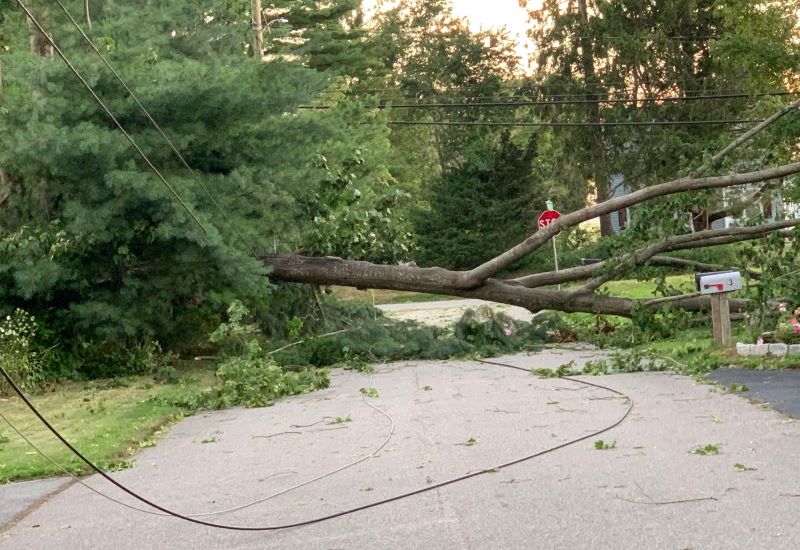
Badly-damaged trees, such as the one in the photo above, require removal. Photo by Jay Graves.
If you have a badly-damaged tree, meaning over 50 percent damaged or diseased, then have it removed, which may allow for a sun garden or perhaps the vegetable garden you have always wanted.
I do not cut down my spent perennials in fall, leaving them up so that I am able to enjoy the browns, grays, and yellows and faded greens, which blend gently with winter’s muted landscape. The seed heads of the perennials are wonderful snacks for the birds and in the dead of winter, what better sight than a red cardinal on the Winterberry bush in the snow.
Also wait until next April to cut down ornamental grasses; their graceful foliage is lovely to enjoy with the icicles on them shining in the pale winter sun.
Any spent perennials that show disease should be cut down but if the plant is more than one third diseased it should be dug up and discarded. Then throw the diseased material in the garbage not in the compost. Clean up any fallen plant debris from the soil and ONLY if it is disease- and weed-free, can it be added to the compost pile.
PEONIES
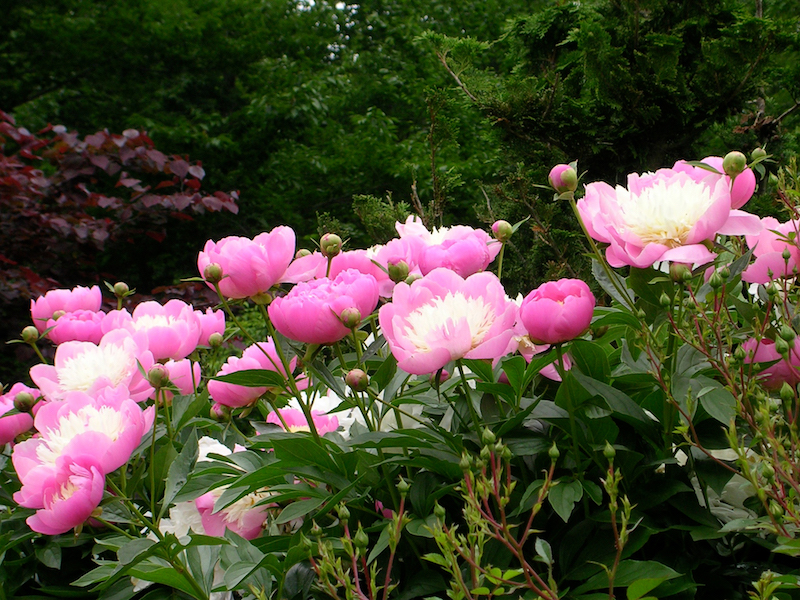
Peonies need careful attention at this time of year to create a display like this next year.
In November, after the first hard frost, cut down peonies to within six inches from the ground and add some composted manure around the base of the plant.
SIGNS OF FROST
You can foretell a hard frost when you notice the afternoon temperature falling fast under a clear sky. Assess the wind by taking a long strip of plastic, like a shopping bag from the supermarket, and hang it from a tree branch. If the bag flutters about a foot in either direction, you do not have to worry about frost, but if it blows vigorously then frost is on the way. If you still have plants in the garden that are of concern, cover them with salt hay, newspapers or light weight old quilts and put a brown paper bag from the grocery store over smaller plants like herbs, anchored down with rocks.
Your houseplants should be indoors by now. After their summer sojourn outdoors, then wash the pots thoroughly and add fresh potting soil. Then replant the plant at the same depth it was at originally and into the sink or shower and allow water to wash the foliage and water the plant well. If the plant has outgrown its pot, transplant it to the next size clean pot, only one and a half inches larger.
Enjoy the pleasant Fall weather and if you have any gardening questions, feel free to email me at MaureenHaseleyJones@gmail.com and I will see you in your garden in November.
About the author: Maureen Haseley-Jones is a member of a family of renowned horticultural artisans, whose landscaping heritage dates back to the 17th century. She is one of the founders, together with her son Ian, of, The English Lady Landscape and Home Company. Maureen and Ian are landscape designers and garden experts, who believe that everyone deserves to live in an eco-conscious environment and enjoy the pleasure that it brings. Maureen learned her design skills from both her mother and grandmother, and honed her horticultural and construction skills while working in the family nursery and landscape business in the U.K. Her formal horticultural training was undertaken at the Royal Botanic Gardens at Kew in Surrey.
OLD LYME—Robert C. Florin Jr., 63, of Old Lyme, died Sunday, Nov. 3, 2024, following a brief illness.
Bob was a one-of-a-kind man, passionate about the people and pastimes he loved, mechanically gifted, generous with his time and a lifelong learner and teacher. As a young man, he enjoyed fishing, skiing, camping and attending concerts. During their 33-year marriage, he enjoyed walking through the woods with his wife Karen (Webber) Florin and their dogs Jericho and Jett, traveling and spending time with family. He was an avid news consumer, expert target shooter and a master crossword puzzle and Sudoku solver.
He was born in Yonkers, N.Y., Jan. 11, 1961, to Robert C. Florin Sr. and Kathleen H. “Dolly” Florin, who predeceased him. He attended Sacred Heart Grade School in Yonkers. The Florins moved to Chester in 1971 and later settled in Old Lyme.
Robert graduated from Xavier High School in Middletown in 1979. After attending Middlesex Community College, he returned to New York, where he became a journeyman electrician with IBEW Local 501, retiring in 2021 as a master electrician.
In addition to his wife, he is survived by his three sisters, having been a loving big brother to Kathleen Emerson, Mary Elizabeth Florin, Patricia Florin and her partner Kenneth Emerson of Old Lyme. He was predeceased by his brother-in-law Dean Emerson.
The four Florin siblings grew up in a tightknit group of eight with their cousins, Anne Marie (Horrigan) Menton of Yonkers, Eileen (Horrigan) Drescher of Duanesburg, N.Y. and the late John Horrigan and Barbara (Horrigan) Thiemann, both of Yonkers.
Robert was a loving son-in-law to Mary Webber of Merritt Island, Fla., and was close with his brother-in-law John Webber and his wife, Marcie Webber of Glastonbury, and his sister-in-law Melanie Webber of Merritt Island.
Many people called him “Uncle Bob,” but he was dearest to those who held the official title of niece or nephew, including Cristine Emerson and Joshua D’Lizarraga of Old Lyme, Katherine Machol of East Lyme, Candice Webber and Jenna Webber, both of Middletown, Cara Webber of Waterford, John Webber Jr. of Garner, N.C. and Oliver Gates of Merritt Island.
He will be sadly missed by his relatives in the Roche, Horrigan, Brown, Florin and Crimmins families and the hundreds of friends he had gathered from near and far.
Bob was a proud, longtime member of the Niantic Sportsmen’s Club, the Raven’s social club and the American Legion.
Calling hours will be from 5 to 7 p.m. Friday, Nov. 8, at the Fulton-Theroux Funeral Home, 13 Beckwith Lane in Old Lyme. A Mass of Christian Burial will be held at 10 a.m. Saturday, Nov. 9, at Christ the King Church, 1 McCurdy Road, Old Lyme, followed by interment in the Duck River Cemetery.
OLD LYME—Lillian I. Spais died on September 20, 2024, at the age of ninety-two. A daughter of Canada’s western plains, Lillian grew up learning the hard lessons of the Depression. Among those lessons were the values of family, self-reliance, adaptability, and community. Throughout all the many challenges in her life, these were the basics that sustained her.
Having trained and worked as a registered nurse throughout Saskatchewan and in Toronto, including service as a Second Lieutenant Nursing Sister in the Royal Canadian Army Medical Corps, Lillian became the staff nurse at the British American Oil Company in Moose Jaw, Saskatchewan. She left that post to emigrate to the States with her beloved husband, Thanase. They ultimately settled in Pennington, New Jersey, where Lillian stayed at home to raise their family. There, she served as president of the local library board and the Pennington Woman’s Club. She also volunteered with the Fresh Air Fund and HomeFront.
After Thanase’s death in 1980, Lillian returned to the workforce to support her family. She earned an Associate Degree with honors from Mercer County Community College, and later served on an advisory committee for the college. She worked as Tax Collector and Assistant Municipal Clerk for Pennington Borough, and finally retired as an administrative assistant with Princeton University’s Department of Economics.
Following her retirement, she relocated to Old Lyme, Connecticut, to be near family. There she volunteered at the Nearly New Shop, served on the board of the Old Lyme Visiting Nurse Association, kept busy with her circle of friends and activities at the Lymes’ Senior Center, spent many hours at the library, and savored dinners on the beach.
A skilled seamstress, self-taught painter, enthusiastic gardener, avid camper, and powerful swimmer, Lillian could do almost anything. Almost. She couldn’t resist chocolate, tolerate injustice, pass up a Scrabble game, prevaricate, or type sixty words a minute. Despite these shortcomings, she was an exceptional mom, GMa, mentor and friend.
Lillian always maintained that her life’s greatest gift was her family, and she loved them all fiercely. Her children, Rebecca (also of Old Lyme), David, George, and Chrysanthe are so grateful for her journey with them even as they mourn her loss. Her grandchildren, Emily, Chelsea, and Lex, her great grandson, Leo, and her extended family, Briella and Avianna, brought her such joy as they grew. She wholeheartedly embraced the spouses and partners of her brood: John, Dee, Cheryl, Dave, Marcelo, and Jesus. Even the collective fur babies were dear to her. She was never happier than when the whole rambunctious crew was gathered together.
Donations in her memory may be made to Phoebe Griffin Noyes Library of Old Lyme, Connecticut, or to HomeFront in Lawrenceville, New Jersey. Interment will be private.