High Hopes in Old Lyme Launches Innovative, Equine-Assisted Services Program for People with Parkinson’s Disease

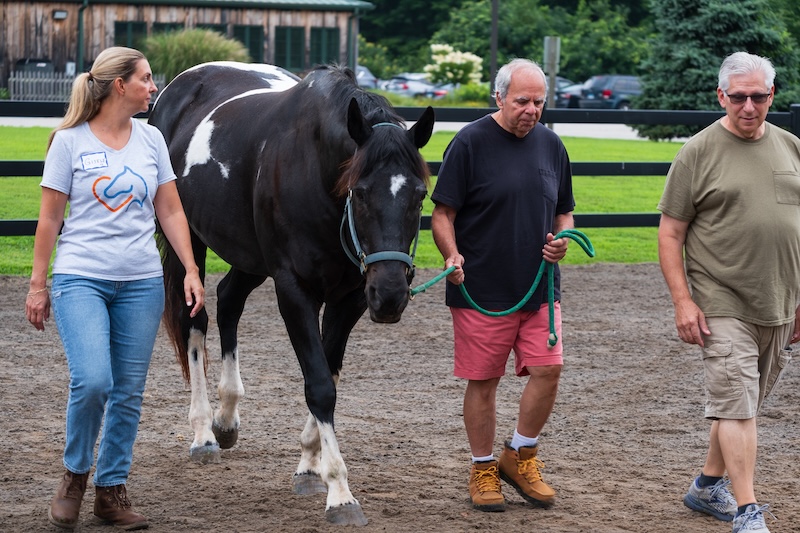
Parkinson’s program participants Michael Bigiarelli (second from right) and David Plat (right ) lead High Hopes horse Addie in the outdoor arena. High Hopes volunteer Gisele Kurns stands by for support.


Program Creates Pathways to Wellness, Relaxation, and Connection

OLD LYME—High Hopes Therapeutic Riding, Inc. has announced the continued success and expansion of its pioneering Equine-Assisted Services Program for people with Parkinson’s disease. What began as a pilot program just one year ago has blossomed into a transformative, life-changing initiative, helping participants experience improved movement, relaxation, and a unique connection with horses.

The program, which meets weekly on Tuesdays from 10:30 to 11:30 a.m., offers gentle stretching exercises, grooming, and leading of horses as part of a therapeutic regimen designed to encourage physical activity, relieve muscle tension, and promote relaxation. The natural, calming presence of the horses fosters a sense of mindfulness, helping participants to be fully present while they engage in each activity.

A year ago, a compassionate High Hopes volunteer and participant, Carol Merkt, recognized a growing need in the community for services tailored to people living with Parkinson’s disease. Merkt, whose deep connection with the High Hopes community led her to identify this gap, approached the center with the idea for a specialized program.

Her insight into and dedication to improving the lives of others has been instrumental in shaping this initiative. “I couldn’t be more impressed with the progress of this program,” says Merkt. “When I first brought the idea to High Hopes, I was hopeful, but what’s been created is better than I ever expected. The benefits for participants are truly remarkable.”
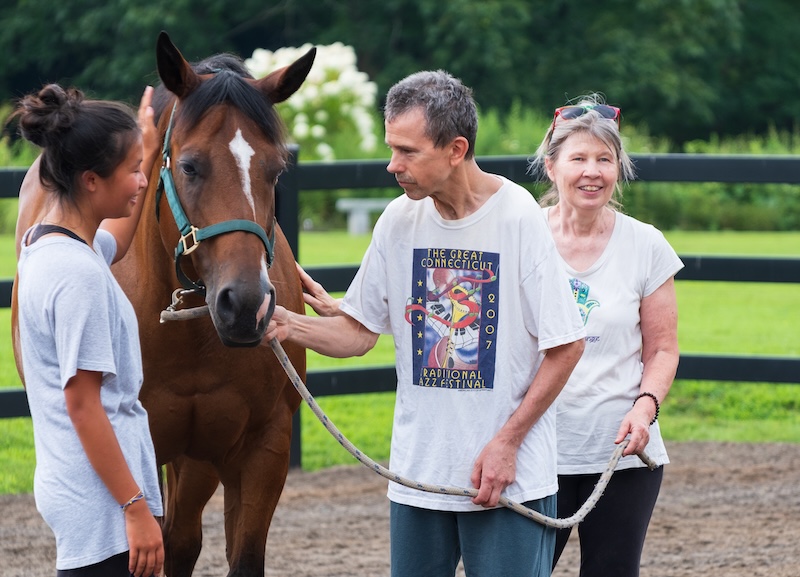
James Bendinzski, a program participant (second from right), praises his horse, Savannah, after completing an obstacle course. Bendinzski’s wife Karen Nichols (right) and High Hopes volunteer Danielle Liston greet both Bendinzski and Savannah at the finish line.

The Parkinson’s Program is facilitated by several High Hopes instructors, who are certified in ‘Equine Mental Health and Learning.’

One of the instructors, who co-facilitates the program, explains more about the program saying, “[It] is about more than physical benefits—it’s about building relationships and finding joy.” She continues, “Horses have an incredible ability to meet people where they are, offering connection and understanding that goes beyond words. Seeing participants light up during these sessions is what makes this work so rewarding.”

The High Hopes Parkinson’s Program is funded by the generous support of the Kitchings Family Foundation, whose contributions cover over 95 percent of the program’s costs through scholarships, ensuring accessibility for all participants regardless of financial circumstances. 

Another facilitator of the program comments, “We’re honored to help make this program possible. Our goal is to create a safe and supportive environment where participants feel empowered. The horses are truly the heart of what we do—they offer nonjudgmental companionship and help participants find moments of peace and accomplishment.”

The program is open to new participants at any time, welcoming individuals with Parkinson’s disease to join the classes and experience the benefits of equine-assisted services. For those who wish to reflect on their experience, there is an optional group “coffee session” following each class. 

“This program exemplifies the mission of High Hopes—to inspire, support, and transform through the power of horses,” says Missy Lamont, Executive Director of High Hopes, adding, “Thanks to the incredible support from the Kitchings Family Foundation, we’re able to provide life-changing experiences to individuals living with Parkinson’s disease.”

Lamont concludes, “At High Hopes, we believe in the power of horses to inspire, heal, and transform. Our equine-assisted services are designed to meet the diverse needs of our community, and we are excited to see how the program continues to grow, improving the lives of people with Parkinson’s disease.”

For more information on the program, visit High Hopes’ website or call High Hopes at (860) 434-1974.

Editor’s Note: This article is based on a press release issued by High Hopes Therapeutic Riding, Inc.
Letter to the Editor: Support Old Lyme Zoning Commission in Enforcing Regulations for Smith Neck House Plan, Reminder That a Hill is Still a Hill

To the Editor:

Over 100 people attended the OL Zoning Commission hearing on Monday evening. They frequently applauded the many speakers who disapproved of the proposed 11,000 square foot house proposed beside the Smith Neck Boat launch. Speakers described site violations of regulations, excessive water use and un-permitted clearcutting. The CT River Gateway Commission has recommended denial of the zoning application. Over many decades, Old Lyme residents have developed and agreed on our zoning regulations to protect the quality of our environment and the character of our towns.  

The Applicant’s architect asserted many surprising defenses as to why they should be allowed to build a house that does not comply with the zoning regulations. One main point was that the other houses in the neighborhood didn’t comply with the regulations but she forgot to add that the other houses were built in the 30’s before the regulations existed. 

Perhaps the Applicants most bizarre claim was that the requirement to locate the house behind the crest of the hill doesn’t apply. They actually asserted that the  property is not really on a hill, so there isn’t really a crest of the hill, because there can’t be a crest if there isn’t a hill. Anyone with two feet knows that there is a hill and a crest at the boat launch and this house must be located behind the crest according to the regulations. 

The hearing reinforced the need for town residents to support the CT River Gateway Commission denial and let the volunteers on the Zoning Commission know that we support them in enforcing our regulations. The hearing process for this Application is closed but Old Lyme’s need for regulatory clarity and compliance is not.  The Zoning Commission rules apply to everyone and failure to enforce them puts us all at risk of living in a community with unchecked development, with no hills. 

Sincerely,

Elizabeth Karter,
Old Lyme.

Old Lyme Zoning Continues Hearing on Halls Rd. Overlay District through Feb. 27

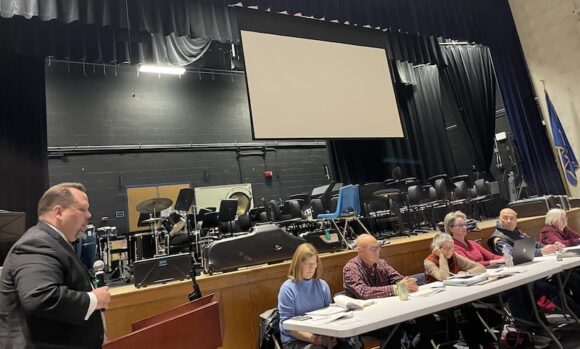
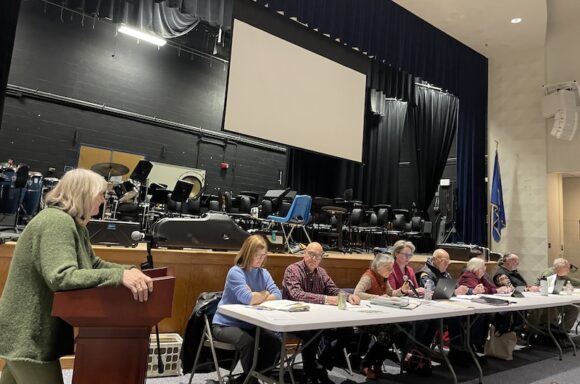
The audience for Wednesday’s Special Meeting of the Old Lyme Zoning Commission ultimately numbered around 60.

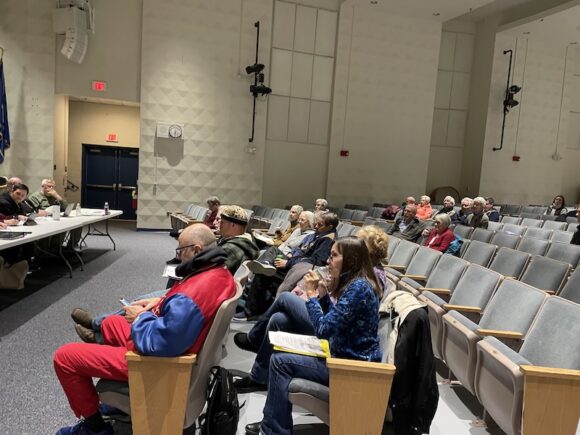
OLD LYME—Around 60 people turned out for last night’s Old Lyme Zoning Commission Special Meeting, which had originally been scheduled for Monday, Jan. 13, but was postponed due to the number in attendance at that meeting. The audience exceeded the permitted fire regulations.

The agenda for Wednesday’s meeting featured both an Old Business item and a Continued Public Hearing related to a Petition to Amend the Old Lyme Zoning Regulations, Section 5.15, to create a Halls Road Overlay District (HROD) allowing, among other items, mixed zoning use along Halls Road and the entire C-30S Zoning District, with associated architectural design guidelines.

Edie Twining, Halls Road Improvement Committee Chair, answered questions from the podium.

The Town of Old Lyme is the applicant.

After the details of this optional Overlay District proposal had been presented by Atty. William Sweeney, public comment was opened and a variety of comments, both in support of and opposed to the proposal were made.

Atty. William Sweeney (left) presented details of the proposed HROD plan.

Old Lyme Economic Development Commission Chairman Cheryl Poirier spoke in support of the proposal as did Old Lyme Democratic Town Committee Chairwoman Kim Thompson.

A number of other people spoke against it.

The Zoning Commission proposed some changes to the wording in the proposal, which the HRIC appeared willing to make.

The meeting ended around 9:40 p.m. with the Public Hearing being continued through to a Special Meeting scheduled for Thursday, Feb. 27, at 6:30 p.m. in the Old Lyme Town Hall.

Old Lyme Zoning Meeting Draws Over Capacity Crowd; Halls Rd. Overlay District Item Postponed to New Meeting, Wednesday

OLD LYME—UPDATED 1/14 at 9pm with additional details on the speakers for the applicant: Last night’s Old Lyme (OL) Zoning Commission meeting drew such a large audience, which not only filled the Meeting Room but also spilled out into the Lobby, that OL Fire Marshal David Roberge determined the spaces were over-capacity from a fire safety angle.

Asked in a phone call how he handled the situation, he told LymeLIne that his estimate was that there were around 135 people in attendance with over 110 in the Meeting Room and the remainder out in the Lobby.

He continued, “We discussed the problem with the Zoning Chair and gave them (sic) a couple of options.” Commission members decided to postpone the second item on the agenda relating to the Halls Rd. Overlay District until Wednesday. That meeting will now be held in the Lyme-Old Lyme Middle School Auditorium starting at 6:30 p.m.

With that announcement, Roberge estimated the audience reduced to around 85, thus falling within the fire-safety parameters for the Meeting Room.

When the business of the evening finally began, the proceedings opened with a number of people speaking on behalf of the applicants, Jeffrey and Emily Merriam, including their attorney, Lewis K. Wise; Senior Design Architect for Cardello Architects Sarah Finch (the main speaker), along with an additional architect; and engineer Seamus Moran PE of H+H Engineering.

The second speaker was ‘the Intervener’—Peter McKillop—a Smiths Neck Rd. resident, who spoke on behalf of the non-profit Great Island Foundation, Inc.

Finally, roughly an hour later, the public had a chance to speak. Some 17 individuals offered opinions and concerns, exclusively with a negative point of view towards the proposal. Those commenting variously asked the Commission outright to deny the application for an 11,000 sq. ft. eight-bedroom, seven-bathroom house with two laundries, a swimming pool, and extensive gardens; or send it back to the Connecticut River Gateway Commission for further review; or to request answers to the numerous still unanswered questions by the applicant; or other questions.

The applicant then responded to comments from both the ‘Intervener’ and the public.

The Zoning Chair then closed the Hearing at around 9:15 p.m., which meant no further comments can be accepted from this point onwards.

The meeting itself ended around 30 minutes later. The Commission now has 65 days to render a decision.

Editor’s Note: We have been advised that since last month’s meeting, the applicant has removed the proposed pool from the application, and added more landscaping.

Old Lyme Zoning Commission to Review Applications for New Home on Smith Neck Rd., Halls Rd. Overlay District Tonight

OLD LYME—UPDATED 1/12 10:20PM with links to additional Letters to the Editor: On Monday, Jan. 13, at 6:30 p.m. in the Memorial Town Hall Meeting Room, the Old Lyme Zoning Commission will hold its next regular monthly meeting. The agenda features two topics that have been sparking interest in the community.

The first is 43 Smith Neck Rd. in the RU-40 Zone, which is the subject of both a Continued Public Hearing and an Old Business item. The applicants, Jeffrey and Emily Merriam, are seeking a Special Permit to replace and construct a new five-bedroom residence with an attached two-car garage.

Visit this link to read a Letter to the Editor that offers an opinion about the project.

Visit this link to read a Letter to the Editor that raises concerns about well water supplies after completion of the project.

The agenda also notes in another item that a Public Hearing will be opened into a Petition to Amend the Old Lyme Zoning Regulations, Section 5.15 to create a Halls Road Overlay District allowing, among other items, mixed zoning use along Halls Road and the entire C-30S Zoning District, with associated architectural design guidelines. The applicant in this case is the Halls Road Improvement Committee (HRIC.)

The HRIC suggests residents interested in the project should bring written thoughts to read and submit, and make a statement for the record. Visit this link to read a Letter to the Editor urging supporters of the proposal to attend the meeting.

Attorney William Sweeney will describe the details of this optional Overlay District and answer questions.

The HRIC believes approval of this addition to Old Lyme’s Zoning is a vital step supporting the future prosperity and livability of Old Lyme.

The HRIC submits that the key features of its proposal are that it:

  • Is totally optional; it allows but does not require change to any property.
  • Keeps the shopping area vital and focused on Old Lyme, not the highway.
  • Creates options for much needed apartment type housing.
  • Balances housing stock without covering the remaining open land.
  • Promotes creation of a safe, walkable, bike-able, mixed-use town center.
  • Guides (via the Design Review process) development to be “like Old Lyme.”
  • Promotes increased town revenues, reducing residents’ taxes.

The HRIC suggests readers visit this link for more information: https://www.oldlyme-ct.gov/343/Halls-Road-Improvements-Committee