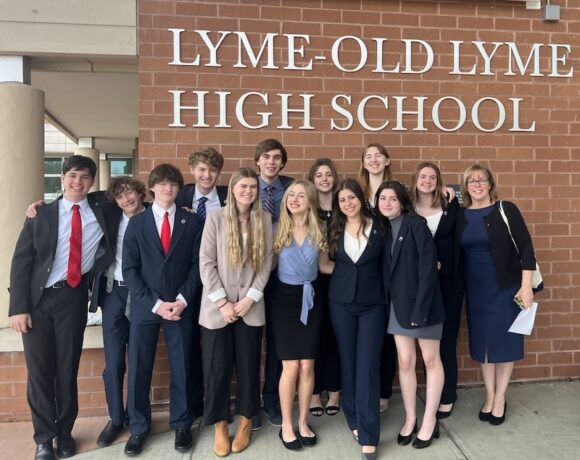
Lyme-Old Lyme Schools Superintendent Ian Neviaser commented, “This is an amazing accomplishment by these young men and women. They have worked incredibly hard. We are so excited for them.”
Winning the state championship has earned the LOLHS team the honor of representing Connecticut at the National Mock Trial Competition in Wilmington, Del. in early May.
The team’s coach, Laura Nelson, has started a GoFundMe campaign to raise funds to send the team and its coaches to Wilmington to compete.
Nelson states on the GoFundMe page, ” Please consider donating to our trip fund to help them realize their goal and represent Lyme-Old Lyme and the State of Connecticut at the highest level..”
EAST LYME—Ledge Light Health District (LLHD) has announced in a press release that on April 19, a raccoon found on Joyce Ct. in the Niantic section of East Lyme was tested and found to be positive for rabies. The public should rtherefore efrain from feeding or approaching any wild or stray animals.
Rabies is a deadly disease caused by a virus that can infect all warm-blooded animals, including people. It is spread mostly by wild animals, but stray cats and dogs may also become infected and spread the virus. The rabies virus lives in the saliva and brain tissue of infected animals. Rabies can be spread by scratches from infected animals or when infected saliva comes into contact with open wounds, breaks in the skin or mucous membranes (eyes, nose, mouth, etc.)
If you have any questions or concerns, contact LLHD at 860-448-4882 or East Lyme Animal Controlat 860-739-3419.
Ledge Light Health District serves as the local health department for Lyme and Old Lyme, along with East Lyme, Groton, Ledyard, New London, North Stonington, Stonington and Waterford, Conn. As a health district, formed under Connecticut General Statutes Section 19a-241, LLHD is a special unit of government, allowing member municipalities to provide comprehensive public health services to residents in a more efficient manner by consolidating the services within one organization.
LYME/OLD LYME— UPDATED 4/18 with voting numbers and quote from Lymes’ Senior Center Building Committee Chair: On Monday evening, Lyme and Old Lyme residents overwhelmingly passed motions to approve supplemental budget appropriations for the renovation of the Lymes’ Senior Center. Both votes were held initially by voice and so convincing—only one ‘No’ was heard at either location—that no paper vote was requested.
Eighty-three Lyme voters approved an amount of $220,000 at their Special Town Meeting held starting at 6 p.m. at Lyme Town Hall and around 175 Old Lyme residents approved $660,000 at their meeting held in the Lyme-Old Lyme Middle School auditorium beginning at 7:30 p.m. the same evening.
With these budget appropriations totaling $880,000 approved by the towns, the Lymes’ Senior Center Building Committee now has all the approvals necessary to accept the trade bids opened Feb. 6 of this year so the project can move forward and construction can begin. Those bids expired May 6, and so the timing of this vote was critical.
Asked by LymeLine what her reaction to the vote was,Lymes’ Senior Center Building Committee Chair Jeri Baker said via email, “I am so grateful that the confidence is there to move us forward.”
The initial $1.33 million overrun on the approximately $5.46 million project, which was identified when the trade bids were opened, had already been reduced through approximately $602,000 in construction savings.
Meanwhile, contingency funds for the project had been increased by nearly $65,000 to cover any unforeseen circumstances. Those two moves reduced the initial $1.33 million overage to $800,000.
An additional appropriation of $80,000 to cover the kitchen upgrades was requested by the towns, taking the total value of the supplemental budget appropriation for both towns combined to $880,000.
As of last night, that amount has now been approved and Building Committee Chair Jeri Baker says that—once construction begins—the committee anticipates a 10-month schedule for the completion of the project, barring any unforeseen circumstances.
Lyme residents had approved an initial appropriation of $1,315,886 at last year’s Town Budget Meeting and Old Lyme residents had similarly approved an initial appropriation of $4,158,407 at a Town Referendum held June 20, 2023. Since that time, through efforts of the towns and the committee, the project has been awarded $1 million in grants from the state.
When the renovations are completed, the Senior Center will offer:
An additional 3,265 square feet of interior space (for a total of 8,737 square feet of interior space) that will enable the center to accommodate more members and activities.
Motorized room partitions that allow for multiple room configurations so programs and activities can take place simultaneously.
An enlarged kitchen space with multiple kitchen upgrades that allows for greater center luncheon attendance.
A quiet library room where members can relax and/or read.
A greeting area that is separate from the activities area.
A public entrance that can accommodate the arrival and departure of buses and emergency vehicles.
Redesigned entryway and hallways, improved door thresholds and additional shelving and storage space.
A new roof, porch, cupola, windows, walkways and landscaping.
HARTFORD, CT/OLD LYME — On April 10, Governor Ned Lamont announced that his administration is awarding approximately $35.5 million in state funding to nonprofit providers across Connecticut for capital improvement projects that support each respective organization in their mission of delivering services to some of the state’s most vulnerable residents.
One of the recipients is Lymes’ Youth Service Bureau (LYSB) in Old Lyme, which will receive $400,256 to support renovations. A post on the LYSB Facebook page explains, “The grant will be used to renovate and modernize the LYSB main office building, bring all mechanical systems up to code, maximize energy efficiency, improve safety and ADA accessibility.”
The post continues, ” The grant will cover 75% of the project budget, with the remaining 25% coming from LYSB donations. Although LYSB’s building is lovely and structurally sound, just about everything is old and failing. This project will ensure that LYSB is able to serve their clients and our community for generations to come.”
In conclusion, the post notes, “Last awarded in 2018, this current round of awards was highly competitive.”
Other recipients in the local area are Safe Futures of New London, which will receive just over $380,000 to support upgrades to its emergency domestic violence shelter, along with renovations at Phoenix House Transitional Housing; and the Child and Family Agency of Southeastern Connecticut in New London, which will receive $295,000 to support facility improvements.
The grants are being released through the state’s Nonprofit Grant Program, which is administered by the Connecticut Office of Policy and Management. They will be used to fund capital projects not typically reimbursed through other funding mechanisms and will support items such as facility alterations, renovations, improvements, and additions; new construction; health, safety, and Americans with Disabilities Act projects; energy conservation improvements; information technology systems; technology that promotes client independence; purchase of vehicles; and acquisition of property.
“Connecticut’s nonprofit providers support residents in every town and are a vital part of our social services safety net,” Governor Lamont said. “Providing funding to make strategic investments helps these organizations deliver the services some of our most vulnerable residents depend upon. This grant funding will help all of the residents that these organizations support be able to utilize their personal strengths, talents, and passions.”
Established in 2013, this program has provided more than $130 million to the state’s nonprofit organizations, supporting about 750 projects. Today’s awards, which support 94 projects, are the program’s eighth round of grants.
State Senator Martha Marx (D-New London) welcomed the announcement saying, “Community nonprofits play an important role in supporting and lifting up members of our communities, and knowing these funds will support those in need and bolster the services aiding them is incredibly meaningful.”
She added, “I’m grateful to Governor Lamont and my fellow legislators for making sure this funding will support transitional housing, domestic violence victims and renovations to the Lymes’ Youth Service Bureau.”
Gov. Lamont commented, “Connecticut’s nonprofit providers support residents in every town and are a vital part of our social services safety net. Providing funding to make strategic investments helps these organizations deliver the services some of our most vulnerable residents depend upon.”
He concluded, “This grant funding will help all of the residents that these organizations support be able to utilize their personal strengths, talents, and passions.”
Those April showers that come our way They bring the flowers that bloom in May. And when it’s raining, let’s not forget, It isn’t raining rain at all, it’s raining violets. ~From a song by Al Jolson~
Maureen Haseley-Jones is “The English Lady.”
April is the month of activity in the garden, and our old nemesis, weeds are beginning to rear their heads, so we need to extract the little devils before they take hold and are difficult to remove.
Having said that, I must point out the benefits of many weeds. Nettles are food for butterflies, clover extracts nitrogen from the air which is then absorbed into the soil and the oil from jewel weed soothes poison ivy rash. The young foliage of Dandelions is great in salads and when lightly cooked it tastes like spinach with the added advantage of containing many healthy nutrients.
In this group, I do not want to forget our songbirds and other wildlife who depend on weed seeds as a food source.
Weed removal – weeds must be pulled gently so that the weed and roots do not break apart, because if this happens, thousands of weed seeds will reseed and you will find yourself with an endless cycle of unnecessary weeding. When careful weeding has been accomplished, apply an organic weed pre-emergent, with a corn gluten base by Bradfield Organics; this natural product will keep weeds at bay for about six weeks. :
The end of April is the time to plant bare-root roses. Photo by Bailey Chenevey on Unsplash.
Plant bare-root roses at the end of April and plant container roses in mid-May. In the middle of May when the soil temperature has reached 55 degrees, add manure and on top of the manure add a fine bark mulch about one foot from the base of the roses. Check my March tips to remind yourself on pruning roses.
Be careful clearing winter debris from around rhododendrons, mountain laurel and azaleas; these evergreens have shallow roots and do not appreciate having their roots exposed. If winter weather did erode soil around some roots, add soil to cover the exposed roots and at the same time resettle the plant in place. In the middle of May apply manure and fine bark mulch as well as some peat, which adds much needed acidity for evergreens.
Plant Gladioli corms at two-week intervals in late April. Planting in two- week intervals ensure you will get a succession of bloom. Plant the corms eight inches below the surface; this extra depth helps to keep the heavy blooms erect.
The Red Lily Beetle will soon appear and I suggest applying organic Neem oil on the Lilies when they are about four inches above ground which helps to halt this beetle problem.
SOIL SOLARIZATION is an effective way to control many soil- borne problems, specifically the tomato blight that causes fruit rot. Covering the soil with clear plastic at the end of April, for one to two months can generate high enough temperatures in the top six to 12 inches of soil to kill pests, nematodes, weed seeds and many disease organisms like the tomato blight. This process has proved invaluable for home gardeners and the beneficial effects last for several seasons.
To solarize, dig a trench several inches deep around the soil bed, and spread a thin, clear plastic film (1-4mils) over the bed. Press the plastic into close contact with the soil and seal the edges by filling the trench with soil. Leave the plastic on the soil until you are ready to plant tomatoes or other vegetables in about six weeks.
When the soil temperature reaches 55 degrees, manure all the borders with composted manure in bags from the garden center or aged manure from the bottom of the farmer’s pile, then mulch with a fine brown hardwood mulch.
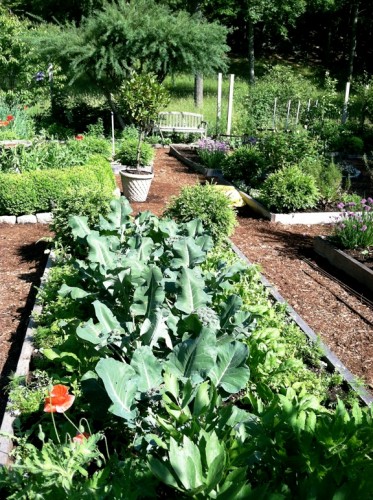
Mulch in April with composted manure in order to achieve a vegetable patch like this later in the season.
In the vegetable garden after preparation and planting, then it is time to mulch. Mulch with the composted manure, which will not ‘cap’—this means, that it does not form a crust like other mulches so that air and water can get through to the roots of the plants where it is needed.
If you did not apply an organic grub control on the grass in March, apply now to reduce the grubs, which are the food source for Moles and therefore cut down on the mole population.
Soil is the most important component of production in the garden; with compost, organic manure and peat to amend soil and rebuild its structure. The ratio to use is one part compost to three parts manure and apply peat to the planting mix in the ratio of one part peat to three parts manure when planting evergreens. And as mentioned above, peat adds the acidity which evergreens require.
Good soil structure assists with drainage, prevents compaction, and the rich nutrients with the amendments break down and encourage the soil animals beneath the surface to work at full capacity. In a sandy soil, humus is needed to produce micronutrients for this soil, which are the combination of manure, mulch and carbon from the atmosphere that binds the sand particles together therefore producing a healthy workable soil. In heavy soil such as clay, the humus separates the clay particles which allows for air and drainage.
GROWING CONDITIONS IN APRIL are very favorable for new plant-root development. This month is the best time to transplant evergreen shrubs and plant new evergreens. Apply composted manure and peat together with the topsoil in the planting hole. Then give the roots a workout with your hands before planting. Separating the roots in this way gives them the freedom to reach into the surrounding soil for nutrients and water and not dry out in the heat of summer.
Many years ago, when I moved into my farmhouse on the shoreline, I discovered that my soil was sandy, which is good for drainage but sadly lacking in nutrients. I began adding a few inches of manure to all planted borders in April, July and October. The result today is when I put a spade in the ground to check the color of the soil in spring it’s ‘black gold’.
Gloves should be worn when handling manure which contains bacteria; the bacteria is great for the plants and the soil but not good for your health. These natural soil amendments tend to be slow acting; gradually making the nutrients available to the plants and the rewards are infinite. Composted manure is applied in spring around mid May when the soil temperature has reached 55 degrees and when the plant shows about six inches of growth. This method allows for the nutrients and soil animals to become active at the time when plant growth is occurring at a rapid pace.
DAFFODILS, which are my favorite flower, are appearing in gardens and on roadways, which is a lovely sight. When the Daffodil bloom has past, do not cut the leaves from Daffodils or any of your spring flowering bulbs, the leaves send down energy into the bulbs to store for next season’s bloom.
April is the time to tackle a new lawn or patch seed, use only good quality grass seed, organic fertilizers and lime, which provides the alkaline and not acid for the grass.
Do not be lulled into complacency with a few back-to-back warm days; we can still get frost, so I caution that you not to plant annuals until Memorial weekend. Do not cultivate around the perennials in the borders until mid-May.
Do not panic if you were not able to get the April tasks done until May, your garden will wait for you and the constancy that is Mother Nature will continue to keep your patch of earth flourishing.
Enjoy the pleasure of being outdoors in warmer temperatures, inhaling the pungency of awakening soil and your connection with Mother Nature. Do not overdo it; warm up the body before the garden labor and stay well hydrated with lots of water.
We are inexorably entwined with the earth and know that even the smallest gesture of a garden has positive rewards; the effects are not only on you but on our planet.
It is important to have a well thought out plan before creating a new garden or landscape. My son Ian is a landscape designer and creator for the last 30 years and you can arrange your consultation at LandscapesByIan.com
I will see you in your garden with more gardening tips in May and if you have any gardening questions, please email MaureenHaseleyJones@gmail.com
About the author: Maureen Haseley-Jones is a member of a family of renowned horticultural artisans, whose landscaping heritage dates back to the 17th century. She is one of the founders, together with her son Ian, of, The English Lady Landscape and Home Company. Maureen and Ian are landscape designers and garden experts, who believe that everyone deserves to live in an eco-conscious environment and enjoy the pleasure that it brings. Maureen learned her design skills from both her mother and grandmother, and honed her horticultural and construction skills while working in the family nursery and landscape business in the U.K. Her formal horticultural training was undertaken at the Royal Botanic Gardens at Kew in Surrey.