RiverQuest’s ‘Winter Wildlife Eagle Cruise’ Offers Remarkable Insight, Views of CT River

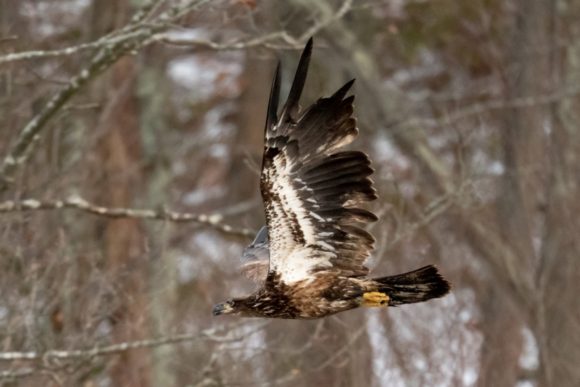
This juvenile bald eagle flew alongside the RiverQuest during our recent afternoon cruise. Photo by Michael Pressman.

Oh, what a trip!
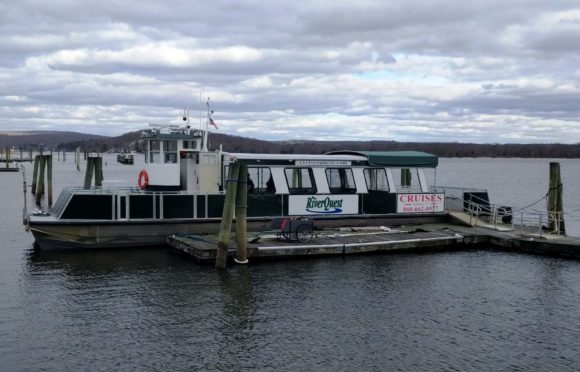
The RiverQuest at the Connecticut River Museum dock

RiverQuest hosted several members of the Fourth Estate recently on a wonderful Winter Wildlife Eagle Cruise. Temperatures were distinctly chilly last Wednesday afternoon (Feb. 13), but the heated cabin stayed warm while the boat gently sailed upstream from the Connecticut River Museum.
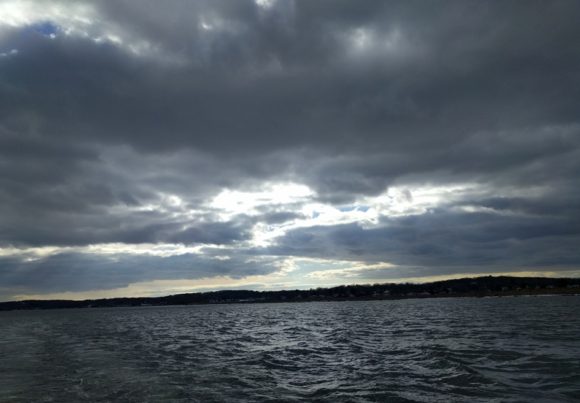
View from on board the RiverQuest.

The views were stunning throughout the trip and, despite the frigid temperatures, the majority of the 30 or so on board stayed outside most of the time to enjoy the whole experience to the full.
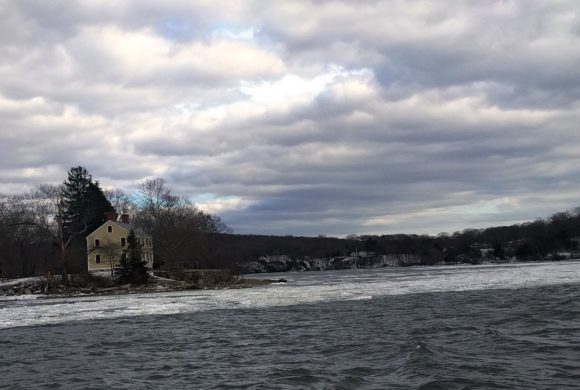
Look hard and you’ll see the mast (slightly right of center) of the sunken luxury yacht in Hamburg Cove.

As we sailed north, apart from all the wildlife on the water and in the sky, we saw the mast of the luxury yacht that has sunk in Hamburg Cove and the always delightful view of Gillette Castle high atop its East Haddam perch overlooking the Connecticut River.
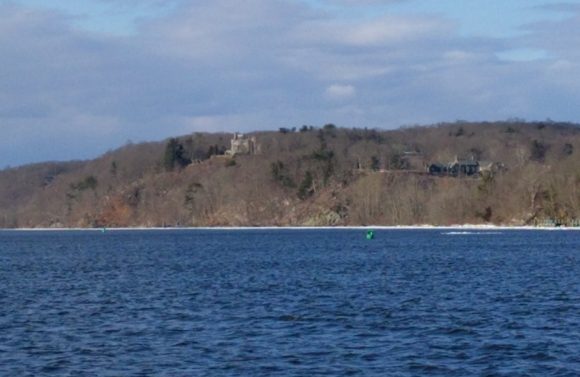
Gillette Castle commands a stunning of the river.

Naturalist and lecturer Bill Yule shared a vast amount of fascinating facts, figures, history, happenings, and anecdotes about the river and its inhabitants, ably accompanied by naturalist and crew member Cathy Malin.
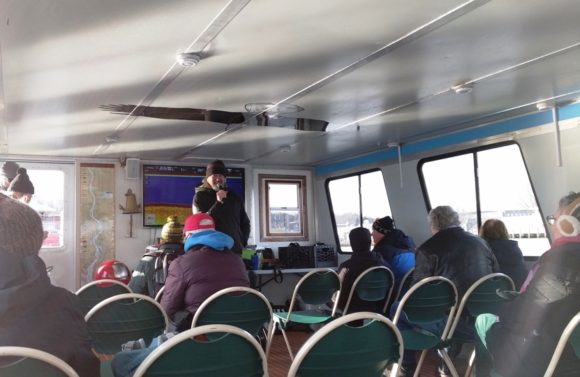
Naturalist Bill Yule shared a great deal of interesting information with the passengers.

Both were on board for the duration of the trip and, while not busy disseminating information in a lively and engaging manner, they were actively spotting and identifying wildlife of all shapes and sizes on, above and alongside the river and its banks.  They also took great care to ensure the  passengers were at all times warm, comfortable … and supplied with plenty of hot coffee!
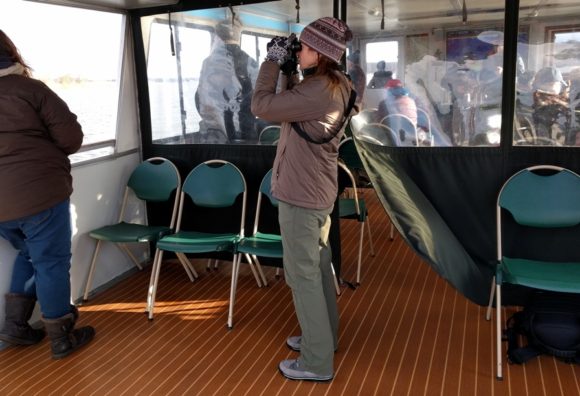
Cathy Malin kept her eyes on the prize and was rewarded with sightings of 13 bald eagles on this trip..

Although named an ‘Eagle Cruise,’ the sighting of an eagle cannot, of course, be guaranteed, but we were fortunate to see 13 bald eagles on our trip, one flying immediately alongside the RiverQuest, and also enjoyed numerous sightings of cormorants, black-backed gulls, and common merganser ducks.
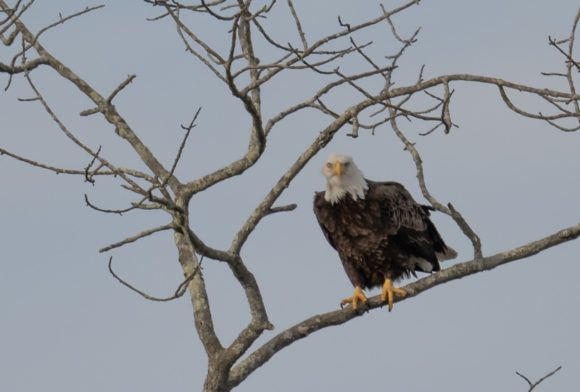
An adult bald eagle spotted during our cruise keeps a close watch on everything happening on the river beneath him. Photo by Michael Pressman.

The bald-headed eagle — the national emblem of the United States of America — reaches maturity at around age four when it acquires its signature white head and maximum wingspan of approximately six feet.
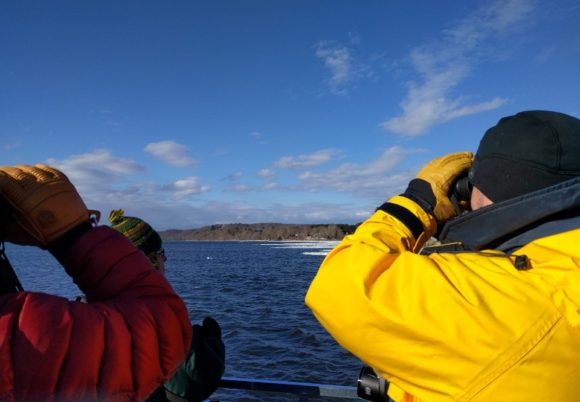
All eyes — and binoculars– were on the sky … and water.

Declared an endangered species in 1973 with the passage of the federal Endangered Species Act, bald eagle populations slowly began to recover following the ban on DDT, and by 2007, populations had recovered to such an extent that the species has now been removed from the endangered species list.
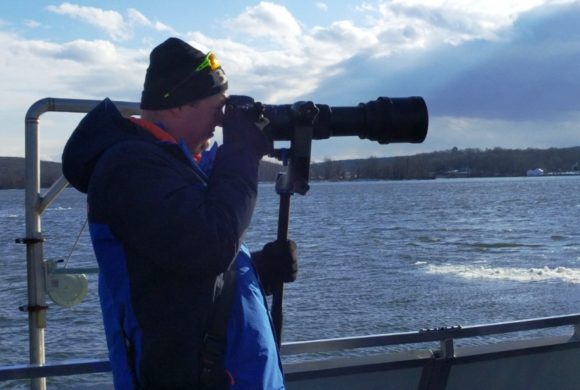
There were a number of professional photographers on board sporting rather larger lenses than our cell phone!

The magnificent raptors are, however, still protected on the federal level by the Bald Eagle and Golden Eagle Protection Act of 1940 and the Migratory Bird Treaty Act of 1918.
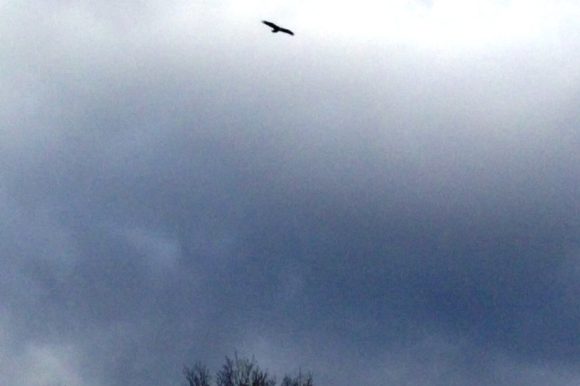
Spotting eagles was the job of everyone on board.

Every winter a number of bald eagles migrate south looking for open water on which to feed as the lakes and rivers in Canada and northern New England  freeze. Many of these magnificent birds stop in Connecticut and winter along major rivers and large reservoirs, where they can also be seen feeding and sometimes nesting on the banks of the Connecticut River.
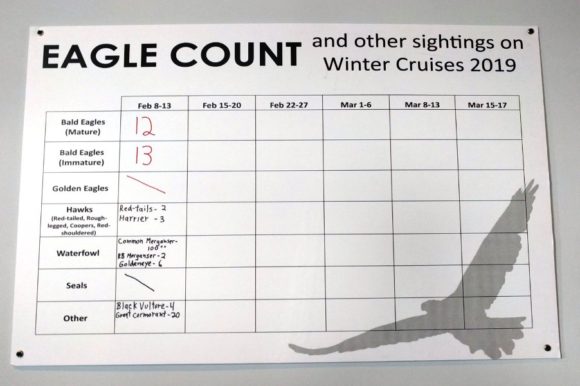
A record of all the birds seen during each trip is kept in the Connecticut River Museum.

Counts taken in 2018 indicated there were 80 pairs of nesting bald eagles in Connecticut, which produced a record 68 chicks.
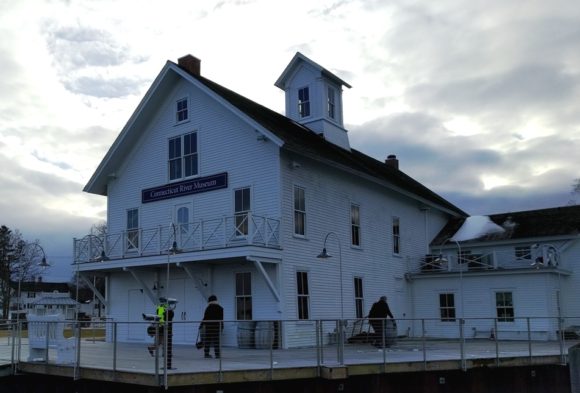
The Connecticut River Museum was the start and end-point of our trip.

The Connecticut River Museum is currently hosting a “Big Birds of Winter” exhibit, which offers an excellent overview of all the birds that might be seen on the river.
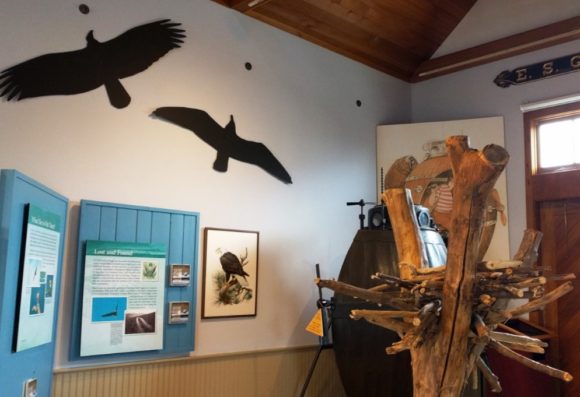
This mock-up of an eagle’s nest and the raptor silhouettes are part of the Connecticut River Museum’s “Big Birds of Winter”exhibition.

Your $42 ticket not only gives you two hours on the river aboard the RiverQuest, but also admission to all the exhibits at the Museum.

Our unequivocal opinion of this wonderful trip is simply, “Take it … it deserves two big thumbs up!”

Editor’s Note: For more information on Winter Wildlife Eagle Cruises, visit this link. For more information on RiverQuest and all the trips they offer, visit this link.  For more information on the Connecticut River Museum, visit this link.
Essex Winter Series Presents Midiri Brothers Sextet This Afternoon

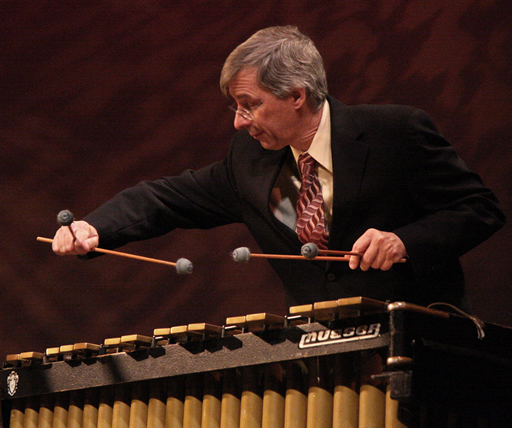
Paul Midiri who will play in the Midiri Brothers Sextet on Sunday, Feb. 17. File photo courtesy of Essex Winter Series by Tom Salvas.

ESSEX – Essex Winter Series’ presents its Stu Ingersoll Jazz Concert featuring the Midiri Brothers Sextet with special guest Jeff Barnhart on Sunday, Feb. 17, at 3 p.m. at John Winthrop Middle School, Deep River.

The incomparable Midiri Brothers Sextet performs a phenomenal jazz program celebrating the great reedmen, including Benny Goodman, Artie Shaw, Jimmy Noone and many othersJoseph Midiri is considered a virtuoso of clarinet and saxophone, and Paul Midiri’s wide-ranging talents include vibraphone, drums, and trombone. The added bonus will be Essex Winter Series’ Jazz Advisor and pianist Jeff Barnhart, who will join the group with his dynamic energy.

“I am thrilled to have multi-instrumental virtuosi Joe and Paul Midiri return for a concert, this time with their jazz ensemble, the Midiri Brothers Sextet,” said Barnhart. “The Sextet has been a mainstay of the CT Jazz scene throughout the Great CT Traditional Jazz Festival and the Hot Steamed Jazz Festival, and their legions of fans will be out in force to see their new show celebrating music of the great jazz reedmen. Don’t miss it!”

The lineup includes Joseph Midiri, co-leader, reeds; Paul Midiri, co-leader, vibraphone; Danny Tobias, jazz cornet, trumpet; Pat Mercuri, guitar, banjo; Jack Hegyi, bass; Jim Lawlor, drums; Jeff Barnhart, piano.

Essex Winter Series’ 42nd season continues on March 17 with violinist Tai Murray (the 2019 Fenton Brown Emerging Artist) joining the New Haven Symphony Orchestra under the direction of William Boughton for a program featuring Mozart, Prokofiev, Barber, and Hadyn.

The final concert of the series is Chanticleer, known around the world as “an orchestra of voices,” celebrating their 40th year with a program of favorites composers, from Palestrina and Victoria to Mason Bates and Steven Stucky, as well as audience favorite arrangements by Jennings, Shaw and others.  The concert will take place on April 7.

All performances take place on Sundays at 3 p.m. with the February jazz concert at John Winthrop Middle School, 1 John Winthrop Middle School Road, Deep River; the March concert at Valley Regional High School, 256 Kelsey Hill Road, Deep River; and the April concert at Old Saybrook Senior High School, 1111 Boston Post Road, Old Saybrook. Seating is general admission and tickets may be purchased by calling 860-272-4572 or visiting www.essexwinterseries.com.

The 2019 season is generously sponsored by The Clark Group, Essex Meadows, Essex Savings Bank, Jeffrey N. Mehler CFP LLC, Masonicare at Chester Village, Tower Laboratories, Guilford Savings Bank, and BrandTech Scientific.

Letter From Paris: Life in the ‘City of Light’ is a War Zone … with Wheels!

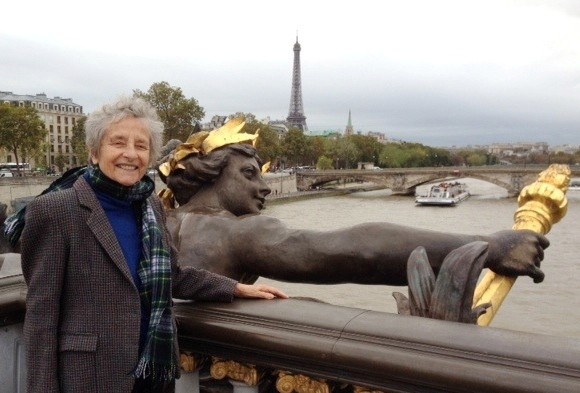
Nicole Prévost Logan

Paris is waging a war on wheels.

In order to survive crossing the street, pedestrians have to defy car drivers while on the sidewalks, the war is between the people who walk and those on wheels in a multitude of forms.

Mayor Anne Hidalgo, a socialist, has made it her mission to reduce pollution in the French capital by shrinking the space open to vehicles.  It is a laudable cause and many Parisians appreciate its immediate results. 

Thanks to the closing of the roadways along the Seine, people have regained the previously lost pleasure of walking leisurely near the water, away from the noise of the traffic, while their children can play freely.

It is possible now to walk miles and discover Paris from east to west.  More boats line up at the quays and have become floating cafés.  In warm weather, tons of sand and palm trees appear overnight to give the berges (banks) de la Seine a summery look. 

But the process of narrowing avenues with larger sidewalks and creating bicycle and bus lanes can be overwhelming for residents.  For months, the ambitious project to reduce the Bastille circle to merely an intersection of avenues has turned the area into a gigantic worksite. 

People have to struggle through ever-changing makeshift paths amid the noise and dust of heavy equipment that is variously moving mountains of dirt or asphalt, installing fire hydrants and electrical cables, and relocating bus stops.  Everyday the urban landscape changes causing irritation among Parisians and resultant excessive horn-blowing. 

For pedestrians, crossing a street feels like an obstacle course.  When the lights change, motorcycles seem to think they are at the Le Mans 24 hour race (the most famous car race in France), backfire their engine to make as much noise as possible and surge forward riding only on their back wheel.  Pedestrians had better get out of the way! 

Arriving at a traffic light, drivers will not stop until it turns to amber.  The crossing space, called les clous in France (it used to be-marked by what looked like oversize thumbtacks), is encumbered with trucks, cars and busses through which one has to meander to find a passage. 

Even when the light turns green, a war of nerves starts between drivers and pedestrians. Tourists and out-of-towners hesitate and are too polite.  This is a big mistake, which is interpreted as an opportunity to move forward rapidly by drivers.  But old-time Parisians are more daring and will bluff their adversaries at the wheel.  At busy intersections, the vehicles coming from side streets do not even slow down, turning the scene into ridiculous grid locks .

Sidewalks are supposedly designed for pedestrians. Wrong!

A ‘trottinette’

A ‘gyrorue’

Today the latter share the space with an ever-increasing number of humans on wheels: big-engined motorbikes taking a short-cut then parking right in front of their destination, bicycles, skateboards, electric scooters or trottinettes — the current rage — and monowheel scooters or gyroroue.  The list is open-ended since technology invents new devices all the time. 

Traffic on sidewalks is not regulated and follows the rule of the jungle, which means no rules at all.  

Last month, I attended a big event along with hundreds of residents of my arrondissement to hear our mayor present his New Year wishes.  Among the elected members of the conseil municipal (town council), I spotted the person in charge of transportation and commented on the war-like atmosphere in our streets. 

He was very evasive, saying, yes, we are aware there is a problem, but I wondered what this transportation official was actually doing besides “being aware of the problem.” 

I almost forgot … I should add another category to my story about the wheels onslaught and that is the hordes of tourists pushing their suitcases … on wheels!

Living in Paris is an enjoyable challenge.  Having no wheels definitely keeps you on your toes.

Editor’s Note: This is the opinion of Nicole Prévost Logan.

Nicole Prévost Logan

About the author: Nicole Prévost Logan divides her time between Essex and Paris, spending summers in the former and winters in the latter. She writes a regular column for us from her Paris home where her topics will include politics, economy, social unrest — mostly in France — but also in other European countries. She also covers a variety of art exhibits and the performing arts in Europe. Logan is the author of ‘Forever on the Road: A Franco-American Family’s Thirty Years in the Foreign Service,’ an autobiography of her life as the wife of an overseas diplomat, who lived in 10 foreign countries on three continents. Her experiences during her foreign service life included being in Lebanon when civil war erupted, excavating a medieval city in Moscow and spending a week under house arrest in Guinea.

Ivoryton Playhouse Hosts Auditions for ‘Godspell, Mama Mia and Cabaret’ Today

The Ivoryton Playhouse will be holding local auditions for Equity and non- Equity actors for the 2019 summer musicals – Godspell, Mama Mia and Cabaret – on Friday, Feb. 8, from 11 a.m. to 7 p.m. at the Ivoryton Playhouse Rehearsal Studio, 22 Main Street in Centerbrook, Conn.

The Playhouse is looking for actors, singers and dancers to fill all roles. Check their website for production dates at www.ivorytonplayhouse.org

All auditions are by appointment. Bring a picture and resumé and prepare a song in the style of the show.

For audition appointments, call 860-767-9520, ext.207 or email lizzy@ivorytonplayhouse.org

Letter from Paris: Picasso’s Early Years on View in Blue … and Pink

Nicole Prévost Logan

In October 1900, Picasso – at age 19 – arrived at the Gare d’Orsay in Paris from Barcelona. So, it is appropriate that the Orsay Museum would host an exhibition about the young Spanish artist.

The blockbuster, which opened in the autumn of 2018, was called “Picasso. Bleu, Rose” and refers to the 1900-1906 years. It is a long overdue theme, never before treated in France.

For several reasons, this period is unique among Picasso’s long career. It reveals the precocious virtuosity of such a young person as a draughtsman;
never again will he express such intense emotions; Harlequin — a main character from the Commedia del’arte — is introduced for the first time and will remain his double throughout his life’s work. The image at right shows “Arlequin with an acrobat” (1905) portrayed as a young and emaciated boy.

Between 1900 and 1904, Picasso made several trips between Spain and Paris, until he settled permanently in the French capital where he rented a studio, along with other artists, in a dilapidated building baptized the Bateau-Lavoir (washhouse.)

He liked to hang around at the tavern of Els Quatre Gats (Four Cats) in Barcelona where he met Catalan friends – such as Santiago Rusinol or Ramon Casos. The exhibit shows hundreds of the small portraits and sketches, sometimes humorous, that he created at full speed.

With a voracious curiosity, he would watch the colorful, loud crowds at cabarets, bordellos, night clubs or caf’concs (cafés with a music hall performance) of Montmartre.

Toulouse Lautrec was his idol.

Like him, Picasso depicted the dejected night-life customers stunned under the effect of absinthe. “Arlequin and his companion” (1901, Pushkin museum, Moscow) shown at left represents a couple totally alienated from each other, sitting at a bistro table, with vacuous expressions on their faces.

The man is Harlequin, dressed in his usual costume with lozenges.

The “Portrait of Gustave Coquiot” (1901, Musee d’art moderne, Paris) at right is emblematic of this garish night life. The collector and art critic is depicted as a well-fed individual, with half naked girls dancing in the background, his mouth snarled in a lecherous grimace, under an insolent mustache.

But those years were lean years for Picasso. Both in Barcelona and in Paris Picasso lived in utter poverty.

This was the height of his “Blue Period” — the color of the bottom of the abyss. Beggars, orphans, the poor — Picasso showed his empathy for all of them.

He would take for models the former prostitutes incarcerated at the Saint Lazare prison in Barcelona, where many were dying of venereal diseases .

One usually links the Blue Period with the death of his close friend Casagemas in 1901 The painting at left of the young Catalan artist on his death bed, (1901, Musee Picasso, Paris) is realistic and shows the bullet wound on his temple after he committed suicide. The feverish multicolor strokes around the candle are reminiscent of van Gogh’s technique.

Abject poverty did not prevent Picasso from leading a lively, bohemian life among artists, poets, writers in the Montmartre district of the French capital, which was the center of the artistic world at that time.

The German art dealer Daniel-Henry Kahnweiler immediately discovered the genius of Picasso. Things started looking up when art merchant Ambroise Vollard bought several of his paintings. His melancholy disappeared when he fell passionately in love with Fernande Olivier, one of his many companions whose body and face he kept deconstructing.

The distinction between Blue and Pink Periods is rather artificial. Sadness lingered on through both periods.

Pink became predominant when the artist became interested in the circus world. Several times a week he would go to the cirque Medrano. But unlike other artists like Seurat, Rouault or Matisse, he was not interested in the spectacles per se but rather in what happened backstage and in the miserable existence of the acrobats.

In “Acrobate a la boule” (at right), a frail adolescent is trying to keep his (her) balance on a round ball watched by a heavy set acrobat sitting on a massive cube. Art historians give a deep meaning to the scene, to the contrast between the spiritual world, taking risks, being continually in motion with the stability of life grounded in the earth.

In the summer of 1906, Picasso’s life took a new turn. Being with Fernande on the hillside village of Gozolf, he seemed totally happy, enjoying the sun and inspired by the pink and ochre color of the clay. He discovered the Iberian sculptures of the fifth and sixth centuries BC influenced by Phoenician and Greek cultures as well as 12th century medieval sculptures.

His art seems to be changing course. In “Deux Nus” (1906, MOMA), shown at left, the bodies of the naked women, are deformed, with disproportionate legs and heavy torso. Picasso was ready for another discovery … African art.

Matisse showed him an African statuette in the apartment of Gertrude and Leo Stein. Picasso was stunned.

As a result, after numerous sketches, (the Steins bought most of them when Picasso was still unknown), Picasso produced the ‘Demoiselles d’Avignon’ (1907, MOMA), which remains probably the most important painting of the 20th century.

Editor’s Note: This is the opinion of Nicole Prévost Logan.

Nicole Prévost Logan

About the author: Nicole Prévost Logan divides her time between Essex and Paris, spending summers in the former and winters in the latter. She writes a regular column for us from her Paris home where her topics will include politics, economy, social unrest — mostly in France — but also in other European countries. She also covers a variety of art exhibits and the performing arts in Europe. Logan is the author of ‘Forever on the Road: A Franco-American Family’s Thirty Years in the Foreign Service,’ an autobiography of her life as the wife of an overseas diplomat, who lived in 10 foreign countries on three continents. Her experiences during her foreign service life included being in Lebanon when civil war erupted, excavating a medieval city in Moscow and spending a week under house arrest in Guinea.