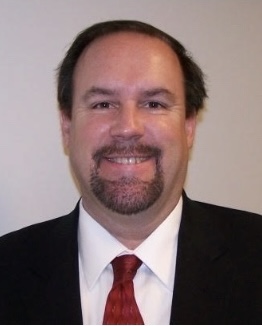
Jeff Duigou (R) is a candidate for Connecticut’s 33rd Senate District
COLCHESTER/LYME — Citing the need for “fresh, family-focused ideas” in the Connecticut legislature, Colchester’s Jeff Duigou announced yesterday that he is running to be the next Connecticut Senator from the 33rd District.
The 33rd District includes Lyme along with Chester, Clinton, Colchester, Deep River, East Haddam, East Hampton, Essex, Haddam, Portland, Westbrook and part of Old Saybrook.
“From groceries to gasoline, Connecticut remains unaffordable for working and middle class families as well as for seniors and small business owners,” Duigou said.“
He continued, “As State Senator, I will work with Democrats and Republicans to lower those tax burdens. I will also work to pass laws which make our communities safer. We need to better support our law enforcement officials and first responders. As state senator, I will put you, the taxpayers, first. Your voices will be listened to.”
Noting, “I will bring a law-and-order, business-friendly, pro-environment perspective to the State Capitol, adding, “As a conservationist, I believe we should be good stewards of the abundant natural resources we enjoy here in Connecticut,”
Duigou stated, “I will be a voice for sustainability, preservation. and public health. At the same time, I understand that innovation, research, trades, and small businesses are the backbone of our economy.”
A Republican, Duigou worked for more than 30 years in the environmental engineering field and retired from his Vice President of Environmental Sciences position at Eagle Environmental, Inc.
For 18 years, he served as a Licensed Environmental Professional, helping clients with compliance with federal and state environmental regulations and for 15 years, Duigou worked with multiple school districts to help provide safety services to administrators, teachers and maintenance staff.
Duigou concluded,. “From affordability to public safety to wasteful government spending, there are so many areas where we can improve our state’s policies.”
A graduate of the University of Connecticut, Duigou and his wife Cari have lived in Colchester for the past 38 years and have raised their family there.
Editor’s Note: This article is based on a press release issued Jan. 17, by Jeff Duigou.
HARTFORD/ESSEX/LYME—Yesterday, State Senator Norm Needleman (D-Essex) announced he is running for a fourth term in the State Senate. First elected in 2018, Sen. Needleman represents the 33rd Senate District, which includes the town of Lyme along with Chester, Clinton, Colchester, Deep River, East Haddam, East Hampton, Essex, Haddam, Old Saybrook, Portland and Westbrook.
“While I am proud of what my colleagues and I have accomplished in Hartford since I was elected to the State Senate six years ago, there is still work left to be done,” said Sen. Needleman. “I want to continue to build on my reputation as someone who builds consensus and forges common-sense solutions to Connecticut’s challenges that have received bipartisan support.”
He continued, “From my leadership positions on the Energy and Technology and Planning Development committees to my membership on the Commerce, Finance, Revenue and Transportation committees.”
Needleman concluded, “I’m excited to continue working as a pragmatic problem solver and support my constituents.”
Since he was sworn in as a State Senator, Sen. Needleman has served as Senate Chair of the Energy & Technology Committee. In 2020, he authored and led passage of the “Take Back Our Grid Act,” and in 2023, he took those protections further with Senate Bill 7.
Sen. Needleman has also achieved victories in energy and technology legislation.
Additionally, In 2023, Sen. Needleman championed the passage of a state budget that included the largest income tax reduction ever enacted in state history, an increase in a tax credit targeting lowest-income workers, and expanded exemptions on certain certain pension and annuity earnings benefitting seniors.
In addition to his work as State Senator, Sen. Needleman also serves as First Selectman of Essex, currently in his seventh term in the role, with a focus on effective municipal management.
He is also the founder and CEO of Tower Laboratories in Essex, a pharmaceutical manufacturing company he built from the ground up to be a leader in its field.
Editor’s Note: This article is based on a press release issued by State Sen. Needleman’s office.
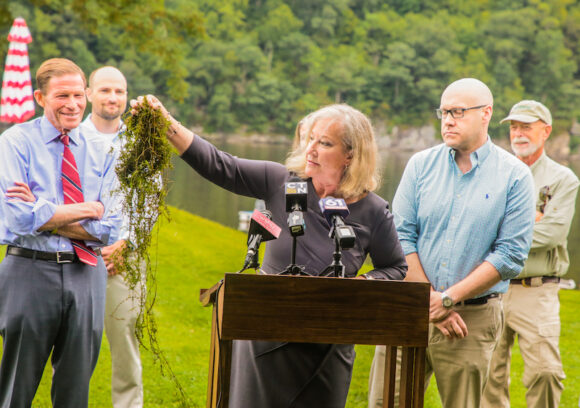
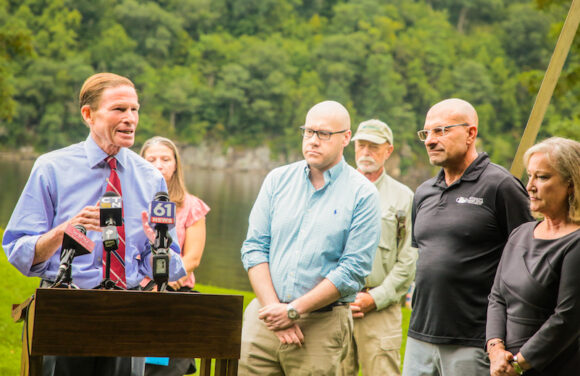
State Rep. Christine Palm (D-36th) holds up some hydrilla during Wednesday’s press conference to demonstrate how its structure chokes native plants, harms fish and wildlife habitats, and prevents recreation. All photos courtesy of CT House Democrats.
Press Conference Held to Educate Public About Harm Caused by Hydrilla, Discuss Projects to Control Invasive Aquatic’s Spread
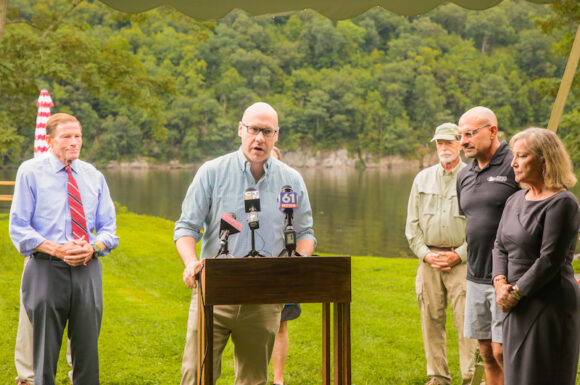
CHESTER — On Wednesday, Aug. 16, state and federal legislators, federal agencies, and stewards of the Connecticut River, met in Chester to educate the public about testing and remediation of invasive aquatic species in the Connecticut River, focusing on hydrilla (hydrilla verticillata), a highly problematic invasive rapidly spreading throughout the lower River Valley.
Experts addressed how these species cause ecological and economic harm, discussed the different research and removal projects being conducted in the Connecticut River, introduced the newly formed Office of Aquatic Invasive Species, and offered methods of prevention.
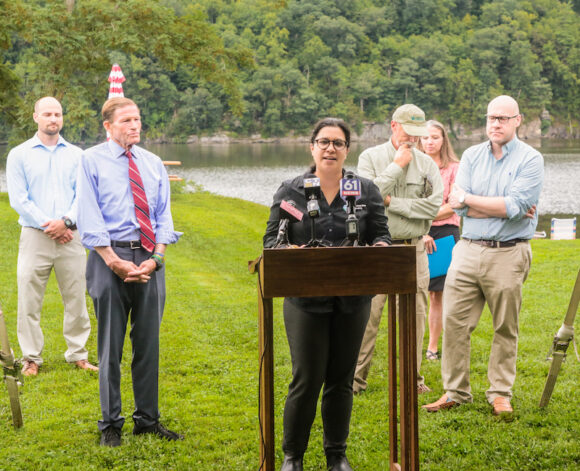
“Hydrilla is a threat to the Connecticut River as it can crowd out native plants, harm habitat for fish and wildlife, and prevent recreation,” said Rhea Drozdenko, River Steward for the Connecticut River Conservancy.
Rhea Drozdenko, River Steward for the Connecticut River Conservancy., addresses the audience at the press conference.
She continued, “I’m grateful we have strong partnerships throughout the watershed as we learn more about this species and work to protect our waterways. The Connecticut River Conservancy has worked on several related projects including the use of benthic barriers to prevent hydrilla growth and promoting preventing the spread of hydrilla through the practice of ‘Clean, Drain, Dry.'”
To improve understanding of the dynamics of water flow and exchange in the local waterways, the U.S. Army Corps of Engineers (USACE), in cooperation with the CT Agriculture Experiment Station (CAES), will be applying Rhodamine WT (RWT), a red tracer dye to the Chester Boat Basin, along with three other sites.
This dye release and study program is preparatory to the eventual release of herbicide treatment for the control of hydrilla at each site.
According to the USACE, RWT dye is a fluorescent, xanthene dye that has been used for water tracing since at least the mid-20th century to quantify time of travel in dynamic (in this case, tidal) waters. This dye has no significant effects on aquatic organisms and has been proven safe for these studies.
The dye will be applied to the sites during various environmental conditions using different application techniques at 10 parts per billion concentrations. The concentrations of the dye in the water will be collected using fluorometry equipment at certain intervals following initial dye treatment at sampling points within and just outside of the sites.
There will be impacts on the color of the water at the sites and surrounding areas as the dye is bright red in color but expected to be minimal and short-term as the dye will dilute and dissipate with the flow and tides of the river.
State Rep. Devin Carney (R-23rd) thanked State Rep. Christine Palm (D-36th) for taking the lead on the hydrilla issue and emphasized the urgency of eradicating it.
“I am grateful for the combined brain power of these biologists, engineers, and advocates,” said State Representative Christine Palm (D-36th), whose district covers Chester, Deep River, Essex, and Haddam.
She stressed, “We don’t want the public alarmed at the sudden appearance of red dye in the water, so we’re trying to get ahead of it by educating boaters, businesses, and residents. Ultimately, the goal is to eradicate the spread of this invasive, which is devastating our waterways.”
Rep. Palm, who serves as vice chair of the General Assembly’s Environment Committee, successfully introduced a bill in 2022 to establish and fund the Office of Aquatic Species at CAES.
“Hydrilla and invasive plants can and have caused significant damage across a number of bodies of water in our state, said State Senator Norm Needleman (D-33rd), whose district includes Lyme, Conn.
He noted, “By working to study how water flow and downstream activity can result in the spread of such plants, we can better prepare for and respond to the future spread of these plants, better supporting our natural resources.”
“It is vital that we continue to do what we can to prevent the spread of hydrilla and work to eradicate it,” said State Representative Devin Carney (R-23rd), whose district includes both Lyme and Old Lyme.
He said, “This is an issue that affects our environment, economy, and our overall quality of life. I want to thank Rep. Christine Palm for taking the lead on this issue and for all of the efforts by state agencies and organizations to remove this invasive species from our waters.”
U.S. Senator Richard Blumenthal said he had advocated for $6 million in federal funding to help the U.S. Army Corps of Engineers control and eradicate hydrilla.
“Hydrilla poses a significant ecological, environmental, and economic threat to the Connecticut River,” said U.S. Senator Richard Blumenthal.
He pointed out, “This invasive species is spreading rapidly – knocking out aquatic plants, choking fish and other wildlife, and making the waters unsafe for recreation,” adding, “I am proud to have advocated for the $6 million in federal funding included in the omnibus bill to help the U.S. Army Corps of Engineers control and eradicate this harmful species.”
LYME/OLD SAYBROOK — With so many Connecticut families feeling the financial pain of inflation, Saybrook District Probate Judge Jeannine Lewis reminds guardians caring for children that they may be eligible for thousands of dollars in grants to help with housing, food and transportation, as well as summer camp and other enrichment activities.
The Saybrook District Probate Court serves the town of Lyme along with the eight additional towns of Chester, Clinton, Deep River, Essex, Haddam, Killingworth, Old Saybrook and Westbrook.
A guardianship case typically comes before the Saybrook District Probate Court when parents are unable to care for their children due to addiction, mental illness, incarceration or other circumstances. In most cases, Probate Courts appoint a grandparent or other relative to care for the children. In some cases, courts will appoint a close family friend who has a long-standing relationship with the child, as children tend to experience the most benefits when they are placed with adults they already know and trust.
Appointing kinship guardians also saves Connecticut an estimated $72 million a year by keeping thousands of children out of foster care. However, unlike foster parents, Probate Court-appointed guardians receive no financial support for taking on this incredibly important – and often unexpected – responsibility.
For more than a decade, local Probate Courts have annually awarded $2 million in grants from the state Kinship Fund and Respite Fund to guardians of children who meet low-income guidelines.
The Kinship Fund awards grants of up to $550 a child — or up to $2,200 a family – a year to help pay for necessities such as eyeglasses and clothing, or for enrichment activities such as summer camp, art supplies or creative books.
The second available fund, the Respite Fund, helps guardians with the cost of child care, rent, transportation and food. Respite Fund grants are capped at $2,200 a year.
“Many families are struggling,” said Judge Lewis, “with an increasing number of news stories talking about how some families are choosing between rent and food. These two grants can help guardians in meeting essential needs, as well as helping to ensure that extras like summer camp aren’t impossible. We’re so pleased this money exists to help guardians and the children in their care.”
Guardians can apply for both funds, though a separate application for each is required. Amounts awarded to local residents are determined by the Saybrook District Probate Court.
Applications can be found at ctprobate.gov under the Children’s Matters tab, or by contacting the Saybrook District Probate Court at (860) 510-5028.
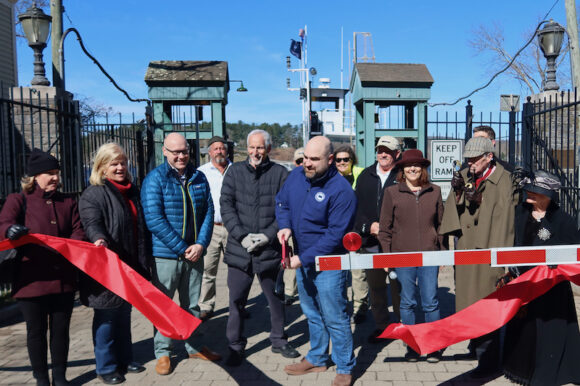
A ribbon-cutting was held April 2 to celebrate the inaugural trip of the Chester-Hadlyme Ferry’s 2023 season. The celebration was held at the entrance to the ferry in Hadlyme where Department of Transportation Commissioner Garrett Eucalitto (center) cut the ribbon. Looking on are (from left to right) State Rep. Christine A. Palm, (D-36th District); State Rep. Irene Haines, (R-34th District); State Rep. Devin Carney, R-23rd District); State Senator Norman Needleman, D-33rd District); Lynn Wilkinson, President of the Friends of Gillette Castle State Park, and Tyke and Theodora Niver (a.k.a. William and Helen Gillette).
HADLYME — During an April 2 celebration of the Chester-Hadlyme Ferry’s 253-year legacy of service on the Connecticut River, Department of Transportation (DOT) Commissioner Garrett Eucalitto cut a ribbon before welcoming new passengers aboard.
Attending the event were State Rep. Devin Carney, R-23rd, whose district includes Lyme and Old Lyme; State Rep. Christine A. Palm, (D-36th District); State Rep. Irene Haines, (R-34th District); District); Senator Norman Needleman, D-33rd District); Lynn Wilkinson, President of the Friends of Gillette Castle State Park, and Tyke and Theodora Niver (a.k.a. William and Helen Gillette).
The event was sponsored by the Friends of Gillette Castle State Park with refreshments from the Hadlyme Country Market.
The boat loaded first on the Chester side and then made its five-minute run east to the Hadlyme landing adjacent to the park, where members of the Friends of Gillette Castle State Park gathered to mingle with regional dignitaries.
Access to the western landing is on Rte. 148 at Ferry Road in Chester. The eastern landing is on park property at the base of Seventh Sister Hill, with a road and footpath leading up to the castle, the eccentric, century-old home of the late actor William Gillette.
The event included the portrayal of Gillette and his wife by Harold and Theodora Niver of Rocky Hill, who have portrayed the Gillettes at the castle for decades.
The park itself is in the towns of East Haddam and Lyme along the Connecticut River, and is open daily from 8 a.m. until sunset.
In addition to being a continuation of scenic Rte. 148, the initiation of ferry service is an important lifeline between Chester and Hadlyme, Lynn Wilkinson, president of the Friends of Gillette Castle State Park, noted.
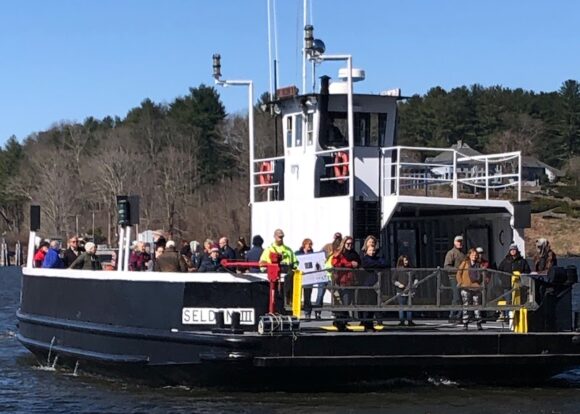
The 65-foot diesel-run Selden III crosses the Connecticut River filled with passengers enjoying the 2022 “First Ferry Celebration”. The Chester-Hadlyme Ferry is one of the oldest continuously-operating ferries in the United States.
“The ferry offers a wonderful alternative traffic route, and this year especially it will help ease the pressure of traffic during closures this year of the East Haddam Swing Bridge, which carries Rte. 82 over the Connecticut River,” Wilkinson said. “It also gives park visitors a really fun and ‘photo-friendly’ way to get to the castle.”
The bridge-rehabilitation project is expected to have no impact on the ferry’s operations or hours, according to John Kennedy, the ferry’s captain. The Connecticut DOT launched the project in 2022 to improve the swing-span operation’s reliability, extend its service life and improve the roadway. Completion is expected by late 2024.
A series of 63-hour road-closure periods are planned during which traffic will be detoured away from the bridge, according to a state-published pamphlet. Several closures are to take place this year, beginning at 8 p.m. Sundays and ending at 11 am. Wednesdays, except on holiday weekends.
Ferry passengers will be charged current rates to ride the 65-foot diesel-run Selden III, which include a walk-on charge of $2 to pedestrians and bicyclists, $5 for vehicles on weekdays and $6 for vehicles on weekends. A $3 commuter rate requires pre-purchased coupons priced in a book of 20 for $60.
Because the boat is a public conveyance, the ongoing COVID-19 pandemic may affect the boat’s capacity as well as safety precautions such as masking and social distancing while aboard the boat. Under normal conditions, the boat has a nine-vehicle capacity.
A book detailing the history of Connecticut ferries is available for purchase at the Gillette Castle souvenir shop.
The Chester-Hadlyme Ferry began service in 1769 as Warner’s Ferry, and is one of the oldest continuously operating ferries in the United States. It is also Connecticut’s second-oldest ferry service, after the Rocky Hill-Glastonbury Ferry, which began in 1655.
A steam-powered barge began to serve the ferry crossing in 1879 and was named the Chester-Hadlyme Ferry in 1882 while it was operated by the town of Chester. In 1917, the Connecticut Department of Transportation took over the service, and the current boat has been in operation since 1949.
The Friends of Gillette Castle State Park is a nonprofit, all-volunteer group dedicated to the preservation, conservation and educational activities of the building and its grounds. More information may be found at www.gillettecastlefriends.org.