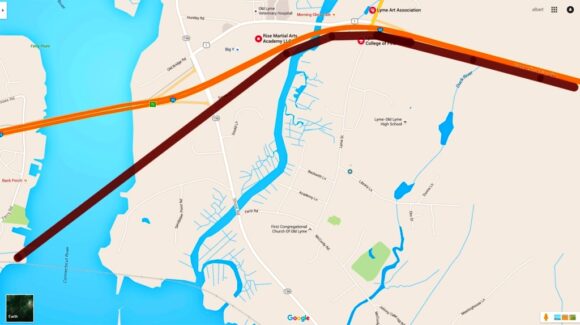
Op-Ed: Proposed Northeast Corridor High Speed Rail Route Cuts Through Old Lyme Historical District, Public Comment Now Extended to Feb. 16

Proposed routes for high speed rail track under Amtrak's Northeast Corridor modernization plans.

Proposed routes for high speed rail track under Amtrak’s Northeast Corridor modernization plans.

One month ago, with little fanfare, the Federal government announced a plan to modernize the Northeast Corridor by rerouting high-speed rail lines over a new bridge crossing the Connecticut River, across the saltwater marshes at the Lieutenant River and through the historical district of Old Lyme.

The plan appears so nonsensical, from a local perspective, that it is very easy to dismiss out of hand. It will never happen. A high-speed rail through our little town, the home of American Impressionism? A town so wonderful, in its own way, that from a local perspective we feel well-neigh untouchable.  It will never happen.

But then, I ask you, when did you first hear of the plan? And why not? Public comment was originally scheduled to close on January 31st. It has been extended two weeks until February 15th. After that, I am told, our leverage will be immeasurably weaker, and our task considerably more difficult and more lengthy. This odd silence should give us pause. Why haven’t we heard?

To be sure, this is a slow train. And it will take years of revision and appropriations, and very likely it will never happen in its entirety. But I urge you to look at the plan. It’s available for study and comment at www.necfuture.com. There is no doubt that at least part of this plan will happen. The Connecticut River crossing will be modernized. And the preferred alternative—there are three—will be chosen later this year. If Alternative 1 is chosen as the preferred option, even if it is later blocked, it will hang over our town for a decade, or more, promising destruction, lowering property values, troubling mortgages.

Yes, from a local perspective the plan is absurd, but the plan was not written from a local perspective. Alternative 1, the plan that most directly impacts Old Lyme, from the Federal—even on the state level—appears, on its face, the most sensible, the least expensive, the least impactful. In fact, if you look carefully through the footnotes, which discuss in detail the cultural and historical casualties, you will find that for the entire rail line from Boston to Washington, D.C. only one town is slated as a serious loss: Old Lyme. That should give us pause.

In fact, what concerns me most about Alternative 1, is just how sensible it appears, if you’ve never visited Lyme Street, or paddled down the Lieutenant or heard of the Old Lyme Art Colony.  One plan will be chosen. Let’s not make it easy for the politicians, the planners in Washington and Hartford.

Please contact our representatives at the Federal level, in particular, and submit public comment at http://www.necfuture.com/get_involved/ . We only have two weeks.

Dr. Gregory Stroud
Old Lyme, CT

Op-Ed: Thoughts on Old Lyme’s Wastewater Situation and Where Blame Lies

With my growing family, my wife and I moved to Old Lyme over 55 years ago.  Then it was another coastal town with a small, stable year-round population and a large vacationer transient group who came here to enjoy the Long Island Sound shoreline beaches for about 10 to 12 weeks in summertime.  Many of these visitors scheduled their time here to mesh with summer school vacations. Some owned cottages, others rented for a week or two, and others for the season.  These cottages were clustered to be within walking distance of The Sound.  The average family had but one car, which the husband took to work, and he would drive to the shore only on weekends.

One example of such a cluster of cottages in Old Lyme was aptly named White Sand Beach.  The sand was dug from borrow pits on Buttonball Road, about a mile inland from the shore.  It was fine, white, and free of clay or soil.  The developer of this community spread this sand on top of a salt-hay Spartina marsh.  Now, Spartina grass is nice to look at but doesn’t lend itself to beach recreation.

This beach community, and others like it, were frequently state chartered beach associations with enumerated powers and responsibilities.  The developer provided paved roads and summer potable water from upland wells.  Water delivery was limited to summer, and many pipelines were hardly buried or were not buried at all.  Winter freezing was not a problem since these pipelines were all drained annually when the summer season ended.  It didn’t matter since the occupants were gone and would not return until the following June.  This pattern repeated itself in several Old Lyme chartered beach associations.

Septic waste disposal was primitive in many instances.  Cottage house lots were rarely large enough to support a conventional septic tank and a leach field plus a reserve leach field.  Some were simply a punctured 55-gallon steel drum that then drained quickly into the ground.  Mother Nature sustained this insult for only 10 or 12 weeks a year, but as the years rolled by – new technologies and new lifestyles put new loads on the natural remediation processes.  Better roads, more autos, longer vacations, and disposal garbage grinders all contributed to additional loading on these already inadequate septic systems.

The thin layer of white sand over a mat of roots and dead Spartina grass and marsh muck is not the ideal soil for aerobic digestion of human waste.  Smells of anaerobic decomposition would come and go, and sometimes the wastewater would actually erupt on the ground around a cottage.

The beach communities limped along in part because there were no drinking water wells near these failing wastewater “systems”.   Remember, potable water was piped in.  Sanitarians knew how to correct the problems, but other forces were also in play.  In Old Lyme, our Registered Sanitarian, operating under the rules of the Connecticut State Health Code, and inhibited by rules from the State Department of Environmental Protection, had few legal tools to combat pollution.  One attempt was by stamping the land records with the words “Summer Use Only”, but after several years, a court found the procedure to be invalid.

As time went on, land values rose, and those summer cottages on postage stamp lots continued to be enlarged, and insulated, and heated, and occupied for longer and longer periods.

Concurrently, several other things were taking place.  The State Legislature that created a Department of Environmental Protection (DEP) gave them a blank check for jurisdiction over sewage treatment plants.  Also, they were granted power to regulate wastewater discharges of over 5,000 gallons per day.  The State Health Department retained its control over small flows, but they were restrained from any treatment except the passive septic tank-leach field arrangement.

Furthermore, the DEP also assumed powers over what they called “areas of special concern” and they thus claimed jurisdiction over a neighborhood. Also, they claimed jurisdiction over all wastewater treatment which employs modern technology.  The Health Department must restrict itself to the passive septic tank-leach field treatment.

Now both of our neighbor states, Rhode Island and Massachusetts, permit technology which by aeration and circulation, a home septic system could accommodate greater loads.  This may not be done in Connecticut according to the DEP (now renamed DEEP), even by a registered sanitarian whose work is supervised by a health director, and according to the published Health Code of our State Health Department.  This, it seems to me, is simply a turf war in Hartford for control and the desk in the corner office.  Registered Sanitarians, in both the DEEP and the Connecticut State Health Department, have the same qualifications and must pass the same examinations.

I believe that the drive to sewerize in Old Lyme is mostly from people and organizations that have motives far apart from economy and the environment but rather for power or money.  They should recuse themselves from decision-making since their views are tainted.

Take note also that several of the beach associations in Old Lyme are charted by the State Legislature, and the charters clearly state that these associations may, if they wish, control their wastewater.  However, this control would be at their expense.  This is not quite what sewer proponents are advocating.  They seem to want these projects to be town-wide and not at their expense.  Rather, they seem to expect the municipality, or the state or federal government, to expend tax revenues to correct the problems of their increasing usage of lots that were never intended for year-round occupancy.

I believe further that the DEEP is the fox in the henhouse, making and enforcing rules, with little or no supervision or oversight by the legislature.  For example, the State Health Department publishes a health code, but the DEEP has no comparable document.

If the DEEP is to dump its treated effluent from sewage treatment plants into our streams and rivers, that water should be pristine drinking water quality, and if it is pristine, then why is it not replaced into our aquifers or our ground waters?

Dilution is not the solution to pollution, and the DEEP is the culprit.

Op-Ed: Valley Warriors Need to Reconsider Outdated, Distressing Mascot

valley regional2I am a proud alum of Lyme-Old Lyme High School, class of 2010. I could not have asked for a better education or community. One of the most important experiences I had as a student there was my involvement in athletics. I enjoyed every moment of cross country that did not involve running, and during basketball games, I ensured that the team’s bench remained warm at all times. I also supported my friends in their athletic pursuits, especially those dedicated enough to travel to another school to play football for the Valley Regional Warriors. Having heard about their growing success, I’ve begun to follow along once more and I’m proud to see that some of the team’s best players are from LOLHS, some of whom I know from my time as a summer camp counselor in town. However, I was saddened to see that the image used for the mascot is an antiquated, stereotypical depiction of Native Americans.


The image used to represent the “warriors” is a red face with black hair and two loosely hanging feathers. It is, in my opinion, a highly problematic image. The image would be problematic anywhere, but it is particularly troubling given the region’s history of violence against native peoples. The Pequot War, the war that ensured colonial hegemony in Connecticut, culminated with the Mystic Massacre of 1637, during which colonists and their native allies attacked a Pequot village and shot or burned to death over 400 hundred men, women, and children. The attackers targeted the village after bypassing a stronghold of warriors, knowing that non-combatants would put up less of a fight. To misappropriate the imagery of that time period is a deeply uninformed way of grappling with our violent history.

This imagery also promotes a racialized view of American life. The idea that there is a race of “red” people is an idea that Euro-Americans constructed in the 18th and 19th centuries to justify campaigns of conquest and displacement. Far from being an ideology of the past, this racism is still very much alive and dangerous. Few people know that police kill Native American men at about the same rate as African American men. It has been encouraging to see the removal of imagery that glorifies the Confederacy and chattel slavery, and we must now remove symbols that trivialize the centuries-old abuses of native peoples. Only then can we begin to combat the caustic racism that continues to permeate our society.

Finally, using Native Americans as mascots promotes the myth of the “vanishing Indian.” This myth, which dates back to the early-19th century, contends that Native Americans died out in the course of American history, unable to adapt to new contexts or hold their lands. The myth could not be more wrong. Native peoples, who represent countless languages, cosmologies, and identities, have displayed remarkable resilience and have been intertwined in American life since the early-colonial period. Native peoples have shaped American politics, contributed to the American ethos, and served in our wars in greater proportion than any other population. And they have fought tenaciously to preserve their lands and cultures. While they lost a great deal under the onslaught of imperialism, and now grapple with the resulting poverty and trauma, they are proud of what they have maintained. I’ve travelled to numerous reservations—I recently returned from a month-long trip to the beautiful Standing Rock Reservation in North Dakota—and the people there work tirelessly to elevate their communities without losing sight of their heritage. They continue to fight, every day, to revitalize their languages and resist new forms of encroachment, such as the Keystone XL Pipeline. They’re not a novelty or a relic of the past. They are students and teachers and parents and artists, and they cannot be encapsulated by a picture of a red face and feathers.

I’m being oversensitive, you might say. Perhaps. The mascot debate is by no means our most important. But it’s a good place to start. So can we change the image used by Valley Regional’s football team? The important things—the lines on the field, the minutes in a half, the positive impact of playing on a team—will remain unchanged. This problematic image will be the only thing to go, and when it does, our boys will have even more to be proud of.

Editor’s Note: Michael McLean graduated from Lyme-Old Lyme High School in 2010.  He went on to obtain an undergraduate degree from Trinity College in 2014 and is currently studying for his PhD in American History at Boston College.  He is a contributor to the online history magazine, “We’re History” at http://werehistory.org.


Op-Ed: We Can All Help Protect Long Island Sound 

State Senator Paul Formica

State Senator Paul Formica

Water quality begins at the point of discharge, not in relocation of bottom materials from one location to another.  It is a very important distinction to make when talking about one of Connecticut’s most precious assets, Long Island Sound.

The U.S. Army Corps of Engineers recently released a draft Dredged Material Management Plan.  Digging up the material at the bottom of our waterways is critical to ensure public access and commerce.

This scientific plan is currently under public review.  It clearly shows open-water disposal to be the most cost effective and environmentally compatible method for getting rid of bottom material.  According to the Army Corps of Engineers, open-water placement for the majority of dredged material is the best way to protect Long Island Sound.

Why should Connecticut care?

Dredging is an economic necessity in maintaining access to and from the public waterways, harbors, rivers, coves and marinas. Consider the following about navigation-dependent activities:

  • They produce more than 55,000 jobs
  • They create $1.6 billion in federal and state tax revenues
  • They produce $9.4 billion of economic output in the Long Island Sound region
  • They generate $5.5 billion per year for the Long Island Sound Region’s State’s Gross Product

The Connecticut Department of Energy and Environmental Protection has stated their support for this plan.  It has taken ten years to complete.

What happens if no action is taken on this plan?

No action will result in skyrocketing dredging costs, the closure of Long Island Sound open-water placement locations within a year’s time, fewer maintained ports and harbors, and significant reduction in access – all of which will substantially impair the regional economy.

I urge everyone to join me in supporting this project and helping to protect this Connecticut jewel.

Public hearings will be held Wednesday, Sept. 16, and Thursday Sept.17, one in New York and one in Connecticut.  Please check my website for updates on where and when they will happen.

Your comments can make a difference.

You can read the plan by visiting www.nae.usace.army.mil/ or write to:

U.S. Army Corps of Engineers
New England District
ATTN: LIS DMMP/PEIS Program Manager Meghan Quinn
696 Virginia Road
Concord, MA 01742-2751

Editor’s Note: Senator Paul M. Formica is a member of the Energy and Technology Committee of the General Assembly.

Op-Ed: Connecticut’s Publicly-Funded Campaign System Is A Joke

Suzanne Bates

Suzanne Bates

Here’s one last poll I’d like to see the numbers for — how many Connecticut residents woke up Wednesday morning excited about four more years of Gov. Dannel P. Malloy?

Unfortunately for Republican candidate Tom Foley, it appears voters chose the devil they know (or is it the porcupine?) instead of the devil they didn’t know …

Click here to read the full article by Suzanne Bates, which was published Nov. 6 on one of our partner news websites, CTNewsJunkie.com.