Lyme’s Senior Center Reopens Slowly Under Carefully Phased Timeline

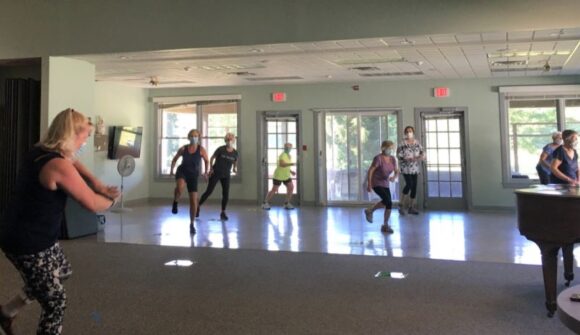
A limited number of in-person exercise classes are now being held at the Lymes’ Senior Center. Photo submitted.

OLD LYME — Lymes’ Senior Center is undergoing a carefully-planned phased opening with the safety of everyone at the Center paramount at all times. May and June were very successful months with a combination of outdoor programs, services, and entertainment offered.

One hundred and fifty five people visited the Center in person over the month of May and Stephanie Gould, Director of the Center, comments enthusiastically, ” It has been great to see people enjoy the in-person programs and services again.”

She adds, “We also continue to offer virtual programs, in which approximately 500 people participated in May.”

Gould notes, “My hope in enacting the phased opening is that it will give people much-needed opportunities to see and be with each other all while keeping people safe.”

After conferring with other Senior Centers regarding their reopening plans and keeping in mind the Lymes’ Senior Center’s own building limitations, Gould explains, “After the 4th of July holiday, we moved to our next reopening phase by bringing certain programs and services that can be socially-distanced inside. Masks and preregistration continue to be required.”

By the end of July, air filters will have been installed in the remaining four heat pumps. At that point, the whole building will be serviced with air purifiers and Merv filters.

One change to the old policy is that if you are fully vaccinated, you will no longer be required to wear masks outside, although you always can do so if you wish.

Gould comments, “We hope to be targeting other, non-socially distanced programs to return indoors starting Aug. 9. Masks and preregistration will still be required. These programs will include cards, Wii, movies, and so forth.”

Meanwhile, larger entertainment events will still be held outside through the fall.

It is anticipated that in-person meals will return to the Center sometime this fall, possibly in September. The precise date of return will be determined by the Estuary Senior Center and the local Area Agency on Aging. Gould notes, “In the meantime, we are offering a few outdoor lunch opportunities in July and August to get people together, which will be held outside under the tent.”

Gould expressed her thanks to everyone for their patience, “… while we work to safely get our Senior Center back to the lively, happening place that it was pre-pandemic.”

Lyme Academy of Fine Arts Launches New Program of Study, Offers Classical Arts Education for Less Than $10K Per Year 

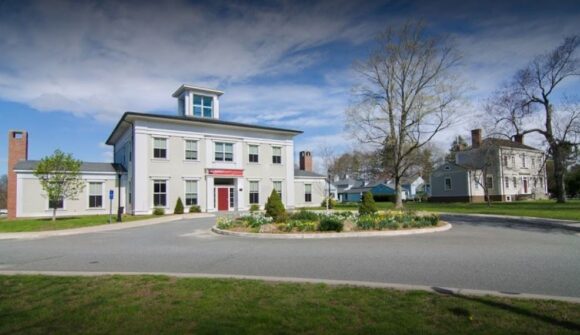
OLD LYME — The Lyme Academy of Fine Arts, pictured above, has launched its application drive for full-time students with a reimagined core program of study, which will commence in late September. Led by the  husband and wife team of Jordan Sokol and Amaya Gurpide, a dynamic new faculty of internationally-acclaimed instructors will teach students the foundational skills on which they can  build a career in the fine arts.

“We’re looking for students who really want to apply themselves and work hard to grow and develop” said Sokol, himself an accomplished painter, adding, “You’ve got to be willing to put in the thousands of hours required, if you are serious about developing your talent. There are no short-cuts.”

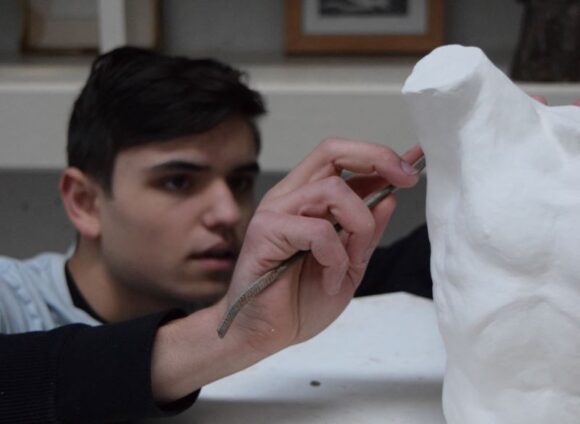
Jordan Sokol (right) and Amaya Gurpide are the new Artistic Director at Lyme Academy of Fine Arts.

It is expected that most students will study for three years, although some will pursue a shorter course of study and others longer, depending on their individual objectives and the progress they make developing their skills.  

Building on the momentum developed from a series of community programs that have energized the campus, the Academy’s Executive Director Mora Rowe, said, “We have stunning facilities in a magical setting that combines a great history with the future of figurative and representational arts.”

Due to the reorganization that has taken place at the Academy, it will no longer confer Bachelor’s degrees. In place of seat-time requirements for credit accumulation, students will instead focus on skill-building with an eye towards mastery.

The Executive Director of Lyme Academy of Fine Arts is Mora Rowe.

“As a result of this shift, we’ve been able to significantly reduce the Academy’s overhead costs and can offer a full-time course of study for under $10,000,” said Rowe. At a time when many are questioning the spiraling costs of higher education, students can now attend Lyme Academy and complete a course of study for less than the amount for a single year’s tuition when the institution conferred Bachelor of Fine Arts degrees. 

Founded in 1976 by the sculptor Elisabeth Gordon Chandler, the Academy was created as an institution dedicated to the traditional, skills-based education, first taught in the Renaissance academies of Europe and later at Paris’s École des Beaux-Arts.

In walking away from being a degree-granting institution, Lyme Academy has returned to its roots: at its founding and for many years thereafter, students were attracted to the Academy to learn skills, not to obtain a degree.

Chandler’s legacy continues in its new curriculum, which combines rigorous studio instruction in drawing and painting with anatomy, sculpture, and the histories of art. Integrated into this instructional framework is the progressive spirit of today’s Academy and a commitment to preparing its students for the 21st century art world. 

The Academy’s Core Program is comprehensive and intense: classes are conducted five days a week, from 9 a.m. until 9 p.m., with weekly supplementary instruction in anatomy, sculpture, and the histories of art. Landscape, still life, and portraiture are included in the program, as are dedicated explorations of the properties of light and form.

Students work in custom north-lit studios, honing their technical skills through the direct observation of imported  European plaster casts and live models. Intimate class sizes allow for in-studio demonstrations and individualized critiques, as well as guided museum and gallery visits.

Faculty and guest lectures are regularly scheduled, many of which are open to the public.

The camaraderie that is felt by students at the Academy is mirrored by the community outside the campus grounds. Located midway between Boston and New York, Old Lyme, Conn. has been a site of artistic congregation for over a century, recognized as the birthplace of the famed Lyme Art Colony and the ‘Home of American Impressionism.’ 

Editor’s Note: Enrollment for the 2021-2022 academic year is now open; applications are accepted on a rolling basis throughout the academic year. For further information about enrollment and how to apply, visit this link.

For further information about the Academy and its vibrant schedule of lectures, exhibitions, workshops, and part-time programs, and how to become an ‘Arts Insider,’ visit this link.

July 8 COVID-19 Update: Lyme, Old Lyme Both Report One New Confirmed Case; Lyme’ Cumulative Total Rises to 109, OL’s to 342

This map, updated July 8, 2021 shows the average daily rate of new cases of COVID-19 by town during the past two weeks. Both Lyme and Old Lyme are still in the (lowest) Gray Zone. (Only cases among persons living in community settings are included in this map; the map does not include cases among people who reside in nursing home, assisted living, or correctional facilities.) Map: Ver 12.1.2020 Source: CT Department of Public Health Get the data Created with Datawrapper. Details in italics are the same for each of the maps included in this article.

LYME/OLD LYMEUPDATED 11:40pm with LLHD latest data: The Daily Data Report for Connecticut issued Thursday, July 8, by the Connecticut Department of Public Health  (CT-DPH) for data as at 8:30 p.m. Wednesday, July 7, shows that both Lyme and Old Lyme have each reported one new confirmed COVID-19 case. This takes Old Lyme’s cumulative total of confirmed cases to 342 and Lyme’s to 109.

The report issued Thursday, July 8, by the Connecticut Department of Public Health (CT DPH) for the average daily rate of new cases of COVID-19 by town during the past two weeks (see map above) shows another improvement for the state as a whole over the previous week’s report with the number of towns in the Yellow Zone (indicating the lowest but one rate of COVID-19 new cases) reducing from two to one.

Last week Marlborough and Prospect were in the Yellow Zone; this week, the sole town in the Yellow Zone is New Hartford.

All the remaining 168 towns in Connecticut, including Lyme and Old Lyme, are in the Gray (lowest rate) Zone for two-week new case rates. It is the ninth week in succession for Old Lyme in that Zone, while Lyme is in the Gray Zone for a 17th straight week.

  • The Gray category is defined as when the Average Daily Rate of COVID-19 Cases Among Persons Living in Community Settings per 100,000 Population By Town is less than five or less than five reported cases.
  • The Yellow category is defined as when the Average Daily Rate of COVID-19 Cases Among Persons Living in Community Settings per 100,000 Population By Town is between five and nine reported cases.
  • The Orange category is defined as when the Average Daily Rate of COVID-19 Cases Among Persons Living in Community Settings per 100,000 Population By Town is between 10 and 14.
  • The Red category is defined as when the Average Daily Rate of COVID-19 Cases Among Persons Living in Community Settings per 100,000 Population By Town exceeds 15.

In all cases, this rate does not include cases or tests among residents of nursing home, assisted living, or correctional facilities.

The map below is from July 1, when Marlborough and Prospect were in the Yellow Zone.

This map, updated July 1, 2021 shows the average daily rate of new cases of COVID-19 by town during the past two weeks. Both Lyme and Old Lyme are still in the (lowest) Gray Zone.

The map below is from June 24, when Somers, Prospect and Bolton were in the Yellow Zone.

This map, updated June 24, shows the average daily rate of new cases of COVID-19 by town during the past two weeks. Both Lyme and Old Lyme are still in the (lowest) Gray Zone.

This is the June 17 map, when just one town, Bolton, was in the Yellow Zone.

This map, updated June 17, shows the average daily rate of new cases of COVID-19 by town during the past two weeks. Both Lyme and Old Lyme are still in the (lowest) Gray Zone.

For comparison, the map below is from June 3 and shows one town, Waterbury, in the Orange Zone and 21 towns in the Yellow Zone, down from 48 the previous week. The towns in the Yellow Zone were: Ansonia, Beacon Falls, Bloomfield, Brooklyn, Coventry, Cromwell, Derby, East Hartford, East Haven, Granby, Hamden, Hartford, Manchester, New Britain, New Haven, New London, Putnam, Rocky Hill, Shelton, Waterford and Windsor.

This map, updated June 3, shows the average daily rate of new cases of COVID-19 by town during the previous two weeks. Both Lyme and Old Lyme are in the (lowest) Gray Zone.

Below is the map from May 27 that showed one town in the Red Zone, Putnam, and 10 towns in the Orange Zone.

This map, updated May 27, shows the average daily rate of new cases of COVID-19 by town during the past two weeks. Both Lyme and Old Lyme were still in the (lowest) Gray Zone.

Compare the maps above with the one we published Dec. 18, 2020 to see the remarkable progress that has been made with controlling the spread of the virus through expansion of vaccination rates and improved mitigation strategies.
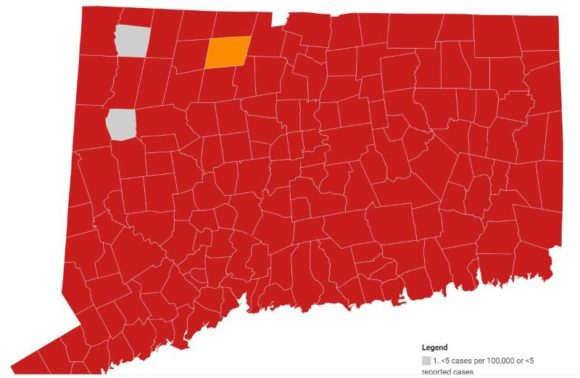
Map of Connecticut dated Dec. 17, 2020 showing both Lyme and Old Lyme now in the CT DPH-identified ‘Red Zone.’ This is defined as when the Average Daily Rate of COVID-19 Cases Among Persons Living in Community Settings per 100,000 Population By Town is over 15.

On July 9, Ledge Light Health District (LLHD) issued their latest weekly report of COVID data for the municipalities within their District. LLHD also announced this will be the final week that this report will be issued.

Seven towns in the nine-town district (which includes Lyme and Old Lyme) now report less than five new cases in the past two weeks. Both Groton and New London reported six cases apiece. Last week, all nine  towns reported less than five new cases in the past two weeks..

Ledge Light Director of Health Stephen Mansfield prefaces the report with the comment, “We are happy to see low numbers throughout our jurisdiction, and encourage everyone to get vaccinated!”

He adds, “Information regarding vaccination opportunities and other relevant information can be found at https://llhd.org/coronavirus-covid-19-situation/covid-19-vaccine/

The following link provides centralized access to Connecticut COVID data: https://data.ct.gov/stories/s/COVID-19-data/wa3g-tfvc/

Vaccination rates in Lyme and Old Lyme are also extremely encouraging with 81.52 percent of the population in Lyme having received at least one dose of the COVID-19 vaccine and the equivalent number for Old Lyme being 73.21 percent.

Percentages for the fully vaccinated are 77.98 for Lyme and 69.24 for Old Lyme.

These rates remain among the higher percentages in the state.
Reading Uncertainly: ‘Table of Contents’ by John McPhee

‘Bear’ with me: this review is the result of strange circumstances.

In mid-April I received an email from some Lyme neighbors, announcing a new resident with a photograph – a black bear strolling unceremoniously along Ely’s Ferry Road. As it happened, I had just started a re-read of one of my favorite authors, John McPhee, and his 1985 series of essays.

The very first two described the growing advent of black bears into eastern Pennsylvania and northern New Jersey, and the second the efforts of a New Jersey biologist and bear-trapper, Patricia McConnell, at work in her home state.

Black bears are curious, vegetarian, nocturnal creatures, as interested in human beings as we are instinctively afraid of them. What I learned in McPhee’s essays made me wish I was still living in Lyme!

But black bears are also cavorting up here in Massachusetts — my physical therapist reported one in her family’s back yard just a few days ago. How interconnected we are!

McPhee’s essays continue with a lengthy dissertation on the growing interest in doctors becoming “General Practitioners” (GP’s), as he relates their efforts, travails, and joys in the northern extremes of the State of Maine. He extols the “omniscient, ubiquitous” GP as a real aberration in the growing specialization of taking care of us fragile human beings.

He determines that the greatest skill of the GP is a willingness to sit and listen to our stories of our ills and ourselves. How many docs these days really sit and listen?

McPhee then moves quickly to a story of following ex-Senator Bill Bradley in a campaign stroll along seaside towns on the Jersey Shore. In it he displays his unique capability of describing what each person is wearing, from hat to shoes, as well as distinctive facial expressions. “He wears a blue-and-white striped shirt with a button-down collar. His tie is brown and has small New Jerseys all over it like sea horses.” It is a perfect, yet brief, follow-up to his best-seller, A Sense of Where You Are”.

Another essay relates the growth of “mini-hydros”, the resurrection of eroded old dams, their waterways and ancient turbines to take advantage of new legislation requiring power companies to buy small bits of electricity produced by these revived facilities. Again, curious and ambitious entrepreneurs willing to take a chance. And risk their modest funds.

And finally, the author’s last essay describes his meeting, and working with a Northern Maine bush pilot, named, of all things, John McPhee (better known as Jack.)

As the author explains, “ There is a lot of identification, even transformation, in the work I do – moving along from place to place, person to person, as a reporter, a writer, repeatedly trying to sense another existence and in some ways to share it.” What an extraordinary thing to meet a State of Maine Bush Pilot with your name!

If you’ve seen a black bear recently, do read John McPhee. With the continuing chaos in the daily news, reading this author is a distinct relief.

Editor’s Note: ‘Table of Contents’ by John McPhee was published 1985 by Farrar, Straus & Giroux, New York. 

Felix Kloman

About the Author: Felix Kloman is a sailor, rower, husband, father, grandfather, retired management consultant and, above all, a curious reader and writer. He’s explored how we as human beings and organizations respond to ever-present uncertainty in two books, ‘Mumpsimus Revisited’ (2005) and ‘The Fantods of Risk’ (2008). A 20-year former resident of Lyme, Conn., he now lives in Peabody, Mass. He writes book reviews, mostly of non-fiction, a subject which explores our minds, our behavior, our politics and our history, but he does throw in a novel here and there. For more than 50 years, he’s put together the 17 syllables that comprise haiku, the traditional Japanese poetry, and served faithfully as the self-appointed “poet laureate” of Ashlawn Farm Coffee. His late wife, Ann, was also a writer, but of mystery novels, all of which begin in a village in midcoast Maine, strangely reminiscent of the town she and her husband visited every summer.

Barry Scores Her First Ever Hole-in-One, Success Achieved at Old Lyme Country Club

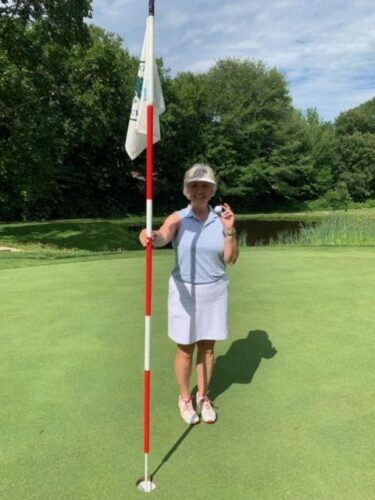
Hollis Barry, Co-Chairperson Old Lyme Country Club Women’s Golf League, scored a hole-in-one at the club on July 1.

OLD LYME — During Thursday Women’s League Play on July 1, Hollis Barry of Essex, Conn., scored a hole-in-one on the 3rd hole. Barry is co-chairperson of the Old Lyme Country Club Women’s Golf League (OLCC WGA.)

Barry’s drive on the par three hole landed on the green and rolled into the cup.  This was her first hole-in-one.

With a 16.5 handicap, Hollis has been a life-long golfer. As the new co-chairperson, Barry has advocated for making the OLCC WGA a program that fosters friendships and promotes women’s golf as a relaxing and fun activity for all levels of players.  She encourages healthy competition and the learning of all aspects of the game.