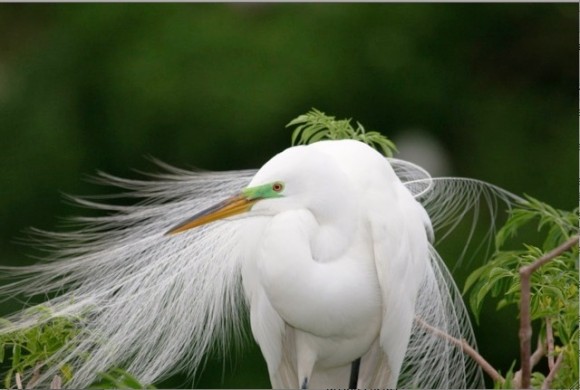
Spring is the time to plan for summer gardens.
Those March winds shall blow and we shall have snow and what will the Robin do then poor thing?
He’ll hide in the barn and keep himself warm and hide his head under his wing.

Maureen Haseley-Jones is “The English Lady.”
March is a month of ‘wait and see’ as we anticipate walking around our gardens. This morning I walked outside, into a westerly breeze and a pleasantly warm sun. I took a deep breath and as I did, I caught the rich fragrance of the soil beginning to awaken.
All of us are itching to get into the garden and I believe that foray will be earlier than last year due to the fact that frost did not penetrate deep into the ground this past winter.
The sodden soil will dry out in the next few weeks but I urge you to tread gently as you tend the soil, our precious commodity of Mother Nature. In that regard I am asking that you do not till the soil as tilling damages soil structure and can break friable root systems.
I am asking you to be patient right now especially in the aftermath of so many long months of the pandemic. I know you are chafing at the bit to get your hands into the soil, however, in the meantime, I suggest you continue planning for the upcoming season. Planning means organizing, which prevents gardening mistakes that can occur if you do not plan.
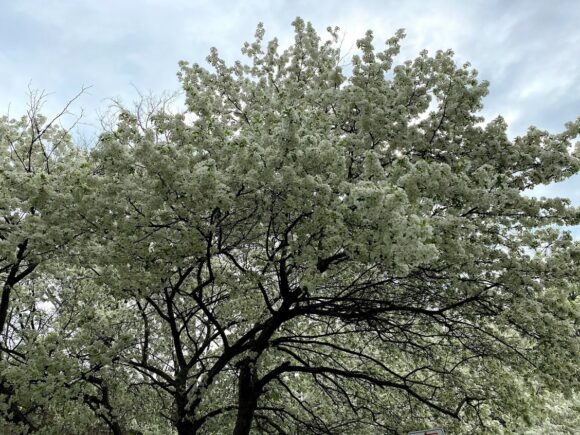
Spring is also a time to think about trees.
When you go outdoors, I suggest you check the trees in your garden to decide what might need pruning, which limbs need to be removed or the canopy lifted to allow more sunshine into the garden. It is less expensive and takes less time for arborists to do the tree work before the foliage appears when the branches and the overall shape of the trees can be seen more clearly.
What to look for:
- Are there broken or dead limbs?
- What branches require cabling?
- If a tree appears to be 50% dead, then it should be removed.
- A medium shade area can be changed to a dappled shade area, allowing more sunlight in by thinning out the upper tree branches or tree canopy.
Perhaps you would like a tree removed to transform a shade area to a sunny spot which allows for a larger choice of plants available to you.
I always hesitate to remove a healthy tree but sometimes a tree may have been planted too close to the house and consequently the roots have undermined your home’s foundation and the shading over the roof has resulted in mold and mildew. If you need any of the above work to be done, please contact a licensed arborist.
There is an art to tree work knowing how, when and why to cut. Work on the trees should to be carried out by a professional so that at the completion of the work, the effect is both practical and aesthetically pleasing. An experienced arborist will also take into consideration the health of the trees. Having the work done by an arborist also avoids injury to yourself from falling from ladders or perhaps tree branches or trees falling on you.

Spring is a time to prune.
PRUNING – tasks that you can accomplish now.
March is the month to prune evergreens before the new growth appears.
Hedges can be sheared for shape, so that any stubby ends will be concealed by new spring growth. Please keep to the natural shape of the shrub – no round balls.
Prune Spirea to six inches from the ground.
In April, prune Lavender to three inches.
In late March, prune Sweet Pepper Bush (Clethra), cutting out the oldest branches.
Lilac – Prune back all old branches to various lengths before leaf growth begins, from two to five feet, retaining a natural shape. Sprinkle lime around the base of the Lilac and add manure in May. Lilacs enjoy alkaline soil receiving benefit from lime.
Prune Butterfly bushes to two feet from the ground and in May apply composted manure around the base.
Prune Forsythia after it has bloomed, pruning out sparse flowering old wood.
Prune roses when the forsythia blooms. If the roses have only been in the ground for one year, do not prune, wait until October.
Do not remove the protective mulch from around the base of the roses, wait until mid May, and then apply a dressing of manure and fine bark mulch.
You may be asking, ‘Why wait until May to apply manure’ The answer is that the soil needs to warm up to 55 degrees otherwise the nutrient benefits of the manure bacteria that works with plant roots and soil organisms are not activated. I suggest you invest in an inexpensive soil thermometer to check the soil temperature. At soil temperature of 55 degrees, apply a three to four- inch layer of composted manure.
When April arrives, carefully begin to clear away winter debris, treading carefully on the soil to avoid damaging soil structure and friable root systems. When you have cleared away the debris, make a clean edge to the borders with a sharp spade; this makes such a difference to the look of your garden.
The best tool to use is a sharpened lawn edger, the blade is a half circle 9 inches wide and 4.5 inches deep with a flat top – this tool creates a deep edge. Face the bed and thrust the edger down to its full depth and push the cut soil into the bed. Continue along and then remove the spade and surplus clumps of soil and grass.
Edging was one of the first lessons I was taught at our family nursery in England; my great-grandfather was a strict taskmaster standing over me for quite a few days until I got the edging correct.
If you are contemplating the location of a new planting bed or expanding an existing one, here are some tips:
- Think in terms of where you spend your leisure time outdoors, and where you can sit in close proximity to the new bed in order to enjoy the bloom, fragrance and structure of your plantings.
- From indoors are you able to view and enjoy the new border?
- Is it an area where there will not be drainage problems, erosion concerns or water pooling?
- Is it convenient to tend and enjoy where you can place a bench or chair?
- Will you be able to water it with relative ease?
For an informal garden I prefer a curved bed – a curved line gives grace and fluidity. I lay out a garden hose in the desired shape and size of bed, adjust the hose until you are satisfied with the gentle curves.
As previously mentioned, the best tool to use to edge or cut out a new bed is a sharpened lawn edger, this tool creates a deep edge.
MANURE
Do not apply manure until the soil temperature has reached 55 degrees which is usually in May, but with a soil thermometer you can check earlier. Many of you who have been my radio listeners and lecture audiences know how I feel about that wonderful natural product. Manure is not a fertilizer – it builds soil structure, aids in drainage and its bacteria encourages the millions of soil animals below the surface to come alive and work with the manure bacteria to produce nutrients for the roots of the plants.

Types of manure:
- Poultry manure – I know the odor can be rather objectionable, however, this manure contains about 2% nitrogen, one of the highest levels in any manure. If you have access to poultry manure, allow it to age for two months and then add it to the garden.
- Horse manure is about .5% nitrogen. If you obtain horse manure from a stable, which has sawdust on its floors – it should be pretty weed free. What I have done in the past is obtain horse and cow manure from stables and farms in April. When you get it home, spread manure out in a flat area (not in a planting bed) then cover it with a tarp for a month. With this method, the tarp will suffocate the weed seeds and the sun on the tarp encourage the manures to continue to decompose. A week before using horse and cow manure remove the tarp to allow the sun to further decompose it.
- Cow manure is 0.25 % nitrogen and is the most available manure. If you get horse and cow manure from the farm, ask the farmer to give you manure from the bottom of the pile so that it is already partially decomposed.
- Compost pile – If you do not have a compost pile, maybe it could go on your list for this season. Vegetable waste from the kitchen plus grass clippings, and wood pruning can be added to the pile. The high temperature in the compost kills the weed seed and cooks all those other necessary ingredients. The ratio of compost and manure for your garden is 1 part compost to 3 parts manure – but if you do not have compost – manure will do the trick.
**DO NOT apply fresh manure to the garden, as it will burn the plants. If you do not have a source of manures from a farm, purchase composted manure in bags from the garden center.
To produce the best-planting environment, resulting in a soil that is ‘black gold’ apply 3 inches of composted manure to all planted areas in May, July and October.
Natural fine bark Mulch can be added later in May. Do not use buckwheat mulch as it flies everywhere. Do not, I repeat do not use cocoa mulch, which is poisonous to dogs and cats and please do not use the chemically colored red mulch. The benefits of natural fine bark mulch are that mulch helps to retain the beneficial moisture in the soil and aids to retard weeds as does Bradfield organics, a corn gluten weed pre- emergent.
THE HUMUS COMPONENT
I know I have written about the importance of the Humus component for the soil but I feel I must continue to stress this fact.
In 1937 Franklin D Roosevelt told us ‘that the nation that destroys its soil destroys itself.’
Unfortunately, America has not heeded that warning. Precious soils in this country and around the world are being destroyed by dangerous practices used in industrialized agriculture as well as poisonous chemicals, which completely disrupts our eco system and poisons all living things.
In your own garden you can build and retain a rich growing environment by building the Humus component -We are all carbon-based creatures as is all life on earth. Not only humans but also our soil microbes need carbon to flourish. To attract carbon from the atmosphere into your soil you need to build the humus component.
HOW TO BUILD THE HUMUS COMPONENT
Do not till soil – tilling breaks up soil structure.
Step 1 – Add composted manure three times – in spring when the soil has reached a temperature of 55 degrees. If the soil has not reached that temperature, the soil organisms are not able to work with the bacteria in the manure to produce nutrients for the roots of the plants.
This year, as we have not experienced deep frost therefore, the soil temperature may reach 55 degrees by the end of April or early May. Add the manure again in July to continue to nourish your growing plants and again in October to protect and nourish your plants and roots through winter. Manure is not a fertilizer; it builds soil structure and works with all the soil animals to keep a healthy disease- free growing environment.
Step 2 – Add wood chips in the form of brown fine bark mulch or wood chips that you produce from your garden; these are aged wood chips combined with leaves, twigs and branches.
These two major steps build the humus component. If you do this in your own garden – not only will you be helping to heal the planet but also produce the healthiest of gardens.
A question I am often asked is ‘Can I put manure over mulch for example in my July garden’? The answer is ‘Yes’ – the manure together with nature’s moisture and your own irrigation enables the manure to find its way easily into the soil and the roots of your plants.
WHAT EXACTLY DOES HUMUS DO?
Humus acts like a sponge and can hold 90% of its weight in water.
Because of its negative charge – plant nutrients stick to humus for nitrogen, calcium, phosphorus and minerals, which prevents these from washing away and acts as nature’s slow release fertilizer throughout the year.
Humus improves soil structure making it loose and friable, which helps plants to root in this soil to get better access to nutrients, water and oxygen.
Humus also helps ‘filter’ toxic chemicals from the soil, mulch like carbon-based water filtration systems filter toxins from your water.
We are not able to control industrialized agricultural practices – but in your own garden you can make a difference. Feed the soil and it will feed the plants.
Once again, I’m getting a little ahead of myself. So back to a cloudy day at the end of March, at this time you can gradually begin to remove protective covering from shrubs and small trees. In exposed garden areas, where wind is a problem, leave the covering on until mid April. Cold wind is more damaging and drying to plants than extreme cold and frost.
FROST HEAVE: If some perennials, trees and shrubs have heaved out of the ground, cover the roots with fresh topsoil or mulch until mid May when they can be settled back in place.
I just walked around the corner of my house to check on my trellis on the chimney where I have Roses and Clematis planted together. Roses and Clematis are a delightful combination in a companion planting. A companion planting indicates that the rose and the clematis planted together have the same growing needs, ‘feet in the shade and heads in the sun’. Each month beginning in May, add manure and mulch around the base of both. Discontinue feeding roses and clematis in mid August; this enables both plants to go into a necessary slow dormancy.
MOLES: To keep the mole population at a minimum in your garden; apply organic grub control once a month from March for two months; less grubs, less food for the moles. When you see signs of moles, find the mole holes and insert Exlax which contains Senna, an organic herb. The moles eat the exlax, become dehydrated from defecation and die. Apply organic pre-emergent crabgrass killers in March and April.
VOLES: Spread castor oil around the base of plants and keep mulch away from the base of the plants so that voles, which are canny little creatures are not able to hide there and gnaw on plants and roots.
DEADHEADING: Do not cut off the leaves of the crocus as they bloom; the leaves make food for the bulbs for next season’s bloom.
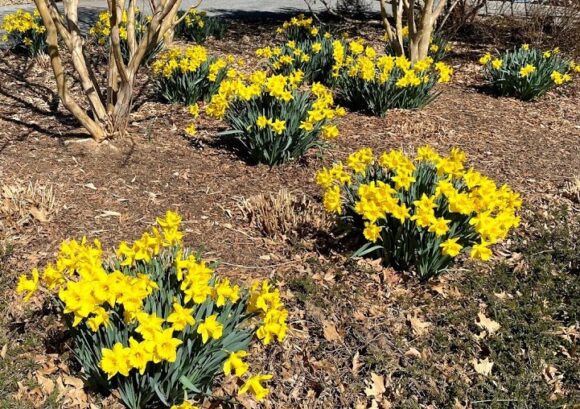
Spring has sprung!
DAFFODILS: When the green shoots emerge; spread composted manure around the plants.
DAFFODILS FOR DISPLAY INDOORS: The stems release a sap like “goop” that harms other flowers. Before adding Daffodils to an arrangement, cut the stems at an angle, and leave them in a vase half filled with lukewarm water for a couple of hours. Discard that water and add the Daffodils to the other flowers. If you recut the stems you will need to repeat the process. Change the water in the vase often.
PERENNIALS: In May when perennials are about four inches above soil level and when the soil is 55 degrees, apply composted manure around them to further encourage healthy growth.
DIVIDING PLANTS: At the end of April or beginning of May, you can divide late blooming perennials that have been in the ground for four years or more; these divisions encourage stronger bloom.
Discard the older, inner parts of the clumps and plant the new outside portions. Do not plant the new divisions any deeper than they were originally in the ground.
When dividing Irises – barely cover the root system so they do not fall over – if Irises are planted too deep they will not bloom.
PANSIES: pick the flowers regularly to encourage more bloom.
March is the time to plant the following seeds indoors: gaillardia, salvia, marigold, zinnia, petunia, snapdragon, stock and verbena. Before planting these seeds, soak seeds in warm water and plant them in sphagnum moss or coir. Coir is the outer shell or fiber of the Coconut, either of these two mediums prevents a disease called “damping off”, which can cause seeds to rot before germination.
Cover pots and seed trays with plastic wrap, to create a mini-greenhouse, which provides moisture which seeds need to germinate.
Note: Remove the plastic once the seeds have germinated, as the soil needs to drain and needs air circulation around the emerging stems.
If you are going away on business, or on vacation reapply the plastic wrap
over the pots and trays and prop some sticks or skewers in the corners. While you are away the seedlings will stay moist, make sure the seedlings do not come in contact with the plastic.
START tuberous begonias, and caladiums indoors.
DORMANT SPRING SPRAYING of fruit trees, flowering cherry, crabapple, hawthorn, mountain ash and lilac can be done before the leaf buds open.
Call in a professional company and request that they use only organic products.
Houseplants – repot them if they need repotting in April.

Geraniums are always a joy through the summer months. Photo by Annie Spratt on Unsplash.
GERANIUMS: The plants that you brought indoors at the end of last season check them for new side shoots appear, then cut them back to four inches and repot them in clean pots about and inch and a half larger with fresh potting soil.
Well, fellow gardeners I know you are getting excited to be in your gardens this season and I hope that these tips have given you plenty to think about to keep you busy for a while. Enjoy photo of lovely gardens that my son Ian and I have designed on Facebook and if you wish I suggest you contact Ian for a consultation and enjoy the photos on his website LandscapesbyIan.com.
Enjoy being outdoors in spring sunshine and I look forward to seeing you in your garden in April.
About the author: Maureen Haseley-Jones is a member of a family of renowned horticultural artisans, whose landscaping heritage dates back to the 17th century. She is one of the founders, together with her son Ian, of, The English Lady Landscape and Home Company. Maureen and Ian are landscape designers and garden experts, who believe that everyone deserves to live in an eco-conscious environment and enjoy the pleasure that it brings. Maureen learned her design skills from both her mother and grandmother, and honed her horticultural and construction skills while working in the family nursery and landscape business in the U.K. Her formal horticultural training was undertaken at the Royal Botanic Gardens at Kew in Surrey.


 1 pint cherry or grape tomatoes, halved