
Letter to the Editor: Halls Road Improvements Committee’s Proposals are ‘Extreme’, Zoning Should Keep Intensity, Scale of Plans ‘in Keeping with Rest of Town’

To the Editor:

The question of development on Halls Road is likely to come to a head at the continued public hearing scheduled for Thursday February 27th, 2025 at 6:30 at the Old Lyme Middle School.

The proposed guidelines for that development have been the subject of intense debate.

What began as the Halls Road Improvements committee more than 12 years ago has morphed into a proposed overlay District which allows up to 40 dwellings/acre – a quantum leap from installing sidewalks, lighting, greenery, and signage.

The Halls Road Committee has gone from uncontroversial to extreme, but now the public is catching on.

At the same time, the town of Old Lyme is paying lawyers $125,000 over 2 years to review and help rewrite the town’s entire set of Zoning rules …except Halls Road.

Why had the most contentious and crucial section of those rules, Halls Road, been excluded from consideration as part of this larger professional process, and one that will be guided by impartial questionnaires provided to all towns people?

As an alternate on the Zoning Commission, I have recused myself from voting on Halls Road, so that I can speak like any other townsperson.

The public has been told that the town’s Board of Selectmen are in favor of this redevelopment.  That is not the whole truth.  My wife Jude Read, a selectperson in Old Lyme, voted against the proposal long ago feeling it was too ambitious and far reaching and had lost sight of the original point of the Halls Road Improvements Committee: to make improvements.

The Halls Road Improvements Committee, by their own admission, have told the Zoning Commission that developers will be reluctant to invest if the town refuses to allow parking garages, and 60,000 sq’ buildings directly on Halls Road.

But why should we allow our town to be exploited by developers?

Many who have signed the petition against this effort at redevelopment are agreeable to responsible development.

The prudent response is for members of the Zoning Commission to include these ideas in the larger rewrite and revisions – at an intensity and scale in keeping with the rest of the town.

Sincerely,

Sloan Danenhower
Old Lyme, CT
Letter to the Editor: Nosal Says Proposed Upgrades to Old Lyme EOC Are Important, Necessary For Residents’ Safety

To the Editor:

This evening, at the Old Lyme Annual Town Business Meeting, there will be a presentation, followed by a vote, on proposed upgrades to our Emergency Operations Center (EOC).  After expected grants of over $900,000, which will cover most of the construction, furnishings, and IT, the town would be responsible for about $600,000 for the upgrades to our town asset at the Boughton Road Fire Station..

As a former town selectwoman, I have participated in numerous emergency drills and actual emergency events at the Boughton Road Fire House. I consider these communication and infrastructure upgrades important and necessary for the safety of our residents.  Additionally, these upgrades will enhance the required training of our volunteers who, for example, must practice decontamination drills in the event of an accident at Millstone.  Compared to other facilities I have seen, the EOC is cramped, and the limited space makes it difficult for personnel to efficiently manage the multitude of required tasks in an emergency event.  A centralized facility in any emergency provides direct, effective, and essential, communication to all emergency personnel and residents. 

I understand that emergencies requiring personnel to assemble at the EOC are infrequent, but if and when they arise, an effective operation center is absolutely critical.

Sincerely,

Mary Jo Nosal,
Old Lyme.

Letter to the Editor: Smith Neck Rd. Proposed House Poses ‘Serious Threat’ to ‘Natural Beauty’ of CT River Valley

To the Editor:

As residents of Old Lyme, we feel a strong responsibility to voice our concerns regarding a recent Special Permit application before the Zoning Commission for 43 Smiths Neck Road, which poses a serious threat to the natural beauty of our cherished Connecticut River Valley. After attending the public hearing, we identified two critical issues that were not addressed, further supporting the case for denying this application—issues the community should be aware of and take action on.

1. Inadequate Planning for Visual Impact

The applicant has failed to present any visual renditions illustrating how the proposed structure will appear in relation to its surroundings—particularly in relation to the neighboring home, located less than 11 yards away. This omission is especially concerning given the site’s pristine location at the mouth of the Back River, where it meets Long Island Sound.

We urge residents to visit the boat landing to envision the visual impact of two substantial homes—a new, massive build adjacent to an already large existing home—situated a mere 11 yards apart. The resulting juxtaposition of two overwhelming, obtrusive, and incongruously designed homes (“monstrous” is a more apt description) would be entirely out of character with the area’s natural charm.

Furthermore, the visual impact of these structures starkly contradicts the Connecticut River Gateway Commission’s mission “to preserve the aesthetic and ecological natural beauty of the lower Connecticut River valley for present and future generations.” Disregarding the Gateway Commission’s expert recommendation to reject the Special Permit application would establish a dangerous precedent, weakening the regulatory framework that safeguards our community and environment and opening the door to unchecked deviations from established zoning principles. The Gateway Commission and its mission were established in law by the Connecticut General Assembly in 1973, recognizing that “this river possesses unique scenic, ecological, scientific, and historic value contributing to public enjoyment, inspiration, and scientific study…that it is in the public interest…to preserve such values and to prevent deterioration of the natural and traditional river-way scene for the enjoyment of present and future generations.”

Allowing this development to proceed would violate the Gateway Commission’s mission and the principles it was founded to uphold. The construction of this new home—essentially positioned on top of an existing one—would irrevocably degrade the unique beauty of the marsh and the entire Back River as it flows into Long Island Sound.

2. Violation of Zoning Regulations

The proposal also conflicts with zoning regulations requiring structures to be built behind the natural crest of a hill to maintain the site’s topography. The applicant’s plans rely on substantial landfill to artificially alter the hill’s contours, concealing the fact that the proposed home’s river-facing wall extends at least 30 yards beyond the hill’s natural crest. Such actions contradict both the letter and the spirit of local zoning laws.

Preserving Our Community’s Legacy

If approved, this application would set a dangerous precedent, endorsing incongruous development that disregards zoning standards and the region’s natural beauty. We urge residents to join us in calling on the Zoning Commission to uphold the principles of responsible land use by denying this application. Together, we can protect the natural legacy we are privileged to enjoy and ensure its preservation for future generations.

Sincerely,

Susan and Thor Kayeum,
Old Lyme.

Letter to the Editor: Support Old Lyme Zoning Commission in Enforcing Regulations for Smith Neck House Plan, Reminder That a Hill is Still a Hill

To the Editor:

Over 100 people attended the OL Zoning Commission hearing on Monday evening. They frequently applauded the many speakers who disapproved of the proposed 11,000 square foot house proposed beside the Smith Neck Boat launch. Speakers described site violations of regulations, excessive water use and un-permitted clearcutting. The CT River Gateway Commission has recommended denial of the zoning application. Over many decades, Old Lyme residents have developed and agreed on our zoning regulations to protect the quality of our environment and the character of our towns.  

The Applicant’s architect asserted many surprising defenses as to why they should be allowed to build a house that does not comply with the zoning regulations. One main point was that the other houses in the neighborhood didn’t comply with the regulations but she forgot to add that the other houses were built in the 30’s before the regulations existed. 

Perhaps the Applicants most bizarre claim was that the requirement to locate the house behind the crest of the hill doesn’t apply. They actually asserted that the  property is not really on a hill, so there isn’t really a crest of the hill, because there can’t be a crest if there isn’t a hill. Anyone with two feet knows that there is a hill and a crest at the boat launch and this house must be located behind the crest according to the regulations. 

The hearing reinforced the need for town residents to support the CT River Gateway Commission denial and let the volunteers on the Zoning Commission know that we support them in enforcing our regulations. The hearing process for this Application is closed but Old Lyme’s need for regulatory clarity and compliance is not.  The Zoning Commission rules apply to everyone and failure to enforce them puts us all at risk of living in a community with unchecked development, with no hills. 

Sincerely,

Elizabeth Karter,
Old Lyme.

Letter to the Editor: Halls Rd. Overlay District on Agenda at Old Lyme Zoning Meeting; Residents Encouraged to Attend, Support Proposal

A Open Letter to the Residents of Old Lyme

To the Editor:

On Monday, January 13, 2025 at 6:30 pm in Memorial Town Hall, the Halls Road Improvements Committee of the Town of Old Lyme will present the Halls Road Overlay District (HROD) proposal in a public meeting of the Old Lyme Zoning Commission. Attorney William Sweeney will describe the details of this optional Overlay District and answer questions. 

The Planning Commission has unanimously agreed that the HROD proposal is consistent with the goals and standards set out for the Town in its latest Plan of Conservation and Development (2020). Now it is up to Zoning to approve, reject, or modify the proposal. 

The HROD is the centerpiece of the Halls Road Master Plan. Current commercial-only zoning does not allow the changes envisioned there. HROD creates the options needed to allow investors to help change the focus of Halls Road toward the needs of Old Lyme and not through travelers. 

This is an important public meeting, and a chance to show your support for a better future for Old Lyme. I urge you to come and be counted; bring your written thoughts to read and submit, make a statement for the record. We need your support to carry this important matter forward. 

Approval of this added flexibility in our zoning is a vital step in supporting the future prosperity and livability of Old Lyme.

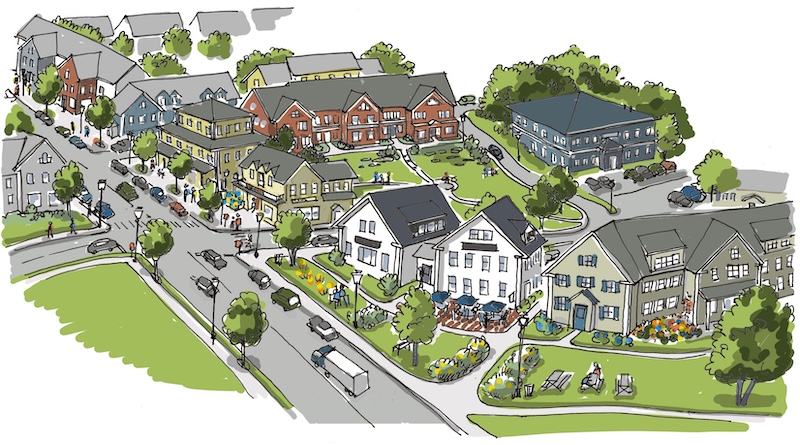
The image above shows a rendering of what the northwest segment of Halls Rd. might look like after the implementation of the proposed HROD. Image credit: Edie Twining.

Key Features of HROD are that it:

• Is totally optional; allows but does not require change to any property. 

• Keeps our shopping area vital and focused on Old Lyme, not the highway. 

• Creates options for much needed apartment/town-house-type housing. 

• Balances our housing stock without using up our remaining open land. 

• Promotes creation of a safe, walkable, bikeable, mixed-use town center. 

• Follows Design Review process guides development to be “like Old Lyme.” 

• Promotes significant new town revenues, reducing resident taxes. 

Thank you in advance for your help with this important issue. I look forward to seeing you there!

For more information on the project, visit this link.

Sincerely,

Edie Twining,
Old Lyme.

Editor’s Note: The author is the chair of Old Lyme’s Halls Road Improvements Committee.