
Commenting CLOSED on This Article: Nosal Again Urges Old Lyme Board of Selectmen to Sign Resolution on Racism, No Response Received

Old Lyme Selectwoman Mary Jo Nosal (File photo)

OLD LYME — NOTE: 1/27, The comments on this article are now closed.  At the Old Board of Selectmen’s (BOS) meeting held this past Tuesday, Jan. 19, Selectwoman Mary Jo Nosal again urged her fellow members on the board, First Selectman Timothy Griswold (R) and Selectman Christopher Kerr (R) to sign the Resolution Declaring Racism a Public Health Crisis, a draft of which is printed below for reference.

She had first raised the request at the Aug. 8, 2021 BOS meeting. It was not on the agenda at the Aug. 17 BOS meeting, but was discussed at the Sept. 8 BOS meeting and then again at the Sept. 22 BOS meeting.  Nosal raised the matter once more at both the Dec. 21 BOS meeting and the Jan. 4 BOS meeting.

Each time she was promised that Griswold and Kerr would review the resolution in more detail, but neither has offered any amendments to it to date.

Speaking under ‘Other Business,’ Nosal began by saying, “I am again acknowledging your fear, uncertainty, and uncomfortable feelings about racism existing in Old Lyme. I acknowledge your resistance to a substantive discussion on the Resolutions provided. I recognize that white privilege allows us to focus on the status quo and not look beyond Lyme St.”

She continued, “But it is unjust to ignore the many people who have spoken passionately in person to this board in favor of signing the Resolution, to the many who have written the board in support of the Resolution, to ignore CCM’s [Connecticut Conference of Municipalities] support of the Resolution, and to ignore our neighboring shoreline towns [Old Saybrook, Lyme, New London and New Haven] who have signed on to work towards justice.”

Concluding forcefully, she urged Griswold and Kerr to sign the Resolution, saying, “Tonight, I ask you to lead, to lead with love not fear, to do the right and the just thing. To stand up and do the work. Our world and our town need healing, more than ever.”

She ended with the words, “This is a good first step. Please sign.”

Neither Griswold nor Kerr responded and the meeting was adjourned a few minutes later.

***

The following is the original DRAFT Resolution that Nosal presented for discussion:

WHEREAS, racism is a social system with multiple dimensions: individual racism that is interpersonal and/or internalized or systemic racism that is institutional or structural, and is a system of structuring opportunity and assigning value based on the social interpretation of how one looks;

WHEREAS race is a social construct with no biological basis; 

WHEREAS racism unfairly disadvantages specific individuals and communities, while unfairly giving advantages to other individuals and communities, and saps the strength of the whole society through the waste of human resources; 

WHEREAS racism is a root cause of poverty and constricts economic mobility; 

WHEREAS racism causes persistent discrimination and disparate outcomes in many areas of life, including housing, education, employment, and criminal justice, and is itself a social determinant of health; 

WHEREAS racism and segregation have exacerbated a health divide resulting in people of color in Connecticut bearing a disproportionate burden of illness and mortality including COVID-19 infection and death, heart disease, diabetes, and infant mortality; 

WHEREAS Black, Native American, Asian and Latino residents are more likely to experience poor health outcomes as a consequence of inequities in economic stability, education, physical environment, food, and access to health care and these inequities are, themselves, a result of racism; 

WHEREAS more than 100 studies have linked racism to worse health outcomes; and 

WHEREAS the collective prosperity and wellbeing of TOWN depends upon equitable access to opportunity for every resident regardless of the color of their skin: 

Now, therefore, be it Resolved, that the TOWN Board of Selectmen

(1) Assert that racism is a public health crisis affecting our town and all of Connecticut; 

(2) Work to progress as an equity and justice-oriented organization, by continuing to identify specific activities to enhance diversity and to ensure antiracism principles across our leadership, staffing and contracting;

(3) Promote equity through all policies approved by the Board of Selectmen and enhance educational efforts aimed at understanding, addressing and dismantling racism and how it affects the delivery of human and social services, economic development and public safety;

(4) Improve the quality of the data our town collects and the analysis of that data—it is not enough to assume that an initiative is producing its intended outcome, qualitative and quantitative data should be used to assess inequities in impact and continuously improve;

(5) Continue to advocate locally for relevant policies that improve health in communities of color, and support local, state, regional, and federal initiatives that advance efforts to dismantle systemic racism;

(6) Further work to solidify alliances and partnerships with other organizations that are confronting racism and encourage other local, state, regional, and national entities to recognize racism as a public health crisis;

(7) Support community efforts to amplify issues of racism and engage actively and authentically with communities of color wherever they live; and

(8) Identify clear goals and objectives, including periodic reports to the Board of Selectmen, to assess progress and capitalize on opportunities to further advance racial equity.


Public Hearing for Old Lyme’s Planning Commission’s Conservation, Development Plan Draws Most Comments on Town’s Housing Needs

Old Lyme Planning Commission members and visitors participated in a virtual Public Hearing Thursday on the commission’s proposed Plan of Conservation & Development.

OLD LYME — Old Lyme Planning Commission Chairman Harold Thompson opened Thursday evening’s Public Hearing for the ‘Adoption of the 2020 Plan of Conservation & Development (POCD)’ by noting, “This has been a long road with some difficult times.” Adding that the Commission had held 15 workshops to discuss the document, which is published on the Town of Old Lyme website, he went on to detail the required timeline for gaining its approval in order to  submit it by the mandatory deadline to the state.

He then opened the virtual (the meeting was held via Webex) floor to comments from the public. First to speak was Halls Road Improvement Committee Chairman Edie Twining, who initially quoted from comments she had submitted in writing to the Commission prior to the meeting.

She stated, “The Halls Road Improvements Committee has initiated a Halls Road Plan which is currently being created by the BSC group. This is a significant, town-approved, and town-funded planning initiative that will guide any future development in the Halls Road Commercial area. The plan will include recommendations for significant capital investment by the town to create new sidewalks, bike paths, pedestrian lighting, and landscaping in the Halls Road area.”

Continuing, “It will provide studies on the market needs of this area, the infrastructure options, CT DOT constraints, and documentation of all existing conditions to provide recommendations for changes in zoning, uses, and design guidelines,” she added,  “This report will lay the groundwork to aid in maintaining our town’s commercial center with the introduction of mixed use.”

She then stressed, “In keeping with clearly expressed public sentiment, it will steer away from the current “strip center” aesthetic of 60’ setbacks. Instead it will promote a return to the original small town character of Old Lyme’s town center, as found on historic Lyme Street.”

Twining concluded her comments in her own words, “We feel the town’s 10-year Plan of Conservation and Development should include a reasonable discussion of the largest formal planning effort currently underway under the town’s auspices and at the town’s expense,” noting, “I have delivered an outline of specific pages where I see a need for changes in order to correctly represent the Halls Road Planning effort. I would like to request that these changes be included in your document.”

Finally she thanked the commission for their, “time and consideration of this work.”

Howard Margules, Old Lyme Economic Development Commission Chairman, then questioned whether the issue of blighted structures in the town should be included in the document. He also quoted from a general description of a strip mall, which Thompson agreed bore a strong resemblance to Halls Rd. Margules pointed out that it states in the POCD that strip malls are not permitted and therefore suggested there might be a “disconnect” in the report on that matter.

Margules further suggested the commission should confer with the new leadership at Lyme Academy to update information in the plan regarding the Academy and then concluded by saying how much he appreciated the commission’s work.

Thompson responded he had already had a lengthy phone conversation with Michael Duffy, the new board chair at the Academy.

Stephen Jungkeit, Senior Minister at the First Congregational Church of Old Lyme, thanked the planning commission for their work, adding, “This is a really well done report.” He said he wished to “affirm interest in [a variety of types of] housing,” which had been mentioned in the report, noting that, “from his vantage point,” this was a major issue in the town that he felt needed urgent attention. After noting that he hoped that the POCD represented, “… the beginning of a wider look at the issue,” he ended by saying simply, “I’m just saying thank you for that.”

Commission member Stephen Ross expressed the opinion, “that what would benefit the town a lot would be a broader survey of what the town needs in terms of housing.” Remarking that a house near his own on Shore Rd. had been vacant for one and a half years, he said, “We need to assess the actual demand [for housing] as opposed to the perceived demand.”

Twining responded that the HRIC was doing a “market study looking into some of those things,” and had reported that, “only one apartment was available in the whole town.”

Ross disputed that finding saying, “There’s a heck of a lot more than one apartment available,” noting that there was a need to look into all rentals.

Jungkeit suggested any survey should also include research into housing needs emanating from outside the town. Ross then stated, “It’s all about inventory.”

Margules agreed that “drilling down further into housing needs” would be beneficial, noting that, for example, the needs of seniors downsizing and young people moving into town “need to be addressed as well.”

The Public Hearing concluded with a unanimous vote to continue the hearing until Feb. 9.


Jan 15 COVID-19 Update: Cumulative Cases in Old Lyme Reach 211; Griswold Urges, ‘We Can’t Let Our Guard Down Now’

Old Lyme First Selectman Timothy Griswold

LYME/OLD LYME — Old Lyme’s COVID-19 case numbers increased by five in the report issued Friday afternoon (Jan. 15) by the Connecticut Department of Public Health (CT DPH) taking the cumulative total for the town since the pandemic began to 211.

On Friday, Jan. 8, the report issued by CT DPH that day gave Old Lyme’s cumulative total as 173, meaning that in the following week (1/8-1/15), 38 new cases were confirmed.

Lyme’s number was unchanged from the previous day, standing at a cumulative total of 66.

Asked his thoughts on the recent significant rise in COVID-19 cases in the town, Old Lyme First Selectman Timothy Griswold told LymeLine exclusively, “These troubling numbers are typical of what’s happening through the state and the country. The salient point is that we’ve been seeing it [the number of cases] gradually picking up, but now they’re really ramping up.”

He added, “You’ve had the holidays and now it’s incumbent on all of us to keep doing what we’re doing,” stressing, “We can’t let our guard down now.”

Referring to the expansion of the vaccine program, Griswold noted optimistically that with the combination of that and people continuing to be vigilant, “We can hopefully begin to get the curve down.”


Lyme Town Hall, Library Shift to By-Appointment Basis Only

Lyme Town Hall (pictured above) and Lyme Public Library will both move to an appointment-only basis, Dec. 28.

LYME — The Lyme Board of Selectmen announced Dec. 22 that since the number of COVID-19 cases in Lyme (then standing at 38 cases) continues to grow and neighboring towns are experiencing an accelerating rate of infection, the Lyme Town Hall and Library operations will move to a “by-appointment” basis only, starting Monday, Dec. 28.

In their announcement, the selectmen say they, “Anticipate that holiday gatherings will only add to the number of cases we may experience in the near future,” adding that they are taking these measures, “To protect our residents and employees.”

Staff will be available to assist residents, who email ahead of time for assistance. In-person service will not be available without an appointment.

The selectmen anticipate operating under this revised method until at least Jan. 19, 2021, and another announcement will be made when it is determined that in-person services can again be permitted.

The town garage, transfer station and recycling center will continue their present schedule for the foreseeable future. Opening hours for these facilities may be curtailed if, and when, the selectmen feel it may be warranted.

Email addresses for assistance are as follows:

Should other employees need to be contacted, email the First Selectman or the Town Clerk who will direct inquiries to the appropriate employee.

The selectmen’s announcement concludes, “We appreciate your patience as we deal with this spike in virus cases and thank you for your cooperation. We recognize that this may be an inconvenience and trust that you all will understand the need for these measures.”

Old Lyme Zoning Approves Lyme-Old Lyme Schools Proposal for Turf Field — With Conditions

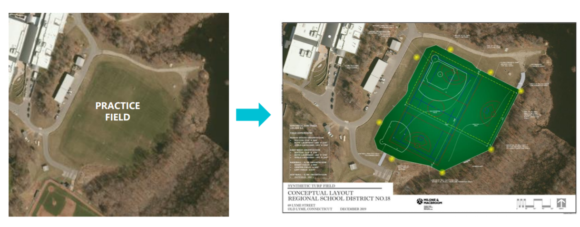
This image, courtesy of Milone & MacBroom, shows the current field behind Lyme-Old Lyme High School (left) and the proposed synthetic turf field (right.)

OLD LYME — At their regular monthly meeting held virtually last Monday, Dec. 14, Old Lyme’s Zoning Commission members unanimously approved Lyme-Old Lyme School’s Special Permit Application to “modify the playing geometry ” of the athletic field behind Lyme-Old Lyme High School and change the “playing surface from manicured lawn to synthetic turf.”

The motion to approve the application did, however, have one significant condition.

At the November meeting, commission members had requested that Tom Metcalf, the engineer for the Planning and Zoning Commission, should review the project plans and report back to them.

Commission Chair Paul Orzel was expecting Metcalf to be on the phone during the meeting but Metcalf was not present. Commission member Jane Marsh reminded Ozol that Metcalf had submitted a letter to the commission with details of his review.

Ozol then requested that Marsh should read the letter aloud for those present and everyone attending the meeting virtually.

Marsh noted that in the letter Metcalf stated he had reviewed a set of project plans prepared by Milone & MacBroom, Inc. and recently visited the site to view existing conditions. 

His comments read verbatim by Marsh were as follows:

  • Presumably the synthetic turf is a proprietary product. The project plans do not specify the synthetic turf type or manufacturer. Therefore, I assume the details associated with the synthetic turf and collector (drainage) pipe system shown on Sheet SD2 are compliant with the synthetic turf type and manufacturers requirements and specifications for the application proposed at the Lyme – Old Lyme High School. ] suggest the applicant confirm this. Additionally, it appears the Sheet SD2 details for the synthetic turf and collector pipe system are general in nature and do not provide sufficient information for construction/installation purposes. While perhaps not necessary for permitting purposes, Prior to construction, I suggest the applicant provide the Town with final construction plans and specifications for the project.
  • Similar to the synthetic turf installation, additional information for the turf stone grid pavers (detail on Sheet SD-2) should be included on final plans to facilitate construction.
  • Additional information and details for the French Drain System” should be included. The information and details should include elevations, materials and construction details to facilitate installation. Reference: Sheet UT. 
  • Although Grading Note 3 on Sheet GR and the existing conditions shown on Sheet EX acknowledges the presence of the existing geothermal well system within the project area, presumably the layout and design of the synthetic turf field and associated drainage have considered potential conflicts and impacts to these proposed improvements as well as to the existing geothermal well system. 
  • I recommend that the construction/installation of the synthetic turf and associated drainage be monitored/inspected by the design engineer to assure improvements are satisfactorily constructed. Additionally, I suggest that an asbuilt survey/plan (horizontal and vertical/elevation) be prepared of the drainage system to verify improvements have been constructed per design plans and for future reference. A copy of the as-built plan should be provided to the Land-Use Office.
  • Given the lengths/runs of the 12″ perforated collector (drainage) pipe (873 linear feet and 170 linear feet) and the inclusion of angle/bend points along the lengths/runs, consideration should be given to placing manholes and/or accessible cleanouts along the pipe length at critical locations to facilitate future maintenance.
  • I did not review the playing field(s) layouts, slope and dimensions or the associated fencing for the fields. I assume the field layouts and fencing were developed in conjunction with the school and meet their use needs.
  • An elevation bench mark should be included on the plans to facilitate construction.
  • To avoid any misunderstanding of the intent of final landscape plantings, you may want to confirm the size, type and number of shrubs. Reference: Sheet LA.
  • Presumably the 8 fiberglass hand-holes shown on Sheet LA are associated with the electrical conduits to be placed around the field perimeter as shown on Sheet UT.
  • Plan graphics of existing drainage pipes and flared end sections at the Detention Pond should be checked. (FES inv. = 7.6′ is outlet from pond through the pond berm; FES inv. = 7,4′ is outlet from pipe through pond berm). Reference: Sheet EX. Accordingly, the proposed 18″ HDPE outlet pipe from the manhole to the Detention Pond should include a flared end section or other suitable outlet type and suitable scour protection at the pipe outlet. Reference: Sheet UT.
  • Construction sequencing, procedures and timing is unclear. I suggest the plans include basic construction sequencing, procedures and timing information. In addition to facilitating construction, this information is necessary to assist with implementing temporary erosion control measures during construction.

Metcalf concluded by asking Old Lyme Land Use Coordinator Daniel Bourret to forward a copy of his letter to the design engineers Milone & MacBroom, Inc. and the Regional School District since he did not have their emails.

Bourret reported that he had not complied with that request since the Public Hearing was closed and rules prohibit the applicant from supplying more information after that point.

Marsh commented that in the past it has been permissible for the engineer to talk with Zoning staff in order to resolve outstanding issues. She then proposed that in this case, since the project had been under their review by the Zoning Commission for some time, that the commission should approve the project with the condition that all the requirements stated by Metcalf are met. Further, as part of her motion, she said Bourret would be required to ensure the condition were enforced.

The motion with the condition passed unanimously.