Op-Ed: Reject HROD—Don’t Compromise Old Lyme’s Identity: “Thoughtful, Transparent Planning” Needed

Editor’s Note: This op-ed was submitted by Old Lyme residents Jill and Russell Todd.

We write to express our deep concern regarding the Halls Road Overlay District (HROD) proposal recently presented to the [Old Lyme] Zoning Commission and the lack of public scrutiny and acceptance surrounding this plan.   

What was sold to the community as a charming, village-like vision has revealed itself to be a high-density urban blueprint that would fundamentally alter Old Lyme, replacing its historic rural character with the kind of overdevelopment seen along I-95. 

This is not just an interpretation; it is a direct reflection of the allowances in the proposal. A development of 40 units per acre, 200ft frontage buildings with even larger non-frontage buildings, and three-story  parking garages represents a significant shift towards a higher-density model that typically defines urban suburban areas.  

During the last Zoning Commission meeting, the Halls Road Improvement Committee (HRIC) justified these building parameters by claiming this level of density and scale is necessary to attract developers.  However, this change raises serious questions about the long-term vision for our town.  

When challenged by members of the Zoning Commission, the justification changed. Suddenly, the HRIC and their lawyer reassured us that “safeguards” were in place to prevent the very type of overdevelopment that the regulations explicitly permit. This assurance feels contradictory and alarming.  

These are our concerns about the safeguards mentioned: 

1. Zoning Approval will be a rubber stamp – Although zoning approval is necessary for individual  projects under the overlay, what real power will the Zoning Commission realistically hold if the regulations permit high-density residential developments, large-scale retail buildings, and parking garages? If the overlay is approved, developers will undoubtedly seek to take full advantage of its provisions, making it very challenging for the Zoning Commission to deny proposals that meet these criteria. 

2. Design Committee lacks credible oversight – The proposal calls for a pre-application process and establishes a three-person design committee to oversee design guidelines. However, the  committee’s composition, scope of authority, and accountability are unclear, leaving its role ambiguous. 

3. Septic Limitations are temporary – Traditional septic systems can create density constraints.  However, advancements in above-ground alternatives and continuously improving technology could increase septic capacity, thereby reducing this constraint. 

4. Parking Restrictions are gone – Parking, which used to be a significant limiting factor for development, has essentially been removed as a safeguard. Developers can now depend on parking garages to meet parking requirements.

None of these measures provide adequate safeguards against determined developers and their experienced legal teams, which could make high-density urban development in the primary artery of rural Old Lyme a reality. 

We attended many of the HRIC’s “open houses” over the years and came away with the impression that the verbal assurances and visual illustrations presented during those forums aligned with a vision of a  “village feel.” However, the current regulations outlined in the application bear little resemblance to that vision. With over 700 signatures (and counting) on a recent petition opposing this overlay, it’s clear we are not alone in our concerns. 

While we support the idea of responsible development along Halls Road, such development must align with the community’s shared vision and the character of Old Lyme. To ensure this alignment, we recommend the following:  

1. Comprehensive Review: A professional assessment should define appropriate size, scale, and density dimensions driven by the town’s needs, rather than developer imposed. Considerations  should include traffic flow, accessibility, septic system requirements, water usage, water runoff,  environmental impacts, and the overall aesthetics of the town as examples. 

2. Visual Confirmation: Create professional scaled plans and elevation renderings to clearly illustrate the potential impact of the proposed regulations across the entire overlay zone at maximum capacity. 

3. Community Engagement: At a minimum, a town-wide presentation should be held prior to any zoning changes, providing an opportunity for public questions and answers. Ideally, a zoning  change of this magnitude would be put to a vote and decided by the citizens.  

This is not about opposing progress; instead, it is about ensuring that any progress aligns with the community’s collective aspiration for a village-like community in keeping with Old Lyme. 

We urge the Board of Selectmen, Zoning Commission and all town leaders to listen to the growing concerns of Old Lyme residents and businesses and request the Zoning Commission reject the HROD proposal in its current form. The proposed overlay and the associated process need to be reevaluated to ensure they meet the community’s needs and values. Thoughtful, transparent planning and meaningful public engagement will facilitate development that enhances Halls Road without compromising Old Lyme’s identity.
Letter to the Editor: Halls Rd. Overlay District Will Allow Old Lyme to Remain a Small, But Walkable, Vibrant Community

To the Editor:

The Halls Road Overlay District Plan offers our community the opportunity to develop a small but vibrant town and community center. This area has been in urgent need of long-range planning & development and now we have it – after years of dedicated committee work, multiple surveys, community input sessions, and revisions in response to every conceivable authority.

Today, people are demanding mixed use because it provides convenience, flexibility, and a range of experiences within a smaller neighborhood. To reject this plan is to choose to maintain a 1950s approach to 21st century conditions, retaining a commercial district that is a relic of a time when enthusiasm for the automobile and suburban life put greater distances between people and their town centers.

Without at least the potential for a mixed-use, walkable town center where people can live, work and shop, our little shopping district will continue to limp along without the support that a mixed-use neighborhood provides for retail. There is no pedestrian traffic and no walk-in trade, which is the one remaining attraction for retail investment in the era of Amazon. Instead, new off-ramp convenience stores and franchises will continue to replace local merchants. 

I personally know several people whose professional and personal contribution to this community is unique and highly valued but who choose to live elsewhere because they cannot access the resources that are convenient for their young families and lifestyle here.

For some, the idea of any change to our beloved community is scary, indeed some appear to find it so threatening as to suggest nefarious and corrupt motives on the part of the planners. I urge you not to be influenced by those who harbor these irrational fears and suspicions. Without a plan that at least allows (does not require!) change that will make Old Lyme more attractive to younger families, single households and other individuals who want and need to live within walking distance of essential services, the aging and unattractive traffic strip that has become half of our town center will continue to be an embarrassment and a lost opportunity which will not come again in our lifetimes.

The Halls Road Overlay District plan now presents the Zoning Commission with an opportunity to choose: between the potential for a walkable town center where people can live, work, shop, and enjoy participation in a neighborhood and a community, or a Route 1 extension allowing drivers to speed quickly though and out of town, bordered by half-empty parking lots and decaying strip-malls where the only available new business options are gas stations and convenience stores.

I urge the Zoning Commission to make the right choice.

Sincerely,

Katy Klarnet,
Old Lyme.

Letter to the Editor: Halls Road Improvements Committee’s Proposals are ‘Extreme’, Zoning Should Keep Intensity, Scale of Plans ‘in Keeping with Rest of Town’

To the Editor:

The question of development on Halls Road is likely to come to a head at the continued public hearing scheduled for Thursday February 27th, 2025 at 6:30 at the Old Lyme Middle School.

The proposed guidelines for that development have been the subject of intense debate.

What began as the Halls Road Improvements committee more than 12 years ago has morphed into a proposed overlay District which allows up to 40 dwellings/acre – a quantum leap from installing sidewalks, lighting, greenery, and signage.

The Halls Road Committee has gone from uncontroversial to extreme, but now the public is catching on.

At the same time, the town of Old Lyme is paying lawyers $125,000 over 2 years to review and help rewrite the town’s entire set of Zoning rules …except Halls Road.

Why had the most contentious and crucial section of those rules, Halls Road, been excluded from consideration as part of this larger professional process, and one that will be guided by impartial questionnaires provided to all towns people?

As an alternate on the Zoning Commission, I have recused myself from voting on Halls Road, so that I can speak like any other townsperson.

The public has been told that the town’s Board of Selectmen are in favor of this redevelopment.  That is not the whole truth.  My wife Jude Read, a selectperson in Old Lyme, voted against the proposal long ago feeling it was too ambitious and far reaching and had lost sight of the original point of the Halls Road Improvements Committee: to make improvements.

The Halls Road Improvements Committee, by their own admission, have told the Zoning Commission that developers will be reluctant to invest if the town refuses to allow parking garages, and 60,000 sq’ buildings directly on Halls Road.

But why should we allow our town to be exploited by developers?

Many who have signed the petition against this effort at redevelopment are agreeable to responsible development.

The prudent response is for members of the Zoning Commission to include these ideas in the larger rewrite and revisions – at an intensity and scale in keeping with the rest of the town.

Sincerely,

Sloan Danenhower
Old Lyme, CT

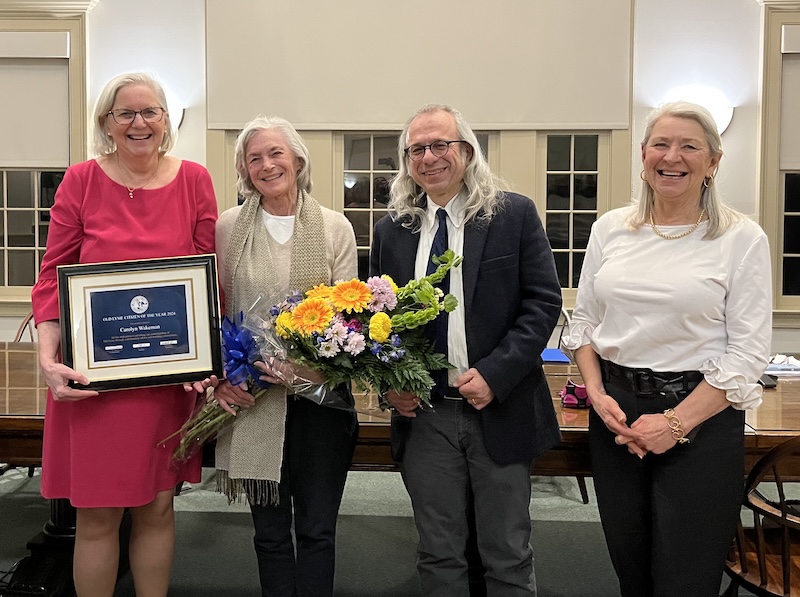
Carolyn Wakeman is Old Lyme’s 2024 Citizen of the Year!

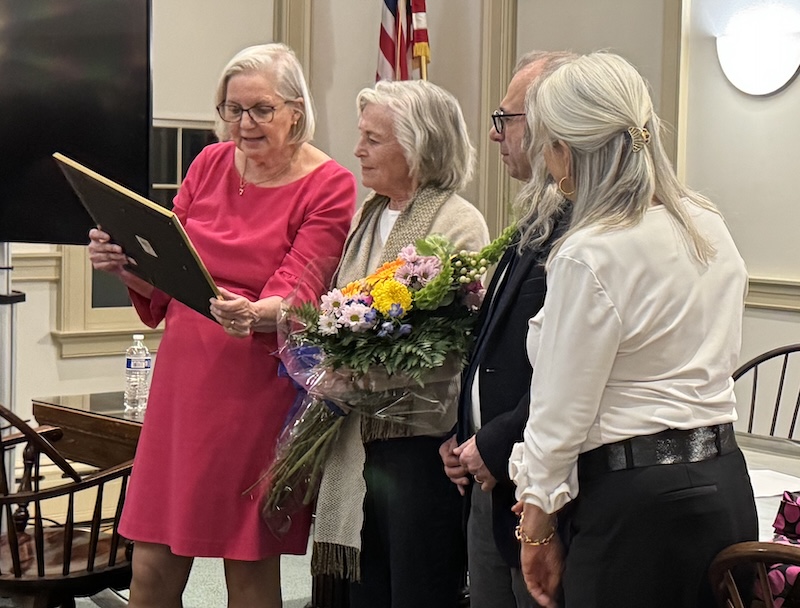
Tonight at Old Lyme’s Annual Town Business Meeting, Carolyn Wakeman, second from left, was named the Town’s 2024 Citizen of the Year. Old Lyme First Selectwoman Martha Shoemaker stands to Wakeman’s left, Selectman Jim Lampos to her right and Selectwoman Judith Read is at far right. Photo credit:Town of Old Lyme.

OLD LYME—At Monday evening’s Annual Town Business Meeting, Old Lyme First Selectwoman Martha Shoemaker announced Carolyn Wakeman as the Town’s 2024 Citizen of the Year.

Shoemaker introduced the eagerly anticipated announcement by saying, “This award, “Citizen of the Year,” is presented by the Town of Old Lyme to recognize someone who has gone above and beyond to improve the well-being of others and our community as a whole.  Our “Citizen of the Year” is an individual who has made significant contributions to our community through numerous hours of volunteer work and leadership.  This year’s recipient has demonstrated outstanding service in a multitude of areas: education, social justice, and the preservation of our town’s history. Their values of civic responsibility and community engagement are to be recognized.”

With the identity of the recipient still secret, Shoemaker continued, “When I contacted the people that nominated this year’s recipient, they reached out to others that they worked with, and a multitude of endorsing letters were sent to me.  These letters included many of the same descriptive words: passionate, a true treasure, dedicated, a hard worker, scholar, unwavering commitment, and gardener to name a few.”

Shoemaker then said, “Tonight, it is my honor to announce that those words describe the 2024 Old Lyme Citizen of the Year, Carolyn Wakeman.”

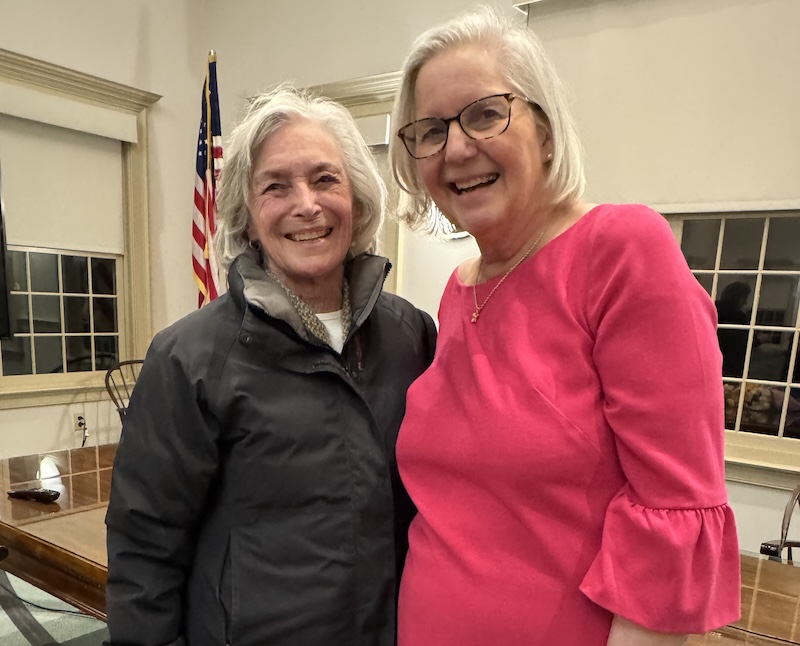
Old Lyme’s 2024 Citizen of the Year Carolyn Wakeman (left) stands with Old Lyme First Selectwoman Martha Shoemaker.

After an extremely surprised Wakeman (she had attended the event believing a friend was receiving the award) had joined Shoemaker at the front of the auditorium, Shoemaker continued, “Every good story has a strong beginning.  Ed Pinn who serves on the Historic District Commission with you informed me that you began your life here in Old Lyme.  He told me your father was once the Postmaster, that you graduated from high school here and then went on to have a distinguished career as a teacher and researcher.  Your research took you to China and then to the University of California/Berkeley, as a professor of journalism and East Asian Studies.  You returned home to Old Lyme in 2005 and Carolyn, we are so glad you did!”

Shoemaker added, “Some might say you came home to retire but your relentless energy was channeled into organizing not one, but several groups and organizations.  By the way, Carolyn did not just organize these groups, she led them.  John Noyes wrote, “She has developed ways for people to collaborate in important endeavors; she has helped create communities.”” 

Noting, “John [Noyes] spoke highly of your dedication to your historical work and the time and energy you commit to tracking original sources and documenting information.,” Shoemaker said, “This was echoed by Jeffrey Andersen, Former Director of the Florence Griswold Museum, who wrote of your idea for the museum to start a series of blog posts that would explore various aspects of the town’s past, using primary source documents in the Lyme Historical Society Archives.  Jeff [Andersen] noted that The History Blog became an indispensable resource for town residents, students, and scholars from near and far.  The Connecticut League of History Organizations awarded the History Blog an Award of Merit in 2013.” 

From left to right, Old Lyme First Selectwoman Martha Shoemaker, Old Lyme’s 2024 Citizen of the Year Carolyn Wakeman, Selectman Jim Lampos and Selectwoman Judith Read admire the framed citation of Wakeman’s award.

Another person who commended Wakeman’s work ethic was Amy Kurtz Lansing, Curator at the Florence Griswold Museum, who, according to Shoemaker, noted that Wakeman’s “tireless research in pursuit of hard truths has changed how she and others understand this town and its history.” Kurtz Lansing further commented that Wakeman, “Served not only as a Trustee but also as a member of several board committees at the museum … volunteer[ing] for 15 years in the Lyme Historical Society Archives, where you unearthed information about enslavement, and thus this became your next project, The Witness Stones Old Lyme.”

Shoemaker told Wakeman that, “… through the Witness Stones project you have provided middle school students with primary historical documents from which to learn about enslavement.  After their studies, these students write poems to commemorate some of the over 300 people of African and Native American descent who lived here in bondage and whose presence and labor shaped Old Lyme.  Amy also stated that you “courageously engage in dialogue with those of differing perspectives to move the project forward in the interest of truth and history.” 

Citing support for the award from Old Lyme’s Phoebe Griffin Noyes (PGN) Library Director Katie Huffman, Shoemaker quoted Huffman as saying about Wakeman, “It is a privilege to work directly with you on the project … Carolyn’s dedication to this project simply can’t be overstated. She’s known to be the historian of the project, and as such has contributed countless hours of research and expertise toward better understanding the lives of those who were enslaved in historic Lyme, but her skill as a collaborator and organizer are perhaps less well known.”  

Shoemaker explained that both Liz Frankel and Tim Griswold had shared their thoughts about working with Wakeman on multiple projects, saying, “They both note that in your role as Director of the Old Lyme Cemetery Association you have “been a visionary force.”  You have led the restoration of the ancient section of Duck River Cemetery and under your guidance an informative website and a digital burial database has been created. Liz and Tim both note that you have worked hard to improve the way the Board functions. You have made thoughtful revisions to the association’s bylaws, which have significantly strengthened the association and have encouraged fellow Board members to offer their opinions on how the operation of the eight [Old Lyme] cemeteries could be improved.”   

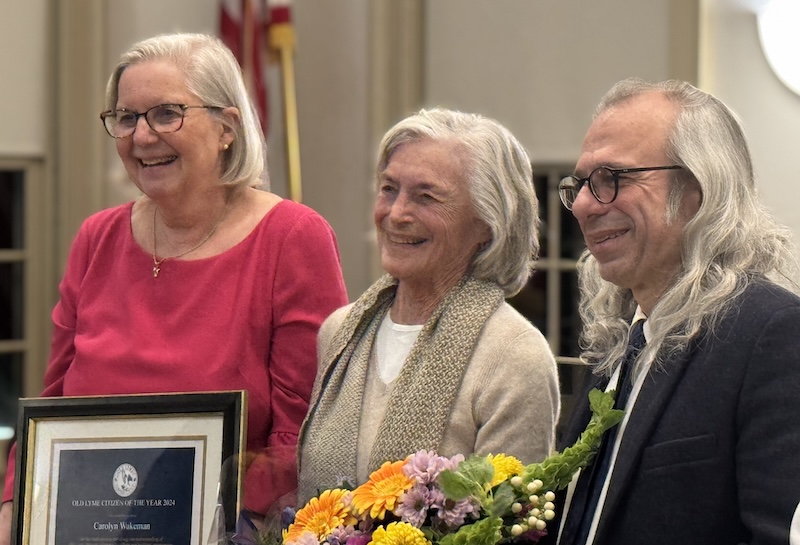
Old Lyme’s 2024 Citizen of the Year Carolyn Wakeman shares a celebratory smile with Old Lyme First Selectwoman Martha Shoemaker and Selectman Jim Lampos .

Tim Griswold also noted that Wakeman was, “An active participant in the seasonal cleaning, straightening and mending of grave markers in the “Ancient Section” of the Duck River Cemetery.  Dozens of volunteers come to the Cemetery to work under the supervision of a professional monument preservationist.”  Griswold stated, “Carolyn oversees these events and, on occasion, she has rewarded workers with a post-work wine and cheese treat.”

Shoemaker than listed some other accomplishments that are “noteworthy, as Old Lyme has benefited from all of them.” These include:

  • The history she pieced together provided an invaluable foundation for the 2025 Florence Griswold Museum exhibition “Their Kindred Earth: Photographs of William Earle Williams.” 
  • Her work to establish the presence of Black history here in Old Lyme also resulted in her organization of three Juneteenth Jazz and Poetry events in association with the Museum, with a fourth installment to take place this spring. 
  • Her leadership of the volunteer members of the Florence Griswold Museum’s Archives Interest Group, which explores local history through the museum’s document collections.
  • Undertaking exhibitions at the Museum related to Lyme’s early medical care and oceangoing families sharing archival materials with the public. 
  • Her collaborative work across local institutions including the First Congregational Church of Old Lyme, the Cemetery Association, the Old Lyme Historical Society, and the Historic District Commission.
  • As the researcher and author of The Charm of the Place: Old Lyme in the 1920s (published with the Old Lyme Historical Society) and Forgotten Voices: The Hidden History of a New England Meetinghouse (published with the First Congregational Church and Wesleyan University Press), Carolyn has provided anyone who loves Old Lyme—as she does—with a factual understanding of its past and how that history has shaped the town it is today. 
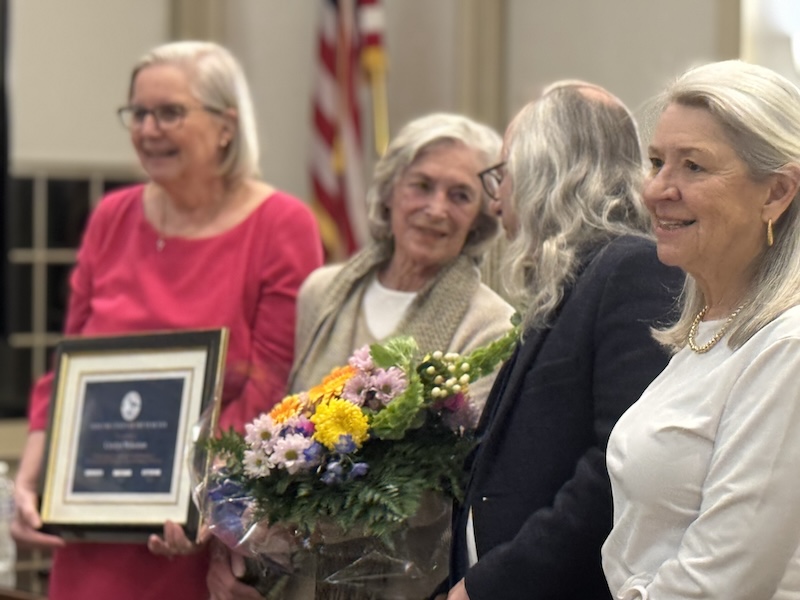
Old Lyme’s 2024 Citizen of the Year Carolyn Wakeman (second from left) exchanges a brief word with Selectman Jim Lampos during the post-award photography session.

Marcia McLean wrote, “Carolyn’s contributions to the Town of Old Lyme have not only enriched our understanding of Old Lyme’s past but have also educated us as we set a course for the town in the future.”  

Old Lyme PGN Library Director Huffman added that Wakeman has served, “To help the people of Old Lyme connect with, understand, and learn from its past to become a stronger, more thoughtful, and more compassionate community now, and in the days to come.”

Shoemaker concluded, “Carolyn, it is evident that you love Old Lyme and that is just one of the many reasons we are proud to name you as our 2024 Citizen of the Year.”

Wakeman was then presented with flowers and a proclamation declaring her as Old Lyme’s 2024 Citizen of the Year. 

Editor’s Note: We send hearty congratulations to Wakeman on this well-deserved honor.

Funding Unanimously Approved to Expand, Upgrade Old Lyme’s Emergency Operations Center

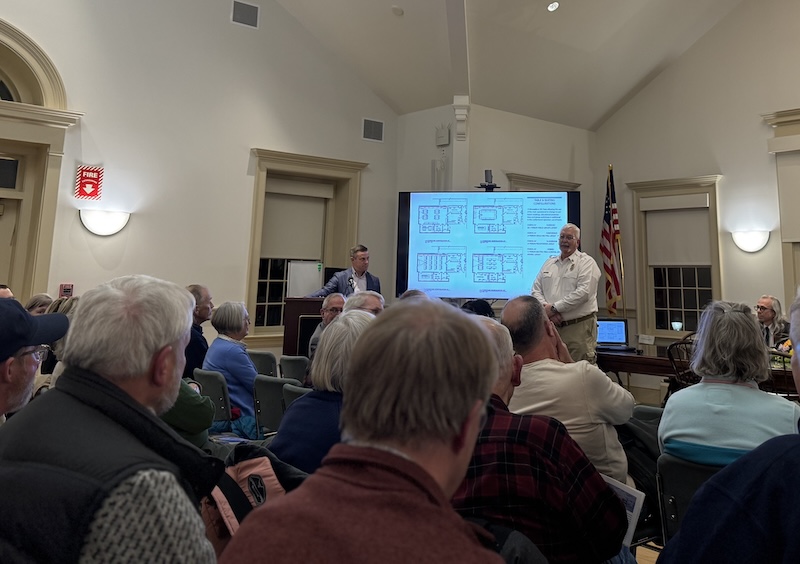
Old Lyme Emergency Services Director David Roberge gives a presentation at the Town’s Annual Business Meeting about the Emergency Operations Center Building Project.

OLD LYME—Around 100 people attended Monday evening’s Old Lyme Town Business Meeting when Emergency Services Director David Roberge gave a presentation about the Emergency Operations Center Building Project. The project involves expanding and upgrading the facility.

Subsequently, an appropriation in the amount of $1,522,170 for the total cost of the facility was approved unanimously by a voice vote. Grant funding is available totaling $912,950, which, if obtained, would reduce the net cost of the project to the town to $609,220.

Visit this link to read why the Old Lyme Fire Department supported the proposal.

Visit this link to read why OL’s First Selectwoman and First Selectman supported the proposal.

Visit this link to read a related Letter to the Editor.