Lyme-Old Lyme Troop 26 Boy Scouts Conquer ‘Swamp Base’ in Louisiana

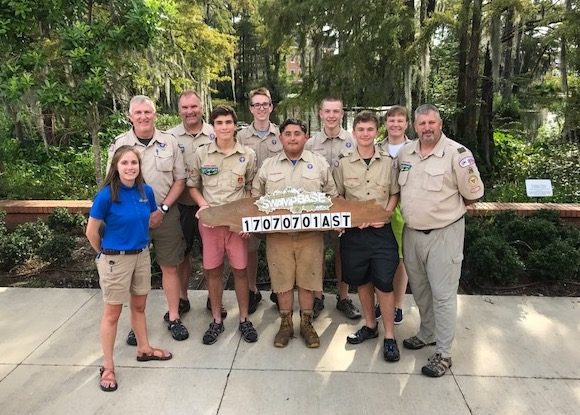
These intrepid Lyme-Old Lyme Troop 26 Boy Scouts and Scot Leaders attended ‘Swamp Base’ in July of this year. From left to right, (front row) Brooke Smith, Swampbase guide; Mike Miller, Theodore Wayland, Dennys Andrades, Maxwell Bauchmann, and Peter Bauchmann; (back row)  Mark Wayland, John Miller, Evan St. Louis, and Mary Powell-St.Louis.

Editor’s Note: This personal account of the Swamp Base 2017 experience was submitted by Life Scouts Evan St. Louis and Theodore Wayland.

The steady lapping of our oars was only interrupted as we had to lean back in our canoe seats to avoid low branches, while we were keenly observed by the alligators swimming by …

On July 7, Lyme-Old Lyme Boy Scout Troop 26 became the first ever Connecticut troop to attend the Boy Scouts of America High Adventure called Swamp Base. This program is based at the Atchafalaya Swamps in southern Louisiana. On the day of our arrival, our crew of five scouts and four adult leaders visited the nearby town of Lafayette, to sample local cuisine and to become acclimated to the local temperature and humidity. 

The next day, our first full day in the area, we traveled to a historical region called Vermilionville and learned about the Acadian culture of southern Louisiana. We met our guide for the trip, Brooke, a sophomore at the University of Louisiana at Lafayette (ULL.) That night we thoroughly checked all our equipment and provisions then fell fast asleep in the ULL dorms.
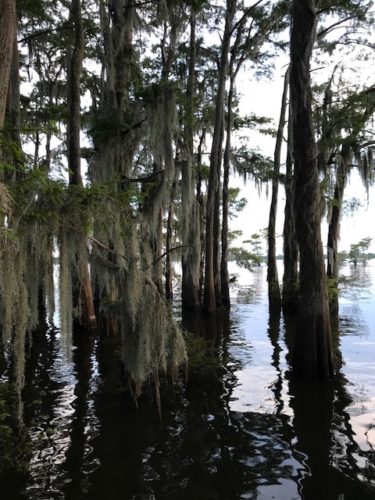
Cypress groves stand tall in the Henderson Swamp.

Our swamp venture began very early that next morning as we drove to a spot at the start of a canal and launched our canoes. The canal went on for 4.4 miles. At the end of the canal, it seemed as though there was a wall of trees, and that section of paddling was aptly called “The Wall” by our guide. That area was perhaps the most challenging section of the whole trip. There were trees and shrubs very close together, and you had to stay in the middle of the waterway to avoid wasp nests.

Thankfully, we made it through this section unscathed and there were no wasps anywhere else on the trip.

After the narrows opened up into the Henderson Swamp, there was much more room to maneuver. The first day we traveled 19.3 miles to houseboats where we would be sleeping. The Henderson swamp had areas where the Cypress trees were logged over 100 years ago, and any trees that are left were considered the runts back then.

Our houseboat captain gave a fascinating overview on the alligators of the Bayous, and their role in the environment. At this point, we had seen enough alligator behavior to realize that they are more scared of us then we were of them, and would try to avoid us.

The next morning, we had an exciting airboat tour of the outlying areas of Henderson Swamp where cypress trees grew in groves. It truly is amazing that the Cypress trees can grow in over six feet of water. After all of the beautiful sights on the airboat tour, it would be back to traveling under our own power.

This day we would cover 10.3 miles; however, after paddling only about a mile from the houseboats, we had to portage our canoes over a levee. This portage was 900 feet long and over the 25-foot-tall levee, but with the extra weight of gear and canoes, it felt much longer. The late morning heat was near its peak adding to the challenge of this portage. After that, the paddle was nice and slow with a wide-open waterway, with plenty of shade from the heat.

That night, we slept on Rougarou Island in hammocks covered with mosquito-netting. The Rougarou was a creature similar to a werewolf in the legends of the Laurentian French communities – fortunately there were no modern versions present during our trip! We also had a blowgun contest with very basic materials – this was fun, but may not have provided us too much security if a Rougarou showed up.

Our next day of paddling was 14.4 miles and not too difficult, but the wildlife was probably the most diverse that we saw throughout our trip. We saw a wide variety of birds and plants in different areas, and quite a few alligators, the most on any day of our journey. Midday of this paddle, it began pouring with rain, and there was an interesting sight of the giant raindrops bouncing on the water as they hit it, but multiplied millions of times. This was the point we were really glad to have dry bags, so none of our gear got wet.

After the rain stopped, we still had to cross two lakes, which were strenuous, but we knew how close Island Outpost was, our final stop. Once we arrived, the Boy Scout crew that had arrived the previous day helped us get our canoes onto the dock. On Island Outpost, there were showers, and clean water was readily available. We would be sleeping in cabins for two nights, on bunks in rustic cabins, after enjoying our jambalaya dinner prepared for us. 
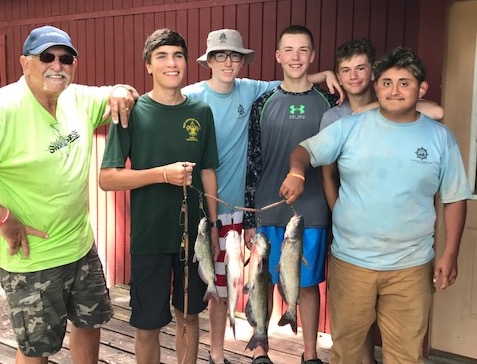
Catfish for dinner!

The next day at Island Outpost we had no paddling and enjoyed other relaxing activities including swimming, boating, and paddle boarding. There were fishing trips by boat, and setting out catfish jug lines. After later checking the jug lines to harvest our catch, we enjoyed a catfish fry that would be a side to gumbo for dinner with plentiful Cajun spice to notch up the heat.

The morning of the last day, we woke up before 5 a.m. to be able to see the sunrise at 6:13 a.m. on Sandy Cove from a great vantage point. We were in the water at about 5:30 a.m. and started immediately. We made it to the outlook point just in time, because within a minute of us arriving, the top of the sun had started to peek above the horizon. It was definitely worth waking up for, to see the sun climb up into the sky rapidly.
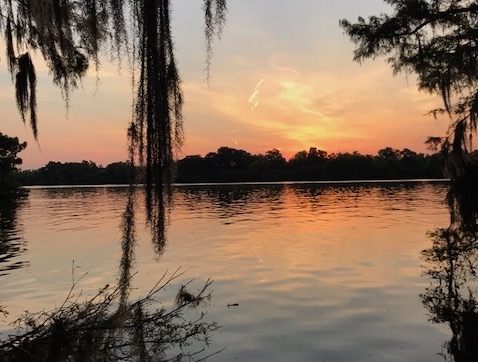
A beautiful early morning view of the bayou.

After eating breakfast on the water, we continued paddling, trying to get to the next scheduled portage early before it got too hot. We went in between ancient Cypress trees on the edge of Lake Fausse  Pointe. There were a few alligators there that were very close to us. It was fabulous here too in terms of both the view and the overall cleanliness of the area.

The second portage was easier than the first, except for the very end. The end of the second portage, behind the levee, was referred to as the “Swamp Stomp” – an area several hundred-feet long where there was thick mud and certain areas of waist-high water that we had to wade through pulling our canoes. Once we were through the Swamp Stomp, we came out onto a chilly river.

This part of our trek was the easiest, because there was a current that carried us almost the whole way to the end of our journey. We had gone swimming off the canoes from time to time on previous days of the trip, but with this current it was not necessary to paddle as much, and at this time it was much more refreshing and enjoyable to be in the water.
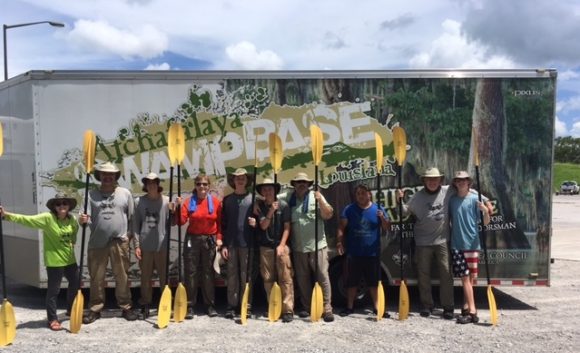
The conquerers of Swamp Base High Adventure 2017 stand with paddles in hand at the end of their successful journey.

At the end of our paddling adventure, we had completed 61.6 miles of canoeing the swamps and lakes of this amazing area over five days. We had a sense of accomplishment at completion, and all of us agreed if offered the chance to conquer the Swamp again, we would be there! 

Y’all come back now, won’t ya?!
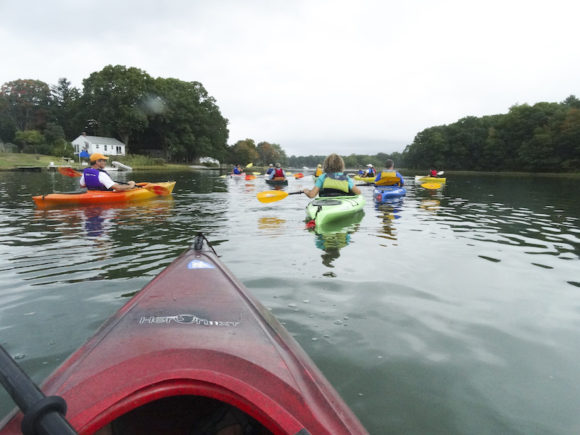
Old Lyme Land Trust Announces Annual Kayak Regatta, Sept. 10

The Old Lyme Land Trust hosts the 4th Annual Kayak Regatta, Sept. 10.

All kayakers and canoers are invited to join the 4th annual Kayak Regatta. The Regatta will launch at 1 p.m. on Sunday, Sept. 10, from the Lieutenant River boat launch, located on Rte. 156 near Ferry Rd.

The launch will start on the rising tide; boaters can take the opportunity to put ashore at the Morning Glory Café for lunch or to meet with friends, or continue up river to explore from the water the natural beauty and features of the Lieutenant River.

The river was once a thriving boat building center and is now a serene protected waterway surrounded by salt marsh and cliffs. The tour will pass several Old Lyme Land Trust preserves, Lohmann Buck Twining and the Roger Tory Peterson Refuge. On the eastern bank of the river the Regatta will pass the picturesque grounds of the Bee and Thistle Inn and the Florence Griswold Museum. During the high tide, a side trip up the Mill Brook River is possible. Beaver dams and fish ladders can be seen before reaching Rogers Lake.

The Regatta will be led by Fred Fenton, an experienced kayaker and a long time director of the Old Lyme Land Trust (OLLT). Fenton will point out special features of the area and answer questions about the preserves.

The return trip will start about 3 p.m. as the tide changes

The Regatta will be held rain or shine. No registration is needed and there is no charge for the Regatta. Donations to the OLLT will be gratefully accepted.

For more information, visit www.oldlymelandtrust.org or contact fredffenton@gmail.com. Send your e-mail if you would like to be notified of cancellation.

Personal flotation devices, i.e. life jackets are mandatory.

Lyme Land Trust Celebrates 50 Glorious Years of Conserving Land


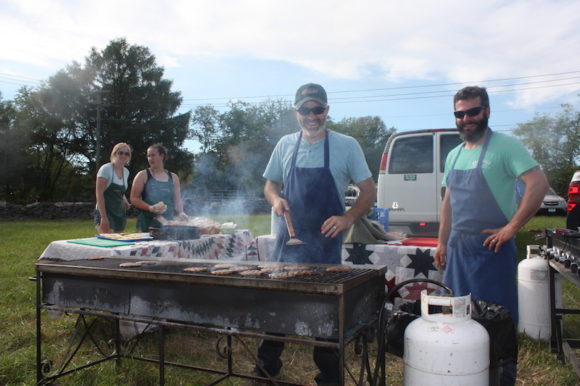
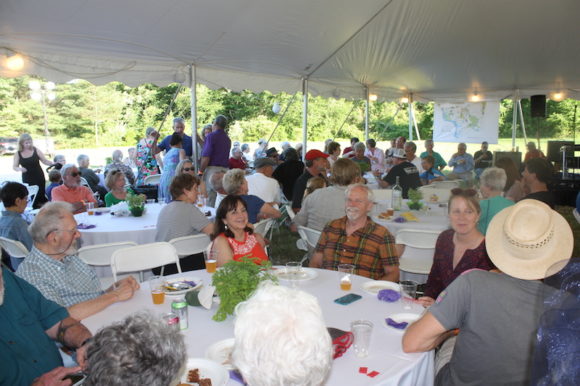
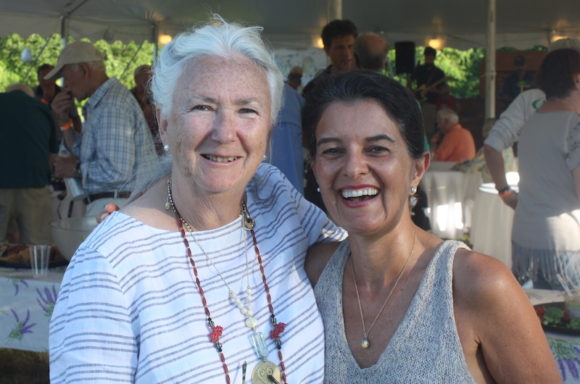
The Lyme Land Conservation Trust celebrated its 50th anniversary last Saturday with a barbecue picnic on the field next to the iconic Grassy Hill Church that the Land Trust saved several years from being turned into a housing development.


In keeping with the Land Trust’s tradition of focusing its energies on environmental preservation rather than social galas, the picnic was low-key and informal.


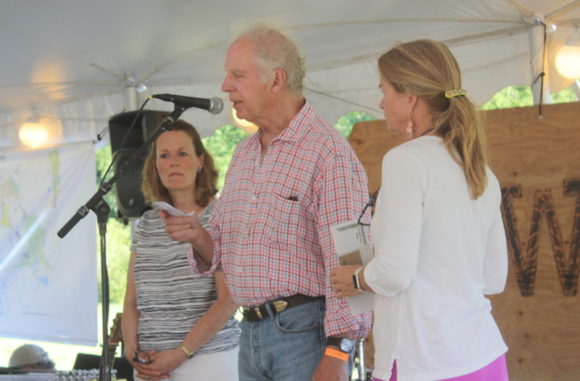
President John Pritchard’s remarks were brief, noting the Land Trust’s astounding success in helping to protect the rural character of Lyme, thanking the picnic volunteers, and reminding the picnickers that they are responsible for the Land Trust’s achievements.


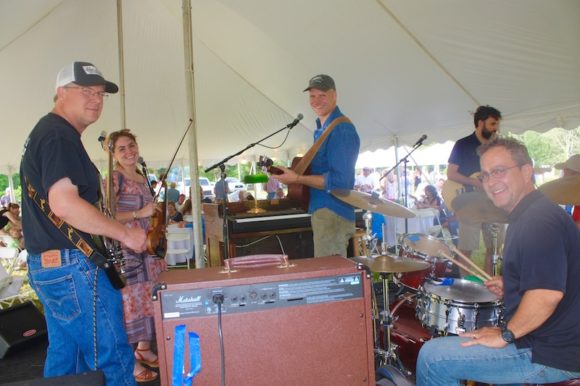
He then turned the microphone back the Plywood Cowboy band, which provided lively music for the event.

And clearly a good time was had by all!

Old Lyme’s Children’s Learning Center Creates a Delicious ‘Edible Garden’

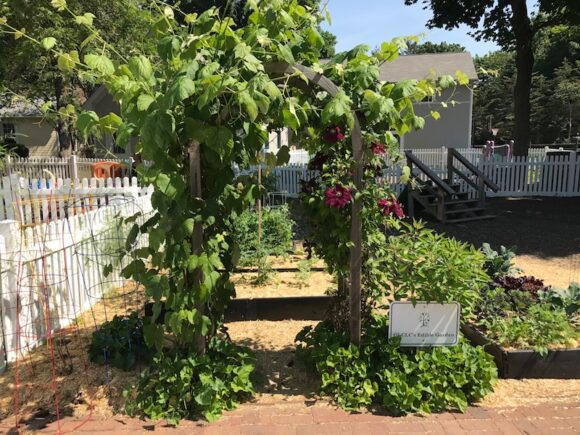
The OLCLC Edible Garden is thriving.

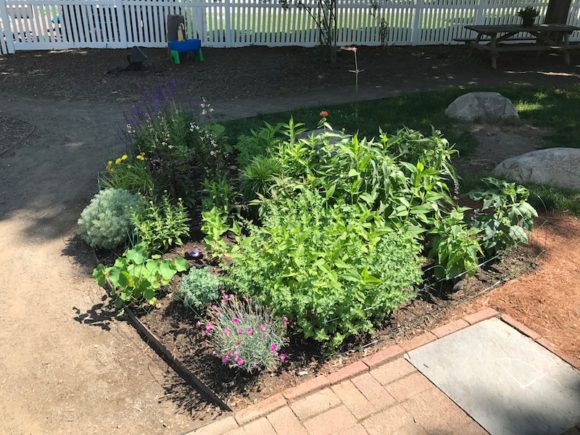
The cold start to the month of June may have had many gardeners worried about their harvest. Thanks to the pro bono labor of Anu Koiv, the children of the Old Lyme Children’s Learning Center (OLCLC) have already been enjoying fruits and vegetables from their thriving edible garden.

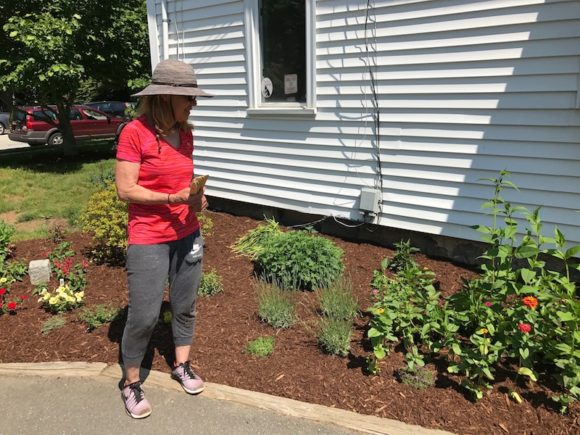
Anu Koiv not only works pro bono on the edible garden, but also on the beds that surround the OLCLC.

“Not only do the kids get to learn about eating healthy foods, but they learn about sustainability and how to manage their own garden,” says Alison Zanardi, director of the OLCLC. It is not very often that preschoolers have the opportunity to interact with a garden and a myriad of different fruits and vegetables like this one. The kids can interact with the plants in the sensory garden, feeling and smelling different tantalizing plants, like mint, cacti and more.

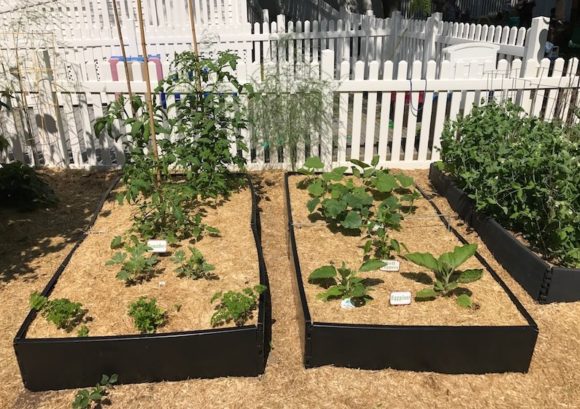
Vegetables patiently waiting to be picked by the preschoolers.

Preschoolers are free to walk around the garden during their time outside and select whatever food that they choose from their luscious garden. Kale chips, fresh tomatoes, blueberries, and strawberries are often enjoyed as snacks.

More vegetables in the Edible Garden that are ‘ripe for the picking’ by the preschoolers.

Anu Koiv is the mastermind behind the garden, and the staff and students are all extremely appreciative of the work she has done.  Not only is she building a garden for the benefit of the preschooler’s education, but also to benefit the wildlife who will be inhabiting the garden. “We’re inviting nature back into the landscape of the courtyard. Each and every plant has ornamental and food value,” notes Koiv.

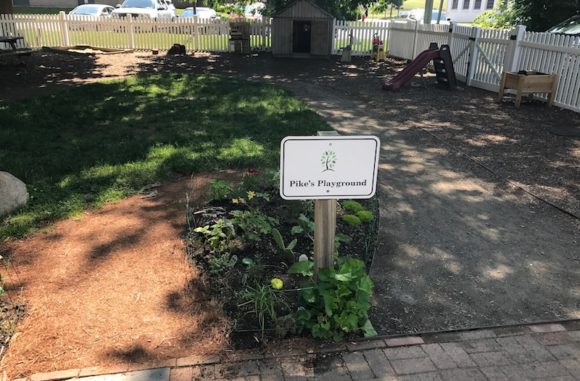
Pike’s Playground is named in honor of Connie Pike, founder of the OLCLC.  Children can interact with plants in the sensory garden.

Volunteers Needed to Control Invasive Plant in Local Rivers, Reserve an Informational Talk at Your Club/Organization

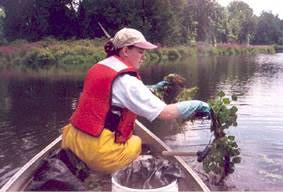
Water chestnut is an invasive plant that is easy for volunteers to remove & keep under control. Join CRC for upcoming volunteer events to learn about & remove this invasive plant.

There is an emerging threat to the Connecticut River and the waters within its basin that any boater, paddler, angler or property manager can help control. European water chestnut (Trapa natans) is an aquatic invasive plant that spreads rapidly, covering bodies of water with dense foliage impeding recreational activities such as boating, fishing, and swimming.

The Connecticut River Conservancy (CRC), formerly Connecticut River Watershed Council, is hosting a variety of opportunities this summer for residents to learn more and help remove this threat.

Quick and thorough action must be taken to prevent this plant from taking over because water chestnut reproduces exponentially. “The good news is that this plant is easy to identify, it reproduces only by seed, and pulls up easily,” notes Alicea Charamut, River Steward for the Connecticut River Conservancy.

She continues, “It can be managed by trained volunteers. For small to moderate infestations, no chemicals or equipment are needed other than willing volunteers in canoes, kayaks, and shallow draft boats. This work offers an opportunity for those of us who love our rivers, lakes and ponds to give back to them in a fun and easy way.”

There are two opportunities to learn to identify and report the plants. CRC hosted an information session at the Connecticut River Museum in Essex on Tuesday, June 13, and will do so again at LL Bean at Evergreen Walk in South Windsor on Friday, June 19. Both events are at 6:30 p.m. There will be a brief presentation, live plants on display, and plenty of time for questions.

Charamut is also available to give talks to groups within the Connecticut River watershed, who want to bring this information to their organization or club.

Paddlers and boaters can also help CRC manage known infestations. Five hand-pulling events are already scheduled for the floating meadows of the Mattabesset River in Middletown and Keeney Cove in Glastonbury in June and July with more to be scheduled as new infestations are reported. The work is fairly easy, a little dirty and very rewarding. Supplies are provided. Those who wish to attend need only bring their boat and PFD.

In addition, CRC is coordinating a River Sweep of the Connecticut River, its coves and ponds to scout for this invasive plant. “Because the seeds from these plants can last for up to twelve years, knowing where these plants have been found is crucial. In order to effectively control the spread of these plants we must monitor locations where they have been found each year and have as many eyes on the water as possible.” Paddling and boating groups can adopt a section of the river to scout for plants on or around Saturday, June 24.

“It will take a community of those who care coming together to help control this plant,” says Charamut. The Connecticut River Conservancy joins many partners in the effort to control water chestnut in the Connecticut River watershed. The US Fish and Wildlife Service, the Connecticut Department of Energy and Environmental Protection, Lower Connecticut River Council of Governments, Jonah Center for Earth and Art, Connecticut River Museum, and the Connecticut Agricultural Experiment Station are all active participants working to help control this aquatic invasive plant.

More groups are encouraged to join the effort. Much of the work in the lower Connecticut River Valley here in Connecticut is possible thanks to a generous grant from the Rockfall Foundation.

For more information about education and volunteer opportunities to help control European water chestnut, visit www.ctriver.org/get-involved or contact Alicea Charamut at acharamut@ctriver.org.