RTP Estuary Center Presents Lecture on Environmental Protection in a ‘Climate of Change,’ Oct. 18

The Connecticut Audubon Society’s Roger Tory Peterson Estuary Center is hosting a 2018 Fall Lecture Series, which opens this evening with a lecture on songbird migration. These lectures are free but seating is limited.

Details of the lectures and their locations are as follows:

North on the Wing: Travels with the Songbird Migration of Spring
Thursday, Oct. 4, 5 p.m.
Essex Meadows, Essex

Bruce Beehler, a research associate in the Division of Birds of the Smithsonian’s Museum of Natural History will recount his 100-day journey in 2015 following the spring songbird migration from the coast of Texas, up the Mississippi, and then into the North American wood warblers’ breeding grounds in northern Ontario and the Adirondack Mountains of New York.  His presentation touches on wildlife, nature conservation, migration research, American history, and rural culture.
RSVP Here

Protecting Our Environment in a Climate of Change
Thursday, Oct. 18, 5 p.m.
Old Lyme Town Hall, Old Lyme

Connecticut and its residents have a strong history of support for protection and conservation of the environment. Our coastal and estuarine communities have a particular interest in policies and strategies to mitigate sea level rise, storm surge and protect wildlife habitats. Yet, budget constraints at the local level, state deficits, and rapidly changing federal policies with respect to standards, regulation, and enforcement, present challenges. Some states have chosen to maintain their own strict standards. What can a small state like Connecticut do? Our speaker, Commissioner Rob Klee of the Connecticut Department of Energy and Environmental Protection, will address the challenges that policy makers face and how we can be effective advocates.
RSVP Here

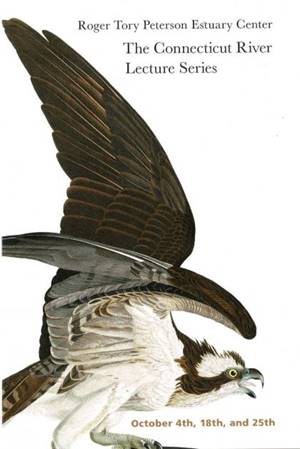
Journeys: Osprey and an Author, Rob Bierregaard
Thursday, Oct. 25, 4 p.m.
Lyme Art Association, Old Lyme

Between 2000 and 2017 Rob Bierregaard and his colleagues placed GPS satellite transmitters on 47 adult and 61 juvenile Ospreys from South Carolina to the Avalon Peninsula in Newfoundland.  In 2013 a friend suggested that Rob write a book for children about his favorite Osprey. Five years later, Belle’s Journey: An Osprey Takes Flight, a middle-school book, was published. Rob Bierregaard will highlight his findings from satellite tracking studies of Osprey migrations and describe his own journey as a first-time children’s book author.
Note: This is a family friendly lecture. We urge you to bring your children and grandchildren.
RSVP Here

To learn more about the lecture speakers, click here
Black Bear Kills Sheep in Lyme, Residents Warned to Take Precautions; DEEP Notes Black Bears Rarely Aggressive to Humans

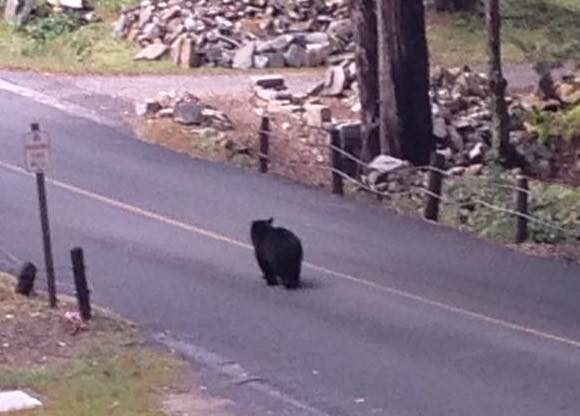
Photo of the black bear seen Friday in Hadlyme. Photo by J. Bjornberg.

During the daytime hours on Friday, Emily Bjornberg, who lives on Brush Hill Rd. in Hadlyme, reports that her husband came upon a black bear attacking and subsequently killing a sheep on their property.  The Connecticut Department of Energy and Environmental Protection (DEEP) has been informed and is monitoring the situation.

The DEEP stresses that black bears only occasionally will prey on small mammals, deer, and livestock. DEEP notes on their website that black bears are omnivorous and, “they eat grasses, forbs, fruits, nuts, and berries. They also will seek insects (particularly ants and bees), scavenge carrion, and raid bird feeders and garbage cans.”

Additional important advice from the DEEP regarding black bears is as follows:

Never feed bears
-Remove bird feeders if a bear visits them
-Add a few capfuls of ammonia to your trash bags as the smell is a deterrent
-Thoroughly clean grills after use
-Do not leave pet food outside overnight
-Do not add meats or sweets to compost

If you see a bear:
View from a safe distance and leave an escape route for the bear – do not corner him
-Make noise and wave your arms
-Stand your ground and slowly back away – do not run or climb a tree – try to go into a car or building
Black Bears are rarely aggressive towards humans. They should be respected, not feared.

For more information on black bears, visit this link.

Celebrate the Equinox, National Public Lands Day by Exploring Lyme, Old Lyme’s Open Space

Lyme and Old Lyme both offer innumerable opportunities for walking, hiking and simply enjoying their Open Space.

Saturday, Sept. 22, will be a day of double celebration since it is both the Autumn Equinox and National Public Lands Day.

The Equinox officially marks the beginning of autumn in Connecticut, and for six months thereafter nights will be longer than days.

National Public Lands Day (NPLD), held annually on the fourth Saturday in September, was established in 1994 to celebrate the connection between people and green space in their community, and to encourage use of open space for education, recreation, and general health.

The seasonal change offers tremendous compensation. Fall’s crisper, cooler days are ideal for hiking and nature watching, and our local forests present a truly spectacular color show for leaf-peeping.

The Old Lyme Open Space Commission invites you to enjoy the town’s 600 acres of public lands. Their publication Take a Hike provides a fascinating natural history overview of open space properties. “The Hartford Courant” also recently published a Peter Marteka column on caves within the Ames Family Preserve.

Hiking maps can be found on the Open Space page on the Town of Old Lyme’s web site.

In addition to town-owned open space property, the Old Lyme Land Trust owns over 1,000 acres of scenic, historic and ecologically important land in Old Lyme. Many of these properties have well-maintained hiking trails – descriptions, directions and hiking maps can be found on their website.

Celebrate the Equinox and National Public Lands Day tomorrow, and into the fall, by visiting Old Lyme’s open space.

Share your favorite outdoor activity Saturday on social media with the hashtag #NPLD.

Old Lyme Land Trust Hosts 52nd Annual Meeting, Honors Lea Harty as Volunteer of the Year

The Old Lyme Land Trust held its 52nd Annual Meeting at the Lymes’ Senior Center on Sunday, March 18.  Attendance was the largest in the Trust’s history.

The meeting was highlighted by an informative and entertaining presentation on bobcats in CT. The program, “The Bobcat: Connecticut’s Secretive Wild Cat” was presented by Master Wildlife Conservationist, Paul Colburn. He discussed the natural history of bobcats in Connecticut and provided an overview of bobcat habitat, diet, behavior, reproduction, and current research efforts.

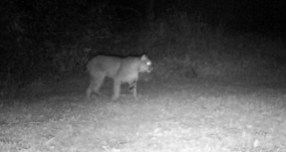
Colburn encouraged the audience to report bobcat sightings to the state Department of Energy and Environmental Protection (DEEP) at deep.wildlife@ct.gov. The image at left was captured on a trail cam by an Old Lyme resident.
Bobcats, lynx rufus, are the state’s only wild cat and have been sighted in almost every town in the state. The bobcat was once hunted for both its fur and bounty payments, but is now protected. and the current population is estimated at 1500 to 2000. Even though bobcats can catch and kill a deer, they are shy of humans.

In the business portion of the meeting, the Trust honored Lea Harty as the Volunteer of the Year. She is the former Trust secretary and still edits and produces the Trust’s Annual Letter, Tributaries.  She has organized work crews to eliminate invasive burning bush on the Jericho Preserve and will soon lead another crew to plant native shrubs at Watch Rock.

Trust President Michael Kiernan announced that the newly acquired 11-acre “Denison Farm” parcel is now fully accessible through the trail system on the Upper Three Mile River Preserve.  He also announced receipt of a $36,000 grant toward the purchase of Denison from the state DEEP’s OSWA grant program. The Trust conducts regular work parties to maintain its 14 preserves; volunteers are always welcome to participate.

In other business, Mary Devins and Sabine O’Donnell were elected to the board of directors.

The Old Lyme Trust reminds LymeLine readers to visit the Trust’s display at the Midsummer Festival on Saturday, July 28. Meet some of the local wildlife (the non-human kind!) that make their homes in the Trust’s preserves. Raptors, reptiles and a variety of insects will be looking forward to meeting you.

The Old Lyme Land Trust is a private nonprofit corporation not affiliated with the town government. Membership is open to all.  “Buy land, they’re not making it anymore.” – Mark Twain

Roger Tory Peterson Estuary Center Hosts Spring Lecture Series; Next Lecture is May 3

The Connecticut Audubon Society’s Roger Tory Peterson Estuary Center is hosting a three-part Spring Lecture Series from April 19 through May 17.

The second lecture in the series will be held Thursday, May 3, at 5 p.m. at Essex Meadows and is titled The Remarkable Edward Lear.

Edward Lear (1812-1888) is best known and much loved for “The Owl and the Pussycat.” But he was also a fine painter of birds, mammals, reptiles, and landscapes, and an adventurous, world-wide traveler.

Lear’s paintings of parrots, macaws, toucans, owls, and other birds are among the finest ever published. Often compared to his friend and contemporary, John James Audubon, the two men are considered among the greatest natural history painters of the age. Using slides of Lear’s extraordinary work, Robert Peck will describe his career in natural history. He will show how he compares to and differs from Audubon, and discuss his lasting influence today. RSVP here

The third and final lecture in the series will be held Thursday, May 17, at 5 p.m. at Lyme Art Association and is titled Creation of a Genius: Roger Tory Peterson.

Roger Tory Peterson made his home and, as an adult, found inspiration for his monumental work on the banks of the Connecticut River Estuary. But the seeds of his passion for art and conservation were sown in his youth. Twan Leenders, President of the Roger Tory Peterson Institute in Jamestown, N.Y., will focus on Peterson’s early years, his youthful explorations, and how the hidden treasures of his hometown, were to become a passion and eventually lead to inspiring amateur and professional naturalists through generations and throughout the world.  RSVP here.