Why Do Birds Crash? Potapaug Unravels the Mystery of ‘Window Collisions,’ Tonight in Old Lyme

Windows can present a ‘clear and present danger’ to birds in flight. Find out why at Thursday evening’s lecture hosted by the Potapaug Audubon Society. Photo by Ant Rozetsky on Unsplash.

OLD LYME — Harry Bird of the Potapaug Audubon Society presents ‘Window Collisions’ on Thursday, Oct. 3,  at 7 p.m. at Old Lyme Town Hall, 52 Lyme St., Old Lyme. All are welcome.

This fascinating talk will investigate the hazards to birds of window collisions. It is a complex topic, which will be looked at from a variety of angles. Possible solutions will be offered, and it is hoped a lively discussion will follow.

This presentation exemplifies the Society’s mission to provide informative and entertaining subjects.

For more information about the Society, visit their website.

For more information on this presentation, visit the Presentation Toolkit.

Update From Old Lyme Town Hall Regarding Eastern Equine Encephalitis

OLD LYME — The following e-mail was sent out from Old Lyme Town Hall at 7:15 p.m. Tuesday evening.

A message from First Selectwoman Bonnie Reemsnyder:

Today we learned that a resident of Old Lyme has become the second victim of the mosquito-borne illness, Eastern Equine Encephalitis, or the Triple-E virus. The Town of Old Lyme sends heartfelt condolences to the family of the victim. While we do not have the identity of the person at this time, I am sure that the loss is felt by all of the residents of Old Lyme.

Many have asked what the Town is doing with this threat in mind, so here is an update:

The Selectman’s Office has been in regular contact with Ledge Light Health District, has participated in scheduled conference calls with the State Dept. of Public Health, which provides updates on tests and recommendations, and is following all of the recommendations to date. The next conference call is scheduled for this Thursday.

Since Friday of last week, we have warned all outdoor sports activities to end by 5:30 PM (which may get earlier as the days grow shorter) and warned people to move indoors well before dusk.

We post all updates from Ledge Light Health District on our website.

The Town currently contracts with Innovative Mosquito to manage our plan to address nuisance mosquitos, which are primarily daytime-biting mosquitos. We regularly use non-chemical dunks in our catch basins, and monitor the mosquito population along the marshland of the shoreline neighborhoods. When warranted, backpack adulticide spraying is done to reduce the population. But these daytime-biting mosquitos have not tested positive for EEE virus. It is the night time mosquitos that have tested positive, and so far, none of the mosquitos tested from Old Lyme have been positive for the virus.

With the latest victim from Old Lyme, our contractor has increased trapping in the freshwater areas of town to assess the population, and the State Dept. of Agriculture has done the same, testing those caught for the virus. Those results are not yet available, but based on the outcome, recommendations will be made and followed by us.

If spraying is recommended, we will follow up immediately, and are prepared to do so.

We continue to stay in touch with our Health District and the State Dept. of Health, and will follow all recommendations that they give us.

We urge all residents to take this threat seriously, and take all precautions to avoid mosquitos.

Once again, our heartfelt condolences are sent to the family whose loved one has succumbed to this tragic illness.

State Announces Old Lyme Resident Tests Positive for EEE, Confirms Death of East Lyme Resident Diagnosed with EEE

HARTFORD/OLD LYME – (Press release from DPH) RESIDENTS ARE ADVISED TO PROTECT THEMSELVES AND THEIR CHILDREN BY AVOIDING OUTDOOR ACTIVITY FROM DUSK TO DAWN, WHEN MOSQUITOES ARE MOST ACTIVE
Yesterday, Department of Public Health (DPH) Commissioner Renée D. Coleman-Mitchell announced a second Connecticut resident has tested positive for Eastern Equine Encephalitis (EEE) infection. The patient is an adult resident of Old Lyme, who became ill during the second week of September with encephalitis and remains hospitalized. Laboratory tests, which were completed Friday at the Centers for Disease Control and Prevvention (CDC) Laboratory in Ft. Collins, Colo., confirmed the presence of antibodies to the virus that causes EEE.

Friday afternoon, DPH learned that the first person diagnosed with EEE this year in Connecticut passed away earlier this week. The patient, an adult resident from the Town of East Lyme, was hospitalized with encephalitis in late August. This is Connecticut’s first fatal human EEE case since 2013.

“The identification of two Connecticut residents with EEE, one of whom has passed away, emphasizes the seriousness of this infection,” cautioned DPH Commissioner Renée Coleman Mitchell. “Using insect repellent, covering bare skin and avoiding being outdoors from dusk to dawn are effective ways to help keep you from being bitten by mosquitoes. Mosquitoes continue to be active until the first heavy frost.”

States throughout the Northeast are also experiencing an active season for EEE. In addition to the virus being found in mosquitoes, there have been a total of 10 human cases of EEE infection in Massachusetts, including two fatalities, and three human cases in Rhode Island, including 1 fatality. Although EEE-infected mosquitoes continue to be detected in the southeastern corner of Connecticut, the numbers are declining and we are not experiencing the excessively high levels of
activity seen in Massachusetts. Although EEE-infected mosquitoes continue to be detected in the southeastern corner of the State, the numbers are declining and the area is not experiencing the excessively high levels of activity seen in Massachusetts.

It takes four to 10 days after the bite of an infected mosquito to develop symptoms of EEE. Severe cases of EEE virus infection result in encephalitis, an inflammation of the brain. Approximately a third of patients who develop EEE die and there is no specific treatment for EEE.

The DPH continues to advise against unnecessary trips into mosquito breeding grounds and marshes as the mosquitoes that transmit EEE virus are associated with freshwater swamps and are most active at dusk and dawn. Overnight camping or other substantial outdoor exposure in freshwater swamps in Connecticut should be avoided. Even though the temperatures are getting cooler, mosquitoes continue to be active until the first heavy frost and residents should continue to take measures to prevent mosquito bites. Pesticide spraying to kill adult mosquitoes is unlikely to be effective at this time of year when it is cooler at night and mosquitoes are less active.

First Human Case of West Nile Virus (WNV) Identified in Connecticut This Year 

The DPH is also announcing an adult resident of Danbury has tested positive for West Nile virus (WNV) infection. This is the first human case of WNV identified in Connecticut this season. The patient became ill during the third week of August with encephalitis and is recovering. Tests performed at the CDC Laboratory in Ft. Collins, Colo., confirmed the presence of antibodies to the virus that causes WNV disease.

West Nile virus has been detected in the state every year since 1999. While WNV has been detected in mosquitoes in the state this season, the numbers of infected mosquitoes identified have been lower than the historical average. The mosquitoes that transmit WNV are most abundant in urban and suburban areas with dense human populations.

Most people (8 out of 10) infected with WNV do not develop symptoms. Approximately 1 in 5 people who are infected develop a fever and other symptoms. About 1 out of 150 infected people develop a serious, sometimes fatal, illness. In 2018, 23 human cases of WNV virus were identified in Connecticut residents, including one fatality.

Connecticut Mosquito Management Program

The management of mosquitoes in Connecticut is a collaborative effort involving the Department of Energy and Environmental Protection (DEEP), the Connecticut Agricultural Experiment Station (CAES) and the Department of Public Health (DPH), together with the Department of Agriculture and the Department of Pathobiology at the University of Connecticut (UCONN). These agencies are responsible for monitoring and managing the state’s mosquito population levels to reduce the potential public health threat of mosquito-borne diseases.

For information on what can be done to prevent getting bitten by mosquitoes and the latest mosquito test results and human infections, visit the Connecticut Mosquito Management Program web site at https://portal.ct.gov/mosquito

For more information about EEE prevention, visit the CDC website:https://www.cdc.gov/easternequineencephalitis/gen/pre.html

Old Lyme’s Christ the King Church Hosts Harvest Festival & Rummage Sale Today

Bargain hunters stand patiently in line at last year’s King’s Rummage Sale.

OLD LYME — Autumn arrives officially in Connecticut on Sept. 23, and Christ the King Church in Old Lyme is celebrating the new season with its family-friendly Harvest Festival Saturday, Sept. 21, from 8:30 a.m. to 3 p.m.

At the huge King’s Rummage Sale held during the Harvest Festival, you’ll find housewares and kitchen items, books and CDs, holiday decorations, jewelry, bicycles and exercise equipment, furniture, rugs, artwork, toys, and more.

Find a bargain (or two!) at the King’s Rummage Sale in Old Lyme, Sept. 21 and 22.

At the Harvest Festival, kids of all ages can try their luck at Games like Soccer Kick, Hockey Shot, and Bust-a-Balloon; get creative with Paint-a-Pumpkin; or simply have their face painted.

There will be games galore at Christ the King’s Harvest Festival.

The Silent Auction offers exciting items like artwork, gift certificates, and themed baskets to bid on.  Local musicians will provide entertainment for you to enjoy while you have lunch or snacks prepared by the Men’s Club.  You can pick out a homemade goodie at the Bake Sale — and choose some autumn color for your home at the Fall Plants & Produce stand.

All the fun of the fair will be happening at Christ the King’s Harvest Festival, Sept. 21.

Admission to Christ the King’s Harvest Festival is free.  Proceeds from the 2019 Harvest Festival will be directed towards the cost of refinishing the hardwood floors in the church.

The Harvest Festival and Rummage Sale take place at Christ the King Church, 1 McCurdy Road, Old Lyme.

The Rummage Sale, Bake Sale, and Plant Sale will continue after the Masses Sunday morning (Sept. 22) from 9 a.m. to 12 noon (with steep discounts on Rummage Sale items, while supplies last.)  Visit www.christthekingchurch.net for directions. And follow the church on Facebook (@ChristtheKingChurchOldLyme) for regular updates.

For more information, call 860-434-1669.

Friends of Whalebone Cove Finish Project to Clear Invasive Water Chestnut from Selden Cove

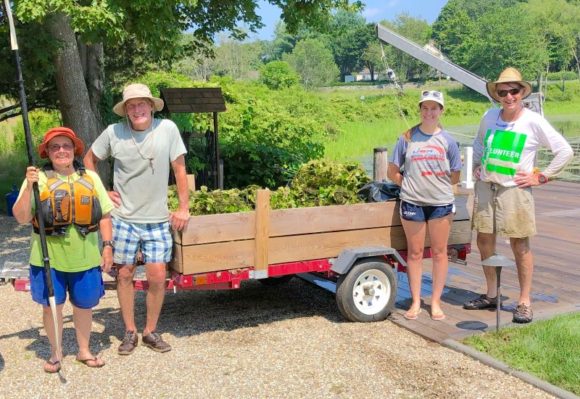
Volunteers display the fruits of their labor after working all morning to remove invasive water chestnut in Whalebone Cove.

LYME — Nine volunteers spent last Saturday morning (Sept. 7) finishing up Friends of Whalebone Cove (FOWC) two-month project of clearing more than 5,000 square feet of invasive water chestnut from Lyme’s Selden Cove.

During July, August and early September FOWC organized 10 separate “paddle & pull” expeditions involving more than 30 volunteers to rid the Cove of thousands of water chestnut plants discovered there in July.

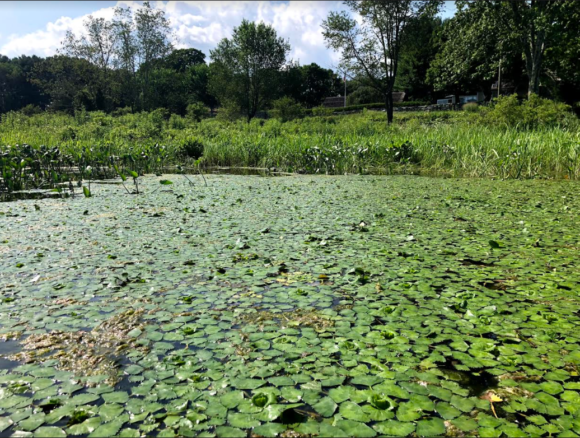
This photo shows the dense invasive water chestnut that was choking Selden Cove prior to its removal.

Water chestnut (trapa natans) is an invasive freshwater plant native to Europe, Asia and North Africa that can cover shallow coves and slow moving rivers with a thick carpet of multi-leafed waxy medallion-like rosettes that kill native plants and deplete the oxygen in the water, driving out marine life and making swimming, fishing, and boating impossble.

A volunteer gathers invasive water chestnut in her canoe.

Because it is an annual plant and some seed pods have already dropped off the plants in Selden Cove this year before being removed, water chestnut is likely to reappear in the Cove next year and continue in future years, requiring annual removal to protect the native ecosystems of Selden Cove and nearby Selden Creek from being obliterated by the highly aggressive invasive.
Friends of Whalebone Cove is a community conservation group based in Hadlyme formed three years ago to protect and preserve the native ecosystems and wildlife habitat of Hadlyme’s Whalebone Cove and the surrounding area.