
Mosquitoes in Stonington Test Positive for Eastern Equine Encephalitis (EEE) Virus

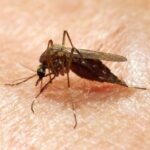
Mosquitoes can carry Eastern Equine Encephalitis (EEE.)

AREAWIDE/LYME/OLD LYME — (Froma Press Releas)Ledge Light Health District announced today that mosquitoes trapped in Stonington have tested positive for Eastern Equine Encephalitis (EEE) virus. The virus was found in Culiseta melanura species mosquitoes, which is a species that primarily bites birds.

Eastern Equine Encephalitis is a rare but serious disease caused by a virus that is transmitted by mosquitoes. In Connecticut, the virus has been found in trapped mosquitoes in most years. In 2019, there were four human cases of EEE in Connecticut.

Residents who live in towns or near towns where EEE virus has been found are advised to take precautions to avoid mosquito bites, including:

  • Be sure door and window screens are tight fitting and in good repair.
  • While outdoors for long periods of time, wear shoes, socks, long pants, and long-sleeved shirts. Clothing should be light colored and made of tightly woven materials that keep mosquitoes away from the skin.
  • Use mosquito netting when sleeping outdoors and to protect small babies when outdoors.

Consider the use of mosquito repellents recommended by the Centers for Disease Control and Prevention (CDC), such as ones containing DEET, picaridin, oil of lemon eucalyptus, IR3535, or 2-undecanone, and apply according to directions, when it is necessary to be outdoors.

  • When using DEET, use the lowest concentration effective for the time spent outdoors (for example, 6 percent lasts approximately two hours and 2 percent for four hours) and wash treated skin when returning indoors. Do not apply under clothing, to wounds or irritated skin, the hands of children, or to infants less than two months.
  • Minimize time spent outdoors between dusk and dawn when mosquitoes are most active.

Measures to reduce mosquitoes around the home include:

  • Dispose of water-holding containers, such as ceramic pots, used tires, and tire

Swings, clogged gutters.

  • Drill holes in the bottom of containers such as those used for recycling.
  • Change water in bird baths on a weekly basis.
  • Clean and chlorinate swimming pools, and cover pools when not in use.
  • Use landscaping to eliminate areas where water can collect on your property.

Additional resources for information on EEE and mosquito management can be found at http://www.ct.gov/mosquito/site/default.asp

Ledge Light Health District – LLHD – serves as the local health department for East Lyme, Groton, Ledyard, Lyme, New London, North Stonington, Old Lyme, Stonington and Waterford, Connecticut. As a health district, formed under Connecticut General Statutes Section 19a-241, LLHD is a special unit of government, allowing member municipalities to provide comprehensive public health services to residents in a more efficient manner by consolidating the services within one organization.
Yale Performs Alewife Sampling in Rogers Lake From Sunset to 2am Through Saturday

LYME/OLD LYME — Rogers Lake Authority has announced that Yale University will be doing their annual alewife sampling on Rogers Lake from Aug. 10 through Aug. 15. This activity will take place between sunset and 2 a.m.

The researchers will be using a large net and some floating green and white lights.

DEEP has been notified of this activity.

All persons out on the lake during this time are requested to stay clear of this work.

Winning Against Water Chestnut: Volunteers Clear Hadlyme’s Selden Cove, Creek Of New Plants


LYME —
(from a press release issued by Friends of Whalebone Cove) The two-year community effort by volunteers to save Hadlyme’s Selden Cove and Selden Creek from being covered by a carpet of invasive water chestnut plants is achieving success.

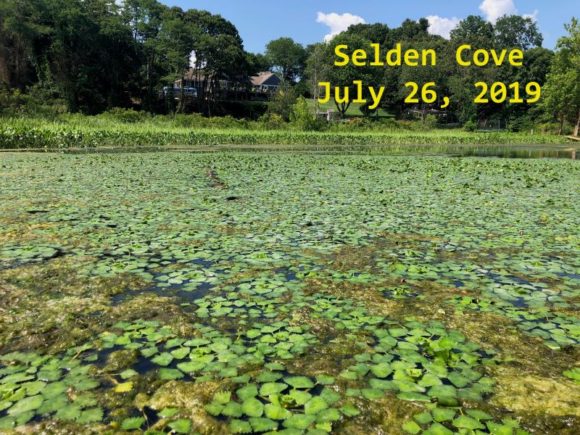
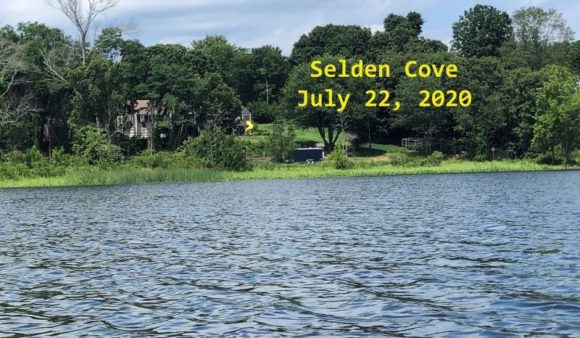
After three “Paddle & Pull” work parties involving 25 volunteers in June and July, an inspection of Selden Cove and Creek last Thursday revealed almost no new plants have emerged in the last week. See photo below.

As a result, Friends of Whalebone Cove (FOWC) cancelled the “Paddle & Pull” work party scheduled for Wednesday, Aug. 5.

Last year at this time a large portion of Selden Cove was covered by 5,000 – 7,000 square feet of water chestnut. See photo at head of article.

The FOWC has organized a total of 13 “Paddle & Pull” work parties in 2019 and 2020 involving almost 60 volunteers, who have put in more than 200 hours to remove water chestnut plants from both the Cove and the Creek.

Diana Fiske, FOWC President, expressed gratitude to all the volunteers who have pitched in to save Selden Cove and Selden Creek, saying, “It takes a village … There are so many people to thank for this effort. You know who you are, but I want to personally thank each and every one of you myself and thank the Connecticut River Conservancy for its support that has been critical in our work.”

She concluded, “Thank you all!”

Water chestnut — which dramatically impacts marine and upland wildlife anywhere it gets established — has invaded and taken over many other locations in the Connecticut River.

Friends of Whalebone Cove has managed to prevent water chestnut from getting established in Whalebone Cove and wants to reclaim those parts of Selden Cove where it has gotten a permanent foothold in recent years, because if it is allowed to spread, it is hard to eradicate and will change the ecology the two fresh water tidal wetlands and destroy the habitat eco-systems which species that live in the area rely on to survive.

Water chestnut is an annual plant, but its seeds can remain viable for 12 years, and each plant has enough seeds to produce 300 new plants in a future year.

This means that Selden Cove and Selden Creek will need to be monitored for the next two months for “late emerging” plants, and there will need to be volunteer work parties in future years to remove newly emerging plants from latent seeds dropped in prior years that could start massive new infestations.

Future “Paddle & Pull” work party dates scheduled in Selden Cove are:

August
Thursday 8/20 – 12 Noon
Rain Date: Fri. 8/21 – 1 p.m.

September
Thursday  9/3 – 12 Noon
Rain Date: Fri. 9/4 – 1 p.m.
Tuesday 9/29 – 9AM
Rain Date: Wed. 9/30 – 10 a.m.

If you would like to volunteer to help FOWC, send an email to: fowchadlyme@gmail.com

Letter to the Editor: Old Lyme Land Trust’s Assessment of Bucky Brook Beaver Situation Challenged

To the Editor:

I recently read the statement provided to you by the Old Lyme Land Trust in February. I find it odd that no one from your organization met with Dave Berggren to confirm the lowering level of the pond after one dam was removed.  What’s more egregious is that when I took the Bucky Brook path just yesterday I found 4 beaver dams as well as the beaver’s lodge and how the volunteers did not see these is beyond me and they should be ashamed to have suggested otherwise.

The entire Bucky Brook needs to be dredged as well as the beavers removed.

I have video documentation of all the beaver dams if you want to see.

Sincerely,

Lee Detwiler,
Jenkintown, PA.


Deadline to Complete Old Lyme’s Walk Audit, Online ​Walk/Bike Survey, July 31

Where do you go on your bike in Old Lyme? Complete the Sustainable Old Lyme ​Walk/Bike Survey to help the Sustainable Old Lyme Committee in their work.

OLD LYME — UPDATED 7/31 — edits in red: Do you like to walk or bike around Old Lyme?

If so, the Sustainable Old Lyme Committee would like more information about how you enjoy the town while walking or bicycling.

A new feature is now available for those who like to walk on Lyme Street in the form of a paper Walk Audit, which asks about the experience of walking along Lyme Street between the Lyme Academy of Fine Arts and the Town Green (at the junction with Ferry Rd.)

The Walk Audit is available at Old Lyme Town Hall and at shops along the route — no computer required!

But if you prefer to use a computer, there are two options: the Walk Audit is available online at this link. When completed, it should be printed out and returned either to the Old Lyme Town Hall at 52 Lyme St. or The Chocolate Shell at 18 Lyme St.

The second option is an online Old Lyme ​Walk and Bike Survey, which asks more general questions about your experience walking and biking in the community. The survey is available at this link.

The committee wants to hear from everybody, but especially from those who are older or who have special needs.  The questionnaires are short (20 questions) and all questions are optional.

The survey and walk audit will be available until TODAY, July 31.

During the Old Lyme Board of Selectmen’s meeting held July 6, Selectwoman Mary Jo Nosal urged as many residents as possible to complete the survey. She explained later to LymeLine.com in a phone conversation that the objective of the survey is to, “Provide evidence to help make Old Lyme more walkable and bicycle-friendly.”

For more information about Sustainable Connecticut, visit ​https://sustainablect.org.

Contact the survey organizers through that website or email them at rogerslakehealth@gmail.com​ or ​walkauditol@gmail.com​.