Old Lyme Board of Selectmen to Hold Special Meeting to Discuss, Take Action on Tantummaheag Access ‘Memo of Understanding’

OLD LYME — The Old Lyme Board of Selectmen has scheduled a Special Meeting on Monday, April 29, at 5:30 p.m. in the Memorial Town Hall Meeting Room.

The agenda is focused exclusively on the draft Memorandum of Understanding between the Town of Old Lyme and George Frampton/Carla D’Arista concerning Tantummaheag Landing. Visit this link to read our article by Olwen Logan and published April 21, titled, Introduction of Draft ‘Memo of Understanding’ by Town of Old Lyme, Owners Moves Tantummaheag Landing Dispute Into ‘Less-Divisive Environment’, that includes full details of the Memorandum and associated statements.

After introductory formalities, the agenda items are as follows:

  • Public Comment on the Memorandum of Understanding Draft between the Town of Old Lyme and George
    Frampton/Carla D’Arista concerning Tantummaheag Landing.
  • Selectmen General Discussion
  • Action on the Memorandum of Understanding Draft between the Town of Old Lyme and George Frampton/Carla
    D’Arista concerning Tantummaheag Landing.

Two virtual meeting options are being offered, the first by computer, mobile app or room device and the second by phone (audio only). Visit this link to obtain full details regarding how to join the meeting by either method.

Old Lyme Tree Commission Celebrates Arbor Day with Tree Seedling Give-Away

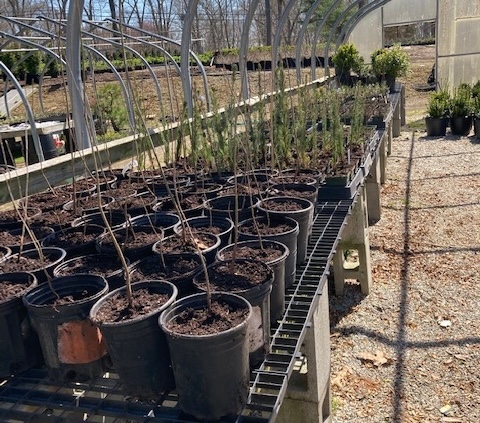
Two hundred and fifty seedlings stand potted and ready to be given away on Saturday at the Old Lyme Tree Commission’s Second Annual Spring Seedling Event. Photos by Joanne DiCamillo.

OLD LYME—Celebrate Arbor Day by helping plant a new generation of trees in Old Lyme!

Join the Old Lyme (OL) Tree Commission’s Second Annual Spring Seedling Event when commission members will give away an assortment of five Native Species of tree seedlings. The event will be held on Saturday, April 27, from 10 a.m. to 12 p.m. at Memorial Town Hall on Lyme St. in Old Lyme.

Old Lyme residents will be able to select up to three seedlings from a choice of:

  • Evergreen tree:- White Spruce
  • Ornamental flowering trees:- White Dogwood or Eastern Redbud
  • Shade trees:- Sugar Maple or Scarlet Oak.

The percentage of survival of the seedlings is an important component of the project. This year, residents will be asked to sign in and register before they collect their seedlings. This will enable the commission to collect data on their health. Written instructions will be provided with the plants. 

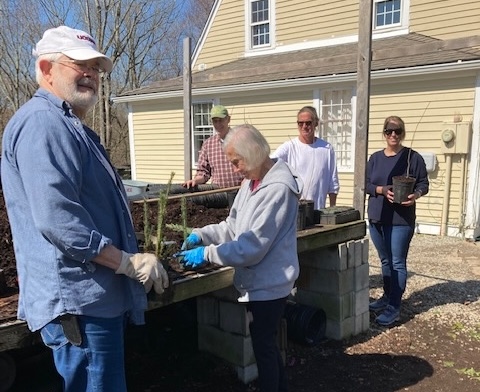
Seem here potting up the seedlings are, from left to right in the foreground, Old Lyme Tree Commission members Michael Gaffey, and Joan Flynn, and in the rear, Fred Behringer at left and Emily Griswold at right. Mark Comstock, owner of the Hydrangea Galore Nursery, stands between Behringer and Griswold.

As happened last year, the commission purchased 250 seedlings from the Arbor Day Foundation and gathered at Hydrangea Galore Nursery with owner Mark Comstock, to pot the seedlings. Comstock donated the soil, pots and trays, and also made space available in the nursery for the potting task.

Old Lyme Tree Commission members are grateful for both Comstock’s generosity and his support of the commission’s goal to plant a new generation of trees in Old Lyme. 

The commission is looking forward to meeting with the community members, who will take home and nurture the seedlings that will provide beauty, shade to their properties, while also enhancing the community’s landscape.

Introduction of Draft ‘Memo of Understanding’ by Town of Old Lyme, Owners Moves Tantummaheag Landing Dispute Into ‘Less-Divisive Environment’

MOU to be Discussed at 4/29 OL Special Town Meeting

OLD LYME—At the Old Lyme Board of Selectmen’s (BOS) meeting held Monday, April 15, Selectman Jim Lampos (D) introduced a Memorandum of Understanding (MOU) regarding the ongoing and protracted dispute over public use of “Tantummaheag Landing” between the Town of Old Lyme and the owners of 12 and 19 Tantummaheag Rd., George T. Frampton, Jr. and Carla D’Arista.

Visit this link to read an article related to the history of the dispute by Olwen Logan, dated Sept. 17, 2022 and published on LymeLine, titled, Old Lyme Town Attorneys Issue Findings on Tantummaheag Dispute, Owners Describe Report as “Filled with Factual, Legal and Historic Errors.

A press release issued April 15, by the Old Lyme First Selectman’s Office describes the MOU as an attempt, “to move toward a more final resolution of the current dispute,” and notes that, “The BOS and the Framptons have entered into an interim agreement for the next year regarding use of the so-called Landing.”

The press release states, “The Framptons will continue to permit pedestrian access between the hours of 8 am and sundown, but no vehicular access of any kind will be permitted. Parking for at least two to three cars is available just outside the property on a paved turnaround area. The Town will enforce these limitations and will assist the Framptons as necessary in doing so.”

It continues, “The Framptons will erect a sign on a stone pillar stating “12” on the top of the pillar and “Tantummaheag Landing” going down the pillar,” adding, “The Framptons will maintain access for pedestrians to the river and the ice-pond in essentially the current natural condition.”

Finally, the release notes, “The agreement also provides for the parties to seek in good faith to engage a third-party advisor or mediator at modest cost to facilitate further discussions, and for Mr. Frampton to make a presentation to each member of the BOS separately on what official town land records and other official documents show about Tantummaheag Landing.”

In a statement issued to members of the press (see full text below), Frampton maintains, “While we are the owners in fee simple of Tantummaheag Landing and maintain that the Town’s own official documents conclusively establish that it has no public access rights of any kind …”

Asked in a phone conversation with LymeLine on April 16, to comment on the MOU, OL First Selectwoman Martha Shoemaker (D) said, “Jim Lampos did an amazing job, working many hours, to negotiate an agreement with the Framptons.” She explained that, although both sides in the dispute still are not in agreement, the tone of the discussion has changed dramatically and a new attitude of, “Let’s work it all out,” now prevails.

Shoemaker stressed that at this point, the MOU has simply been introduced and subsequently, “The townspeople will be allowed to speak on it.” Asked by LymeLine whether the Town Attorneys Suisman Shapiro had viewed the MOU, Shoemaker responded that they, “Had had eyes on it.”

No discussion on the MOU was permitted at the meeting on Monday evening.

Shoemaker stated at the April 15 meeting that the MOU represents, “A great starting place,” and that she was, “Eager to hear what our residents think.”

On Friday, April 19, Shoemaker announced in her weekly newsletter, “We have scheduled a special Board of Selectmen meeting for April 29 at 5:30 p.m.” She notes, “The only agenda item at this meeting will be the MOU. If you would like to attend the meeting and let us know your thoughts, we would appreciate hearing from you. If you cannot attend, please feel free to send an email to the Selectman’s office, and we will make sure all selectmen receive a copy.”

The full text of Selectman Jim Lampos’s statement introducing the Tantummaheag Landing MOU, which he read at the April 15 BOS meeting, is as follows:

The dispute concerning public access to, and ownership of Tantummaheag Landing between George Frampton and Carla D’Arista and the Town of Old Lyme is now in its fourth year.   The controversy became increasingly contentious, stretching over two terms of the previous Board of Selectmen.  It was presented to this Board as a top priority when we first took office four months ago.   I am happy to announce today that we have an agreement with the Framptons to ensure public access.   

We understood that this controversy has had a chilling effect on public access of Tantummaheag Landing.   Seeking to avoid conflict, or being unsure about its status, neighbors and other town residents have refrained from visiting.    With this agreement, we restore public confidence and comfort in enjoying the Landing for pedestrians who seek to view the river and cove, enjoy the natural landscape of Tantummaheag Brook, or view the annual swallow migration on Goose Island, just offshore.

This agreement restores pubic access to the Landing from 8am to sundown, with essentially the same conditions the public was accustomed to before this controversy began.  The only exception is that there will be no vehicular access to the Landing, and the potential parking space or two that had been identified to be created in previous plans has been moved 300’ east to the paved turnaround just outside of the property gates.  

Vehicular access, which was never formally marked or established at the Landing, has proved troublesome in the past with vehicles needing to use the grounds of the private residence as a turnaround.   There is no room for cars to pass each other necessitating vehicles to back up the drive, and the narrow one lane road presents a potential danger if one or more cars have to share the unpaved surface with pedestrians.   The area that had been identified as a potential parking area is also unimproved with a steep drop into the brook at its edge.   Improvements necessary to make this an official parking area would require significant sitework, environmental impacts and permitting.  Thus, making this path to the river a pedestrian-only zone makes practical sense as a matter of public safety and in enhancing the quiet enjoyment of those seeking to access the Landing.   Parking will now be approximately 150 additional steps away, but it will be on a paved, safe surface for ease of access.

While Tantummaheag Landing has never been a desirable kayak put-in, with several yards of muck and mire between the Landing and the open waters of the river, kayakers are still free to wheel their kayaks down to the river on a non-motorized cart.   Backing a car down to the river for kayak or boat access was always impractical, necessitating a significant portage even in the best of conditions.   Preventing vehicle access will add another 175 or so steps to the kayak portage, but loading and unloading of the kayak from the vehicle will be in a much safer location.   A CT Examiner article from January 13, 2021 quotes a member of the Harbor Commission as saying their kayak committee “did not rate the landing as a high usability site”.   Another member of the Harbor Commission is quoted as being seriously concerned about pedestrian safety with vehicles backing up the driveway.  

It is important to note that this agreement is for one year only, and it is explicitly stated that neither side gives up any stated or implied rights.   The agreement reaches a common-sense accord on immediately restoring traditional public access, and seeks to de-conflict a situation that had grown increasingly contentious resulting in a confusing and chaotic situation for the public, and division within the town as expressed in numerous press articles.   The Framptons further agree that the current level of landscaping will be maintained and no further plantings from the March 31, 2024 baseline, as documented in photographs, will impede access.   

Finally, some have argued that this agreement will present a slippery slope whereby comparable town assets will be called into question.    This is not the case, as all other comparable assets already have well established access points, signage, and parking areas.   Tantummaheag never had a formally-established parking area.  Further, the dispute in this case is grounded in specific citations of town records and associated deeds as denoted in the opening statement of the agreement, and a protocol is established by which the two sides will examine the issue regarding ownership in a mutually agreed upon mediation.   

The primary purpose of this agreement is to guarantee public access, reduce conflict and acrimony, and create an atmosphere where a reasoned assessment and potential permanent resolution can take place.   For both sides, all options remain available to them and all rights are retained. 

George Frampton also shared a written statement with members of the press present at the April 15 BOS meeting, and also LymeLine. His statement, dated April 15, reads in full as follows:

“Over the past three months, following exhaustive research of official town documents and historic records, and interviews with relevant stakeholders including town officials, our neighbors and others, a representative of the Town of Old Lyme has engaged us in substantive discussions in a mutually respectful fashion with the goal of finding a satisfactory way forward in resolving our dispute over the public use of Tantummaheag Landing. 

We have reached an interim agreement, lasting at least one year, concerning public access. 

While we are the owners in fee simple of Tantummaheag Landing and maintain that the Town’s own official documents conclusively establish that it has no public access rights of any kind, we agree to allow pedestrian access along our back driveway to the Connecticut River from 8 am to sunset and maintain the Landing in its current condition as a pleasant natural environment .

No motorized vehicles will be permitted except for medical and law enforcement emergencies and the Town will enforce this arrangement.

While neither party cedes any rights they claim for themselves in this agreement, we have established a framework by which we hope further discussions move toward a resolution of our dispute.  Both parties believe that in this less-divisive environment discussions to move toward a more permanent resolution of all issues are likely to be more fruitful.”

The text of the draft MOU reads in full as follows:

MEMORANDUM OF UNDERSTANDING BETWEEN THE TOWN OF OLD LYME AND GEORGE FRAMPTON/CARLA D’ARISTA CONCERNING TANTUMMAHEAG LANDING

The Board of Selectmen of the Town of Old Lyme set forth in this agreement with George Frampton and Carla D’Arista  of 12 & 19  Tantummaheag Rd, Old Lyme the following terms with regards to public access to Tantummaheag Landing, so called, a parcel lying between 12 & 19 Tantummaheag Rd as described in the Frampton/D’Arista (hereinafter Framptons) deeds, BOOK 437, PAGE 557 AND BOOK 437, PAGE 575.

WHEREAS, the Town of Old Lyme maintains that Tantummaheag Landing is a public roadway, and WHEREAS the Framptons contend that the Town has no public access rights since they were extinguished in 1727 by the Town’s earlier agreement in 1713, BOOK 2, PAGE 305 (Jan. 2, 1713), and in any event that Tantummaheag Landing is not a public highway,  the Town of Old Lyme, acting through its Board of Selectmen as the traffic authority for the town, and the Framptons, enter into the following agreement. 

1. It is agreed that public access to the river and the ice pond along Tantummaheag Landing will be allowed for pedestrians only, between the hours of 8 am and sunset. 

2. Except for emergency vehicles, motorized vehicles will not be allowed in Tantummaheag Landing. The Framptons will maintain the current level of landscaping and accessibility for pedestrians, but if they fail to do so the Town will notify them and they will promptly restore that landscaping and accessibility. 

3. Parking for pedestrian access will be available outside of the stone gates at the top of Tantummaheag Landing, on property owned by the Town of Old Lyme. 

4. A stone pillar inscribed with the number 12 and the words Tantummaheag Landing running vertically down the stone pillar will be erected by the Framptons

5. The terms of this agreement will be for one year from the signing of this agreement.  This agreement will renew annually for a one-year term on the anniversary date of the signing of this agreement, unless the Town of Old Lyme or the Framptons notify the other, in writing, of their decision to not renew the agreement at least 30 days before the automatic renewal date of the agreement.

6. It is understood that this agreement in no way impacts the rights retained by any party, nor does either party cede any future exercise of rights or claims.  Moreover, the terms of this agreement do  not constitute any admissions by any party as to the terms or nomenclature used herein, nor may either party use this agreement in any legal proceeding regarding the legal status of Tantummaheag Landing

It is further agreed: 7. Upon execution of this agreement, a good faith effort will be made to find an impartial, mutually-agreed upon mediator from the community, at little or modest cost, to hear arguments from both the Town of Old Lyme and Mr. Frampton/Ms. D’Arista for the purpose of rendering a non-binding opinion on the status of Tantummaheag Landing and public access.

In light of threatened litigation, Mr. Frampton will be granted an opportunity to explain his case before the Board of Selectmen as a whole in executive session, or if he chooses, with members of the Board individually.   It is agreed that the Town’s legal representatives will be permitted to attend these meetings, but will not be required to do so.

Gardening Tips From ‘The English Lady’ For April: The Month of ‘Suns in Showers’

Those April showers that come our way
They bring the flowers that bloom in May.
And when it’s raining, let’s not forget,
It isn’t raining rain at all, it’s raining violets.

~From a song by Al Jolson~

Maureen Haseley-Jones is “The English Lady.”

April is the month of activity in the garden, and our old nemesis, weeds are beginning to rear their heads, so we need to extract the little devils before they take hold and are difficult to remove.  

Having said that, I must point out the benefits of many weeds. Nettles are food for butterflies, clover extracts nitrogen from the air which is then absorbed into the soil and the oil from jewel weed soothes poison ivy rash. The young foliage of Dandelions is great in salads and when lightly cooked it tastes like spinach with the added advantage of containing many healthy nutrients. 

In this group, I do not want to forget our songbirds and other wildlife who depend on weed seeds as a food source. 

Weed removal – weeds must be pulled gently so that the weed and roots do not break apart, because if this happens, thousands of weed seeds will reseed and you will find yourself with an endless cycle of unnecessary weeding. When careful weeding has been accomplished, apply an organic weed pre-emergent, with a corn gluten base by Bradfield Organics; this natural product will keep weeds at bay for about six weeks. :

The end of April is the time to plant bare-root roses. Photo by Bailey Chenevey on Unsplash.

Plant bare-root roses at the end of April and plant container roses in mid-May.  In the middle of May when the soil temperature has reached 55 degrees, add manure and on top of the manure add a fine bark mulch about one foot from the base of the roses. Check my March tips to remind yourself on pruning roses. 

Be careful clearing winter debris from around rhododendrons, mountain laurel and azaleas; these evergreens have shallow roots and do not appreciate having their roots exposed. If winter weather did erode soil around some roots, add soil to cover the exposed roots and at the same time resettle the plant in place. In the middle of May apply manure and fine bark mulch as well as some peat, which adds much needed acidity for evergreens.

Plant Gladioli corms at two-week intervals in late April. Planting in two- week intervals ensure you will get a succession of bloom.  Plant the corms eight inches below the surface; this extra depth helps to keep the heavy blooms erect.

The Red Lily Beetle will soon appear and I suggest applying organic Neem oil on the Lilies when they are about four inches above ground which helps to halt this beetle problem.

SOIL SOLARIZATION is an effective way to control many soil- borne problems, specifically the tomato blight that causes fruit rot. Covering the soil with clear plastic at the end of April, for one to two months can generate high enough temperatures in the top six to 12 inches of soil to kill pests, nematodes, weed seeds and many disease organisms like the tomato blight.  This process has proved invaluable for home gardeners and the beneficial effects last for several seasons.  

To solarize, dig a trench several inches deep around the soil bed, and spread a thin, clear plastic film (1-4mils) over the bed.  Press the plastic into close contact with the soil and seal the edges by filling the trench with soil.  Leave the plastic on the soil until you are ready to plant tomatoes or other vegetables in about six weeks.  

When the soil temperature reaches 55 degrees, manure all the borders with composted manure in bags from the garden center or aged manure from the bottom of the farmer’s pile, then mulch with a fine brown hardwood mulch. 

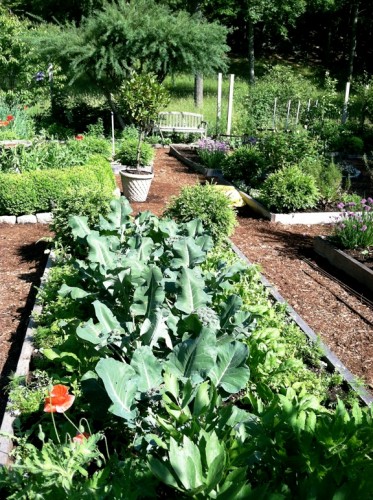
Mulch in April with composted manure in order to achieve a vegetable patch like this later in the season.

In the vegetable garden after preparation and planting, then it is time to mulch. Mulch with the composted manure, which will not ‘cap’—this means, that it does not form a crust like other mulches so that air and water can get through to the roots of the plants where it is needed.      

If you did not apply an organic grub control on the grass in March, apply now to reduce the grubs, which are the food source for Moles and therefore cut down on the mole population.    

Soil is the most important component of production in the garden; with compost, organic manure and peat to amend soil and rebuild its structure. The ratio to use is one part compost to three parts manure and apply peat to the planting mix in the ratio of one part peat to three parts manure when planting evergreens. And as mentioned above, peat adds the acidity which evergreens require.

Good soil structure assists with drainage, prevents compaction, and the rich nutrients with the amendments break down and encourage the soil animals beneath the surface to work at full capacity. In a sandy soil, humus is needed to produce   micronutrients for this soil, which are the combination of manure, mulch and carbon from the atmosphere that binds the sand particles together therefore producing a healthy workable soil. In heavy soil such as clay, the humus separates the clay particles which allows for air and drainage.  

GROWING CONDITIONS IN APRIL are very favorable for new plant-root development. This month is the best time to transplant evergreen shrubs and plant new evergreens. Apply composted manure and peat together with the topsoil in the planting hole. Then give the roots a workout with your hands before planting. Separating the roots in this way gives them the freedom to reach into the surrounding soil for nutrients and water and not dry out in the heat of summer.    

Many years ago, when I moved into my farmhouse on the shoreline, I discovered that my soil was sandy, which is good for drainage but sadly lacking in nutrients.  I began adding a few inches of manure to all planted borders in April, July and October. The result today is when I put a spade in the ground to check the color of the soil in spring it’s ‘black gold’.  

Gloves should be worn when handling manure which contains bacteria; the bacteria is great for the plants and the soil but not good for your health.  These natural soil amendments tend to be slow acting; gradually making the nutrients available to the plants and the rewards are infinite. Composted manure is applied in spring around mid May when the soil temperature has reached 55 degrees and when the plant shows about six inches of growth. This method allows for the nutrients and soil animals to become active at the time when plant growth is occurring at a rapid pace. 

DAFFODILS, which are my favorite flower, are appearing in gardens and on roadways, which is a lovely sight. When the Daffodil bloom has past, do not cut the leaves from Daffodils or any of your spring flowering bulbs, the leaves send down energy into the bulbs to store for next season’s bloom. 

April is the time to tackle a new lawn or patch seed, use only good quality grass seed, organic fertilizers and lime, which provides the alkaline and not acid for the grass.   

Do not be lulled into complacency with a few back-to-back warm days; we can still get frost, so I caution that you not to plant annuals until Memorial weekend.  Do not cultivate around the perennials in the borders until mid-May. 

Do not panic if you were not able to get the April tasks done until May, your garden will wait for you and the constancy that is Mother Nature will continue to keep your patch of earth flourishing. 

Enjoy the pleasure of being outdoors in warmer temperatures, inhaling the pungency of awakening soil and your connection with Mother Nature. Do not overdo it; warm up the body before the garden labor and stay well hydrated with lots of water. 

We are inexorably entwined with the earth and know that even the smallest gesture of a garden has positive rewards; the effects are not only on you but on our planet.  

It is important to have a well thought out plan before creating a new garden or landscape. My son Ian is a landscape designer and creator for the last 30 years and you can arrange your consultation at LandscapesByIan.com

I will see you in your garden with more gardening tips in May and if you have any gardening questions, please email MaureenHaseleyJones@gmail.com

About the author: Maureen Haseley-Jones is a member of a family of renowned horticultural artisans, whose landscaping heritage dates back to the 17th century. She is one of the founders, together with her son Ian, of, The English Lady Landscape and Home Company. Maureen and Ian are landscape designers and garden experts, who believe that everyone deserves to live in an eco-conscious environment and enjoy the pleasure that it brings. Maureen learned her design skills from both her mother and grandmother, and honed her horticultural and construction skills while working in the family nursery and landscape business in the U.K. Her formal horticultural training was undertaken at the Royal Botanic Gardens at Kew in Surrey.

Old Lyme’s Open Space Commission Receives Grant from Rockfall Foundation for Horseneck Creek Landing Program

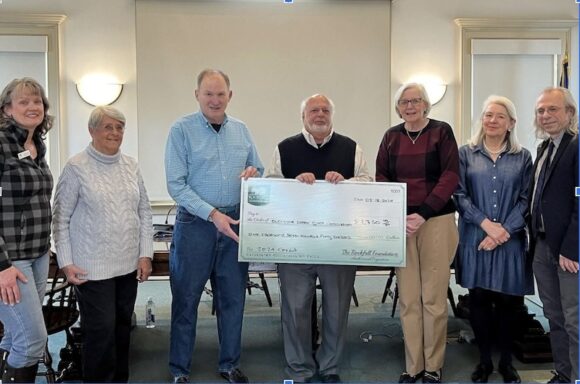
Pictured left to right at the check presentation from the Rockfall Foundation (RF) to the Town of Old Lyme (OL) are Sharon Lewis, RF Board Member, Marilyn Ozols, RF Board President, OL Open Space Chair, Greg Futoma, Tony Marino, Rockfall Foundation Executive Director, Martha Shoemaker, OL First Selectwoman, Jude Read, OL Selectwoman, and Jim Lampos, OL Selectman.

OLD LYME—On March 18, the Rockfall Foundation presented the Town of Old Lyme (OL) with a grant for $1,700 to support a “Coastal Forest and Marshland Conservation and Education” program on the town’s Horseneck Creek Landing. The program will be administered by the OL Open Space Commission. 

Martha Shoemaker, OL First Selectwoman, and other town officials accepted a check from Rockfall Foundation representatives prior to the 3/18 OL Board of Selectman meeting.

The three-acre property offers excellent examples of coastal forest and salt marsh, both under serious threat. Horseneck Creek’s forest includes black, red and white oak, highbush blueberry, northern bayberry, black huckleberry, eastern red cedar, big-tooth aspen and big-leaf marsh elder, among other trees.

Saltmarsh habitats are described as “blue carbon” for their ability to capture significant amounts carbon dioxide from the atmosphere and to store it in grasses and soils, mitigating climate change.

Horseneck Creek Landing also offers wonderful opportunities to see osprey, egrets, cormorants, and great blue herons during the summer, and in colder months, brant and various ducks, including brightly colored hooded mergansers. Bald eagles may also be spotted, and the State of Connecticut reports that seaside sparrow and saltmarsh sharp-tailed sparrows, state-listed birds, may be in the area.

The grant program will complement the existing trail with a virtual guide. A botanist or biologist will collaborate to highlight featured flora. In addition, an interpretative weather and vandal-proof color sign will be produced and installed for visitor information.

Offsite conservation will include sponsorship of a local lecture on coastal forests and salt marshes to encourage their protection. A simple fact sheet will memorialize the message and be physically distributed and be posted for download.

A split-rail barrier fence has been constructed to preserve marshland. While the fence is not within the project scope, it will be part of the program’s friendly message explaining that simply walking on fragile flora can be damaging.

The Open Space Commission looks forward to partnering with Audubon to promote the property as a birding site. Visitors will be introduced to birding apps such as Merlin ID, and an eBird Hotspot has been created. 

Greg Futoma, Open Space Commission Chair, added, “As the Harbor Management Commission works to establish a kayak/canoe launch on site, Open Space looks forward to working cooperatively with its fellow commission to make this beautiful property a treasure for residents and visitors.”

The Rockfall Foundation is one of Connecticut’s oldest non-profit organizations committed to promoting natural resource conservation, sustainable development and environmental education in the Lower Connecticut River Valley.