OLD LYME—We received the following ‘Press Statement’ related to developments regarding the Tantummaheag Landing situation from Old Lyme First Selectwoman Martha Shoemaker late yesterday evening. It is signed by all three members of the Old Lyme Board of Selectmen.
We publish it below in full and unedited.
This evening, we are instructing our town counsel to send a letter to George Frampton and Carla Darista regarding the Town of Old Lyme’s steps moving forward regarding Tantummaheag Landing.
The letter informs the property owners that the town maintains its claim that Tantummaheag Landing is a public highway as is reflected in their deeds.
The letter goes on to explain that we will be completing a survey of the property. Any pins and/or markers which were previously in place which may have been removed will be reestablished by a licensed surveyor.
Upon completion of the survey, the town will determine which plantings interfere with access to the highway/landing. The plantings will be tagged, and the homeowners will have 7 days to remove the plantings they installed. If they are not removed, Public Works will remove or cut down those plantings.
Once the survey is complete and the plantings are removed, the Board of Selectmen will determine the best management to maintain the highway/landing for users. We hope to have this completed by the end of July.
The Board of Selectmen would like the visitors to the landing to be respectful of the property owners. The landing will only be accessible from 9 AM to dusk daily during this period. If you are planning on kayaking from the landing, please note that you cannot have direct access to the landing at this time. Please back up your vehicle to the planting line, drop off your kayaks and return to the street to park. Due to the plantings, parking is not permitted currently on the property. We ask that you take every precaution not to disturb the plantings
The local police and Troop F have been provided with this information and have been asked to instruct their officers of the current situation and our process to resolve it.
As always, the Board of Selectmen believe that our residents will be respectful of the property owners and their abutting land.
Editor’s Note: We will have more on this developing story shortly.
“The darling buds of May” is such an apt phrase for one of the most enchanting months with bloom on spring bulbs and flowering trees, the Amelanchier, the Dogwood and the Cherry to name a few and the new awakening red foliage of Maples winking in the sun.
By now, you have probably removed most of the winter debris, pruned broken branches and re-edged borders. Do not apply composted manure before the soil warms up to 60 degrees. The reason why, you may ask, is that the soil at this temperature awakens soil organisms, which work with the bacteria of the manure to produce nutrients for the roots of the plants. I suggest therefore, when shopping for garden supplies, pick up a soil thermometer to check soil temperature which I feel will reach 60 degrees in a few weeks.
As I walk around the garden, I am seeing my old nemesis, weeds, emerging everywhere. Pull these marauders up by hand, without breaking the weeds and the roots. If you use a tool, this will break the weeds and the broken weed pieces will take root and then you will be facing hundreds of these unwanted visitors more to dispose of yet again.
After weeding, lightly spread on the clean area, an organic corn gluten- based weed pre-emergent by Bradfield Organics; this organic product will keep weeds at bay for quite a few weeks.
In early May, apply composted manure around daffodils and other spring bulbs so that the manure and soil organisms can produce nutrients to feed the bulbs for next year’s bloom. Also, I am asking that you do not cut down the Daffodil foliage as the nutrition from the foliage is absorbed into the bulb for bloom next spring.
In mid -May, with warmed-up soil, apply composted manure and a light layer of fine bark mulch to all maintained areas of the garden, repeat this procedure again in July and finally in October before putting the garden to bed. By giving this attention to the garden, the manure and mulch will begin to build the important humus component.
Types of mulch:
Only use the natural brown wood mulch and please do not use the colored mulches and rubber mulch, which contain poisonous chemicals.
A word of caution on Cocoa Mulch. This product is highly toxic to dogs and cats. This product is manufactured by Hershey and sold in many large garden centers. It is made from the residue of chocolate products and other ingredients and contains a lethal ingredient that has resulted in the reported deaths of cats and dogs that are attracted by the chocolate odor. This mulch contains Theobromine, which is a Xanthine compound with caffeine and theophylline, a dangerous combination. When animals eat this product; it causes seizures and death within hours.
At this point once again, I need to emphasize the importance of the humus component for your soil continuing to build it as part of your garden regimen.
All living things including us humans, are all carbon-based creatures. The Humus you are building in your soil encourages carbon from the air to enter and blend with the soil.
Humus acts like a sponge and holds 90 percent of its weight in water. Because of its negative charge, plant nutrients stick to humus bringing nitrogen, calcium, phosphorus and other important elements to the plants, which prevents these nutrients from washing away and acts like nature’s slow- release fertilizer.
Humus improves soil structure making it loose and friable, which helps plants to root in this environment with easier access to nutrients, water and oxygen. Humus also helps to filter toxic chemicals from soil, much like carbon-based water filtration systems filter toxins from your water.
Roundup
I recommend, when you have a few moments after gardening, that you go online to Scientific American.com/article/Weed-Whacking Herbicide to check out the dangers of Round up. This is the most dangerous herbicide not only because of Glyphosate, which is on the list by the WHO as a chelating agent that causes cancer together with its inert ingredients. I ask that you are not swayed by the word ‘inert’ as the ingredients are anything but inert and those ingredients combined with Glyphosate are deadly to human cells.
Forsythia brings its own version of sunshine into the world!
Forsythia is in bloom with lovely fresh yellow blossoms. If the bloom on your shrub is not as prolific as it was in previous years, prune out the old sparse wood after bloom ends.
A favorite native tree of mine is the Amelanchier (common name is Shadblow Serviceberry, named for the Shad fish that run in the rivers at this time to swim upstream to spawn). This early spring blooming tree has creamy panicle blooms, followed by small green leaves and within weeks, produces red fruit, which is a delicious treat for our feathered friends. Before the birds eat all the fruit, you may want to pick some of the fruit as it makes a delicious jelly for your morning toast.
Here in my town of Old Lyme, the Magnolias, Cherries and Eastern Redbud are vying with one another to show off their finery together with the buds and foliage of the graceful Dogwoods beginning to emerge. Following the recent rains many of these trees are blooming at the same time or within a few weeks of one another. Their bloom will soon be over but then we can look forward to Rhododendrons, Azaleas, which are followed by Mountain Laurel in early June.
A special favorite of mine is a shrub; the Carlesii viburnum (also known as Korean Spice) with its pink buds, opening to white flowers and their delightful fragrance fills the air outside my kitchen door. This viburnum grows to about five feet and can be tucked into many a border particularly in an area where you often walk by to inhale the fragrance.
Blue climbing hydrangeas make a stunning display. Photo by Gemma Evans on Unsplash.
Covering the barn wall and scrambling up to the barn roof is my climbing hydrangea – bright green leaves are emerging with hundreds of buds, which indicates that this beautiful climber will be laden with blossoms in summer.
Tulips, creeping phlox, forget-me-nots, primroses and candytuft are bringing much needed color to borders and rock gardens.
If you have not had the opportunity yet, for another couple of weeks, you can still prune your roses. Pull back the old mulch from around the base of the roses and in two to three weeks apply manure about six inches from the trunk of the plant. Then a week later reapply a layer of the brown natural mulch on top of the composted manure. As well as building the humus component, these layers keep the roots cool, keep weeds at bay and help retain moisture. Do not mulch right up against the base of any plants as this encourages rodents to nest and gnaw on the plants.
Beware of fungi that look like weird mushrooms in your mulch; this is Artillery fungus, which can adhere to the walls of your home and cause problems. If you notice this fungus, you will need to remove all the mulch and get it off your property.
Apply a small amount of lime and about three inches of manure around the lilacs which like sweeter alkaline soil, indicating the use of the lime. By now, you may have already applied lime to the grass, which also enjoys sweeter soil and spread organic grub control which eliminates the Japanese beetle
larvae therefore reducing the chance of moles as you are cutting off some of their food source.
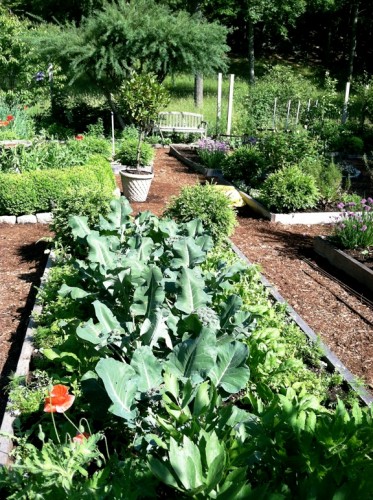
If you are making an organic vegetable garden this year; a garden measuring 16 x 24 can feed a family of four for a year; but keep the size within your needs and capability.
Don’t dig soil if it is too wet or too dry.
Double digging the vegetable garden takes time but is always worth the effort.
Double digging for the vegetable garden is the best method although this takes time and effort but its well worth it – dig down about one foot and remove the topsoil, put the soil to one side, then dig down and loosen the next six inches of soil and add about three inches of composted manure then put back the topsoil and add another three to four inches of manure.
Do not rototill the vegetable garden, as this destroys soil structure. Gently loosening the top few inches of the soil to aerate it, makes it friable and results in an excellent yield of fruits and vegetables.
I prefer 6 x 4ft beds rather than rows; beds produce a larger yield of crops. In addition, beds make for ease of weeding and harvesting by having narrow compacted soil or grass paths (having removed lawn from the area) in-between the beds.
The vegetable garden should be situated on the south or southwest side of the property for maximum sun exposure.
You need a water source close by as vegetables require lots of water, particularly annual fruiting vegetables like tomatoes, which are hydroponic which means they consist of a large amount of water.
Crop Rotation, by that I mean, do not plant the same vegetables in the same place as the previous year. Using this method helps to prevent any soil- born diseases occurring.
In the loosened soil, plant the vegetables plants so that they are touching, this forms a natural canopy, shading out weeds and helps retain moisture.
I prefer to mulch the vegetable garden with composted manure, the reason being that manure, as mulch, does not cap. Capping is when mulch forms a crust, which does not allow water or air to penetrate to the roots of the plants.
Fence in the vegetable garden with a tall fence to keep animals out. At the base of the fence install eight inches of fine mesh chicken wire above ground and eight inches below ground to keep out the digging and burrowing animals.
Organic insect control
Insects do not like fragrance so plant fragrant plants like marigolds, nasturtium, lavender, nepeta, honeysuckle and roses to name a few.
Encourage lacewings, which feed on aphids by planting marigolds and sunflowers,
Attract ground beetles by laying a log or a rock on the earth, under which the beetles can hide. These useful insects are nocturnal and eat slug and snail eggs, cabbage maggots, cutworms and even climb trees to feed on armyworms and tent caterpillars.
Following all the rain, your grass is hopefully a vibrant shade of green; when mowing keep the blades of grass at about three inches tall; the taller blades attracts sunlight, promoting a healthier lawn. The taller blades also shade out weeds and help to retain moisture in the grass.
When mowing, leave grass clippings on the lawn, the clippings are a natural source of nitrogen. If you have clover in the grass, clover is an added benefit as clover takes nitrogen from the air and fixes it in the soil, which is an additional nutrient for plant growth.
After flowering is over, prune flowering shrubs by 25 percent – do this task immediately before new buds set for next year.
On a rainy day go shopping for any garden supplies that may be needed, then when the weather is dry you can be outdoors doing what you love and not indoors shopping. Buy good hoses, cheap ones will bend and crack.
Peonies are a wonderful addition to any yard. Photo by Jaroslava Petrášová on Unsplash.
Peonies need plenty of water to produce flower buds. I had a thirty-foot long stand of Peonies in my field. The Peonies have been in the ground for over fifty years and are a sight to behold when in bloom. I gave them lots of loving care with a light dressing of aged manure in early May. In a few weeks, I pinch off the side buds while they are still small, leaving the terminal flower bud on each stalk, which develops into a large main bloom.
Hydrangeas are a wetland plant and require plenty of water during the season, with the addition of manure and mulch around the base. If you have blue Hydrangeas and want a deeper color of blue, also add some peat around the base of the plant, the acidity in the peat produces the bright blue color.
If you need to prune a Hydrangea, which has become too large then prune it immediately after flowering, in EARLY SEPTEMBER, prune about 1/3 of the old wood and the weakest shoots. DO NOT WAIT, as Hydrangeas begin to develop bloom buds for next year later in September. If you wait to prune it is likely that you will not have bloom for next year.
The much-beloved Lily of the Valley has a delightful fragrance.
My maternal grandmother’s favorite plant, the Lily of the Valley will bloom in another couple of weeks. These lovely flowers are tucked on the small rise on the west side of my apartment, and I am so looking forward to gathering a few fragrant blooms to enjoy indoors.
When the lilacs have finished blooming, pinch off the withered flower clusters, and do the same on the mountain laurel and rhododendrons in late June to ensure good blossoms next year.
In mid May apply composted manure, a light application of peat and fine bark mulch around all evergreens and rhododendrons, mountain laurel and azaleas; these plants are shallow- rooted and the mulch will keep the roots nourished, protected, warm and moist.
Some annual seeds that may be planted outside in mid May are: Calendula, Coreopsis, Marigold, Nasturtium, Nicotiana and Zinnia.
FROST, FOLKS TAKE NOTE – If you purchase annuals, on Mother’s Day weekend, place them in a sheltered spot on the south side of your home. Plant them no earlier than Memorial weekend as we can still get a late frost.
Tuberous-rooted begonias, caladiums, cannas and elephant ears can be moved from porch or cold frame to a part shade area as the weather becomes warmer and there is no sign of frost in the forecast.
If you staked trees, when they were planted last year, cut the stakes off at ground level, do not pull them out otherwise the roots of the trees could break and be damaged.
Aphid tip: squish a few in your hand; dead aphids release a chemical that causes other aphids to drop off the plants.
Another ants and aphids tip – if you drink mint tea, any leftover tea sprinkle on the bugs, as they do not like the smell of mint.
Mint spreads vigorously in the yard.
A WORD OF CAUTION ON MINT – plant mint only in containers, mint is tremendously invasive and can take over your garden.
When planting annuals, perennials, vegetables, trees, shrubs or evergreens keep them watered.
Houseplants can be moved outdoors for their summer sojourn at the end of May. However, do not put your African violets outdoors as they will burn, move the violets to a porch that is covered and shaded, or keep them indoors in a window that does not receive direct rays from the sun.
Wait until the soil warms up at the end of May to set out Dahlia tubers.
ROSES – I like to plant David Austin roses; these shrub roses are repeat bloomers with lovely fragrances.
Roses need at least five hours of sun per day, good air circulation, and excellent drainage. During their growing period from the beginning of June to mid August; add a little extra composted manure each month; it may be applied over the mulch. Stop adding the manure in August so that the roses can go into a slow dormancy.
Roses like the same growing conditions as Clematis and can be planted together in a ‘companion planting’, which means they grow well together, with feet in the shade and head in the sun. I planted a climbing pink Rose and purple Clematis on a trellis on the chimney breast on the west side of my house, which was a lovely combination. Before you top up the soil around the roses, when planting add water and check if the soil drains, roses need good drainage. Deep watering is recommended at least once a week.
Plenty of stuff to keep you hopping folks and remember to keep your eye out for any pest trouble and when you spot it get on the ball immediately to avoid further problems. Carefully discard all herbicides and pesticides; these poisons have the same effect on your health as second- hand smoke.
Your garden offers an anchor for peace and quiet enjoyment. Enjoy the warmth, the gentle breeze, the earth’s fragrance and bloom and please remember to breathe and stretch before any garden labor. Enjoy and I will see you in your garden next month.
If you would like my son Ian of LandscapesbyIan to visit your home for a consultation, feel free to contact him.. As the old saying goes, ‘the apple does not fall far from the tree’ and you will not be disappointed in his work!
About the author: Maureen Haseley-Jones is a member of a family of renowned horticultural artisans, whose landscaping heritage dates back to the 17th century. She is one of the founders, together with her son Ian, of, The English Lady Landscape and Home Company. Maureen and Ian are landscape designers and garden experts, who believe that everyone deserves to live in an eco-conscious environment and enjoy the pleasure that it brings. Maureen learned her design skills from both her mother and grandmother, and honed her horticultural and construction skills while working in the family nursery and landscape business in the U.K. Her formal horticultural training was undertaken at the Royal Botanic Gardens at Kew in Surrey.
And away they go … the 11th annual Tour de Lyme will take place Sunday, June 2.
LYME — The 11th annual Tour de Lyme is happening again on Sunday, June 2.
For competitive riders, this is a chance to warm up for the cycling season ahead. For others, it provides a wonderful occasion to pedal through Lyme and enjoy the surrounding countryside. If you are a mountain biker, this is an opportunity to ride through private lands open only for this event.
Everyone – riders, sponsors, and volunteers – will enjoy a post-ride picnic at Ashlawn Farm with popular food trucks, beer and live music. There will also be Tour de Lyme shirts for sale.
Online registration is open through midnight EST on Friday, May 31. Note registration at the event is an additional $10.00
Ready to ride!
It is not a race but a carefully planned series of rides designed to suit every level of skill and endurance. There are four road rides of varying length and degree of difficulty:
The CHALLENGE, the name says it all, is 60 miles – a real workout;
The CLASSIC, shorter at 25 miles, but still a challenge;
The VALLEY Rides ‒ pleasant easier rides with fewer hills, 26 miles or 35 miles
The FAMILY ‒ at just 8 miles designed for riding with children.
There are also two mountain bike options;
the RIDER’S TEST a 26.5 mile ride for serious enthusiasts
a shorter, less challenging option.
The Tour de Lyme is hosted by The Lyme Land Conservation Trust.Since 1966, the Lyme Land Trust has been conserving the unique and historic landscapes of Lyme, Connecticut. During those years, the Lyme rural community has shown that a small population can have a big impact and protect more than 3000 acres of woodlands, working farm fields, and bird-filled marshes. The result is an outdoor paradise – open to all.
Money raised from the Tour de Lyme will create added opportunities for public enjoyment of the Land Trust preserves while protecting and maintaining what has already been conserved for generations to come.
The Lyme Land Trust is a 501(c)(3) non-profit organization – registration and donations are tax deductible.
Lyme-Old Lyme High School crew celebrates its success at the CT Public School State Championships held May 19 at Lake Waramaug in Litchfield.
‘Learn to Row Day’ Slated for Saturday at Rogers Lake, All Welcome
OLD LYME —On May 19, was your quiet Sunday evening interrupted by a cacophonous police escort of two school buses to the Fred Emerson Boathouse? It was the Lyme-Old Lyme High School (LOLHS) crew celebrating yet another success at the Connecticut Public School State Championships.
The Fred Emerson Boathouse, now in its third building opened in 2017, has been an incubator for rowing excellence for over 50 years. Started in 1965 on Blood Street by Fred Emerson, the organization initially known as Blood Street Sculls has cultivated national champions and Olympians since its inception.
Lyme-Old Lyme High School (LOLHS) crew operates out of the Fred Emerson Boathouse and is supported by Old Lyme Rowing Association (OLRA).
On Sunday, May 19, the LOLHS crew competed in the Connecticut Public School State Championships on Lake Waramaug in Litchfield. Lyme-Old Lyme High School crews won the four varsity races in four-person boats, returning the Hart Perry Points Trophy for excellence in fours to LOLHS.
Lyme-Old Lyme High School garners much of its excellence from our opportunity to introduce middle school students to the sport of rowing in the Summer after their 7th and 8th grade years. The Novice Boys Four includes three athletes, who learned to row in OLRA Summer programs, preparing them to start their first year of competitive rowing in July after their 8th grade year. Still in their first year of competitive rowing, these freshmen came on the high school rowing scene as talented oarsmen.
Having recently won Connecticut State Championships, they represented LOLHS at the prestigious NEIRA regatta on May 25 in Worcester, Mass.
Lyme-Old Lyme High School seniors proudly display the respective pennants for the colleges where they have chosen to continue their rowing careers.
Eight LOLHS graduating seniors are planning to continue rowing in college. College choices include Division One (U. Tennessee, U. Connecticut, U. Rhode Island and U. Southern Florida) and Division Three (Colby College and Bryn Mawr College) as well as Wentworth University and Embry-Riddle Aeronautical University. It is generally believed that making the transition to collegiate life, with the healthy lifestyle and strong friend group afforded by crew increases the probability of collegiate success.
Readers are recommended to look out for a banner at the corner of Grassy Hill and Boston Post Roads, honoring LOLHS/OLRA 2024 Olympians. Liam Corrigan will stroke the US Men’s Four and Ben Washburn will stroke the Para Mixed Four.
Join OLRA at the Emerson Boathouse for Learn To Row Day on Saturday, June 1, from 10 a.m. to 1 p.m.
Summer programs for middle school students are currently open for enrollment.
Visit www.oldlymerowing.org to introduce your Middle School student to a passion, which will likely open doors, and keep them healthy for life.
Thank you, Mr Caron [regarding you letter dated May 22, published on LymeLine.com.] These concerns [re the gravel pit along the Three-Mile River located at 308-1 Mile Creek Rd. in Old Lyme] are very real, and the neighbors of this property are suffering economic, environmental and disturbances to the peace on our properties.
The 1984 (!) noise ordinance in Old Lyme is virtually useless and toothless.
The owner of the property has demonstrated disrespect and lack of civility toward their neighbors.