Lyme Celebrates ‘The Fourth’ With a Perfect Parade

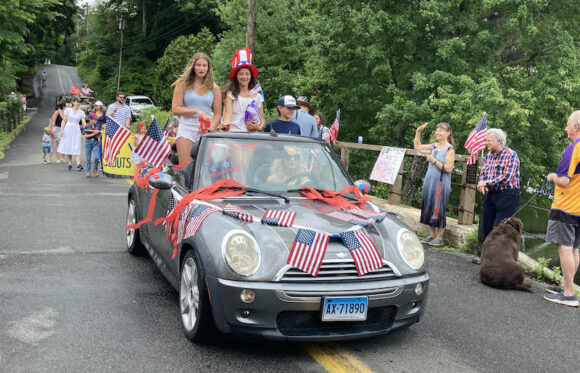
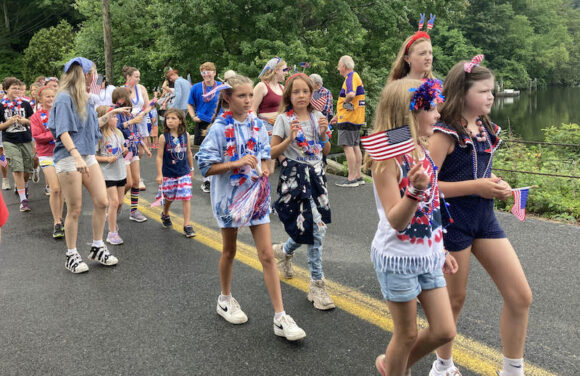
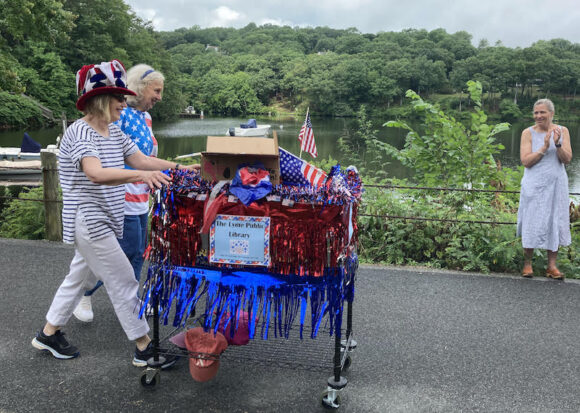
Lyme’s Independence Day parade brought out colorful cars and characters galore! All photos by Michele Dickey.

LYME — UPDATED 7/6 WITH MORE PHOTOS AND ADDITIONAL TEXT: Thankfully pouring rain and dark skies at 9 a.m. did not determine the day. By 9:30 a.m., the sun was breaking through as Lyme’s perennially-popular hometown parade stepped off at 10:09 a.m.


This year’s Grand Marshal was Steve Mattson, pictured above left, who led the parade as a passenger in a vintage car driven by George Willauer. Mattson served as a Selectman on Town of Lyme’s Board of Selectmen for 17 years and then as First Selectman for five years, before retiring in 2022. He continues to serve the Town as a member of the Board of Finance.


The Grand Marshall’s car was followed very closely by a float portraying astronauts on the moon.


A vast number of Camp Clare campers came after the ‘astronauts.’

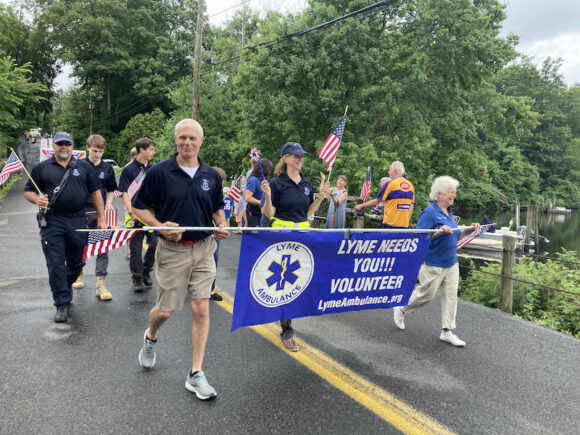
Next came members of Lyme Ambulance seeking more volunteers and passing out frisbees as incentives!


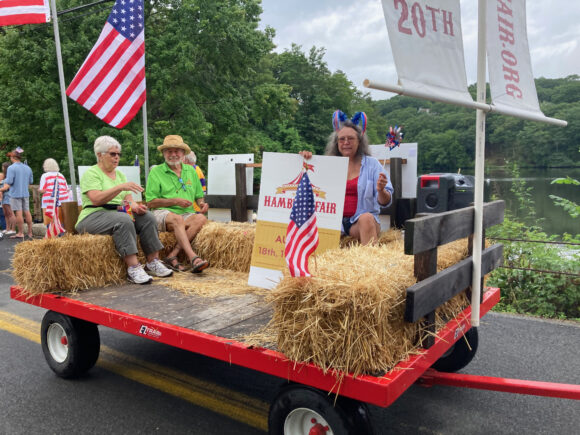
After that, there were two floats  announcing this year‘s Hamburg Fair on Aug. 18-20. The Fair Is always held on the third weekend of August — for more information, visit www.hamburgfair.org.


Next came the Lyme Garden Club, the Lyme Land Trust, and the Lyme Public Library.

I
t was a great day for “free”! Aside from the usual candy, given to children in generous amounts, the Garden Club was offering free native plants at the Lyme Public Hall following the parade.


Wendy Sutton passed out stickers that read, “Plant native for caterpillars – join the Pollinator Pathway.”


Bruce Noyes drove his World War II vehicle while his wife Tammy and Lyme First Selectman David Lahm traveled in style above!

Still more “free” was yet to come. Steve Evankow had a young passenger handing out huge bulbs of fresh garlic, softball-sized! Many recipients were delighted to receive this generous gift.


Cub Scouts followed close behind, and the parade adjourned by 10:15 a.m. to head for the Hamburg Cove Yacht Club to enjoy the traditional free popsicles.

Op-ed: Book Banning Is About More Than Book Banning

Editor’s Note: This op-ed was submitted to us by Old Lyme resident William Fitzgerald. He has also sent it the members of the Old Lyme Board of Selectmen (BOS) and the Old Lyme Phoebe Griffin Noyes Library Director and Board of Trustees. The Old Lyme BOS meet this evening at 5:30 p.m. in the Old Lyme Town Hall with the item, “Inappropriate Book in the Phoebe Griffin Noyes Library – Stephen Spooner and Others” on their agenda under the Communications section. Fitzgerald has asked to BOS to enter this piece as Public Comment for the meeting.

Over the last few months in Lyme and Old Lyme, book banning has been a frequent subject of conversation. The issue first sparked up when the Old Lyme Republicans generously mailed their platform to every member of the town, and were then surprised when people actually read the platform and flagged that one of their key foundations — a shout-out for so-called “parental rights” — mirrored a larger, well funded political strategy popular among the far right.

The most current flare up centers around two letters sent to the Old Lyme Library. The bulk of the attention has been focused on the book banning and censorship efforts included with the letter.

This conversation is misguided, and misses the point.

The letter also includes multiple other demands and observations that are equally offensive, including:

  • a veiled threat about library funding; 
  • a demand that library staff time be wasted replicating review work of every book in the tween section; 
  • a shot across the bow of educators in the school district; and 
  • a demand that the library staff change the “focus for our community’s children”. 

The authors of the letter have gone to some lengths to state that they are not trying to ban books, and that they are only trying to have books reviewed. That very well might be their intent.

However, given that we live in a world where actual words mean actual things, the impact of their letter, and the actions required by their letter, differ from their stated intent. Our local library is a safe place, unless you are afraid of ideas. Library staff deserve our thanks and gratitude.

The impact of the letter attempting to censor books includes threats and intimidation directed at librarians and school staff. This aligns directly with ongoing national efforts. Whether this alignment is coincidental or intentional is irrelevant.

  1. The Distractor Questions

Two questions have been asked repeatedly. I am highlighting them here because they are useful examples of distractor questions, and attempting to answer them erodes our ability to understand.

1. Have you seen the pictures? How can you think that these pictures are okay for kids?

2. An age review of the material to determine if it’s age appropriate, and moving the book if it’s not, seems reasonable. What’s the problem with that?

The reason both of these questions, and any attempt to answer them at face value, is a distraction, boils down to one word: context.

The first question demands that we ignore the full scope of the book, and only focus in on a narrow subset. I wish that the people spending so much time complaining about the pictures spent equal time reading about the sections covering consent and abusive relationships.

Regarding the appropriateness of the content, this question ignores a couple important things. First, we already have a review process, in the form of professional, trained staff. Second, narrowing in on the demand for a review ignores the larger context of the entire letter. The review sets a precedent, and the request for a review has less to do with the actual review than with flexing power.

The full context of the letter makes that clear, and as such, entertaining narrow questions about the appropriateness of any review is a non-starter, not to mention a blatant slap in the face to the professionalism of library staff.

And to highlight the larger context here: around the country, hundreds of people are filing thousands of book challenges using the exact same criteria used here, in Old Lyme: this content isn’t age appropriate, and therefore it needs to be removed. For one of many examples of what this looks like: in March of 2023, a principal of a school in Florida was forced to resign after students in her school were shown pornographic material. This is terrible; clearly she deserved it — except the “pornography” in question was Michaelangelo’s David.

A second example from this spring, with direct parallels to the demands made to the the Phoebe Griffin Noyes Library, comes from Indiana. The teen section of the Hamilton East Public Library in Noblesville, Indiana was gutted after a board-ordered review of books in the teen section. This review cost over $300,000.00 and was accompanied by the familiar request: move the “age-inappropriate” books to the adult section. This is the exact review process described in the letter sent to the library board and staff at the Phoebe Griffin Noyes library.

  1. The National Context

The letter sent to the library, paired with the private meeting with the middle school principal, both align with strategies used by the well-funded national “parental rights” movement. Nationally, the rhetoric of “parental rights” have been bundled together as a series of related policies:

  • Prevent history courses from teaching about slavery, the civil rights movement, and the gay rights movements; 
  • Censor what books are allowed in school and libraries; 
  • Harass teachers and schools via “school transparency” initiatives; and 
  • Erode or eliminate the rights of gay, queer, and transgender people, often starting with youth. 

The most visible incarnation of these policies is probably Ron DeSantis in Florida, although multiple parallel efforts are underway across the country.

The “parental rights” movement evolved from the fabricated outrage over what the right mislabeled “critical race theory.” A key player in the “parental rights” movement has been “Moms for Liberty,” a group that started in Florida and grew with the help of funding from rightwing political activists. The activists pushing “parental rights” have been clear and vocal about their goals, and the methods they will use to achieve those goals.

The following quotation from a conservative activist and Moms for Liberty board member clearly defines their perspective.

“Our laws need to evolve to respond to these new techniques and things that they’re using,” said Jeff Childers, an attorney and conservative commentator who serves on Moms for Liberty’s board, and was also on the panel about Florida’s new law. “So I look at the parents’ bill of rights and the amendments that we’ve had since — it’s a really good framework, right? That’s like taking the body of an AK-47, and then we can start mounting new accessories onto it: a flashlight, a laser pointer and things like that.”

Childers advised those in more liberal states to try to pass a parental rights measure through their school board or county commission. He said that local action would eventually wear down resistance from lawmakers at the state level.

“Our adversaries, it’s not just that they don’t care about our children — I believe they’re actively trying to harm our children,” Childers told the audience, to applause.

The conservative activist working to spread the rightwing vision of parental rights uses an AK-47 as a central metaphor about education, which is an interesting choice given the prevalence of school shootings. The conservative activist also identifies school boards and local politics as a way to normalize hateful policies. Finally, the conservative activist clearly states that “adversaries” are “actively trying to harm our children.” The fact that the conservative activists behind the rightwing co-opting of parental rights attempt to demonize opposition to their policies as actively harming kids needs specific attention.

Texas also provides an example of how, nationally, Republicans are implementing “parental rights” and the discriminatory policies embedded under the umbrella of “parental rights.”

In 2021, Texas passed a law limiting what can be taught about slavery and racism, and how it can be taught.

This was followed by attempts to censor books, which included targeting librarians.

In 2022, Texas governor Greg Abbott promised to pass a “parents bill of rights.”

In 2023, the Texas legislature is attempting to pass a range of legislation targeting LGBTQ people, and attempting to erode basic human rights.

In Missouri, we see the same toxic collection of policies: a self-described parents bill of rights, state action preventing transgender people from receiving health care, and a state bill attempting to defund all libraries.

Nationally, libraries and librarians are under attack.

These are the policies nested alongside “parental rights”. The advocates for these policies have been very clear about their goals, and we should believe what they say. The examples I’ve provided here are a small subset of the efforts currently happening across the country.

  1. The Full Context of The Letter

In the opening of this piece, I describe four things the letter does in addition to requesting the censorship of specific books. To reiterate: the author of the letter has clearly stated that his intent does none of these things. However, intent and impact are two different things. This piece focuses exclusively on impact.

The letter has four impacts that extend beyond the censorship of these two titles. Specifically, the letter contains:

  • a veiled threat about library funding; 
  • a demand that library staff time be wasted replicating review work of every book in the tween section; 
  • a shot across the bow of educators in the school district; and 
  • a demand that the library staff change the “focus for our community’s children”. 
  1. Veiled threat about funding

The letter sent to the library includes a copy of the purchase decision used for this book. The formality of including a copy of the purchase decision — which to the best of my knowledge aren’t publicly available — clearly situates this letter within the context of an economic decision.

This weirdness continues in the next paragraph with the statement that “Every community has limited financial resources and prioritizes how to spend its funds. Libraries must make decisions about what material and content they purchase for public consumption.”

While this somewhat generic statement is true as a general observation, in this context it can be interpreted as a veiled threat. Of course, the letter doesn’t come directly out and say, “We want these books removed or else we will work to cut funding,” but the juxtaposition of a complaint with a discussion about funding certainly creates that connection, especially against a national backdrop where libraries are being targeted for defunding by conservatives.

This threat gets reinforced in the next paragraph when the letter states that it is signed by “taxpayers.” Individually, these references would only feel stilted and overly formal, but collectively, they create an implied threat. Collectively, these statements feel a bit like someone walking up and muttering, “Nice library you got there. It’d be a shame if something happened to it.”

  1. Demands on Library Staff Time

These demands are clearly laid out in the letter. “We ask that you reconsider your decision on this book and its availability to children ages 11-19. If it is determined to be inappropriate, we request a proper review of the materials in the Teen/Tween room in hopes that no other content like this is available in that space.”

Library staff are professionals. The demand made by members of this town second guesses their professionalism, and attempts to substitute the narrow morality of a subset of the town for the professional judgment, training, and experience of library staff. Over time, this will cause staff to leave, and we will not be able to retain talented people because, let’s be blunt: good people have options, and no one should have to deal with micromanagement and harassment.

  1. Intimidation Directed at Educators

The letter states that their efforts included meeting with the Middle School Principal.

“Some of the names below have met with Region 18 middle school principal who has assured us that this material is not available in our schools, as it ought not to be.”

This statement takes on additional weight because of the inclusion of “Parental Rights” within the Republican Town Committee’s platform, and the fact that the letter is signed by the first selectman, the second selectman, and multiple members of the board of education. What comes across very clearly in this statement is that Middle School teachers can’t count on full support against parental meddling in curriculum.

This is subtle intimidation, and this is why educators leave the profession.

  1. Demand For a Shift in Library Mission

This demand is clearly stated in the letter. “Lastly, we encourage a change in the library’s focus for our community’s children.”

  1. Closing

The demands of this letter make clear that censoring books is only the beginning. Attempts at censorship are divisive; standing up to attempts at censorship can bring us together. Censorship is not popular.

The letter is signed by representatives of the Old Lyme Republican Town Committee, multiple Selectmen, and people elected to Lyme and Old Lyme’s School Board.

I hope that some of these people reconsider their support of this letter. This town has a choice, and I hope that we can show — clearly and decisively — that we do not support censorship, and we do not support intimidation of the professionals that work within our town.

Lastly — a lot of this conversation uses the common refrain of “we’re doing this for the children.” I’ll say this loud for those in the back: we need to stop underestimating youth. The kids in this town hear this conversation, and they hear what’s happening nationally. We are sending them a clear message that the adults around them don’t trust them with accurate information. Just by the necessity of having this conversation, we have shown them that we underestimate them. They won’t trust us, and we have earned that skepticism.

Editor’s Note: This is the opinion of William Fitzgerald.

Sound View Celebrates Independence Day In Its Own Special Way

Joann Lishing led the cheerful parade from the Shoreline Community Center down Hartford Ave. to the flagpole. All photos by F. Pappalardo.

OLD LYME — On Saturday, the Sound View Beach Association (SVBA) hosted another great ‘hometown’ Independence Day parade.

This firetruck had a ‘fireman-in-training’ aboard!

The air was filled with much music, merriment, joy and laughter as large crowds turned out to participate in or watch the years-old tradition.

VFW Post 1467 marched down the parade rout drawing many cheers.

Awards were presented at the end of the parade for best-decorated bike or wagon, most patriotic outfit, best float, funniest outfit and more.

More Than 400 Sign Letter Supporting Old Lyme Library, Urging Rejection of Censorship Requests ‘In Their Entirety’

*COMMENTING ON THIS ARTICLE IS NOW CLOSED*

OLD LYME — We received a copy of the letter below from Old Lyme resident David Rubino. The letter is addressed to the OLPGN Library Director, Officers, and Board of Trustees and urges the Old Lyme Phoebe Griffin Noyes (OLPGN) Library to “reject the requests of the censorship supporters in their entirety.”

As at 8 p.m. last night, more than 400 people had signed the letter in the 24 hours that it had been available.

At 12:50 p.m. today, the number had risen to 442 with additional signatures still being verified.

Signatures are still being collected. Anyone wishing to sign the letter/petition can do so at this link.

The letter is in response to a letter sent by a group of Lyme and Old Lyme citizens requesting the OLPGN Library should reconsider its decision to include a specific sex-education book in its collection, undertake, “a proper review of the materials in the Teen/Tween room,” and, “… encourage a change in the library’s focus for our community’s children.”

He explained that a small group of Lyme and Old Lyme residents came together to organize preparation of the letter and collection of signatures. Rubino added that he and Kimberly Russell Thompson are overseeing signature collection and maintaining the master list of signatories.

Signatories include Old Lyme Selectwoman Martha Shoemaker, Lyme Selectman John Kiker, Region 18 Board of Education member Jason Kemp, and New York Times best-selling author Luanne Rice.

Various other signatories serve on Old Lyme Boards and Commissions including Mary Jo Nosal (former Selectwoman and current Zoning Commission), Gil Soucie (Zoning Commission), Edie Twining and Michael Reiter (Halls Road Improvement Committee), and Kimberly Russell Thompson (Board of Finance).

The letter reads:

Dear Madams/Sirs: 

First, let us begin by apologizing for the necessity of this correspondence and the unenviable  position in which you have all been placed. None of the signatories of this letter imagined that in  a community like Lyme/Old Lyme, in the year 2023, we would find ourselves forced to publicly  assert our opposition to book-banning. Yet here we are. 

As you know, some members of the public have written to you complaining about certain books  found in the Tween/Teen reading room. To proactively counter charges of censorship, they  claim they aren’t seeking a “ban” though they paradoxically request that the library “reconsider  [its] decision on this book and its availability to children ages 11-19”1 and conduct “a proper  review of the materials in the Tween/Teen room in hopes that no other content like this is  available in that space.” This is censorship and nothing more. It is the very definition of a book banning campaign. We the undersigned write not only to assert our strong opposition to any such  censorship in our community, but to make clear that those seeking this ban represent a small  fraction of the community at large. 

We believe, as Annex A to the Phoebe Griffin Noyes Library Collection Development Policy so  eloquently states, that, 

“[T]here is no place in our society for efforts to coerce the taste of others, to confine  adults to the reading matter deemed suitable for adolescents, or to inhibit the efforts of  writers to achieve artistic expression… We cut off literature at the source if we prevent writers from dealing with the stuff of life. Parents and teachers have a responsibility to  prepare the young to meet the diversity of experiences in life to which they will be exposed, as they have a responsibility to help them learn to think critically for themselves. These are affirmative responsibilities, not to be discharged simply by  preventing them from reading works for which they are not yet prepared. In these matters values differ, and values cannot be legislated; nor can machinery be devised that will suit the demands of one group without limiting the freedoms of others.

1 It’s worth noting that 18 and 19 year olds can legally drive, vote, serve in the armed forces and marry in  all 50 states. If ever there was an indicator of the unreasonableness of the drafters’ request it is this: they unabashedly ask the library to ban legal adults from accessing books.

We likewise support the policy’s admonition that, “[r]esponsibility for children’s use of  materials rests solely with their parents or legal guardians. Selection of material will not be inhibited by the possibility that items may come into the possession of children.” 

Though we would suggest that the content of the primary book in question, “Let’s Talk About it:  The Teen’s Guide to Sex, Relationships and Being Human,” is of little relevance in this context, we are aware that independent reviewers such as the Kirkus Review, Publishers Weekly and the School Library Journal all reviewed it positively. In addition, we know that the book’s two authors have had their work featured in the Tate Modern Museum in London. We do not offer  this as proof of the objective value of this book or its merit, but rather for the proposition that reasonable minds may differ in this regard. Banning, censoring or restricting books for  “objectionable” content is a slippery slope indeed. 

Even amongst the undersigned, we understand that each of us may individually disagree as to  when, how, or whether to introduce this material to their own children. Where we differ from the  authors of the letter which spawned this debate, however, is that we do not aim to tell other parents what their children can and cannot be exposed to. We do not aim to sanctimoniously claim something should be removed for all because it offends some. We believe, in the words of  Ben Franklin, “if all printers were determined not to print anything till they were sure it would  offend nobody, there would be very little printed.” 

We write this letter to support the library and its well thought-out anti-censorship policies. We ask that, consistent therewith, you reject the requests of the censorship supporters in their  entirety. Not only do we believe these books should remain available to all, we believe that it is  crucial they remain in the safe space of the Tween/Teen reading room where curious young  adults can access them in a comfortable setting surrounded primarily by their peers. The PGN  Collection Development Policy explicitly notes that the Tween/Teen room will, “contain special  interest topics for adolescents, including, but not limited to, sex education, drug abuse, popular  culture, and mental health.” Moving these books – overtly targeted to teen needs – to a place  where access is difficult, embarrassing or populated primarily by adults, may defeat their  purpose. They are designed, in part, to help teenagers navigate questions they may be uncomfortable discussing with or around adults. Forcing them to seek or retrieve them in the  main stacks may be tantamount to banning them altogether. 

Thank you for the valuable resource you provide our community. It is our sincere hope that you continue to do so in a way that remains true to the ideals of our democracy, and stands firm against the suppression of ideas. Please know that we, the undersigned, are standing with you.

Sincerely,

Supporters from Lyme and Old Lyme:*
David Rubino
Alecia Rubino
Anna Reiter
Michael Reiter
Kimberly Russell Thompson
Josh Thompson
Jason Kemp
Michelle Neely Yates
Luanne Rice
Mary Jo Nosal
Jac Lahav
Joseph “Gil” Soucie
Roger Nosal
Steve Jungkeit
Rachael Jungkeit
Juliette J. Meeus
Martha Shoemaker
Rebecca Crosby
Tonie Easter
Pam Ingersoll
Penny Smyth
Janet Roach
Kalie Morrissette
The Rev. Kate Wesch
Gavin Lodge
Joel Wesch
Justin Fuller
Grace Morrissette
Tanya Emmerich
Melanie Lee
Richard Barreto
Annie Fuller
Sallie Schwartz
Deborah Eastman
Tess Hamilton-Ward
Avery Wesch
Jamie Jackson
Edie Twining
John Kiker
Hannah Paynter
Colleen Sablone
Ross W Higgins
Naomi Mohn
Kinny Kreiswirth
Tali Greener
Rev. David W. Good
Erin Cameron Mohn
Elizabeth McEvily
Allison Gaffey
Gaia Cornwall
Cathy Flanagan
John Locke
Catherine Stevens
Morgan Regan
Heather Imbriale
Beth Sullivan
Amanda Baker
Jennifer Hall
Paul Smyth
Anna B. James
Missy Garvin
Matthew Griswold
Nora Leech
Susan Beyer
Angela Mock
Audrey Bombaci, Health Educator
Peter Hunt
Kim Petersen
Bradley Mock
Gerald Lewis
Baylee Drown
Ellen Calkins
Laura Fitzpatrick-Nager
Raina Volovski
Rita G MacWilliam
Joyce Brodeur Soucie
Marcello Marvelli
Candace Fuchs
Caroline Emig
Elaine Brown Stiles
Rosemarie Padovano
Winnie Edmed
Danielle Kuczkowski
Sara Fogarty
Kelly Watkins
Kara Bonsack
Peter Imbriale
Christine Gianquinto
Olaf Bertram-Nothnagel
Meredith Kranz
Julia Ressler
Kelly Lynn Geschwill
Kimberly Quiros
John A. Higgins
Caryn Davis
Michael J. Gaffey
Marcia Gaffey
Jessi Maclean
Kylie Hall
Monty Volovski
Paul Fuchs
Morgan Lavigne
Melissa Behnke
Kristen Nielsen
Kimberly Monson
Joan U. Salm
Robert Kranz
Eileen Kane
Joan Overfield
Eileen Mueller
Elizabeth Rougny
Nicoll Brinley
Bethany Benak
Matthew Barrett
Caitlyn McHugh
Christopher Steiner
Julia Israelski
John Mueller
Russell Fogg
Rachel Schlachter
Tyler Morrissette
Rebecca Steiner
Pam Russell
Andrea Scaglione
Cara Zimmermann
William R. McCollum
Madeliene Donnelly
Karen Taylor
Damon Smith
Richard Korsmeyer
Harry Godfrey-Fogg
Lisa Holmes
Michele Griswold
Michael E. James
Amelia Mastrangelo
Coralyn Hamilton
Hildegarde Hannum
Dawn Hamilton
Alex Twining
Howard Margules
Mark Bradley Jones
Barbara Ballard
Georgiana Goodwin
Claudia Schmaus
Anna Scanlon
George Willauer
Robert Coward
Shannon Nosal
Amy K Greenberg
Danielle Locke
Emily Fisher
Paul Gianquinto
Brynn McGlinchey
Jennifer Zagorski
Kaylyn Emma
Jennifer Kosecki
John Griffin
Bill Dejonge
Anthony Daniels
Barbara Willkens
Toby Lapinski
Melissa Kelly
Shaleigh Reynolds
Carol Adams
Eve O’Connor
William Donovan
Erica Tannen
Evan S. Griswold
Joseph Mastrangelo
Fred Verillo
Mark Terwilliger
William J. Belluzzi
Charles Dahlke
Alida Dahlke
Will Coppola
Campbell Mann
Laura Nelson
Sandra Rueb
Susan Schlachter
Day Halsey
Shay Cantner
Patricia Smith
Joanne Belluzzi
Rachel O’grady
Summer Wollack
Samuel Yates
Will Cooley
Leslie Gourlay
Jamie Gourlay
Melissa Knapp
Mark Nelson
Edwin Lopez
Judith Ulrich
Thomas Lovejoy
Eric Engdall
Agatha Hunt
Mary-Gardner Coppola
Aileen Kosecki
Lynn Richmond
Emily Obrien
Betsy Barry
Corah Engdall
Chad Kelly
Elizabeth C Frankel
Samantha Malone
Maris Wacs
Austin Halsey
Sarah Sahl
Lucy Wilkinson
Doug Wilkinson
Lyndon Haviland
Chris Lawrie
Allyson Cotton
Jeri Baker
Billy Barry
Mimi Brainard
Jillian Adams
Russell Learned
Lee Pritchard
Martin Kreiswirth
Andrea Fenton
Alexandra Clarke
Taylor Sahl
Daniel Small
Sadie Frankel
Rachel Coffee
Meghan Merris
Ben Merris
Melanie Snyder
Joanne Elmoznino
Rachel Fairchild
Francette Donato
Amanda Blair
Michael Thomas Duffy
Andrew Snyder
Gary Jenkins
Nancy Gladwell
Jennifer Harvill
Sarah Foley
Adeline Riccio
Doina Lavoie-Gonci
Ashley Coker
Eleanor Fogle
Scott Mahon
Ann Lightfoot
Maureen Mcculloch
Sarah Bowman
Cynthia Love
Kristin Luck
Teresa Balough
Jacqueline Jaffe
Laura Hansen
Jennifer Holth
Lucy Brainard
Marie Abraham
Michelle Bagnati
Andrew Watson
Denise Savageau
Susan Fox
Christopher Petersen
John Pote
Deborah Andreas
Jesse Vasiloff
Craig Taylor
Bill Fitzgerald
Bobbie Semple
Sarah Ayasse
Mary Bradford
Anthony Enders
Lindsey Scott
Ellen Poetz
Peter Carlson
Catherine Angert
Lucy Blatter
Polly Merrill
James Dahlke
Sheila Riffle
Riley Nelson
Cynthia Kelly
Laura Mooney
Kieran Moone
Lilian King
Alastair Clements
Kirin Peagler
Lee Ann Kornacki
Laura Spector
Cathleen Mcdonald
Heidi Worcester
Bill Garlette
Robert House
Carol House
Jason Shapiro
Jessica Garvin
Lisa Kaplan
Erin Wyman
Todd Ellison
Susan Ballek
Kimberly Van Tongeren
Chrissy Cowell
Jamie Snurkowski
Annabelle Coppola
Ethan Vernon
Betsey Cooley
Hope Worcester
George Wilhelm Fowler
Josh Edmed
Greg Melville
Denise Golden
Rebecca Petersen
Deborah Giaconia
Jill Mazzalupo
Mary Ballachino
Birgit Musheno
Wendolyn Hill
Dottie Wells
Jeffrey Cooley
Carlos Martinez
Joan Motyka
Isabelle Barbour
Mal Karwoski
Christy Clement
Judith Chapman
Joab Hunt
Damon Coppola
Kristen Clark
Sakura Gemme
Abigail Block
Ann H. Brubaker
Mischa Elmoznino
Marlena Window
Konrad Kissling
Jonathan Butler
Mary Roth
Jodi Lott
Ann Aldrich
Alex English
Marcia McLean
Ann Rich
Juliette Case
Maxwell Gagnon
Abigail Cipparone
Mikhela Hull
Meghan Olsen
Sadie Bowman
Cooper Bowman
Marianne DeBruyn
Katherine Favello
Teresa Theriault
James Schwartz
Ella Halsey
Deborah Butler
Richard Wyman
Keri Procko
Kathy Hylas Doonan
Clare Conniff
Marisa Hartmann
Richard Fisler
Frederick B. Gahagan
Eliliana Felix
Jessica Murtz
Alison Conrad
Jane Bachman
Rebecca Pote
Tracy McGlinchey
Mark Hornyak
Robert Andreas
Jennifer Hornyak
John Heckman
Mary OBrien
Franceska Nebel
Scott Shoemaker
Barbara Dooley
Leslie Massa
Cameron Paynter
Jolene Brant
Alan Bradford
Curtis Deane
Imelda Koptonak
Maureen Swarts
Thomas Shoemaker
William Bachman
Pat Aldrich
Marna Wilber Schneid
Helen Cantrell
Alan Froggatt
Christopher Hurtgen
John Zaccaro
Thomas J. Britt
Ericka Moniz
Mary Stone
Holly Rubino
Alison Ritrovato
Anne Mulholland
Chris Berger
Lynn Fairfield-Sonn
Kellie Sablone
Melanie Parker
Alexandra von Raab
Jacob Olsen
Jaymie Nickerson-Buckmaster
Braydon McCormick
Howard M Fish
Donna Hurley
Liz Renaud
Jill Clark
Darren Favello
Delaney Nelson
Erin McCarthy
Erica Zapatka
Briana Hochadel
Chris Bourne
Henry Hunt
Candy Ogland

Supporters from Outside Lyme and Old Lyme:*
Andrea Manning
Denise McEvily
Sarah Bing Prineas
Jeff Moher
Alyssa Lindquist
Thomas O’Grady
Ellen Madere
Anne Newburg
Hugh Cipparone
Mary Sapka-Sams
Elsbeth Dowd
Rev. Kaleigh Corbett
Rasmussen
Sofie Restrepo
Elizabeth Enders
Lynn Williams
Liz Scott
Melissa Fournier
Gayleen Rand-Plakunov
Riley O’Bryan
Olivia Scott
Rev. Dr. Eric Elnes
Heidi Magro
Christine Penberthy
Mary Childs
Abbie Cox
Marjorie Cohen
Anne Clement
Josephine Heck Elmoznino
Thelma Halloran
Beryl Salinger Schmitt

*Signatures collected as of 8pm on Wednesday, June 28, 2023. Additional signatures will be added at a later date.

Letter to the Editor: Author of Letter Requesting Removal of Book From Old Lyme Library’s Teen/Tween Room Asks for ‘Thoughtful, Deliberate Discussion’

To the Editor:

Sadly, some have been whipped into a frenzy applying phrases such as book bans, anti-LGBTQ, and even….fascist.  An enlightened community should encourage thoughtful and deliberate discussion.  

Movies have a rating system: G, PG, PG-13, R, NC-17 (adult). No one is “banning” movies. These ratings exist to protect children and inform adults. If you drop your 11-year-old at the movies expecting them to see Finding Nemo and they instead watch Fifty Shades of Grey – you would be understandably concerned.   

I authored this letter to the library as we believe some of the content in the Teen/Tween (11+) room contains adult content and is thus not age appropriate for this space.  

The library has a process for our request and we look forward to their thoughtful deliberation and outcome.  Let’s respectfully allow the library board to do their work!

Sincerely,

Steve Spooner,
Old Lyme.