Artist Jan Dilenschneider Featured in Exhibition at Lyme Academy

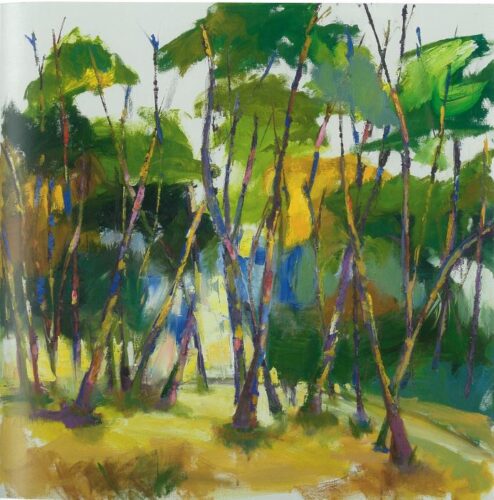
"Trees with broken color" by Jan Dilenschneider

“Trees with broken color” by Jan Dilenschneider is a signature painting from the exhibition opening today at the Sill House Gallery in Old Lyme.

Artist Jan Dilenschneider, just back to the U.S. from acclaimed exhibitions in Paris and Monaco, will exhibit upwards of 20 recent works in a major exhibition in the Sill House galleries on the Old Lyme campus of Lyme Academy College of Fine Arts of the University of New Haven.

The exhibition, “The 4th Dimension,” will open on Friday, Oct. 7, with a reception with the artist from 5 to 7 p.m. and is part of Lyme Academy College’s Center for Arts Programming fall events. The exhibition, in the 1817 federal-style Sill House, will be on view through Nov. 12. Gallery hours are Monday through Saturday, 10 a.m. to 4 p.m. The exhibition is free and open to the public.

“We at Lyme Academy College are very proud to be exhibiting Jan’s exquisite paintings,” said Todd Jokl, campus dean. “Her sensitivity to the lushness, the colors and movements, of the landscape at a certain moment both reminds us of those great painters who first memorialized the Old Lyme area and also looks beyond the moment she captures so imaginatively to the timeless qualities of light and color.”

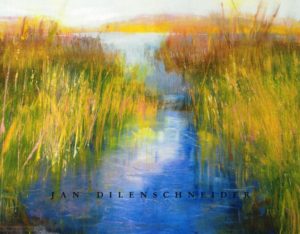
A classic work by Jan Dilenschneider.

A classic work by Jan Dilenschneider.

In Paris and Monaco, Dilenschneider’s landscape paintings met with critical acclaim. She was the only living American artist who had her work displayed at the recent European Art Fair – Monaco. Marguerite d’Aprile, director of the Center for Arts Programming at Lyme Academy College, noted, “We are quite honored and pleased to host an artist with such an extensive international exhibition record. Ms. Dilenschneider’s paintings, in both subject and color, breathe life into her landscape canvases.”

In an ideal marriage of art and place, Dilenschneider’s vibrant landscape paintings, inspired by a passionate confluence of impressionist and expressionist styles, speak precisely to the Old Lyme landscape that gave birth to American Impressionism.

This idyllic setting is as appealing to artists today as it was when viewed over a century ago by Barbizon School painter Henry Ward Ranger, who called it a “landscape waiting to be painted.” The landscape of Long Island Sound outside her studio windows in Darien, Conn., has provided a similar inspiration for Dilenschneider’s work.

Dilenschneider will also be giving a gallery talk at the exhibition site on Thursday, Oct. 27 (reception 6 p.m. to 7 pm; lecture at 7 p.m.).  The talk is open to the public ($15 per person) and seating is limited. Reservations must be made by contacting Kristen Brady at 860 434 3571 ext. 121kbrady@lymefs.newhaven.edu.

The exhibition and gallery talk are highlights of the fall schedule of the Center for Arts Programming. For more information about the fall schedule of classes, lectures, film screenings and special exhibitions, visit http://www.lymeacademy.edu/index.php/community-engagement.

Lyme Academy College of Fine Arts is a college of the University of New Haven.  Its mission is to educate aspiring artists through a rigorous studio curriculum rooted in figurative and representational art.  The college offers a comprehensive liberal arts education essential for advanced critical and creative thought.  For more information, visit: http://lymeacademy.edu/


Letter From Paris – No, Now It’s Essex!  A Brave, New Museum Opens in DC

Nicole Prevost Logan

Nicole Prevost Logan

Editor’s Note:  Our popular writer from Paris, Nicole Prevost Logan, is back in Essex, CT, for the winter.  She does not normally write for us from Essex, but this year, she is making an exception and will be continuing to contribute articles to ValleyNewsNow.com and LymeLine.com during the winter months.  Here is her inaugural column from Essex about the opening of  a very special museum in Washington DC.

The Grand Opening of the National Museum of African American History and Culture (NMAAHC) will take place in Washington DC this coming Saturday, Sept. 24.  The NMAAHC, the 19th and newest of the Smithsonian museums, was established by a bi-partisan Act of Congress in 2003.

The Smithsonian's National Museum of African American History and Culture, Nov. 6, 2015. (Photo by Michael Barnes from http://newsdesk.si.edu/photos)

The Smithsonian’s National Museum of African American History and Culture, Nov. 6, 2015. (Photo by Michael Barnes / Smithsonian Institution.)

The massive structure occupies a prime location next to the Washington Monument and contrasts with the 555 ft. slender obelisk.  The dark bronze-colored metal lattice that covers the ‘Corona” also stands out from the white marble classical architecture of most of the other museums standing on the National Mall.

It has been a long struggle for the supporters, such as Congressman John Lewis (D-Georgia), to make the project a reality.  They needed to overcome the resistance from several senators who advocated another location. The final approval  was more than a triumph — it might be considered a miracle.  It succeeded in making a strong statement as to the importance of Black history and culture in the American nation.

The lead designer was David Adjaye, son of a Ghanaian diplomat and the lead architect Philip Freehon, who died in 2009.  Founding Director Lonnie B. Bunch III is the visionary and driving force of the project.  During some of the many interviews he gave to the press and to a variety of audiences, including select ones like the Aspen institute, he explains the building process and his objective with a very contagious enthusiasm.

The NMAAHC is not intended to be a Holocaust museum, he explains . Its mission is to show the pain but also the joy and the creativity of African-Americans.  A daunting fund-raising goal of 450,000 million dollars had to be reached.

The three-tier effect of the construction incorporates elements from African culture, such as the Yoruban crowns from Nigeria.  Inside the building, high tech designs and the enormity of the space will make it possible to be versatile in organizing several exhibits simultaneously.

The collections had to be created from zero.  It required a treasure hunt into the attics, trunks and basements of the population.  To date 35,000 artifacts have been collected.  A segregated train from outside Chattanooga (TN) was lowered by crane and the museum built around it.  All traffic stopped on Constitution Ave. when an oversized truck delivered the control tower from a federal prison.

Artifacts showing the terrible fate of the slaves are very moving.  Such is an amulet created by the Lombi tribe in the form of a shackle.  More tragic still were the shackles for children.

But fun and the world of entertainment are also present in the displays , such as Louis Armstrong and his trumpet, Lena Horne or Marianne Andersen . The film archives will be essential to build up history, from Harriet Tubman to the human rights movements of the 1950s and 1960s.

According to Washington insiders , the opening of the new museum is the hottest event in a decade.  More than 150,000 special tickets have been distributed to dignitaries while long lines of visitors gather at the entrances of the building to purchase tickets for general admission after the opening.

Editor’s Note: This is the opinion of Nicole Prévost Logan.

Nicole LoganAbout the author: Nicole Prévost Logan divides her time between Essex and Paris, spending summers in the former and winters in the latter. She writes a regular column for us from her Paris home where her topics will include politics, economy, social unrest — mostly in France — but also in other European countries. She also covers a variety of art exhibits and the performing arts in Europe. Logan is the author of ‘Forever on the Road: A Franco-American Family’s Thirty Years in the Foreign Service,’ an autobiography of her life as the wife of an overseas diplomat, who lived in 10 foreign countries on three continents. Her experiences during her foreign service life included being in Lebanon when civil war erupted, excavating a medieval city in Moscow and spending a week under house arrest in Guinea.

OL Library & St. Ann’s Host Art Show, Lecture Series on Plum Island

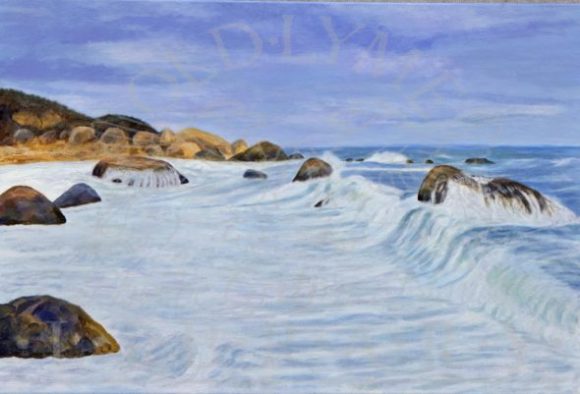
This signature painting for the 'Natural Beauty of Plum Island' exhibition is by John Sargent.

This signature painting for the ‘Natural Beauty of Plum Island’ exhibition is by John Sargent.

The Old Lyme–Phoebe Griffin Noyes Library and St. Ann’s Church announce their collaborative program series,The Natural Beauty of Plum Island: Sea, Seals  Sunsets and More beginning in September. The partnership will hold concurrent art exhibits and a lecture series.

The first art opening reception at the OLPGN Library will be held on Friday, September 16 from 5 to 7 p.m.  St. Ann’s will host an art opening luncheon reception at 11:45 a.m. on Sunday, Sept. 18 following services.

In addition to the art exhibitions, a lecture series to educate the public about the island’s history, habitat and its preservation will be presented. The public is invited to attend the events and experience an amazing breadth of images of Plum Island in acrylics and pastels by painter John Sargent and photographs by Robert Lorenz.  The two exhibits will run until Nov. 23.

Experience the unprecedented access given to Sargent and Lorenz that allowed them to create works depicting beaches, rocky shorelines and coves, wildlife and the occasional visitors who come by boat and ferries. Sargent is a retired art teacher with a studio at his Quaker Hill home and Lorenz a retired commercial photographer, who divides his time between Old Saybrook and New York City.

The lecture series offers four distinct perspectives on the island by experts who will share their insights and knowledge of its importance to our region.  All programs begin at 7 p.m. and are free and open to the public. Note the location for each lecture.

Thursday, Sept 22 at OLPGN Library:

Preserving Plum Island for Future Generations” by Chris Cryder, Special Projects Coordinator for Save The Sound and Outreach Coordinator for the

Thursday, Oct 6 at Saint Ann’s Church:

Survey of the History of Plum Island” by Amy Folk, Collections Manager Southold Historical Society and co-author of the book “A World Unto Itself, The Remarkable History of Plum Island, New York”.

Thursday, Oct 27 at OLPGN Library:

Plum Island’s Place in the Geological History of Southern New England” by Ralph Lewis  Connecticut State Geologist Emeritus, and currently part-time Officiate of The Long Island Sound Resource Center  at the University of Connecticut- Avery Point   and a professor in residence in the Marine Studies Department  at UCONN- Avery Point.

Thursday, Nov. 10 at Saint Ann’s Church:

Plum Island’s Biodiversity, Birds, Bats, Bugs, and Basking Seals” by Matthew D. Schlesinger, PhD, Chief Zoologist New York Natural Heritage Program and Adjunct Assistant Professor, SUNY College of Environmental Science and Forestry.

Registration is expected for all lectures.

For programs at the Library, visit www.oldlyme.lioninc.orgfor the online calendar of events or call 860-434-1684 and ask for the Reference Desk. To register at St. Ann’s Church, call 860-434-1621 or email office@saintannsoldlyme.org.

The Library is located at 2 Library Lane, off Lyme Street in Old Lyme. Hours are Monday and Wednesday, 10am to 7pm; Tuesday and Thursday, 10am to 6pm; Friday, 10am to 5pm and Saturday, 10am to 4pm.

Final Week to View “The Artist’s Garden” at Florence Griswold Museum

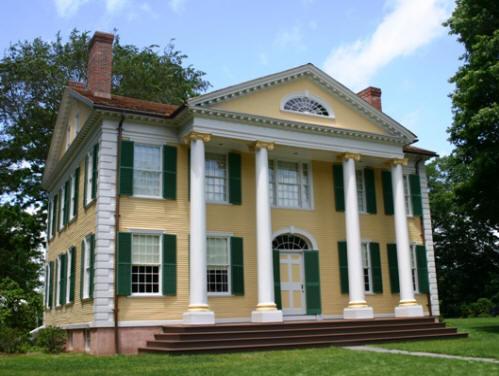
Exterior view of the Florence Griswold Museum, which hosts a Free Day for New London residents on Sunday.

Exterior view of the Florence Griswold Museum on Lyme Street.

This is the final week for the exhibition, The Artist’s Garden: American Impressionism and the Garden Movement, 1887–1920. The exhibition is on view through Sept. 18, and its presentation at this museum is supported by a grant from Connecticut Humanities.

Organized by the Pennsylvania Academy of the Fine Arts, The Artist’s Garden tells the story of American Impressionists and the growing popularity of gardening as a leisure pursuit at the turn of the 20th century. Paintings and stained glass from the Pennsylvania Academy are blended with paintings, sculpture, prints, books, and photographs from the Florence Griswold Museum’s permanent collection, as well as selected private loans. Drawing on new scholarship, The Artist’s Garden considers the role of artists and designers in defining a cultivated landscape in an era of new attitudes toward leisure, labor, and a burgeoning environmentalism.

The Artist’s Garden is the first exhibition to situate discussions of the growth of the Garden Movement within the politics of the Progressive era, with which it overlapped at the turn of the twentieth century. The Progressive era was marked by intense political and social change. Along with the surge of nationalism and patriotic optimism came growing concerns over mass immigration, women’s suffrage, and urbanization. The Garden Movement proposed that the creation of public parks and the hobby of gardening could provide beauty and balance within this fast-changing world.

The American Impressionist works in this exhibition demonstrate the profound impact of theGarden Movement on the American culture. “Not only is the Florence Griswold Museum an ideal venue for this exhibition because of its history as a boardinghouse for artists and its restored gardens, but also because Connecticut women like Old Lyme’s Katharine Ludington played an important part in Progressive-era causes such as women’s suffrage while also tending a much loved garden,” said Curator Amy Kurtz Lansing.   

Many American artists developed their interest in gardens from their travels overseas. The outdoors became a major subject for Impressionists as they embraced painting outside, or en plein air. Not only does Daniel Garber’s Saint James’s Park, London, 1905 (on loan from the Pennsylvania Academy of the Fine Arts – PAFA) demonstrate theImpressionists’ careful study of light and quick, loose brushwork, but an attempt to capture the tension within urban life between the realities of development and the desire for pastoral tranquility. Public parks like St. James’s were praised by critics as peaceful oases amid the hectic frenzy of city life.

The Progressive era was a time of important change for women. They became leaders of the Garden Movement who combined their creative interests in art and gardening with a passion for Progressive causes, such as women’s suffrage. By blending art, writing, and gardening in their careers, women like Anna Lea Merritt were at the vanguard of professionalizing women’s work. They used their public platform to engage social issues like environmental conservation and immigration through the metaphor and example of the garden.

Professional artists such as Cecilia Beaux, Violet Oakley, and Jane Peterson participated in these changes by coupling their interest in modern art with a love of the garden. Peterson wrote that she loved painting flowers for their “prismatic hues of therainbow.” In Spring Bouquet, ca. 1912 (on loan from PAFA) the steeply tilted perspective and sense of patterning inthe composition are variations on the stylistic principles of Post-Impressionism. Locally, practitioners like artist, gardener, and suffragist Katherine Ludington exemplified this trend.

The exhibition will include selections from FGM’s Ludington Family Collection that acknowledge the expression of the Garden Movement in Connecticut, as well as around the family’s other home base in Philadelphia, the epicenter of the Garden Movement.
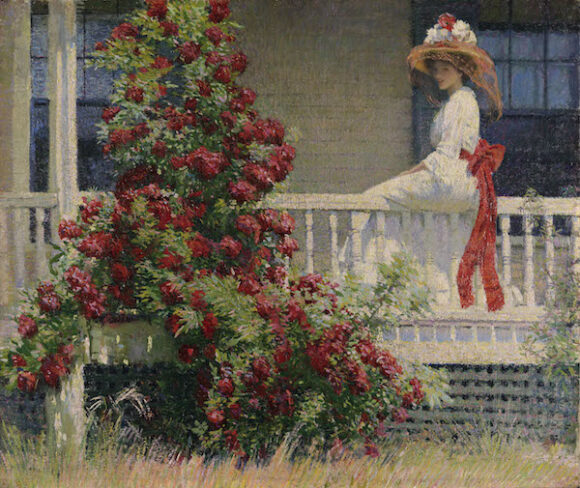
'Crimson Rambler' by Philip Leslie Hale is a signature paintings of the exhibition.

‘Crimson Rambler’ by Philip Leslie Hale is a signature paintings of the exhibition.

Even as women were making inroads towards more equal status and finding personal and professional expression through the venue of the garden, images that presented a sentimental and idealized vision of women posed decoratively in nature were still very popular. Philip Leslie Hale’s The Crimson Rambler, ca. 1908 (on loan from PAFA) embodies this simultaneous tendency to equate women with the beauty of flowers. He pairs a flowering vine with a women by adding touches of rose red to the lady’s hat and sash, and by draping each across the porch or trellis. Hale’s blooms are considerably larger than the flowers actually grow, suggesting that he idealized the fashionable plant as much as the woman beside it.

Hale’s painting also demonstrates his knowledge of gardening. Many artists combined their devotion to painting flowers with the practice of planting and tending gardens. “An artist’s interest in gardening is to produce pictures without brushes,” Anna Lea Merritt observed in her 1908 book An Artist’s Garden Tended, Painted, Described. Artists’ gardens were personal laboratories for Impressionist studies of light and color. They were outdoor classrooms where painters could teach their students about form and composition.

Special emphasis is given in the exhibition to the many ways Miss Florence’s garden served as a space for creative expression, both for her as a gardener and for the artists who painted and taught there. Paint was not the only medium used to translate nature’s vibrancy. Peony Window Panel, 1908-1912 (on loan from a private collection) by Louis Comfort Tiffany shows his appreciation for color and pattern. As a glass designer, his distinctive floral aesthetic defined the era and was perhaps cultivated in his own Long Island garden where he enjoyed painting.

The grounds of the Florence Griswold Museum provide the perfect accompaniment to The Artist’s Garden. After walking through the restored 1910 garden on the Museum’s campus, visitors will see first-hand in the galleries how artists captured nature’s fleeting beauty on canvas. “Miss Florence’s” lovingly tended garden was a favorite subject for many of the artists of the Lyme Art Colony who stayed at her boardinghouse.

One of the paintings on view in the exhibition, William Chadwick’s On the Piazza, ca. 1908 (collection of the Florence Griswold Museum) shows a female model posing on the side porch of the boardinghouse. Chadwick first visited Old Lyme in 1902 and soon became a central figure in this artist colony, along with Childe Hassam, Robert Vonnoh, and other painters who sought the colonial-era architecture and gardens of Old Lyme and their nostalgic suggestions of a simpler, earlier time, far removed from hectic, modern city life. A walk to the Lieutenant River, on the grounds of the Museum, provides further examples of vistas painted by the nature-loving artists.

Visitors can tour the historic boardinghouse – the 1817 Florence Griswold House – where the artists of the Lyme Art Colony lived, played, and worked. Paintings in the home continue the story of the artists’ love of the landscape. A new Guide to the Historic Landscape encourages visitors to walk where the artists created some of their most enduring paintings.

The recipient of a Trip Advisor 2015 Certificate of Excellence, the Florence Griswold Museum has been called a “Giverny in Connecticut” by the Wall Street Journal, and a “must-see” by the Boston Globe. In addition to the restored Florence Griswold House, the Museum features a gallery for changing art exhibitions, education and landscape centers, a restored artist’s studio, thirteen acres along the Lieutenant River, and extensive gardens. TheMuseum is located at 96 Lyme Street, Old Lyme, Connecticut. Visit www.FlorenceGriswoldMuseum.org for more information.
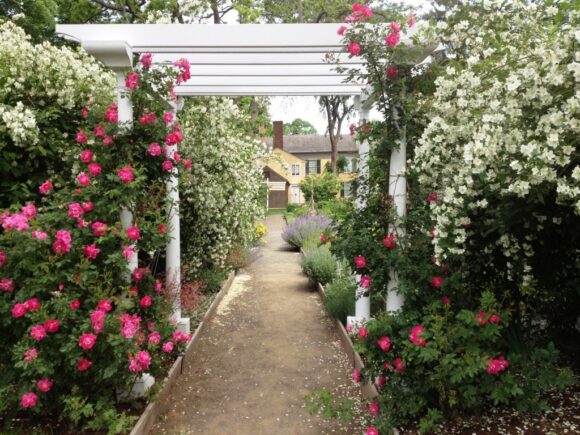
The Florence Griswold Museum in Old Lyme hosts a celebration of the site’s historic gardens featuring special events, displays, demonstrations, and family activities. From June 3 through 12, visitors can enjoy a wide variety of activities for all ages and interests.

The Florence Griswold Museum in Old Lyme hosts a celebration of the site’s historic gardens featuring special events, displays, demonstrations, and family activities. From June 3 through 12, visitors can enjoy a wide variety of activities for all ages and interests.

Garden lovers are invited to enjoy Café Flo Tuesdays and Saturdays from 11:30am-2:30pm and from 1-3:30pm on Sundays. Menu items are garden-fresh and family friendly. Dine on the veranda overlooking the Lieutenant River or pick up a basket and blanket and picnic along the river.

The Museum is located on a 13-acre site in the historic village of Old Lyme at 96 Lyme Street, exit 70 off I-95. Admission is $10 for adults, $9 for seniors, $8 students, and free to children 12 and under. For more information, visit FlorenceGriswoldMuseum.org or call 860-434-5542 x 111.

Lori Warner Gallery Hosts ‘ART-ISTRY’ Featuring Work of David Rau from Flo Gris: Opening Reception Tonight

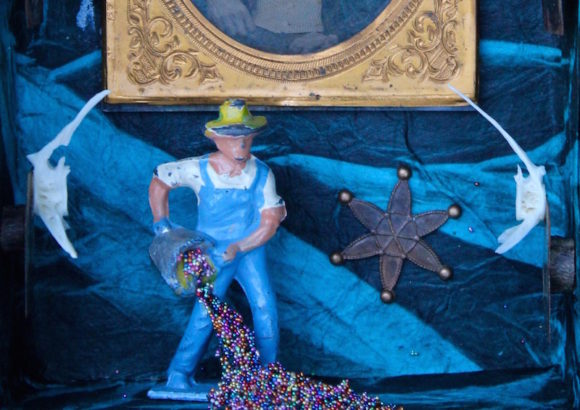
Detail from a featured work by David Rau in the ART-ISTRY exhibition opening Oct. 1 at the Lori Warner Gallery.

Detail from a featured work, ‘Untitled,’ by David Rau in the ART-ISTRY exhibition opening Oct. 1 at the Lori Warner Gallery.

ART-ISTRY, featuring new work by David D. J. Rau and Christopher B. Steiner, opens Saturday, Oct. 1, at the Lori Warner Gallery in Chester with a reception from 5 to 8 p.m. to which all are welcome.  On view will be three-dimensional assemblage pieces by Rau, and limited edition prints and original photomontage works by Steiner.

This exhibition will be a very special one since the Lori Warner Gallery invites artists to exhibit their work once per year and the selection process is highly competitive.

David D.J. Rau’s Vintage Hardware Drawer series, was inspired by 14 antique drawers that originally held screws, bolts, and plugs (according to the various labels). Rau transforms them into miniature surreal stage sets using vintage and antique pieces collected over the years. Inspired by the past, his aesthetic combines vintage photography, tattered paper, intriguing ephemera, and antiques into humorous, ironic, and most importantly, beautiful scenes. 

Rau is the Director of Education & Outreach at the Florence Griswold Museum in Old Lyme, Conn. Responsible for the public programs and making connections between the art and history and the Museum’s visitors. Rau holds a masters degree in Art History and a certificate of Museum Studies from the University of Michigan. Rau has worked at Cranbrook Art Museum.

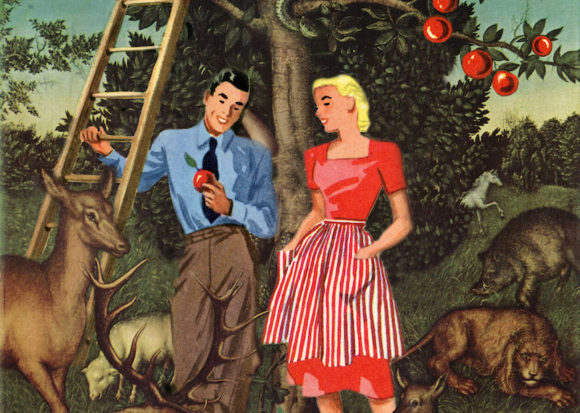
Detail from "The Fall of Suburban Man" by Christopher Steiner.

Detail from “The Fall of Suburban Man” (2016) by Christopher Steiner.

Christopher B. Steiner has always been partial to artists with “a deep sense of wit and (twisted) humor.” His work has been described as “irreverent parody with a twist of dark absurdity.” Steiner deconstructs iconic or cliché images and well-rehearsed art-historical traditions in order to invite alternative readings. These interventions are meant to surprise, delight, destabilize, and sometimes even shock. His intent is to “reinvigorate familiar images by bringing to them new perspectives and insights through unexpected juxtapositions and non sequitur visual tropes”.

Steiner holds an undergraduate degree from the Johns Hopkins University, and a Ph.D. in anthropology from Harvard University. He is the Lucy C. McDannel ’22 Professor of Art History and Anthropology at Connecticut College, where he also serves as Founding Director of the Museum Studies Program.

Steiner is also a member of the board of trustees of the Lyman Allyn Art Museum, where he was also Interim Director in 2003-04. In addition, he serves on the Advisory Boards of both the Florence Griswold Museum and the Bellarmine Museum at Fairfield University.

The exhibition will be on view through Dec. 1, and is free and open to the public. The Lori Warner Gallery is located at 21 Main St. in Chester, Conn.

For further information, call 860-322-4265, email gallery@loriwarner.com and visit www.loriwarner.com or www.facebook.com/loriwarnergallery/

eum; the Henry Ford Museum and The Currier Gallery of Art. Rau also teaches Museum Studies at Connecticut College.