Did Jesus Have a Wife? New Evidence says “Yes.”

John_LaPlante[1]Eagle Rock, CA  — Milady Annabelle and I were visiting Occidental College.  She’s an alumna.  It’s a fine private, coed college, one of the oldest on our Pacific coast. Just a few miles east of downtown Los Angeles.

We were strolling the beautiful grounds when I noticed a newspaper box and, news junkie that I am, took out a paper—the students’ Occidental Weekly.  A freebie.  Never saw it before.

A big headline on Page 1: “Former Occidental Professor debates possible existence of Jesus’ wife.”

Couldn’t resist it.  Read it right there.  Every word.  Seems that Jesus did have a wife.  Gosh!  But the headline was mild compared to the story itself.  In her talk to Occidental students, the professor was not “debating” anything.  She said she had strong evidence that suggested yes, Jesus did have a wife.

I handed the paper to Annabelle.  She feasted on it.  “Sensational,” she said.

Both of us had heard allusions of this over the years, whispers, so to speak.  But nothing like this.  Nothing this firm.  And that’s why I’m sharing it with you now.

Imagine our learning of this in a student newspaper …

The professor, Dr. Karen L. King, had moved on from Occidental and was now a professor at Harvard U. Divinity School. She had had come back to give to give her talk about this astounding development.

And she had first-hand information—she had done the research to come up with it.

She had gotten possession of a scrap of ancient papyrus.  Just a tiny thing—the size of a business card.  It had pieces of Coptic writing on it.  Translated, one of them stated, “Jesus said  (to his disciples), “my wife….”  That’s all.”

Unfortunately, the rest of the sentence was missing.

The story we were reading was written by student Clark Scally—students produce the whole paper.  I was impressed by it.  I noticed Scally had also authored two other articles in it.  A busy young man.  To my eye, quite professional.

His story about Dr. King’s talk had a juicy tidbit.  He wrote, “In the Gospel of Philip, discussed by (Prof.) King in her lecture, Jesus speaks of marriage and sexuality extensively.  He also refers to Mary Magdalene as his close companion whom he kisses more often than his other disciples, much to the concern of Apostles Peter and Matthew.”

That tickled me.  For the simple reason that over the years I have come to think of Jesus as a man, as a very great teacher, one of the greatest ever, but just a man.  And this certainly makes him look manly.  I like that.  Besides. I had never heard it said that boldly before.

In her talk, Dr. King said that scrap of papyrus was believed to have come from the fourth or fifth centuries.

She said an anonymous donor who collected such things had given it to her at Harvard Divinity School.

She had made thorough efforts to authenticate that exciting bit of papyrus. Had shown it to numerous scholars.  Had discussed it with them.  Had double-checked everything as carefully as she could.  Had slept on it.  Had decided it was legitimate.  But she said more analysis is going on.

Certainly she’s a lady and professor of high repute and attainment.  She left Occidental to join Harvard Divinity in 2003 as the Winn Professor of Ecclesiastical History.

Six years later she made history when she became the first woman to be the Hollis Professor of Divinity.  It is the oldest endowed chair on our shores, dating back to 1721.

She has received research grants from prestigious foundations.  Has written many articles and half a dozen scholarly books.  So, she is no lightweight.

I find the titles of two of her books tantalizing, The Secret Revelation of John and The Gospel of Mary of Magdala: Jesus and the First Woman Apostle.

She spilled this about Jesus and his wife at Occidental on Feb. 7.  But that came after a storm of controversial announcements and newsbreaks about it.

Initially, Dr. King had traveled to Rome with the papyrus and displayed it to a group of New Testament experts.  She came back sure that it was authentic, though apparently the scholars were not all agreed.

The Vatican blasted it as counterfeit.  A columnist for Britain’s eminent Guardian newspaper disagreed loudly.  Declared the papyrus document a fraud and explained why.  It boiled down to a typo.

It is known that the notion that Jesus did not have a wife developed only a century after his death.  It is said that numerous people of Jesus’ time believed that he was indeed married.  How about that?

To announce her findings to the wide public, Dr. King staged a press conference at the Divinity School.  It got attention. The New York Times was there, among others.  It followed up with a detailed story.  And it stirred up scores of comments, pro and con.

I read many.  Scholarly and impressive.  Regardless what side they were on, these people seemed awfully knowledgeable.

I’m not sure what to believe.  I’d like more than a scrap of evidence.  But again, deep down I like to believe that Jesus was a married man.  That’s so natural.  That’s what most of us want to do and end up doing.  More and more of us get married more than once.

And now we have men marrying men and women marrying women.  Legally.

Getting hooked seems to satisfy an inner need.

The public reaction was more than Dr. King expected.  She says shat she is not saying Jesus had a wife.  She is saying that the papyrus said he did.

I found it dramatic that this red-hot story was appearing in the student newspaper of a college of strong Christian origins.   Occidental was founded by staunch Presbyterians and was totally Presbyterian for a century or so.  It has been liberalizing in the last decade or two.  I wonder how the old-timers would feel about this.

For sure one would be the Rev. Dr. Hugh K. Walker, D.D.  He was a long-time chairman of Occidental’s board of directors in its earliest days.  He set the school on a firm path.

He was the minister of the leading Presbyterian church in Los Angeles.

Why am I telling you this?  Because of a terrific coincidence.  Dr. Walker was milady Annabelle’s grandfather on her mother’s side.  And that’s why her mom and dad enrolled her at Occidental.

In fact, her dad also was a Presbyterian minister.  But he gave that up and became president for many years of the Hollywood Presbyterian Hospital … in time also became president of the U.S. Protestant Hospital Association.

Occidental’s fine reputation has become even more widely known of late.  A big reason is that it was the first college in our continental U.S. that young Barack Obama, freshly arrived from Hawaii, attended.  He lasted two years, transferring to Columbia U. in New York.

That’s something Annabelle shares with him.  She jumped after two years, too, and probably for the same reason—to experience a broader undergraduate experience.  She went on to the University of California at Berkeley and graduated from there.

One more thing about Clark Scally’s piece in the Occidental Weekly.

At its close, he wrote, “A member of the audience asked Dr. King how she was handling the attention and its pressure.

“’I lost eight pounds in the first week.’ Dr. King answered.

‘The Divinity School arranged a panic button in my office due to concerns for my physical safety.  Most of my job since this has come out is to throw cold water on everything.’”

I liked young Scally’s including this quote.   It shows that it’s not so easy to be a professor.  At times you must really profess.

Maybe he’ll wind up on the New York Times someday.

Are Libraries Doomed?

John Guy LaPlante

John Guy LaPlante


John Guy LaPlante is a veteran writer and journalist. His award-winning columns and articles were previously published in the Main Street News. He is the author of two books, “Around the World at 75. Alone! Dammit!” and “Asia in 80 Days. Oops, 83! Dammit!” He completed his service as a Peace Corps Volunteer in Ukraine in early 2010 after a 27-month tour of duty. John always welcomes comments on his articles. Email him at johnguylaplante@yahoo.com

I read something startling the other day. Amazon.com, among other things, is our biggest retailer of books.  Bigger than Barnes & Noble even.  But last year it sold more e-books than print books.  Wow!

A recent report by the Pew Foundation said that 19 percent of adults in the U.S.have read an e-book.  I’m amazed the percentage is so high.

Some of you may already be buying e-books.  Some of you – even as passionate readers of books as we know them, meaning books printed on paper – may not have a clue about e-books.

E-books are shorthand for electronic books, also known as digital book.  They are books meant to be read not on paper, but on a computer screen.  Or more recently, on specialized devices called e-book readers (e-readers), which have become a rage.

E-books have been around for a decade, maybe two decades.  In fact, undoubtedly since the beginning of word processing programs. Microsoft Word, notably.

If you could write a letter or a report or an article on your computer with Microsoft Word, why not a book?  Sure.  But such a book wasn’t called an e-book back then.  It was just a long Micrisoft Word document (.doc).  You saved it on your computer.

If you wanted to send it to somebody, you did it with a floppy disk and later, a CD.  The widespread arrival of the Internet and email made it possible to send it even thousands of miles in a minute or two.

Then Adobe developed the pdf—the portable digital dial.  Very important because it preserved your document or article–whatever you created—exactly as you wrote it.  With the same typeface, same type size, same formatting (italics, paragraphing, and so on), the same everything in every detail.  A remarkable and wonderful breakthrough.

But—this just occurred to me—if you are reading this, you know a lot about this already.  After all, you are reading this as a digital file.  Suddenly I feel very dumb.

Well, it’s less than five years ago—Nov. 19, 2007, that the first e-book reader appeared.  The Kindle.  That was an invention by Amazon.com.  It sold for $399.  It was sensational.  It sold out practically overnight.

It was also wonderful.  It fit in your pocket.  You could store more books on it than you could read in a lifetime.  You could buy them fron Amazon and receive them on your Kindle in just a couple of minutes.

It was as significant an invention as that of movable, reusable type by Gutenberg in 1447.  The Kindle and the e-book changed our reading habits forever.  It turned the book world topsy-turvy.

Today there are six Kindle models, varying in features and price.  The lowest-price is $79 and the top of the line $199.  Incredible how the prices have dropped.

In fact, there are numerous e-book makers and there are more than 30 different brands on the market.  There is even the extraordinary kind called a tablet.  So-called because it is considerably bigger and lets you access not only e-books, music, photos. movies and connect to the Internet and perform other miracles,

The most sophisticated is Apple’s Ipad—a groundbreaking invention by itself.  A full-fledged computer.  It, too, has been selling like hotcakes.  The price keep changing—about $500 on up depending on features.  Amazon selling for $600 and considerably more, depending.

In fact, Amazon’s $199 unit – the Kindle Fire – is a tablet, designed to cut into Apple’s market.  It has been said that Amazon prices its units even below cost.  All to stimulate sales of e-books.

As some of you know, in the last six years I have written three books.  Print books.  I also wrote one 50 years ago, but let’s forget that.  I would have written more books, I think, but life interfered.

And in the spirit of full disclosure I want to tell you all three will soon be e-books.  Why?  It’s absolutely essential if I want to make them available to the greatest number of readers possible.  And like all writers, I write to be read.

I never, never thought I would own an e-book reader.  No need.  Now I own two.  Use them hardly at all.  Was intrigued by the technology, I guess..

Now back to my main topic today.  Public libraries.  I think they are imperiled.  I say this although I’m aware public libraries have more users than ever.  Yes, it’s true.  Even in this digital age.

National Library Week came and passed just recently. April 7 to 13.  I missed it somehow.  What a shame.  National Library Week?  Hey,who notices?  Who cares?

Well, I do.  Libraries mean so much to me.

I’m worried about their future.  Not for myself.  The day will come before long when I’ll no longer need my library card.  But I’m worried for library lovers everywhere.

This is why I have gone on at length about e-books. Because I realize that if this e-book phenomenon continues … and certainly it will … it will kill public libraries. Yes, kill them.

Well, certainly libraries as we know them.  Just as Amazon.com is killing off neighborhood bookstores as we know them.  Even giant bookstores.  Just consider that the giant chain Borders just went under.  For sure, a casualty of Amazon.com and the e-book revolution.  What a loss.

Just consider also: not only are books becoming digital.  So are newspapers—and look at how our newspapers have declined— because they began producing e-newspapers as well.  And then did the stupid thing of making them available free.  Now the papers are smartening up and beginning to charge for their electronic editions.

The changes are beyond belief.  Even textbooks are becoming e-textbooks.  Tablets like the Ipad are becoming standard everyday necessities for just about any man or woman who has to read and write in order to earn their living.

In fact, look at what just happened to the venerable, absolutely wonderful Encyclopedia Britannica.  Its 30 or so hefty volumes take up whole shelves on a bookcase.  Britannica just printed its last edition.  It, too, is going digital.

I gave my son Mark a set when he married just seven or eight years ago.  I love to see it on display in his living room when I visit.

But I don’t think he’s ever used it, and he is a university professor and a lover of books.  Why?  Because it’s so much easier for him to access this wealth of information online.  He does this online every day.

Still I’m glad he has the big set.  I consider it a sort of statue that attests to one of his core values.

The impending doom of our public libraries saddens me beyond words.  I love libraries.

What’s the problem?  Well, now libraries are providing e-books.  You can download one for two weeks, say.  Free.  The libraries are even teaching people how to do this.

Aren’t they making the same terrible mistake that the newspapers did—committing suicide by being so generous?

Gradually the libraries will acquire more and more e-book titles.  The more e-books published, the more e-books the libraries will want to stock.  Library users will check out more and more e-books.  The libraries’ budget for e-books will swell.

The process will snowball.  The borrowing of print books will decline.  In time, the books in the stacks will gather dust. In time, only e-books will be available.

And remember: e-books don’t take up space on shelves.  They are stored in a computer.  You could put a whole library of e-books in a computer.  Who is going to need a great, big library anymore?

This won’t happen next year.  But it will happen.

Many of you will say, John, how can you be against progress?  I recognize that this is progress.  But frankly, I’m glad I won’t be around to see the demise of the libraries. That’s such a painfuI thought.

I consider the public library the most important institution in any community.  The only thing more important to me is the supermarket.  I admit this.  As much as I love books and reading, I love to eat.  But libraries come next.

I have visited hundreds of libraries.  Make that thousands.  I’m serious.  All over theUnited States and numerous other countries.  I measure a community by its library.  A good library means this is an enlightened community.

A big thing I like about living here in the Connecticut Estuary is that fine libraries surround me.  My own Deep River Public Library, but also Essex and Ivoryton and Chesterand Old Saybrook and Old Lyme and even farther.  And know what? I get to all of them.  Some more often than others, of course.

Yes, how lucky we are.  Connecticut has one of the best library systems in the country.  I know.  Let me give you one example.

In Connecticut I can go to any library in the state, the Sharon Public Library up in the northwest corner, say, borrow a book by showing by Deep River card, and take it home.  To return it, I don’t have to take it back to Sharon.  I just return it to the Deep River Library.  It will get it returned to Sharon.

I spent much of the winter in Newport Beach, Calif.  Beautiful community.  Beautiful library.  I have a card for it.  One day I was in the Huntington Beach Library, just two towns north.  I saw a book I liked.  I wasn’t sure Newport Beach would have it.  I took it to a librarian and showed my Newport Beach card.  “Oh, we don’t do that here,” she said.

I go to a library just about every day.  Let me rewrite that sentence: I enjoy a library just about every day.  I will go to a library today.  I’m sure you are asking yourself, “What kind of nut is this LaPlante?”

Blame my Maman.  I was 8 or 9.  She was a young immigrant gal, French from Québec and woefully poor in English back then.  Working 44 hours a week in the big brick textile factory down the street as Papa struggled to get his little linoleum store going.  That was in Pawtucket, R.I.  That’s where I was born.

We spoke French at home.  I began to learn English only when I went out to play with the neighbor kids.  Began studying it in first grade, of course.

One day she took me on the bus downtown.  Led me up through the bronze doors of thePawtucket (Slater) Public Library.  Managed to explain she wanted a card for me.  The nice lady librarian made that happen, then showed us the kids’ section.  I walked out with a book.  I don’t remember its title.  But I remember I didn’t understand all the words.  Maman took me back again.  I took out another book.  I became hooked.  I still am.

That was about the time she also signed me up at the Boy’s Club for swimming lessons. S wimming also became one of my big interests.  I tell you this only because it tells you so much about my Maman.

Bill Moiles said it perfectly for me back in 1958, I think it was.  I was a rookie reporter at the Worcester Telegram.  He was a star reporter turned columnist.  I feasted on his columns.  One I have never forgotten because I agreed so heartily.

Those were the awful days when we feared the U.S.S.R. would drop an A-bomb on us.  Popular Mechanics and other magazines were telling us how to build underground shelters in our backyard and stock them with canned soups and flash lights and toilet paper.

“The bomb may fall,” Moiles wrote.  “Catastrophic for sure.  But if the Public Library survives, we have a chance.”

I knew exactly what he meant.  It’s all there, on those shelves.  Everything we need to know.  It holds true for any blast in the future.

The Pawtucket Public Library of my youth provided only two services.  It lent out books and let you come in and read papers and magazines.  Free of charge.  That’s what all libraries did back then.

As we know, today libraries don’t provide only books.  They specialize in “media.”  This is the new word that covers books, magazines, newspapers, music and movie disks, audio books, maps, and of late, e-books—information in all its forms.

They often have a children’s library, or a genealogical room, or a map collection.  Provide research assistance.  Host meetings.  Provide free computers for us to use, connected to the Internet, mind you.  Provide photocopying and scanning services.  Operate used-book stores as a fund-raiser for themselves.  Some serve coffee; even have a cafe or even a restaurant.

Often city libraries have branches, even a library on wheels or a service for the housebound.

In all this, I must mention one more grand thing about public libraries.  They are such wonderful, welcoming places.  As we know, anybody is free to come in, sit down, and enjoy all the goodies.  How wonderful.

But there has been one sad development.  In some big libraries…urban libraries, for instance, even smaller ones such as in New London and New Haven … often you will come in and encounter many street people, homeless folks.

On the one hand, how good it is that they have such a safe and comfortable and interesting refuge.  On the other hand, some of these unfortunates–definitely not all–are slovenly and smelly.  Maybe it’s wonderful to welcome them in.  Maybe bad.  I understand both points of view.  Who will come up with a solution fair to the libraries and these poor folks?

Two months ago I was in Las Vegas.  Of course, I had to visit its municipal library.  Quite big.  Modern.  As I arrived, I noticed half a dozen men hanging around the front door, unkempt, smoking butts.  Inside, so many people that it was hard to find a chair.  Many like those I just mentioned.

Yet many were actually reading books.  I did see some who I thought were just putting on an act, hoping to fool the librarian at the desk.

But I walked down a hall and found a class in session.  Crowded with about 25 people.  The teacher was teaching English as a second language.  Some in there looked down and out, or close to it.  But I studied them through the door window.  All looked intent, studious.  And I had to think, how wonderful, this library…

Two weeks ago I was visiting in Sunrise, Fla.  It’s a very nice suburb of Fort Lauderdale.  Fine, new library.  I walked in at 10:15, shortly after it opened.

I noticed the public computer section.  It had about 20 computers.  Half of them were already being used.  More than half by blacks, all adults (schools were in session).  Sunrise is a very predominantly white community.  I assumed most of these folks at the computers did not own one.

As I walked by them, I noticed most were doing serious things—I mean, not playing games or watching porno.  Again I thought, how wonderful, this library …

I bless Benjamin Franklin for his brilliant idea of starting a lending library in Philadelphia.  He was the pioneer.  Other communities did the same.  That’s how our public libraries started.

This is the right moment to tip my hat to the great philanthropist Andrew Carnegie (1935-1919).  He made his millions in the steel business.  Became the richest man in the world.

But he went down in history as a great man because he used much of his fortune to get libraries built all over the country—nearly 3,000 of them, most of which survive and have prospered.  Free public libraries.  What a sensational idea.

I have a story about another philanthropist for you.  I was in the new, beautiful library in Quéébec City.  I asked a librarian if I could use a computer.  Showed her my passport.

“Obi, Monsieur!” she said with a big smile and pointed to one.  “You are American.  Our computers were made possible by your Monsieur Bill Gates and Madame Gates.  Their Foundation.”

Bill and Melinda Gates have done this with their Microsoft money in many libraries and in numerous countries, it seems.

I have a bit more to say about them.  As some of you know, until two years or so ago, I was a Peace Corps Volunteer in Ukraine.  I expected to find a few libraries there, but it has thousands.  It’s a civilized country.  But most are way behind the times.

While I was over there, I read that the Gates Foundation was providing $27 million over five year to expand the use of Internet in the country.  They were doing this by providing computers and funding Internet services in libraries all over the country.  The first priority: to give instruction.

In essence, libraries are not about books and paper.  They’re about knowledge and information and literature and science and civilization and the life of the mind.  This is their purpose.  They achieve it with the books they lend us for free plus all the other services they provide, nearly all free.

The day when e-books will take over is coming fast.  As you know, Google is attempting to convert every book in the world into an-ebook.  Has already converted millions of print books.

This is 2012.  Still 88 years left in this century.  I believe this sweeping change will occur long before 2100.  Who is going to need print books?

And no big library will be needed just to store e-books.  They are just digital files.  They can all be saved in a computer.  In fact, they may all be safe on a digital “cloud” somewhere, to use a totally new digital concept.

Librarians as a breed are not only famously caring and generous and serving.  They are very intelligent.  They have cleverly adapted and made their libraries better for us since the very first.

Just think – they switched from candles to oil lamps to electric bulbs.  Some are now putting in solar panels.  They went from a list of books maintained in a pad to massive card catalogs and the brilliant Dewey Decimal System.  Now even the smallest has a computer on which you can find any book easier and faster—even borrow one from another library.

Our librarians will find a way to make life better for us.  Their working in a library building as we know such is doubtful. There won’t be a library for us to go to.

We’ll be ordering e-books and other media from them by computer.  They’ll send them to us by computer.  Will do everything by computer.  Probably we’ll never see a librarian face to face.  In fact, the process may be automated.

I’m optimistic.  I’m all for progress.  But I’m glad I won’t see this progress.  I treasure my memories of my good times in public libaries big and small, near and far.  Good times beyond count.

But do you think I’m wrong in these speculations?
A New Face for a New Future

I recently read an astonishing news story about a surgical first in the U.S. It was datelined Boston.      

Dallas Wiens, 25, a construction worker in Texas had been given a new face at Brigham and Women’s Hospital.  Not a simple face lift, which is common now. He got a total face transplant.

The surgeons had removed the face of another person—dead, of course—and sewed it onto his face.  No word what the donor had died of or who he was.  The operation was done for the best of reasons.  To give him a new life.  A better future.

Now about this man in Texas, Dallas Wiens.  He was severely burned in a power line accident in 2008.  He lost his eyesight and his face was turned into a horrendous nightmare.  He looked so awful that it’s easy to think he might have thought of ending it all.

A plastic surgeon in Boston came to his rescue.  In fact, it took a whole team.  The operation lasted 15 hours and was enormously complex.  They gave him a new nose, new lips, new eyebrows, new cheeks, new skin. They had to make everything fit right.  And they had to connect all the muscles and nerves that make facial features move and that convey sensation.

The surgeon, Dr. Bohdan Pomahac, had had to wait until a face came along that would be a good match.  Finally he located one.  The tension of it all can last long after the operation.  The body can reject the transplanted pieces.

Nothing on our body identifies us as clearly as does our face, of course.  Many of us feel it important to change it, in little ways and big ones.  Often  for good reasons.  We get a new hairdo.  We dye our hair.  Get a wig or a toupe.  Grow a beard.  Change the color of our eyes through contacts.  Get tattoos.  Re-shape our eyebrows or shave them and paint on new ones.

Tan our cheeks under the sun or under a machine.  Or we lighten our skin a shade or two to pass more easily in our race-sensitive society.  We Botox our wrinkles away or have our nose straightened or our chin pushed in or pushed out..

Sometimes for nefarious reasons.  It may get done because somebody wants a new identity to escape the clutches of the law.  Some people have their finger tips changed, for instance.  Different tips mean different fingerprints.

It’s surprising how much surgery gets done to change how we look.  We make our breasts bigger or smaller.  Have body fat sucked off.  Convert our sexual parts to male or female.

We are familiar with many transplants.  I remember the first heart transplant—in South Africa.  Sorry, I don’t remember the name of the surgeon, or the patient, a man.  Surprised that I don’t remember.  That was front-page all over the world, of course, and that was only right.

Many other transplant surgeries were developed.  Some are routine now– lung transplants, kidney  transplants, other organ transplants, hair transplants, even hand transplants.  As we know, these parts are taken from one person and placed in another or moved from one of the body to another.  Skin and fat, for instance.

Sadly nothing could be done to restore Mr. Wiens’ eyesight.

It was just a year or two ago that I read of the world’s first face transplant.  What drama!  A new face was put on a woman in France whose face had been horribly damaged.  Of course that was headlined all over the world.  Apparently she has recovered and is enjoying her new face.  Let’s hope so.

These two face transplants were done to make these two people look better.  Be more comfortable in the presence of their loved ones and families and even strangers.  Make it possible to earn a living in plain view again—not having to find a job that keeps them out of sight.

Reading this story about Mr. Wiens, I immediately flashed back to a man who could use such an operation.  A woman, too.  Honest — if I had a face like those two poor souls, l’d high-tail it to Dr. Pomanac, too.

They had truly hideous faces.  The worst faces I have ever seen.  My sister Lucie felt the same way.  She was with me.

It was an evening six years ago in Shanghai.  We were there for the wedding of a Chinese friend, Wu.  The two of us were on a Metro train heading downtown.  The rush hour was over.  There were just a few passengers on board.  Lucie and I were sitting on a bench facing the center aisle, which ran through the car.

I heard the door on the left end of the car open and I looked up.  A woman was entering from the car behind ours.  I was shocked.  She had no nose.  Just a gaping hole where it was supposed to be.  No lips. Awful.  No eyebrows.  Yes, I was shocked.  So was Lucie.  It was terrible.  Impossible to describe how bad.

As she approached, she had a cup and held it out to this passenger and that one.  She was begging.

Right behind her came a man.  Just as hideous.  No nose.  No lips.  No eyebrows.  Hideous.  He was doing the same thing, begging.

They made their way so quickly that I had no time to react.  No opportunity to dig into my pocket for money if I wanted to.  Lucie reacted the same way.  We followed them with our eyes as they moved past us.  They had good-looking bodies.  Athletic and fit.  In their 30’s, it seemed.  Appeared to have no problem.  But very few people gave.  The two disappeared into the next car.  Must have been ready to cry with disappointment.

Right away Lucie and I turned to one another.  “What was that all about?!” I said.  She shook her head. “No idea. But how awful!”

My words shot out. “I never, never saw anybody like that before.”  The awe was all over her face.  “Me, either.  Two monsters.”

The next morning we kept our appointment with Wu.  He had come from his office to have lunch with us.  He is an engineer–the international marketing director of an  electronic products company.  He and I met seven years ago in Africa.  We’ve been friends ever since.

The minute I could, I brought up the two monsters.  Yes, monsters.  It’s the word that said it best.  I told him the story.  Lucie kept supplying awful details.

I said, “What was all that about, Wu?”

He had grown up in Shanghai.  If anybody knew, he would.  I was eager to hear it all.  Lucie was all ears.

He shook his head.  “I have heard of such people.  But I have never seen any.  There are not many.”

“Well, what do you think?”

“I have heard stories.”

“Please tell us!”

“There are parents who do this to their children.  When they are young.  They do it with acids.  Maybe with a knife.”

“How awful.  But why?”

“The parents need money.  They want their children to go out on the street and beg.  To become professional beggars.  People will  be horrified and will give.  Will be merciful.   But John,  you said not many gave.  Maybe it does not work.”

We were disappointed, of course.  What a story.  The parents.  The life of these children.  Their terrible life now approaching horrified people and begging.

I had it on mind all through lunch.  I’m sure that when he left, Wu passed on our story to everybody he ran across.  Such an awful story.  So incredible.

As I read Mr. Wiens’ story, I imagined what the last two years must have been for him, so disfigured.  And I imagined what these two poor folks working the Metro riders in Shanghai would go to to get a decent new face from a surgeon like Dr. Pomanac .

Can you imagine how good Dr.Pomahac and his team must feel to have accomplished a miracle like that?

Oh, one more thing. Dr.Pomahac said that Mr. Wiens would not look like he used to, and not like the unidentified donor.  He would look somewhere in between.

That’s appropriate.  His new face is giving him a new life.  A new future.  Wonderful.  Why shouldn’t he enter it happily and excitedly with a nice new—and different–face?

Maybe a clever surgeon will find a way to give him new eyesight.  Maybe by transplanting new eyes into him.  Don’t rule it out, as crazy as it sounds.

I hope so. 

John Guy LaPlante is a veteran writer and journalist.  His award-winning columns and articles were previously published in the Main Street News.  He is the author of two books, “Around the World at 75. Alone! Dammit!” and “Asia in 80 Days. Oops, 83! Dammit!”  He completed his service as a Peace Corps Volunteer in Ukraine in early 2010 after a 27-month tour of duty.  John always welcomes comments on his articles.

Squeezing Every Possible Mile Out of a Tankful of Gas

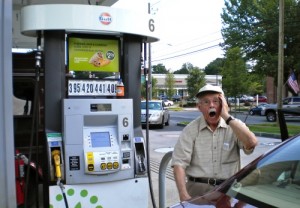
No wonder John is shocked! He remembers buying gas for 26.9 a gallon.

I’ve set a new record for myself on the road. I achieved 24.8 miles per gallon of gas in my Hyundi Sonata in a test!

I’m sure this does not sound like much for you in your Prius. But for me, not bad. I’m accustomed to lower mileage.

I obtained my driver’s license at 18 and I looked forward to this test last week-a feat to cap my 64 years at the wheel. I was excited when I started the final arithmetic. But I admit I was disappointed with the 24.8 result. I had been driving with such constant care throughout the test of nearly 400 miles that I expected a more dramatic score. After all, I had used every trick I knew to maximize that result.

That 24.8 was for my mileage over 13 days. I re-did the arithmetic to make sure my answer was correct.  It was. I had been hoping for 30 miles per gallon. I had gone online. My Sonata is a four-door 2010. For it the Hyundai website claims 24 city/35 highway miles per gallon.

My driving was a combo, in fact leaning toward the highway driving. My heaviest driving was in New London on two visits, but I also made a round trip to Hartford.

I have the highest regard for Hyundai, but I believe reaching that claimed 35 mpg is as realistic as breaking the sound barrier. I’d love to talk to anybody who has ever gotten more than 30!

I have owned some 30 cars. I have driven hundreds of thousands of miles—more than a million, I figure. This is my best mileage ever, I believe, as modest as it is. It comes when gas prices are the highest I’ve ever coughed up. More than $4 per gallon!

I paid 27 cents a gallon when I got my first car in 1950 and that hurt my pocketbook so bad that I remember it to this day.

That was a snappy Terraplane coupe, by the way. Vintage ’38. Two doors; a single bench. I was a junior in college. It cost $100. My father gave me $50 and I scrounged the other $50 from my Aunt Bernadette. What a nice memory.

I remember when the price dropped to a wonderful 17.9 in a gas station war. Those wars sprang up like wild fire. They were wonderful for us consumers. Hated to see them end. I haven’t seen a real gas war in years. It makes me think there may be collusion now. How does it happen that gas stations in a whole neighborhood seem to display basically the same prices every day?

Anyway, I have become a careful driver and frugal. I consider it dumb not to be. I admit that during these stratospherically spiraling gas prices I’ve been even more watchful.

Everybody I know is complaining about these astonishing, numbing prices. It’s right near the top as our biggest topic of the day.

Truth is, I hear more about the day’s gas prices at the coffee shop than I do about Iraq and Afghanistan, which are much more serious.

And know what? Despite these incredible prices, I am astounded to see so much dumb driving on the road. Driving that wastes gas and that means money. Crazy!

Yes, I take pride in wrangling my dollar’s worth. It’s this habit that accounts in part for my untroubled financial life these many years.

Oh, I didn’t tune up my Hyundai Sonata for this trial. Didn’t check my tire pressures, which is recommended for top performance. No special preparations of any kind.

The idea to run a test hit me on the morning I paid $4.14 per gallon for a fill-up. Incredible! What American over the age of 30 ever expected to see such prices?

I immediately set my odometer at zero. And I did not use any new-fangled driving tricks. I used the same old tricks I have used for years. Some are known to many savvy drivers. You probably use some. But I think a couple are my own—things I’ve picked up by myself on the road.

Some are more effective than others, of course. But they all wring out more miles per tankful. I believe this although my close friend Woody strongly disagrees. I’ll tell you about him in a minute.

Interested in how I did it? Well, see how my tricks check out against yours.

First, I must tell you about an exciting experience eight years ago. My Uncle Jack—91 at the time—was a patient at the Rhode Island Veterans Home in Bristol, R.I. I visited him once a month. It was108 miles to Bristol, with two stops on the way. One in Westerly for a quick walk around beautiful Wilcox Park downtown—it’s also a superb arboretum. And a stop for coffee half an hour later down the road.

Oh, I am a shun-piker. Important for you to know this. I drive on our Interstates as little as possible. So to visit my uncle, I traveled on I-95 only to Rte. 234 beyond Mystic. I rode 234 into Westerly. Then Rte. 1 into Rhode Island, turning east on Rte. 138.

Then down the long hill to gorgeous Narragansett Bay and over the two great bridges across it to the eastern shore —the Jamestown Bridge to Conanicut Island, and  then the massive Senator Pell Bridge. Then dense stop and go traffic on 138 for about 15 miles to the old and narrow but graceful Mount Hope Bridge across scenic Mount Hope Bay. Then five miles or so of slow driving to my uncle’s.

So, quite a variety of roads.

It was exciting because I was trying a new game I made up. I got myself two rolls of pennies—100 in all. I wasn’t sure how many I’d need. And I put an empty tin can on the floor to my right. The idea was this: I would drop a penny into the can every time my foot touched the brake pedal. My goal was to get to the hospital with as few pennies in the can as possible.

A wonderful game. A game of skill and anticipation and fun. Yes, fun! My Rule Number One was: no risky chance taking! Do nothing to impede other drivers! Safety first! 

Rule Number Two—obey the law. Drive within the posted speed limits—well, reasonably so (who ever respects every limit?) Do not run a red light. Stop at every stop sign. Do not cross a solid white line.

My score that first time for that 108 miles was 38 pennies.  And I was vigilant. It turned out to be so much fun and so instructive that I wrote a column about it. Later several readers told me they tried it. Very gratifying.

I played that game every time I headed to Bristol. My best score was 19. But there was a bigger pay-off. That game sharpened my driving skills. Anticipate and react. Again and again. That was the essence of the game. What’s about to happen and what should I do about it? I now anticipate at the wheel as a regular thing. It’s a wonderful habit.

Here’s an example. I’m coming around a curve and I see a green light a quarter mile ahead. Now, a quick decision! Should I speed up to make sure I’ll cruise through before it turns red? Or should I slow down (naturally, without braking!)  to glide to a halt in front of the light if it does turn red? Other cars going my way complicate the game. Of course, luck is a factor, as it is in so many aspects of life.

That 108 miles to Bristol presented many variations of this challenge.

One helpful trick I learned the hard way many years ago. One evening, backing up in the dark, I hit a lamp post. Just a gash on the pole, but a $500 accident to my car. Lesson learned!

Backing up is a dangerous maneuver even in broad daylight. We all have three rear-view mirrors but it’s impossible to view all three all the time. And the view is limited. Think of the many times you’ve read about a car backing up and hitting a child, for instance.

Besides, backing up is a total waste of energy…gas. I plan my driving for as few back-ups as possible. As we know, nearly every parking spot at every supermarket and shopping plaza in the country makes it necessary for us to pull into it and park. Then back out.

I search for a spot to park where I won’t have to do that. Easy. Every such parking lot is designed in double rows with cars parking nose to nose. If possible, I choose a row where two nose-to-nose spots are empty. I drive through the first spot and into the second one and park there. Later, in leaving, I drive out forward. Couldn’t be easier.

It’s essential always to drive with a light foot—light on the gas pedal and light on the brake. Besides, my kind of driving is much kinder to the brakes. Nice and steady; no wild spurts up and no frantic braking.

Another trick is to limit my speed to 60 mph on Interstates. These days only a terrible slowpoke does that. Like me. Very difficult to stick to 60—80 is usual now. Well, I’ll accelerate to 65 if a heavy-footed demon is tailing me.

These roads are designed for faster travel, which means higher speeds. But it’s surprising how fuel efficiency fades at higher speeds. It’s the old law of diminishing returns that comes into play.  Driving at 60 is more economical. And safer for sure. 

Another is to make as few trips as possible. This means consolidating errands. Another is to not run the engine a minute longer than usual.  If I’m on my Rte. 154  in Centerbrook and I see our Scenic Steam Train approaching and tooting and the highway gates about to come down, I stop and turn off the ignition. I re-start only once the gates are back up.

Another is to tank up on gas every time and re-fill only when the gauge is approaching Empty. Stops for four or eight gallons at a time are wasteful in time and money. When possible, tank up in cooler temperatures, usually evening—you get more gas for your money. So I’ve read. Never make a special trip just to buy gas.

I practiced all these religiously during my test.  As I said, knowing Hyundai’s boast of 35 mpg on the highway for my car, I expected an even better result.

I told you I’m a shunpiker. I like to enjoy the ride. Like to look around. See everything. Shunpiking is a natural instinct for me. Some 10 years I drove solo to California in my Dodge Ram camping van. But not shunpiking. I used Interstates nearly all the way. So many boring miles!

Getting ready to return home, solo again, I got the idea of making the drive back with as few Interstate Highway miles as possible.

I studied the map and plotted a route.  Getting out of Los Angeles took me more than three hours! And that’s how difficult much of the trip was. In some stretches, everybody uses the Interstates! There seems no reasonable alternative. But I persisted and found my way.

Often I was all alone on narrow old roads for many miles. Through the West and the Midwest and the Great Plains. But I did see some incredible sights. No space here to tell you about all that. Well, I rode all the way across the country into New York State without a single mile on an Interstate! Then, how ironic.

Entering my Connecticut, failure! Without warning and without opportunity to turn off, I was led onto I-84. This happened twice! I succeeded for some 3,600 miles, then my accomplishment faded in the final 150 miles. But it was fun trying. I wrote an article about that also.

Now, about my friend Woody Boynton in Old Say brook. He’s a retiree like me and a fellow former Peace Corps Volunteer. A smart guy…a fount of info about a wide range of things, including mechanical engineering. He astonishes me every time.

I told him about this test of mine. And here is the shocking thing: he told me I was all wet!  He pooh-poohed many of my tricks. He said, “You may save a teeny bit. But all those tricks are largely insignificant. They don’t add up to much. What’s important is steady acceleration. And deceleration.” This part I agreed on. But he said it all with such authority that I was crestfallen.

Chagrined.

Hah! I hate to admit it but he may be right. Maybe that’s why my result of 24.9 was not better. If he is right, there was not much point in my being so diligent and fixated. Maybe I was being dumb in my own way.

Please help me. If you are an expert in this big subject of the day, please advise me. Is Woody right? E-mail me at johnguylaplante@yahoo.com. I thank you in advance, and will do so again in a personal reply to you.

If I come up with good info from you and others, I’ll share it with our readers.

There’s one thing I will not change my opinion about. I love my penny game. It has made me a better driver. Kept me more alert. And given me a lot of fun. Try it once. It doesn’t have to be pennies, of course. Many other things will work. Use silver dollars if you like. Let me know. Talk others into trying it. 

Maybe together we’ll save a few gallons.

John Guy LaPlante is a veteran writer and journalist.  His award-winning columns and articles were most recently published in the Main Street News.  He is the author of two books, “Around the World at 75. Alone! Dammit!” and “Asia in 80 Days. Oops, 83! Dammit!”  He has just completed his service as a Peace Corps Volunteer (PCV) in the Ukraine where his 27-month tour of duty began last fall.  John always welcomes comments on his articles.

The Mystery of Mr. XYZ

Long dead and still unidentified.  But now, a startling development … 

It’s been more than a century since bank robber XYZ was blasted into eternity during a hold-up attempt at the old Deep River Savings Bank on Main Street.  That bank is Citizens Bank now.

I’m familiar with other men widely known by their initials.  JFK and FDR are just two.  But that’s because these two were already famous as John F. Kennedy and Franklin Delano Roosevelt, American presidents.  But XYZ?  He was a nobody.  Or so it seems.

That startling crime made big news way back in 1899.  It’s been 11 decades and the mystery about XYZ has never been penetrated.

Who was this little guy?  Where did he come from?  Did he have a family?  Did he have a trade besides robbery?  Townspeople were fascinated about it for days on end.  They still are and there’s proof of this.

He was buried in Fountain Hill cemetery.  Its first burial was in 1851.  For years—for decades–it was the biggest and most prestigious cemetery in these parts.  People were even brought in by train and boat to get buried in Fountain Hill.  This was the resting place to be laid in.

All understandable.  Those were the days when the ivory and piano industries had made Deep River the Queen of the Valley.  A proud and prosperous town indeed.  You can see this in Fountain Hill—so many great and fine monuments.  A very beautiful final resting place.  Some folks visit it just to visit it.  They know none of the inhabitants.

Fountain Hill Cemetery is a scant half mile from where XYZ was shot and killed.  XYZ’s grave is in the farthest corner back.  It’s the very oldest section of the cemetery.  It’s a trick to find his grave.  Up over the hill, down and around some slopes, then around a ravine or two and some great rocky outcroppings, then along a narrow, rutted road.  The worst final yards in the cemetery.  A hearse doesn’t carry anybody back here any more.

Finally there it is.  A cut stone, but how tiny.  About half the size of a shoe box, I’d say.  A plain “XYZ” engraved on it.  That’s it.  The reason is simple.  Nobody back then knew who he was.  Nobody does today.  He was lucky somebody thought of calling him XYZ.

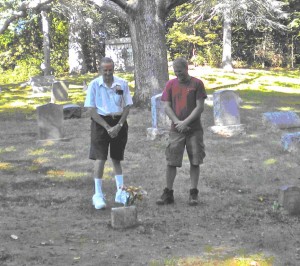
This is where he rests.  There’s a small bouquet of plastic daffodils adorning it.  Faded.  Pathetic.  Looks like it’s been there for years.   In the photo at left, Bob Johnson and Shawn Nelson pay their respects. The tiny stone is at Bob’s feet. Notice the bouquet.

On XYZ’s left under a much bigger monument rests Timothy Hore Cole, a World War I vet.  His neighbor on his right is Josef Hnilicka, also remembered with an imposing monument.  Honorable men, I’m sure.  Unlike XYZ.

Other monuments grace the tranquil green slope, which on this day is mottled with sun and shade.  Back a bit up the slope is a fine, giant oak.  Magnificent.  As old as this old cemetery, I’m sure.  Its great limbs stretch wide in a loving and protective embrace over all.  Tranquility.  Rest.  Peace.  I feel these.  Then I notice that not one of these many superior monuments has even a plastic daffodil on it to show somebody cares.  Interesting.

I never would have found XYZ’s grave by myself.  My friend Robert F. Johnson took me to it.  He knows dozens and dozens of the people resting here.  His wife Rosalie is here.  So are his father and mother.  Other loved ones also.  Bob has lived in Deep River his whole 86 years. 

Was a real estate agent here for decades.  The busiest in town, I’ve heard.  Sold hundreds of houses on these little streets and avenues and lanes.  In fact, is still selling houses.  I’ll bet he knows more people in town even today … except maybe Dick Smith, who’s been our first selectman for 22 years.

I’m in my 80’s, too, but I’ve lived here only a dozen years.  Just a newcomer, but greatly interested.  Bob is priceless to me.  He’s always teaching me new and wonderful things about the town.

He’s made me appreciate Deep River more than ever.  Not rich.  Not poor.  Not much phony about it.  Nothing glossy.  People maintain their properties.  Turn out for elections.  Support good schools.  Respect peace and order.  Work.  Yes, a good town.  And so pretty by the Connecticut River.

Well, Bob and I met Cemetery Superintendent Shawn Nelson up there at Forest Hill.  Right at XYZ’s grave.  He’s just 34 but he’s been superintendent for 12 years.  It’s a big place–90 acres.  Has different sections, of course, with much of interest.  XYZ’s section was the original one.  Fountain Hill grew and spread out from there.

Shawn handles it all.  Keeps the whole place looking good.  Shows people around who are thinking of buying a lot.  Answers their questions.  Digs the graves.  Re-sets monuments when time topples them.  Maintains all the records of who is buried there, and who with, and when that was.  Also keeps an eye out for those coming here maybe for improper reasons.  But that doesn’t happen often.

He surprised me when he said he was in the business since he was 8 or 9.  “I grew up in all this.”  His dad was superintendent—still is—of Pine Grove Cemetery in Middletown.  So were his grandfather and grandfather.

“I’m the fourth generation in my family to be a cemetery superintendent.”  He smiled when he said that.  I could see the pride all over his face.

We talked about XYZ, of course.

Shawn said, “It’s amazing.  Nobody knows a thing about him.  Except that he was a bank robber.  But I see people finding their way to this grave all the time.  They come and stand here.  Maybe they say a prayer.  Some drop a coin down there.”  He pointed to the ground.

“This guy has the smallest monument in the whole place!”

He pointed to the stone.  “Look at it.  It’s just of those stones that paupers get when they die.  In fact, I think it’s maybe the only stone like it in the cemetery.”

“But there are more than 6,000 buried here.  But this guy gets more visitors than anybody else here!  How to explain that?”

I thought of robber Jesse James and others of his ilk.  Are they famous because they were outlaws … or because they were so daring …  Why?  Why?  Unfortunately I am not a psychologist.  Maybe the psychologists would be puzzled too.

“Look,” Shawn said.  He got down on his knees and pointed.  Scattered in front of the tiny monument was a bunch of coins … 27 of them.  A couple of quarters, some dimes and nickels, some pennies.  Some had been there a long, long time, for sure.  A couple looked just minted.

I asked him, “Why do you think people leave money like this?”

“No idea.”  He paused.  He was thinking it over.  “Hey, he was a robber.  He wanted easy money.  Well, people are giving him money!”

I glanced at the coins.  They didn’t amount enough to even buy a beer at Calamari’s Tavern a 15-minute walk from here.

“And look!” he bent down and picked up what I thought was a soda-can ring.  It was a silver ring.  A woman’s ring.  Stone missing, it seemed.  Possibly an engagement ring?

“What’s that all about?” I asked him.

 “No idea.  But I’ve seen it there for many years.  ” He thought a minute.  “Maybe it ties in with the lady in black who used to come here once a year.  She’d visit the grave and leave a flower.  She still comes, some say.”

“Lady in black?”

“Yeah.  So they said.  She’d come on the train.  Young.  Good looking.  Wore a long black cloak with a hood. Never talked to anybody.  Would leave on the train.”

“Have you ever seen her?”

Shawn laughed. “No.”

Let me tell you how XYZ got killed.  I struck gold—I went online and found a wonderful account.  It’s “Legendary Connecticut” by David E. Phillips, published many years ago.  I recommend it to you.  But pay attention to that word in its title, “Legendary.”  My dictionary defines the word as, “of a story coming down from the past—popularly accepted as historical but not verifiable.”

Bank robberies were more frequent back then.  There were two banks in town.  The Deep River National and the Deep River Savings.  Big banks for those times.  The banks had seen several hold-up attempts  on them but none successful.

The American Bankers Association sent them word that an attempt was planned.  A big one … a band of robbers!  How it heard that, no idea.  The Savings Bank took action.  It hired a security guard, Harry Tyler, who had a reputation as resolute and fearless.  And a good shot. 

He stood guard every night.  He armed himself with a Winchester.  It was the biggest, best rifle back then.  It was called a riot gun!  The weeks went by.  He maintained his vigil.  Some folks said it was all just a phony rumor.

Very late one dark night—it was Dec. 13—he heard a dog bark and bark.  He saw four men approaching “stealthily.”  He reached for his big Winchester.  It was said this rifle could kill two people close together with a single shot.

He saw one holding a revolver.  Tyler didn’t wait.  He took careful aim and pulled the trigger.  The man with the gun dropped, dead.  The others fled.  The victim had part of his face blown off.  Later Tyler got $500 for his valor.  A huge sum back then.  That dog deserved a medal.  At least a nice fresh bone.

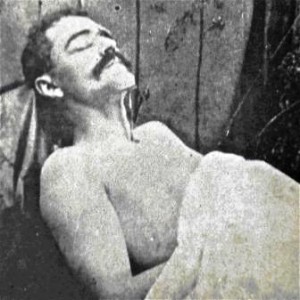
The undertaker held the body a few days, hoping someone would be able to identify the man.  In his early 30’s, it looked like.  A fair build.  A big, wide mustache.  But a mustache was common.  Nobody did provide the answer.  The photo above right shows XYZ at the undertaker’s.  The fatal shot hit him on the other side of his face.

Not a word was ever heard from his accomplices or about them.  The cemetery donated the plot for XYZ.  A few curious folks attended the simple ceremony.

Oh, I should mention that sharp-shooter Harry Tyler is buried here also.  About a rifle shot away.  I should go check what his inscription says.

A few weeks after all this, a letter came in a lady’s dainty handwriting.  She asked that the robber’s grave please be marked with just XYZ.  Did not give her name.  The envelope markings were fuzzy.  Was she the lady in black who came once a year for many years?

A simple wooden cross was put up with XYZ on it.  In time, the basic stone marker replaced it.  Shawn says the records do not say when.  “Maybe the wooden cross wore out.  Maybe the cemetery paid for the stone….”

The stone is weathering just fine.  Those deep letters are good for another century.

All that was long before the F.B.I.  Even before finger-printing.  And now we have DNA testing, which is said to be infallible.  DNA testing is the convincing evidence in more and more trials—absolute proof.  DNA testing has also freed prisoners who have been locked up for years for crimes they never committed. 

Is it possible that DNA testing could finally identify XYZ, resting there six feet under for more than a century?  And give him the name his mom and dad chose for him in the hope, I assume, that he would make that name famous some day?  But famous rather than notorious.

Well, it was time for the three of us to leave XYZ’s grave.  Surprise.  Bob dug into his pocket, bent down, and placed a coin among the others.  Another surprise: Shawn did the same thing. 

But why?  I’m sure they had a good reason.  But it beats me.  I did not.  Later I felt a bit guilty about that. 
Hard to explain.

I hope XYZ is aware that Bob and Shawn did that for him.

NOW ABOUT THE STARTLING DEVELOPMENT …

At the Deep River Public Library, I happened to mention to librarian Ann Paietta that I had just finished writing this story.

Her eyes lit up.  “But XYZ was identified!”

 “What???”

 “I’ll show you!”

In minutes, she handed me a paper.  “This is a photocopy of an article published in the New Era.  The New Era was the big paper here in those days.”

I scannd it eagerly.  It was dated Feb. 23, 1900.  That was a bit more than two months after the shooting.

A headline said, “THE BURGLAR IDENTIFIED. His name Frank Howard, and was a Deep-dyed Criminal.”

A full column of reporting followed.  It said that detectives of the American Bankers Association had been working hard on the case.

He was also known as Frank Ellis and Tom Howard.  In another place, as P.E. King.  He was traced back to Mancelona, Michigan, and to Albany, N.Y., and to Springfield, Mass.  He was described as a desperate and hardened criminal.

In one robbery he shot a man (used a revolver).  The man recovered.  In a hardware store, he blew up the safe but got little.  One time he was pursued by two officers.  They tried to arrest him.  He drew his revolver and shot one man in the back (no mention how seriously) and took off.  Was arrested later in the day “after an exchange of several shots.  It was thought for a time that a lynching would follow.”  No mention of what happened to Howard as a result of that.  I wonder if he realized he might have been lynched.

The detectives also got information about the three who escaped after the Deep River try.  “The same three men were in the gang that shot the watchman in the Bridgeport affair a few weeks after the killing of the burglar in this place.”

Pretty good reporting, I think, given how much more difficult news-gathering was in those days.  The New Era must have had a lot of subscribers.

Now the big question: After the circulation of this sensational article, why did it continue to be said time and again that XYZ was never identified?

I am not sure.  But there’s a lot of fun in keeping a mystery going.

John Guy LaPlante is a veteran writer and journalist.  His award-winning columns and articles were previously published in the Main Street News.  He is the author of two books, “Around the World at 75. Alone! Dammit!” and “Asia in 80 Days. Oops, 83! Dammit!”  He completed his service as a Peace Corps Volunteer in Ukraine in early 2010 after a 27-month tour of duty.  John always welcomes comments on his articles.  Email him at johnguylaplante@yahoo.com