
Reading Uncertainly: ‘Talking to Strangers’ by Malcolm Gladwell

I admit that I am easily drawn to the words of Malcolm Gladwell, having already absorbed his The Tipping Point (2002), Blink (2007), and Outliers (2011).  I was not disappointed!.

This is yet another intriguing and challenging mental exercise about the way in which our brains tend to mislead us,

Consider meeting someone new and engaging in conversation: afterwards, we think we have understood each other, but have we really?

Gladwell cites many past meetings that have resulted in gross misunderstanding: Cortes and Montezuma; Hitler and Chamberlain; Sandra Bland and the Italian police; Bernie Madoff and investors;, Sandusky and the Penn State authorities.

He suggests the fallacy lies in “… the assumption that we all follow in our own effort to make sense of strangers. We believe that the information gathered from a personal interaction is uniquely valuable.”

It is our instinctive desire to believe what a stranger tells us: our latent bias to trust what we hear. But the emotional responses to others can be and often are misleading.  Gladwell says, “We tend to judge people’s honesty based on their demeanor.” Hesitancy, looking away, stammering, all lead us to doubt, but even those traits are misleading.

We are inevitably a species, “a society (that) does not know how to talk to strangers.” When we look differently, act differently, dress differently, we create instinctive wariness, alarm and natural aversion. When the stranger looks, acts, dresses and sounds like us, our natural sympathies are aroused.

Gladwell’s conclusion? Misunderstandings are entirely natural. “We will never know the whole truth,” so “… what is required of us is constraint and humility.”

So take heed … listen; pause, and think!

Editor’s Note: ‘Talking to Strangers’ by Malcolm Gladwell is published by LittleBrown, New York 2020.

Felix Kloman

About the Author: Felix Kloman is a sailor, rower, husband, father, grandfather, retired management consultant and, above all, a curious reader and writer. He’s explored how we as human beings and organizations respond to ever-present uncertainty in two books, ‘Mumpsimus Revisited’ (2005) and ‘The Fantods of Risk’ (2008).

A 20-year resident of Lyme, Conn., he now writes book reviews, mostly of non-fiction, a subject which explores our minds, our behavior, our politics and our history. But he does throw in a novel here and there.

For more than 50 years, he’s put together the 17 syllables that comprise haiku, the traditional Japanese poetry, and now serves as the self-appointed “poet laureate” of Ashlawn Farm Coffee, where he may be seen on Friday mornings. His late wife, Ann, was also a writer, but of mystery novels, all of which begin in a village in midcoast Maine, strangely reminiscent of the town she and her husband visited every summer.
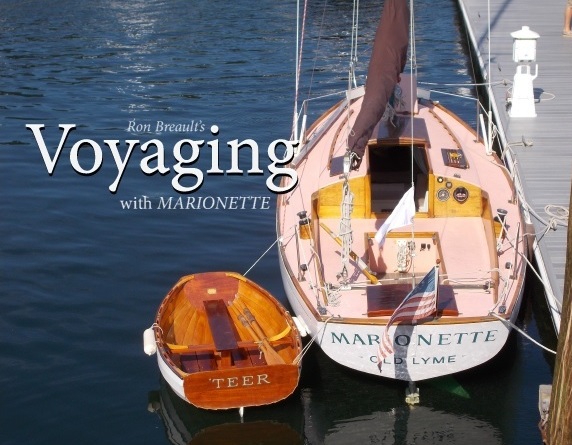
Reading Uncertainly: ‘Voyaging with Marionette’ by Ron Breault of Old Lyme


A quarter century ago, an elderly sailor glimpses an attractive middle-aged lady relaxing on the shore of the Connecticut River.  She’s a bit disheveled; her skirt is torn, revealing a bit of what’s underneath, but she’s lovely! He’s immediately smitten, and, like Henry Higgins in My Fair Lady, the sailor decides he must have an affair.

The sailor is Ron Breault, an Old Lyme resident and a Niantic Bay racer, and the Lady is not Eliza Doolittle, but Marionette, a 24 ft. Dolphin-class sloop. This book is his enthralling, copiously detailed story of their 25-year love affair.

Today she is “a woman of a certain age” and Ron’s a septuagenarian, but the mutual attraction continues. This book recounts their love life of the past quarter century as they both ask, “What next?”

Ah, the details!

The author has collected the most intimate details of this long-standing affair. He recounts almost every moment of their life together, restoring the lady’s youth, beauty, and speed, building her separate palatial quarters at his home in Old Lyme (with, of course, the complete approval of his wife, Chris), dressing her with a new suit of speedy clothes, and, to top it off, creating a tiny offspring.

The latter’s name is ‘Teer!  I thought: charioteer? musketeer? marketeer? profiteer? Ah yes, puppeteer: the perfect name for the child of Marionette! 

Everything about this voluptuous woman is described: her finery aloft and, mirabile dictu, everything underneath and below. Nothing is left to the imagination …

This loving couple then engage in both cruising and racing, two doing the tango from the Connecticut River to Niantic Bay, Fisher’s Island Sound, Block Island, Narragansett Bay, Buzzard’s Bay, the Canal, the waters of Massachusetts and New Hampshire, and, of course, the ultimate nirvana, Maine!

They detail their Penobscot Bay peregrinations from Tenants Harbor, Spruce Head, Rockland, North Haven, Vinalhaven, Isleboro, Eggemoggin Reach, Blue Hill, Deer Isle, Swans Island and on to Mount Desert, with both Southwest Harbor and Northeast Harbor. Plus numerous times in Camden, the heart of sailboat racing in Maine.

Are words insufficient for you?

Your sight is also addled with more than 700+ pictures and photos, and those who want more are directed to the author’s website: www.Dolphin24.org.

Ron and Marionette’s story illustrates superbly that famous conclusion drawn by Rat in Wind in the Willows: “Believe me, my young (and aged?) friend, there is nothing, absolutely nothing, half so much worth doing as simply messing about in boats.”

So ease your sheets, cruise downwind a bit, pop a brew or two and enjoy this love story.

Editor’s Note: ‘Voyaging with Marionette’ by Ron Breault is published by Whaler Books, Buena Vista, VA. 2020. To order a copy of this highly recommended book, visit marinermedia.com/product/voyaging-with-marionette/.

Felix Kloman

About the Author: Felix Kloman is a sailor, rower, husband, father, grandfather, retired management consultant and, above all, a curious reader and writer. He’s explored how we as human beings and organizations respond to ever-present uncertainty in two books, ‘Mumpsimus Revisited’ (2005) and ‘The Fantods of Risk’ (2008). A 20-year resident of Lyme, Conn., he now writes book reviews, mostly of non-fiction, a subject which explores our minds, our behavior, our politics and our history. But he does throw in a novel here and there.
For more than 50 years, he’s put together the 17 syllables that comprise haiku, the traditional Japanese poetry, and now serves as the self-appointed “poet laureate” of Ashlawn Farm Coffee, where he may be seen on Friday mornings. His late wife, Ann, was also a writer, but of mystery novels, all of which begin in a village in midcoast Maine, strangely reminiscent of the town she and her husband visited every summer.

Reading Uncertainly? ‘Code Red’ by E.J. Dionne

Would you be eager to read a book that is sub-titled “How Progressives and Moderates Can Unite to Save Our Country?

If you lean to the right, probably no; to the left, sure. But as I am a determined independent, I paused.

Dionne is a well-known commentator on evening news programs, a columnist for the Washington Post, and on the faculty of both Georgetown  and Harvard Universities. Whenever I have heard him on the news he has been clear, challenging and articulate.  So I read this book.

We seem to hear nothing but complaints and savage accusations these days, gloom and potential doom; the few of “us” fighting of all of “them.” Dionne opens his treatise with “a spirit of hope, but with a sense of alarm.” Not “doom” but alarm. And that dual sense dominates his entire argument.

He writes, “In a democracy, there are no final victories – or defeats.” We simply evolve imperfectly and with stuttered steps. Dionne suggests that one possible course of action is to try and enlist two “groups” – the moderates and the progressives – to work more closely together for necessary changes in this country.

First, a problem of labels: why are we so willing to plant a defining title on almost everyone? This denies the inherent complexity of each one of us.

Far too often we are assigned a label: left; right (but not up or down!); alt-right; conservative; moderate; progressive; lefty; socialist. The Scandinavian states are labeled “socialist” but many of us might well prefer to live in those societies rather than in our tumultuous group of states.

Dionne notes “… our tendency to confuse labels and reality,” denying our natural human individuality. We are also too quick to assign each one of us to a “class,” another artificial sorting that brings confusion and increasing distance.

Well into his thesis, Dionne quotes Stephen Pearlstein, “ The wealth of nations depends on the vigorous pursuit of self-interest by individuals whose natural and productive selfishness is tempered by moral sentiments such as compassion, generosity and a sense of fair play.” That’s our continuing difficulty: dealing with our natural human altruism and selfishness.

Dionne doesn’t dump all those to his right, but he suggests a first step begin with bringing two “groups” together in an effort to change things. His three themes: First, “a more democratic political structure” reducing the power of money and “the influence of the connected”. Second, addressing “the fraying of community and family bonds”, and third, to “experiment with more ambitious regional and place-based policies”.

In other word, decentralize: more responsibility for states, cities, and towns. It is “our obligation to challenge a system that guarantees only the freedom that money can buy.” Dionne’s suggestion: “the politics of visionary gradualism.” Slow but sure …

Dionne wants to replace a nation of numerous and fractious labels, snarling at each other through social media, with “a sense of ‘we’ … belonging and connectedness … provide the fiber for a health democratic polity.” This requires mutual respect and a willingness to listen, politely, to each other.

Is this possible? Dionne concludes his challenge, “This book offers what might be called articles of conciliation … We must learn to say, ‘We’ about all of our fellow-citizens – and mean it.”

Time to start?

Editor’s Note: ‘Code Red’ by E. J. Dionne is published by St. Martins Press, New  York 2020

Felix Kloman

About the Author: Felix Kloman is a sailor, rower, husband, father, grandfather, retired management consultant and, above all, a curious reader and writer. He’s explored how we as human beings and organizations respond to ever-present uncertainty in two books, ‘Mumpsimus Revisited’ (2005) and ‘The Fantods of Risk’ (2008). A 20-year resident of Lyme, Conn., he now writes book reviews, mostly of non-fiction, a subject which explores our minds, our behavior, our politics and our history. But he does throw in a novel here and there.
For more than 50 years, he’s put together the 17 syllables that comprise haiku, the traditional Japanese poetry, and now serves as the self-appointed “poet laureate” of Ashlawn Farm Coffee, where he may be seen on Friday mornings. His late wife, Ann, was also a writer, but of mystery novels, all of which begin in a village in midcoast Maine, strangely reminiscent of the town she and her husband visited every summer.

Reading Uncertainly? ‘The File’ by Timothy Garton Ash -“A Chilling Portrait of Treachery and Compromise” (LeCarré)

Another sleeper!

A neighbor and compulsive reader — as I am too — gave me this paperback with her encouragement. As I started to read, I was somewhat dubious. After all, what is there to interest me in reading about a young Oxford grad student going to Berlin in 1978, and then on to Humboldt University in East Berlin in 1980 to continue his work.

But … it seems this student (the author) was almost immediately the focus of the East German Stasi police, which assumed that he must be an English spy. Shades of John LeCarré.

He guessed, of course, that he might be suspected, but he never realized the extent of the German suspicions and the degree of its work until after the reunion of East and West Germany, and the opening of the Stasi files to his review.

It was, as Ash describes it, “the quiet corruption of mature totalitarianism.” He then went back and first investigated the files on him, and then decided to try and interview many of those who reported on him, some of whom were good friends.

This is the story of what he learned. It is both compelling and fascinating.

He goes on to describe some of their excuses. “I did my job” is the most common, responding to the overwhelming pressure of a repressive and suspicious government.

But what is exceptional about this personal history is its extrapolation to all of us.

Do not many — if not most — of us have that compulsive certainty that we always face “enemies” to be identified, fought and then conquered? It is the classic “us” versus “them”, but, as Pogo correctly pointed out, “We have met the enemy and he is us.”

At the same time as the Stasi was investigating both Germans and foreigners, MI6 in England and the CIA in the U.S. were hard at work doing the very same things.

Ash’s conclusion, “ … the paradox at the head of all spying: the key to betrayal is trust.”

But can we really rely on what we have read and what we think we remember?

Ash asks, “How can you ever really know what is fact, what fiction, and what still lies hidden?” The answer is we can’t — there is no such thing as “fact.”

Ash continues, “What we call ‘my life’ is a constantly rewritten version of our own past … Personal memory is such a slippery customer … Our memories decay or sharpen, mellow or sour, with the passage of time and the change of circumstances.”

His conclusion: “Now the galling thing is to discover how much I have forgotten of my own life.”

Me too …

Despite my reliance on many old records saved over the years, when I came to write my own “autobiography” in 2011, I had to acknowledge, candidly, that it was basically a work of fiction!

Editor’s Note:The File’ by Timothy Garton Ash was published by Vintage Books, New York in 1998.

Reading Uncertainly? ‘How Democracies Die’ by Steven Levitsky and Daniel Ziblatt

Two learned Harvard professors open this provocative challenge to many of our conventional beliefs with a brief sentence: “We feel dread  …” Their worry – that “democracy” as we have known it may be seriously threatened: “Democracies may die at the hands not of generals but of elected leaders … who subvert the very process that brought them to power.”

They cite Hitler, Chavez, Castro, Putin, and Erdogan, among past and current elected leaders who trashed democracy, even when some of them retained popular support.

What is democracy?

These professors define it as “a system of government with regular free and fair elections, in which all adult citizens have the right to vote and possess basic civil liberties such as freedom of speech and association.”

But, given the enormous explosion of human population and the way social media can manipulate many of us, are the precepts of democracy and our “Madisonian system of checks and balances,” still workable?

Our system in this country seems to be based on a desired but frequently non-existent “balance” among executive, legislative, and judicial branches of government, at local, state, and national levels

They continually pose difficult questions in this book:

  • Are “political parties democracy’s gatekeepers?” Are only two the best course (as in the U.S. and U.K.), or are many better (13 now in Switzerland)?
  • Who or what is an “extremist”? Do open primary elections encourage “extremists’? Do they encourage an enormous flow of money?
  • Are we in the midst of a “collective abdication” of the rules of democracy”?
  • Do “neutral arbiters” (the judiciary, for example) even exist?
  • Do “national referenda even serve a useful purpose, when society is fractured and when social media can move large numbers of voters in different directions almost instantly?

One of the authors’ fascinating chapters is a study of elected authoritarians, citing Peron (Argentina), Correa (Ecuador), Orban (Hungary), Berlusconi (Italy), Fujimori (Peru),  Kaczynski (Poland), Putin (Russia), Erdogan (Turkey), Chavez (Venezuela) and, perhaps to come, AMLO in Mexico.

These Cambridge skeptics conclude (properly!) with more questions:

  • Is the “fundamental problem facing American democracy (our) extreme partisan division?”
  • Is a  “multiethnic democracy in which no ethnic group is in the majority” truly possible? See Switzerland now …
  • Is it possible to be “both multiracial and genuinely democratic”?
  • Is trust possible?

There seem to be two critical norms for the continuation of “democracy”: the first is institutional forbearance (don’t try to control and manage everything) and natural toleration (respecting the opinions and habits of other others), but far too often religious beliefs and ethnic habits tend to corrupt our political universe.

Editor’s Note: ‘How Democracies Die’ by Steven Levitsky and Daniel Ziblatt is published by Broadway Books, New York 2018.

About the Author: Felix Kloman is a sailor, rower, husband, father, grandfather, retired management consultant and, above all, a curious reader and writer. He’s explored how we as human beings and organizations respond to ever-present uncertainty in two books, ‘Mumpsimus Revisited’ (2005) and ‘The Fantods of Risk’ (2008). A 20-year resident of Lyme, he now writes book reviews, mostly of non-fiction, a subject which explores our minds, our behavior, our politics and our history. But he does throw in a novel here and there.
For more than 50 years, he’s put together the 17 syllables that comprise haiku, the traditional Japanese poetry, and now serves as the self-appointed “poet laureate” of Ashlawn Farm Coffee, where he may be seen on Friday mornings. His late wife, Ann, was also a writer, but of mystery novels, all of which begin in a village in mid-coast Maine, strangely reminiscent of the town she and her husband visited every summer.