
Talking Transportation: Traveling by Tube

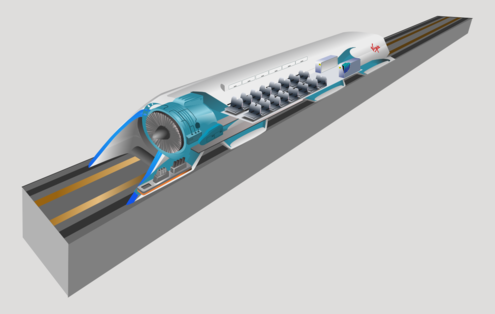
Cutaway graphic of "The Loop."

Cutaway graphic of “The Loop.”

Will the train of the future be a high-speed tube, not a railroad?  That’s inventor and entrepreneur Elon Musk’s and others’ vision.  And Musk, the man who brought us the Tesla (all-electric car) and SpaceX (for-profit space rocket company) is putting his own money behind a proof-of-concept project for what he calls Hyperloop.

The concept sound simple:  move passengers in a sealed tube through a series of giant pipes propelled by air pressure at speeds up to 700+ mph.  That would mean a trip from New York to DC would take 20 minutes.
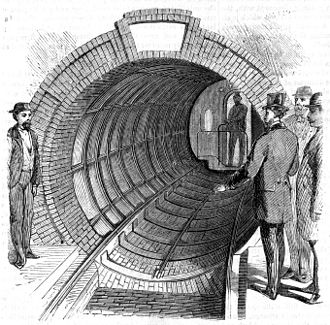
Diagram of the "Beach" pneumatic transit system.

Alfred Beach’s “Pneumatic Transit” system.

But this is not a new concept.  In fact, the first experimental “subway” in New York City, Alfred Beach’s “Pneumatic Transit” proved back in 1870 that it would work.  Despite political opposition, Beach secretly built a 300-foot-long subway under Broadway near City Hall, offering daring passengers a round-trip ride in the system’s only railcar, pushed and pulled by air.  The system ran for almost three years and carried over 400,000 riders, 11,000 alone in the first two weeks.  The fare was 25 cents (equivalent to $18 today). Competing elevated railroad owners eventually won the City’s franchise and Beach’s system was abandoned.

Even Beach’s idea wasn’t new, as vast underground pneumatic tube systems in Paris and London were already delivering telegrams and mail by the 1850’s.  As recently as the 1960s, office buildings in major cities were designed with pneumatic tube systems for inter-office mail.  Some older department stores still use the tubes to record sales and make change from a centralized money room.

Hurtling through a tube may be fine for mail, but what about humans?  As a recent article in Smithsonian Magazine points out, the psychological factor of being enclosed in a sealed tube, traveling 700+ mph, is not that much different than flying in a jet … maybe just a bit more claustrophobic.

Whether by train or plane, I always like to look out the window.  Seeing where we’re going is half the fun, even on a familiar route.  But wrapped in a metal tube inside a giant pipe affords no views at all.  Riding 31 miles in the Chunnel under the English Channel takes 20 minutes at today’s speeds, and that’s more than enough time for me, thank you very much.

Of greater concern are the propulsion methods and the sheer physics of accelerating and braking from near-supersonic speeds.  But the biggest challenge of all would be where to locate the “pipes” and how to acquire necessary land.
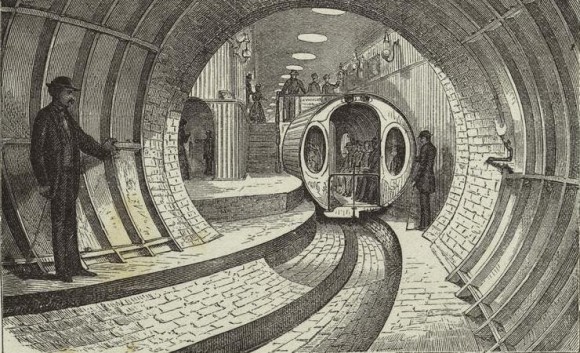
A station inside the"Pneumatic Transit" system.

A station inside the “Pneumatic Transit” system.

Like high-speed rail, it would make no sense to follow the median on Interstate 95 or the Metro-North / Amtrak rights of way with all their twists and turns.  And anyone crazy enough to invest in any project along the coastline with the inevitability of rising sea levels should probably think pontoons, not pipes.

It will be interesting to see if Musk’s and others’ Hyperloop concepts get off the ground (pun intended) … but I don’t expect to ride such a system any distance in my lifetime.

Jim Cameron

Jim Cameron

Jim Cameron is founder of The Commuter Action Group, and a member of the Darien RTM.  The opinions expressed in this column are only his own.  You can reach him at CommuterActionGroup@gmail.com  

For a full collection of “Talking Transportation” columns, see www.talkingtransportation.blogspot.com

Talking Transportation: Good News — and Bad — for Metro-North

It’s been a rough few years for Metro-North what with derailments, crashes and commuter deaths.  But it finally seems like service and safety are coming back.

The best metric of that is the recent surge in ridership, up 1.7 percent compared to last year.  That works out to more than 3,000 additional riders every day.

Certainly this ridership gain is a sign of more people finding jobs. But with gasoline prices near a record low, there’s a reason these folks are training instead of driving:  they like what they see.

  • The trains are on time.  Yes, running slower than in years past, but what’s a few minutes if it means better safety?  What matters most is that the 7:37 shows up at 7:37, plus a minute or so, and arrives in NY pretty close to on-time.  It’s much more dependable now than last winter.
  • There have been no fare increases (at least in Connecticut), even though our fares are still the highest in the nation.
  • There’s more service too:  at least two trains per hour, even in off-peak.  That means more options.
  • And we have the spiffy new M8 railcars, at last.  Riders seem to like the clean, modern interiors and amenities, such a power plugs at each seat.

So for all of these reasons, a lot more people are taking the train.  Good news, right?  Yeah, but in the long run, not so good news because “supply” is not keeping up with “demand”.

More riders without additional capacity means crowding, and we’re already hearing more reports about that, especially at rush hour when some trains are SRO.  And that’s only going to get worse.

The problem is, we didn’t order enough new M8 cars back in 2005 when we placed our order:  just 300 cars for $762 million.  That worked out to $2.54 million per car.

By the time those cars finally went into service in 2011, CDOT and Metro-North realized they should order more. This time, just single un-powered cars, so trains could run with 7 or 9 cars, not just 6, 8 or 10 using the “married pairs” in the original order.

But by then, Kawasaki whacked us $3.3 million per car … and those newest single cars don’t even have motors.   Were we to try ordering more M8 cars today, who knows the price … or delivery time?

From the legislature’s approval of the M8s in 2005 through design, testing and construction, the first M8s took six years to get into service.  The latest single-car order took 4 years.  So even if we were to call Kawasaki today, we couldn’t get new cars until probably 2020 even if we could find the money.

Meanwhile, the Malloy administration is pushing an almost $10 billion, multi-year plan to widen I-95 and I-84.  By the time it’s done, crowding could be so bad on our trains that getting on a four-lane wide interstate might just be better alternative.  Ironic, no?

Jim Cameron

Jim Cameron

Jim Cameron is founder of The Commuter Action Group, and a member of the Darien RTM.  The opinions expressed in this column are only his own.  You can reach him at CommuterActionGroup@gmail.com   For a full collection of “Talking Transportation” columns, see www.talkingtransportation.blogspot.com

Legal News You Can Use: Technology can be Worrisome for Parents

internet_safetySponsored by Suisman Shapiro Attorneys at Law:

The issues facing parents today, as technology ushers in newer and faster means of communicating, are markedly different from those faced by our parents.  Through ever increasing methods of communication, our children have, at their fingertips, the ability to reach a multitude of people in an instant.  Take that instantaneous availability, and mix in the processing and maturity of the adolescent brain, and, in the blink of any eye, circumstances may be set in motion that can immediately change the course of your child’s life.

While the above may seem drastic, it is, nevertheless, true.  On the Internet, our children can access and disseminate child pornography, commit racial and bigotry crimes, and violate our state’s bullying laws, without even knowing it.   Through posts on Facebook, Twitter, Yik Yak, Flickr, Tumblr and MeetUp, just to name a few social media sites, words and images can be sent into the vast world of social media and the internet, where they can be reposted, retweeted, tagged and sent to all corners of the globe.  Once sent, they are there for all to see, including law enforcement.

This onslaught has led organizations like the American Academy of Pediatrics to issue clinical reports on the impact of social media and sexting on our children (Fn1).  Further, it has led each state, Connecticut included, to pass laws making it a crime to engage in certain activity that affects the health and safety of our children.

While this article is not meant to be an in depth analysis of each and every statute which criminalizes certain conduct of our children through their use of social media, it bears mentioning some common issues which arise.  One widespread problem that occurs in the educational environment is bullying.

Connecticut has enacted a comprehensive statute, in conjunction with the U.S. Department of Education, to ensure that bullying does not impede our children’s learning environment.  Enactment of criminal laws, some of which are felonies punishable by more than one year in jail, has made it illegal to discriminate on the basis of race, religion, ethnicity, disability, sexual orientation or gender identity.

Another common problem occurs if your child sends a “visual depiction” of child pornography (nude or showing genitalia) of himself/herself or that of his/her partner, and either one of them is under 16-years-old, they have violated our state’s “possessing or transmitting child pornography” statutes (fn2).  If they use their Facebook account to meet someone under 16, for the purposes of engaging in a sexual act, they have violated our state’s “enticing a minor” statute.

The above is just a snapshot of the complex issues that occur when you mix the not-yet-fully formed mind of a child and the speed of the Internet and social media.  It is also the reason you should seek competent legal representation when confronted with these issues.  Consulting with the right attorney can potentially prevent mistakes such as those mentioned above from affecting your child’s future.

Editor’s Note: Attorney Michael A. Blanchard is a Director at Suisman Shapiro whose practice concentrates in criminal and family law.  Contact him via email at mblanchard@sswbgg.com or via phone at (860) 442-4416 with questions regarding these laws.

Fn1.  Clinical Report-the Impact of Social Media on Children, Adolescents, and Families; O’Keeffe, Gwenn Schurgin, Clarke-Pearson, Kathleen and COUNCIL ON COMMUNICATIONS AND MEDIA; published online March 28, 2011; Sexting and Sexual Behavior among Middle School Students; Rice, Eric PhD, et als; published online June 30, 2014.

Fn2.  Connecticut General Statutes sections 53a-181i through 53a-181l.

Reading Uncertainly? ‘The Sympathizer’ by Viet Thanh Nguyen

The_SympathizerHow often do we take sides while harboring a suspicion that the other fellow’s view actually has some merit? Nguyen’s narrator, never named, but referred to as “The Captain,” states his position at the outset: “ … I am also a man of two minds … I am simply able to see any issue from both sides.”

The Captain is a Vietnamese, ostensibly working for the American forces at the tail-end of the Vietnam (or “American,” as it is called there) War, while acting as mole, an undercover agent, for the Vietcong and the northern forces. Born in North Vietnam of a Vietnamese mother and a father who is a Roman Catholic priest, he leaves for the south and is immediately enmeshed in contradictions. One of the first is the obvious double-meaning of the word “father.”
There he becomes part of an unusual three-man team, the “we” of this compelling take: Bon, an ardent anti-communist, Man, an equally committed communist, and The Captain, who deliciously equivocates through the saga. It is, in fact, a perfect elaboration of the yin and yang culture that dominates the Far East, from the I Ching, to Lao Tse and Confucius. Forces seemingly in opposition are in fact complimentary — they cannot exist without one another.
Nguyen, in the role of The Captain, argues men of “utter conviction” are “insufferable,” noting “The General”, to whom the narrator reports, “ … was a sincere man who believed in everything he said, even if it was a lie, which makes him not so different from most.” The narrator then goes on to puncture every conceivable balloon of human fatuity. We live, he claims, in a litany of contradictions.
Witness another character, “The Congressman”, who berates the “controls” of communism but then describes his “democratic” system as even more autocratic, using censorship and control, because, as he says, “Americans are a confused people.” The Captain comments: “ . that omnipresent American narcotic, optimism, the unending flow of which poured through the American minds continuously whitewashing the graffiti of despair, rage, hatred, and a nihilism scrawled by the black hoodlums of the unconscious.”
Here is a delicious story of the last days of that War and what followed in both the United States and Asia. “We are all puppets in someone else’s play.” And the story is often hilarious, too. The Captain describes, in three joyful pages, his attempt to masturbate with a dead squid!
Nguyen ends with yet another double meaning, “Nothing is more precious than independence and freedom,” as The Captain finally realizes the two senses of this phrase. But he remains “the most hopeful of creatures, a revolutionary in search of a revolution.” A thriller in one sense but a social commentary in another and a challenging counterview to this year commemorating the end of that War.
Opposite ideas are indeed complimentary!
Editor’s Note: The Sympathizer by Viet Thanh Nguyen is published by Grove Press, New York 2015.

Felix Kloman_headshot_2005_284x331-150x150About the author: Felix Kloman is a sailor, rower, husband, father, grandfather, retired management consultant and, above all, a curious reader and writer. He’s explored how we as human beings and organizations respond to ever-present uncertainty in two books, ‘Mumpsimus Revisited’ (2005) and ‘The Fantods of Risk’ (2008). A 20-year resident of Lyme, he now writes book reviews, mostly of non-fiction that explores our minds, our behavior, our politics and our history. But he does throw in a novel here and there. For more than 50 years, he’s put together the 17 syllables that comprise haiku, the traditional Japanese poetry, and now serves as the self-appointed “poet laureate” of Ashlawn Farms Coffee, where he may be seen on Friday mornings. His wife, Ann, is also a writer, but of mystery novels, all of which begin in a bubbling village in midcoast Maine, strangely reminiscent of the town she and her husband visit every summer.

Talking Transportation: Happy 75th Birthday to The Merritt: Queen of the Parkways

A century ago the only way to drive between New York and Boston was on Rte. 1, The Post Rd. If you think traffic is bad today, imagine that journey! So in 1936, 2,000 men began work on the state’s largest public works project, the $21 million four-lane- parkway starting in Greenwich and running to the Housatonic River in Stratford. The adjoining Wilbur Cross Parkway didn’t open until years later when the Sikorsky Bridge across the Housatonic was completed.

The Merritt, named after Stamford resident, Congressman Schuyler Merritt, is best known for its natural beauty, though most of it was planted: 22,000 trees and 40,000 shrubs. And then there are the bridges, since 1991 protected on the National Register of Historic Places.

Architect George Dunkleberger designed 69 bridges in a variety of architectural styles, from Art Moderne to Deco to Rustic. No two bridges are exactly alike. In short order the Merritt was being hailed as “The Queen of Parkways”.

The parkway at first had tolls, a dime (later 35 cents) at each of three barriers, not to pay for the parkway’s upkeep but to finance its extension to Hartford via the Wilbur Cross Parkway, named after Wilbur Lucius Cross who was Governor in the 1930’s. Tolls were dropped in 1988.

The old toll booths themselves were as unique as the Parkway, constructed of wooden beams and covered in shingles. One of the original booths is now preserved in Stratford at the Boothe Memorial Park.

At recent celebrations of the parkway’s 75th birthday, one old timer told of a friend from Yale who resented paying the dime toll in the 1940’s. So he went to the medical school and procured a cadaver arm, glued a dime on its finger and hid the arm up his sleeve. When the prankster slowed to pay his toll, the collector got the dime and the arm as the student sped off.

The Merritt’s right of way is a half-mile wide, the vistas more obvious now since massive tree clearing after the two storms in 2011 and 2012 where downed trees pretty much closed the highway.

Since its design and opening in 1938 the Merritt Parkway has been off-limits to commercial vehicles and trucks. But as traffic worsens on I-95, debates rage from time to time about allowing trucks on the Merritt and possibly widening the road. Either move would probably mean demolition of the Parkway’s historic bridges, so don’t expect such expansion anytime soon.

The best watchdog of the Parkway is the Merritt Parkway Conservancy which has fought to preserve the road’s unique character. Their latest battle is against plans for a multi-use trail along the south side of the roadway. Costing an estimated $6.6 million per mile, the Conservancy worries that the trees and foliage that would be clear-cut to allow bike and pedestrian users would despoil the eco-system.

Jim Cameron

Jim Cameron

Jim Cameron is founder of The Commuter Action Group, and a member of the Darien RTM. The opinions expressed in this column are only his own. You can reach him at CommuterActionGroup@gmail.com For a full collection of “Talking Transportation” columns, see www.talkingtransportation.blogspot.com