
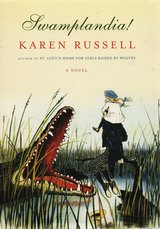
“Swamplandia” by Karen Russell

Swamplandia!  The reviews of Karen Russell’s last book, “Lucy’s Home for Girls Raised by Wolves,” are enough to make you pick this new one up and clutch it to your chest as you race from the shop … “Run for your life. The girl is on fire.” (Los Angeles Times)

Not even a page in and I was captivated by the ease and grace with which she writes.  A pseudo-real Indian tribe on an island with beer and alligators and ghosts?  Really?  And I didn’t bat an eye.  It felt a bit like finding Harper Lee again.  The character of Ava Bigtree is so tangible, so familiar that it grabbed me.

I’ll digress a bit for the sake of clarity (hardly my forte as we all know).  The Bigtree family owns Swamplandia!, the alligator theme park where they also live.  Ava, her parents, brother and sister know little else but life with the “Seths” (as they name each and every alligator) on their island on the west coast of Florida.  The world outside is encroaching.  Cancer, theme park competitors, old folks’ homes,  love affairs.  They all loom on the horizon. 

There is a slightly off-kilter magical quality to Swamplandia! that makes all of this pain bearable.  It is reminiscent of Victorian goth or a dark fairy tale.  This lift keeps it just above the waterline of despair.  Some parts are hard to read.  Her brother Kiwi and her sister Ossie are teetering on a dangerous edge.  Her father, mother and grandfather have fallen over.  Ava’s narrative is just high enough to keep Swamplandia! afloat. 

The beginning seems strangely positive.  Campy, but exhilarating.  When Ava’s mother dies, the change is swift.  The darkness starts to flood in.  Ava’s father, Chief Bigtree, is gone.  Her siblings are too engrossed in their own struggles to cope.  Ava is left to pick up the pieces of their lives and their livelihood.  She has no support.  She has one to rely upon.  She has an island crawling with Seths.  She is 13.

And yet, she is no dummy. 

You hope right away that she will be fine.  She will fight long and hard to be fine.  Hell, her mother swam through alligator-infested swamps for a living … how weak could Ava be?  There is hope and dark humor and stalwart narrative that keeps you reading. 

And the symbolism of one red seth in the congregation is worth holding onto.

Jennifer Petty Mann grew up in New York City, moved to London, England, then back to Boston, and is now happily ensconced on the EightMile river in Lyme with three little ones.  A former teacher, window dresser for Saks, and designer, she is taking her love of books to the proverbial “street.” 
‘Room’ by Emma Donohugh

enterRoom_177x284It should be called ‘Floored.’ I am, completely. A 19-year-old girl is kidnapped and held prisoner in a shed for seven years. She has two babies by the gruesome, evil, sick bastard, who took her. One dies. One lives.
We see the story through the second child’s eyes. A boy, Jack, who is five. He and ‘Ma’ live in ‘Room.’ It is not ‘a’ Room. To Jack it, quite literally, is the world. It is ‘Room’. He has never left. He knows nothing but this 11 by 11 foot reinforced, one-skylighted prison. His mother has done the miraculous and created a world for him where he feels loved and is as safe as he can be given the circumstances. They have power, a bathroom, a television, books, and each other. The dreadful man comes in at night while Jack stays in Wardrobe.

The miracle that this world exists at all is such a testament to his Mother’s innate and adapted coping skills that I am ashamed to try to articulate it.

Because it is all they can have, Ma convinces Jack that this world is all they need. She tries not to over explain the horror of their containment. She makes and keeps a schedule. They exercise, eat as well as they can, stay clean and only watch an hour of TV. Jack speaks well. He has imaginary games with his few toys. He learns to read and write. They narrow down the basics of existence and survival to this one room.

However, a double-edged sword of joy arrives when they get out. How is the real world as seen through the eyes of a five-year-old who didn’t know it even existed. What is rain? Why do doors open and other people know his name? How can his young, tortured mother possibly cope with both of their re-entries to a world she’d lost and he’d never won?

The fact that you can read a book about this at all is amazing. The Shack made me sick and I did not enjoy it. You can read exactly why (Jan 16, 2009) Room is strangely rewarding. The level of hope and resiliency in humans is remarkable. This girl lives through this, raises a good son and still maintains empathy for the plight of many many others, who suffer far worse.

Compound all of that with brilliant writing and the world through the quite believable mouth and eyes of a small child and I have to recommend it.

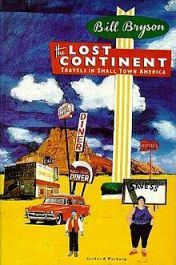
The Lost Continent by Bill Bryson

I live on a little under 10 acres.  It’s fairly private and we all sort of behave the way we like without fear of public scrutiny.

Upon re reading Bill Bryson’s book The Lost Continent, I laughed so hard and so loudly and so often that I was embarrassed and waited for someone to come scold me or at least make fun.

He is bar (almost) none, the most amusing writer.  It may be my practicular brand of sarcastic, snide, clever, back-handed yet kind humor, but Im not the only one.

I am sadly now at the point where I can re-read a book from years back and have it be only vaguely familiar.  Sad but it also excitingly opens a whole new world of literature.

Maybe I’ll start re-reviewing. That could be fun.  You could all send in nasty, pitying letters saying,” You didthat one two years ago.”  Oh well, maybe I have different thoughts on it.  Take that!.

Anyhoo. The Lost Continent is a series of essays on Bryson’s travel and rediscovery of his native country upon return from years and years in England.  He ran from Iowa as fast as he could and is now pining a bit so he has returned.  He is searching for his childhood and memories shared with his recently deceased father.*

As he travels in his mothers Chevette, we follow him through small-town America.

He succumbs to road rage, idiotic directions, angry gravel and angrier waitresses.  He eats Wiffle Ball Surprise and sleeps on  mattresses that sap his will to live.  As we are laughing, we are agreeing that the idiosyncrasies and glories of small-town America are what make us all who we are.  It’s a wonderful journey.

* For more brilliantly written along this vein read, The Life and Times of the Thunderbolt KId.  Maybe I will re-read that next …

Jennifer Petty Mann grew up in New York City, moved to London, England, then back to Boston, and is now happily ensconced on the EightMile river in Lyme with three little ones.  A former teacher, window dresser for Saks, and designer, she is taking her love of books to the proverbial “street.” 

‘Overkill: An Emma Streat Mystery’ By Eugenia Lovett West

Jennifer Petty Mann grew up in New York City, moved to London, England, then back to Boston, and is now happily ensconced on the EightMile river in Lyme with three little ones.  A former teacher, window dresser for Saks, and designer, she is taking her love of books to the proverbial “street.” 

Without Warning (Stripped) is the first book.  Overkillis the second and a third is in the works.

Remember Emma Streat? ( review 5/03/08 ).  The woman who left the world of opera to arrange her Quimper china in blissful married motherhood?  She has come a long way since the brutal murder of her husband and her consequent forays into the world of death and espionage.

Her new life is keeping her on her proverbial toes as well.  Thank goodness she is sharp as a tack.  No little coup de foudre will send her scurrying under the bedcovers.

An intervention for her talented, but foolhardy, famous niece sends Emma to Venice.  A playboy has come between her niece and her music, which is not acceptable.

Not only does Emma have to nip the romance in the bud, but she ends up ensnared in chemical machinations as well.  Germ warfare won’t even be the least of her worries when her romance gets confused as well.  Is the new doctor a threat to our English favorite Lord Rodale?  Who will she choose?  If Will she even live to make the decision?

Does red wine ever come out?  How is the Ritz in Boston as a home away from home?  How will we know if Emma doesn’t beat us to it? ( … it has nothing on the Hyde Park Hotel, but that’s another story…)

West is a very good juggler of the mundane and the outrageous.  In Emma’s hands they hold equal play. Terrorist warfare or soup for lunch?  Which toile would look good in a weekend house, especially if it needs to cover bloodstains?

As with West’s first book, Overkill is a treat.  Emma is so likable that it almost wouldn’t matter if there were a good plot to swoop her along or not.  As an added bonus, the plot is so engrossing it is hardly significant whether or not you like Emma.  This is how the murder mystery series should be played and I am thrilled it continues.

‘Faithful Place’ by Tana French

Jennifer Petty Mann grew up in New York City, moved to London, England, then back to Boston, and is now happily ensconced on the EightMile river in Lyme with three little ones.  A former teacher, window dresser for Saks, and designer, she is taking her love of books to the proverbial “street.” 

I really am getting behind here!  I have a few books you’d love, but as I just closed this one I’ll get to it first.  Good book.  Dark and clever.  Both in equal parts really, which makes for a good mystery detective, personal thriller, angst-ridden-type book.

You really can’t go home again, or really shouldn’t, as undercover detective Frank Mackey discovers. Well, first he discovers the suitcase and subsequently the  body of his long lost love.  Then he discovers that running off all those years ago was an excellent idea.

The night that he and his Rosie were to elope, she doesn’t show.  Assuming that he has been stood up, he says screw it and leaves anyway.

He becomes a police officer.  Marries, divorces and generally stays as far from Faithful Place in Dublin as he can.

His alcohol-fueled family has many, many issues and as they are seemingly unresolvable (or un-fixable), he saves himself at great cost to the other less self-reliant members of the family. Or was the cost due regardless?

It raises a good question.  Are you duty bound to attempt to save your family if it can not or will not attempt to save itself? Does familial duty (even if its guaranteed demise is self-destructive and inevitable) trump personal obligation? Saving oneself at the cost of others is unacceptable, but is it wasteful and defeatest to throw away your own potential to help people who don’t want your help?  Indeed, resent you for offering?

Frank gets deeper and deeper into a mess that is more psychological and sociological than mysterious.  I had a fair guess who dunnnit fairly early on … (Yes, I know, pat, pat on my back.)  The book goes beyond what you are expecting.

What I found most interesting is Tana French writing as Frank Mackey.  A la Memoirs of A Geisha, it is impressive for an author to pull off the other sex’s point of view.  She writes quite well as a man.  (Being a girl – one wonders how I would know this … good point, but ignore it.)

Faithful Place is interesting on many levels and, although a tad bleak, it has quite positive energy about it.  Love can close or open doors and Frank chooses to keep them open.