Letter From Paris: Emmanuel Macron Goes to China

Nicole Prévost Logan

At first sight, the January visit of Emmanuel Macron to meet Xi Jinping might have appeared like the futile encounter between David and  Goliath.  But, in fact, it was a well thought-out strategic move and an illustration of Macron’s personal style of diplomacy.

Never before had any French president gone to China so early in his mandate. He timed his visit to seize the opportunity of a world stage left vacant by most of the players.

He came as an European leader, not as a French one. He stepped into the role Angela Merkel  –– still embroiled in internal political negotiations to create a coalition government — had played for many years.

The trip was put under the symbols of history and culture shared by France and China.  Instead of Pekin, it started in Xi-an, Shaansi province, where the discovery of an imperial tomb made world headlines in 1974.  The tomb contained 8,000 terracotta warriors, horses, and chariots, dating back from the golden age of the Han dynasty (206 BC-220 AD.)

During her several visits to Asia, German chancellor Merkel had openly blamed the Chinese government for its violation of human rights.  Unfortunately, this method did not bring any positive results. 
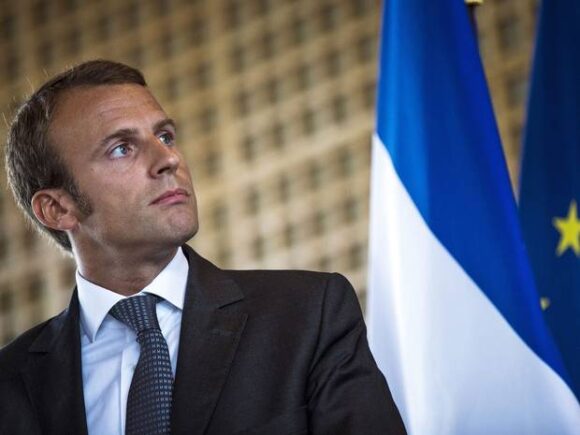
french President Emmanuel Macron

Macron chose a more pragmatic approach, limiting his criticisms to subliminal  remarks.  According to analysts, his diplomacy can be described as “Gaullienne.”  At a press conference in 1964, General de Gaulle abandoned his aloof and philosophical tone and declared that, to talk with leaders having opposing views, did not mean having to agree with or condone them.

Linguistics can create difficulties since the key words used be the two sides may have different meanings.  Take for instance the definition of “terrorism.”  For Xi Jinping, it mostly refers to the activity of the autonomists Ouïgours whereas for  Macron it means the bomb attacks inflicted on the French population by radical followers of Daesch.

To conduct diplomacy with China is to enter a minefield.  Two examples.  One does not attack China frontally for its action in the South China seas because the Chinese government considers this region as its private turf.  Macron would like China to help with the efforts of the G5 to fight terrorism in the Sahel but it might become a two-sided sword because interference by China in the region is not really wanted.

On the crucial topic of the nuclear threat coming from North Korea, the French president could only reinforce the European Union (EU) position.  He complimented Xi Jinping for becoming the world leader in the fight against global warming, and for being a staunch defender of the Paris Accord.

Fifty CEOs of leading French companies were part of the trip, which was marked by the signing of enormous contracts.  The Chinese government ordered 134 A320 Airbus commercial  planes.  AREVA, the French multinational specialized in nuclear power and renewable energy, signed an agreement China National Nuclear Corporation (CNNC) to build facilities for the reprocessing of nuclear waste.  The largest existing plant in the world is located in La Hague, near Le Havre.  Cooperation in the agro-business will be developed.  The Chinese enjoy French beef but since 2011 an embargo had been imposed on the imports following the “mad cow” disease.

The surplus of the Franco-Chinese trade balance amounts to $30 billion in favor of China.  Macron wants too re-equilibrate those figures.  His objective is to widen the types of exports beside foodstuff or cosmetics and include digital technology, artificial intelligence and other sectors.

The silk road sounds like a romantic concept, which makes one dream. but in reality it is pharaonic project where the Chinese plan to invest around $1,000 billions to build a network of rail, maritime, land, or air routes to export its products.  Almost needless to say, this project is worrying many … starting with Macron, who declares that the silk road should be a two-way road.  Historically the silk road was developed in the Han dynasty and its starting point was the town of Xi-an (cf. above.)

During the official visit to Pekin of the French presidential couple, it was impossible not to notice the spectacular redcoat (red is a symbolic color in Chinese, meaning happiness) worn by Brigitte Macron.

Translated into Chinese phonetics, the name Macron means “the horse that dominates the dragon.”  Is that perhaps a good omen for Emmanuel Macron?

Editor’s Note: This is the opinion of Nicole Prévost Logan.

Nicole Prévost Logan

About the author: Nicole Prévost Logan divides her time between Essex and Paris, spending summers in the former and winters in the latter. She writes a regular column for us from her Paris home where her topics will include politics, economy, social unrest — mostly in France — but also in other European countries. She also covers a variety of art exhibits and the performing arts in Europe. Logan is the author of ‘Forever on the Road: A Franco-American Family’s Thirty Years in the Foreign Service,’ an autobiography of her life as the wife of an overseas diplomat, who lived in 10 foreign countries on three continents. Her experiences during her foreign service life included being in Lebanon when civil war erupted, excavating a medieval city in Moscow and spending a week under house arrest in Guinea.
Letter From Paris: Deaths of Two Icons Leave a Nation in Mourning

Nicole Prévost Logan

From Les Invalides to the Champs Elysees, intense emotion grips France at the passing of two iconic personalities.

Within 24 hours France lost two familiar figures: Jean d’Ormesson, 92, man of letters, and Johnny Hallyday, 74, the popular singer who, for almost 60 years, enthralled millions of fans. The intensity of the emotions was incredible. For a week, politics, wars, economic crises, were suspended and replaced by an immense sadness, which united the nation. No matter how different the two men were, they shared a great simplicity and the gift of connecting with the people.

It is not unusual for the French to express their collective grief in the public place. In 1885, two million people attended the national funerals of Victor Hugo. Simone Weil, the courageous woman who showed exceptional fortitude in her public life by being a pioneer of the right to abortion, received the highest honors by being laid to rest in the Pantheon. In 1963, a human tide surged toward the Pere Lachaise cemetery to say goodbye to Edith Piaf.

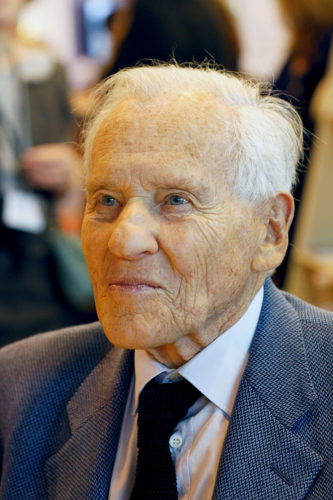
Count Jean d’Ormesson

Count Jean d’Ormesson, at age 48, was the youngest “immortal” to enter the Academie Française – a literary institution created by Louis XIII to uphold the French language. He died as the dean of that 40-members council. Son of a French ambassador, d’Ormesson was part of the French aristocracy, with degrees in history and philosophy. He directed the conservative daily Le Figaro, became a prolific writer, publishing a book per year, with the last one completed three days before his death. His smiling face and piercing blue eyes were a familiar sight for the viewers of countless televised literary shows, such Bouillon de Culture, Apostrophe or La Grande Librairie.

An elegant conversationalist, he spoke with wit, lightness, and optimism. His remarks, studded with literary quotes, included gems of uplifting philosophy, such as,”Life is beautiful because we are lucky to die”, and “In the New Testament, the myth of the Wandering Jew is condemned to immortality by Jesus.”

During the strikingly sober ceremony, in the courtyard of the Invalides, a small group of guests, representing the world of politics and culture, stood stoically, whipped by a glacial wind. The eulogy given by French president Emmanuel Macron, matched the literary sophistication of the deceased academician.

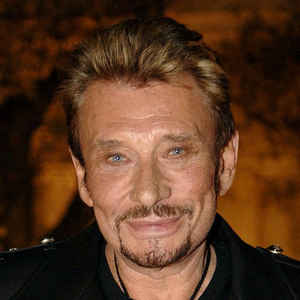
Johnny Hallyday was a monument in France with an amazing longevity. From the first time he appeared on the stage at age 17, this blond, tall young man became an adulated performer and he remained a star for almost 60 years. For millions of fans, his disappearance meant the loss of a chunk of their own life. Fighting lung cancer for several years, in spite of the terrible pain, he continued performing until the very end. People thought he was indestructible, hence the extreme shock people felt when they learned about his death on Dec. 6th.

Abandoned by his father at the age of eight months, Hallyday did not grow up in the security of a proper family but bounced around from one relative to another. A cousin gave him his stage name.

Facts about his career are staggering: more than 28 million spectators attended the 3,300 concerts he gave in 40 countries; he sold 110 million records. He had a real talent in choosing the best composers and song writers, which allowed him to produce 1,000 songs, many of them in Gold albums.

Johnny Hallyday

Hallyday went through all the styles of music from rock n’roll, pop, blues, soul, country, and hard rock. Among the best known hits is, “Ah Marie, si tu savais, tout le mal que l’on m’a fait” (Ah, Marie, if you only knew how much they hurt me) about a young man, fighting in the WWI trenches and writing to his fiancee.

It is a paradox that, in spite of his love for the US, that country barely knew him. Driving full speed on his Harley Davidson with his buddies from the Midwest to California was one of his greatest pleasures. He sang with Sammy Davis Junior. Michel Berger wrote for him a song called “On a tous quelque chose de Tennessee” (We all have something of Tennesse.) The lyrics recall lines from “Cat on a Hot Tin Roof.”

He spent the last 10 years of his life in Los Angeles, Calif., with Tom Hanks and Ben Affleck as neighbors and only returned to France to perform in concerts. Some of his concerts became giant productions of a size never seen before. The absolute zenith of his career was right after France won the soccer World Cup in 1998 when Hallyday flew over the Stade de France by helicopter and was lowered into the hysterical crowd.

The public funeral of Hallyday was an incredible spectacle offered to millions of fans. The cortege moved slowly down the Champs Elysees, led by a white coffin. This was followed by a caravan of black limousines filled with family, close friends and dignitaries and then – even for people who do not particularly like motorcycles – the incredible sight of 700 bikers, who had come from all over France.

On the steps of the Madeleine church, President Emmanuel Macron, paid his respects to the rock star and invited the crowd to bid farewell to “Mr. Johhny Hallyday.”

Editor’s Note: This is the opinion of Nicole Prévost Logan.

Nicole Prévost Logan

About the author: Nicole Prévost Logan divides her time between Essex and Paris, spending summers in the former and winters in the latter. She writes a regular column for us from her Paris home where her topics will include politics, economy, social unrest — mostly in France — but also in other European countries. She also covers a variety of art exhibits and the performing arts in Europe. Logan is the author of ‘Forever on the Road: A Franco-American Family’s Thirty Years in the Foreign Service,’ an autobiography of her life as the wife of an overseas diplomat, who lived in 10 foreign countries on three continents. Her experiences during her foreign service life included being in Lebanon when civil war erupted, excavating a medieval city in Moscow and spending a week under house arrest in Guinea.
Letter From Paris: A Six-Month Performance Review for Emmanuel Macron

Nicole Prévost Logan

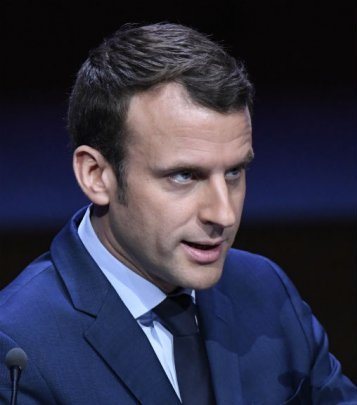
Six months into his mandate, French President Emmanuel Macron has been working at a dizzying pace to fulfill his campaign promises.

Hubert Vedrine, former minister of foreign affairs and expert in international and strategic affairs, made the following comment : “Emmanuel Macron immediately embodied the stature of a chief of State. ”

“The French people are impossible to reform”, said Macron during his campaign.  This is why he set out not to reform but to transform France from top to bottom.  First he brought “parity” men/women into the government. 

The “moralization” of the two legislative chambers was his second objective, which meant bringing an end to the opaque system of financial privileges long enjoyed by the deputies.  Like a breath of fresh air, the professional politicians who, since the beginning of the fifth Republic, had been playing musical chairs, faded away .They were replaced by influential members of the civil society, without any political experience.

Emmanuel Macron

As a rule, the French do not really like to work during the summer.  Breaking with that tradition, Macron spent four months talking with the trade unions.  He invited – separately – the leaders of the different groups (CGT, FO, CFDT)  in order to hear their demands and make his own proposals.

The result was amazing.

The loud manifs (street demonstrations), which traditionally are the main tool of the trade unions, rapidly run out of steam.   On the basis of the summer negotiations, changes in the labor code were formulated into executive orders before becoming law.

Macron used the same strategy – divide and conquer – to defuse the revolt of the mayors. 

There are 36,000 municipalities in France.  Some of the communes are tiny with as few as 200 inhabitants, and feel unfairly treated as compared to the large and wealthy urban centers like Paris, Lyons or Marseille. When Macron announced he would drastically slash down the dotations (subsidies) made by the State, the local officials went up in arms. 

What did Macron do? 

He invited 1,500 mayors to the Elysée Palace and developed his plan to help the small communes .

Thanks to his work experience in the financial and business world, he focused on a crucial economic problem: the cost of French labor is not competitive enough. The main reason?  The cost of labor is bloated by the inclusion of “social charges.” Macron plans to have the entire population share the burden by paying a general tax.  The other pillar of his financial program is to stop demonizing capital income by reducing the tax to a flat rate of 30 percent  – a win-win system to encourage the French population to invest.

Emmanuel Macron has been described as having a velvet smile contrasting with the steely expression of his blue eyes. From the youthful, exuberant attitude he projected during the electoral campaign, he has evolved into the image of an authoritarian leader. He delegates the day-to-day running of the country to his prime minister Edouard Philippe, who is doing his job efficiently and with discretion.  This leaves Macron time to address the big picture, particularly regarding the new place of France on the world stage.

On Sept. 26, in a major speech at the Sorbonne, Macron showed his unwavering ‘Europhile’ vision. He proposes a ‘re-invention’ of Europe with action led by countries willing to make changes. To ensure the future of the Eurozone, he proposes a single budget, a ‘Super Minister’ of economy and the creation of a European IMF. He wants a “protective Europe” in relation to workers and consumers. He believes strongly in giving a central role to culture in defining the European identity.

During his visit to Abu Dhabi for the inauguration of the new Louvre museum on Nov. 8, Macron met with “MBS” (Saudi Arabia prince Mohammed Ben Salmane ) and with “MBZ” (Abu Dhabi crown prince, Mohammed Bin Zayed)  A feverish round of diplomacy took place in which the president succeeded to  “exfiltrate” the Sunni Lebanese minister Saad Hariri from Saudi Arabia and acted as a mediator in the growing fracture of the Persian Gulf.

On Nov. 28,  after a two-hour speech to 800 students of the Ouagadougou University, in Burkina Faso, the Q and A session turned into an hilarious exchange. “Can you help us fix the frequent power outages on the campus?” asked a student. “But this is not my responsibility,” Macron answered, “Ask your president to deal with this problem.” The reaction of his audience – was at first a roar of laughter then deafening applause. A symbolic detail of the Macron’s visit to Africa was that he was accompanied on his trip by leaders of recent  start-ups instead of the CEOs of large companies such as Areva or Total.

The three-day visit to Africa in late November was an opportunity for the French president to break, not only with the colonial era, but also with the neo-colonial era of Françafrique launched by General de Gaulle in 1960.  At a summit meeting held in Abidjan, Ivory Coast, where the discussions at the summit meeting dealt mostly with the immigration crisis, Macron initiated a partnership whereby Europeans and Africans should share responsibilities.  Macron did not mince words when he told his audience : “The passeurs (smugglers) are not European, my friends , they are African.”

At a time when Angela Merkel is vacillating and Brexit is looming, the role of Emmanuel Macron in Europe is crucial. 

Editor’s Note: This is the opinion of Nicole Prévost Logan.

Nicole Prévost Logan

About the author: Nicole Prévost Logan divides her time between Essex and Paris, spending summers in the former and winters in the latter. She writes a regular column for us from her Paris home where her topics will include politics, economy, social unrest — mostly in France — but also in other European countries. She also covers a variety of art exhibits and the performing arts in Europe. Logan is the author of ‘Forever on the Road: A Franco-American Family’s Thirty Years in the Foreign Service,’ an autobiography of her life as the wife of an overseas diplomat, who lived in 10 foreign countries on three continents. Her experiences during her foreign service life included being in Lebanon when civil war erupted, excavating a medieval city in Moscow and spending a week under house arrest in Guinea.
Letter From Paris: André Derain: Major Artist, “Fauvism” Champion Featured in Parisian Retrospective

Nicole Prévost Logan

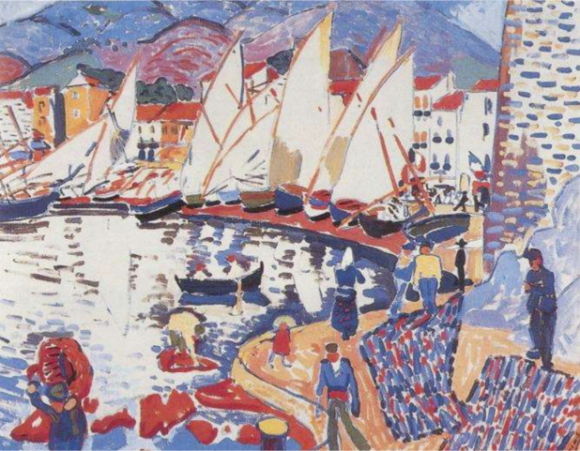
André Derain usually evokes cheerful scenes of sailboats bobbing up and down in the bright colors of a Mediterranean fishing port.

Actually, Derain (1880-1954) is a complex artist, who had a strong influence on the evolving avant-garde movements at the start of the 20th century.  The Pompidou Center is currently holding a retrospective titled, “Derain – 1904-1914. The radical decade.”

The curator of the Pompidou exhibit, Cecile Debray, comments, “Derain is the founder with Matisse of Fauvism and an actor of Cezanne’s Cubism with Picasso.” Never before had the artist been attributed such a crucial role. Derain was not only the link between the masters — Gauguin and Van Gogh — and the next generation of artists, but also an explorer of new sources of inspiration, including primitive Italians, along with African and Oceanic art. 

To quote Gertrude Stein (the writer and art collector famous on the cultural Parisian scene in the 1920s and 1930s), “Derain was the Christopher Columbus of modern art, but it is the others who took advantage of the new continents”

Not interested in the career of engineer planned for him by his father, the young Derain preferred to spend all his time at The Louvre, copying  the classics. He shared a studio with his friend Vlaminck on the Chatou island northwest of Paris where he was born. His first paintings had as subjects the Seine river, its banks and bridges, and the activities of workers. He displayed a distinctive technique of fast brush touches, (slightly different from “pointillism“), innovative plunging views and cropping, which give  his works the spontaneity of photographic snapshots.

“Collioure, the drying of the sails'” by André Derain.

In the summer of 1905, he spent the summer in Collioure with Matisse and was dazzled by the Mediterranean light. Derain defined light as the negation of shadow.  He writes, “Colors become cartridges of dynamite casting off light.”  The room VII of the 1905 Salon d’Automne, called “la cage aux fauves,” caused a scandal, (fauves mean wild animals.)  In 1907, the Russian art collector Ivan Morozov acquired Derain’s paintings from the merchant Ambroise Vollard for the sum of 600 francs.

The following summer,  Derain continued to work with Matisse at l’Estaque, near Marseille. His compositions became more structured, with strong lines, volumes, perspectives and plans.  He still used arbitrary colors.   

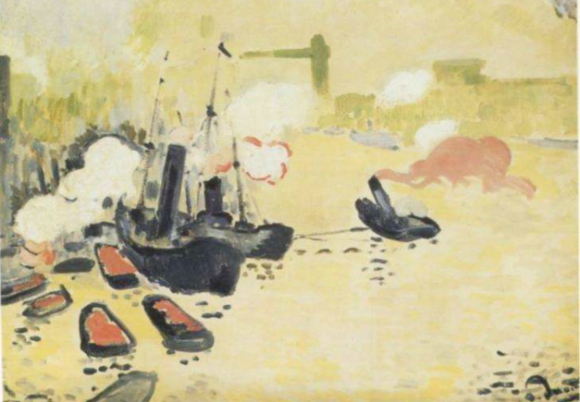
‘London’ by Andre Derain.

During two visits to London, he became fascinated by the bustling traffic of barges and tugboats on the Thames. He used the puffs of smoke mixed with the mist to decline all shades of whites. He found a new inspiration in the representation of water and sky. The apotheosis is an almost abstract sunset with the sun breaking through the dark clouds as if putting the sky on fire.

In 1910, Derain is part of the Cubist movement as shown in his representation of the village of Cagnes – an assemblage of cubes with red roofs scattered on a hilly landscape made of geometric lines and volumes of dense vegetation.

The versatility of Derain seems to be boundless. He played the piano, was  a professional photographer, and enjoyed fast cars (he owned 11 Bugattis.)  Using his virtuosity as a draughtsman, he created illustrations for humor publications along with stage and costume designs (for Diaghilev and the Russian ballets.)

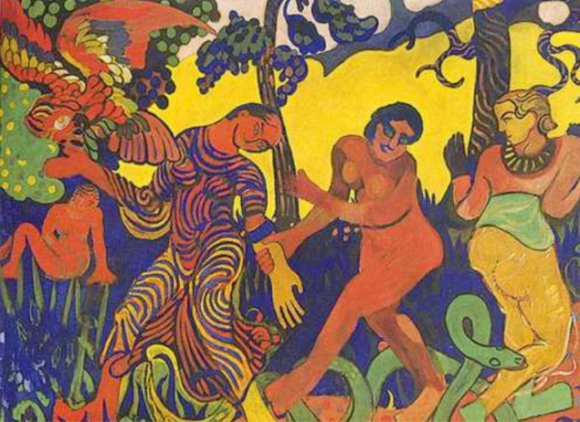
The dance” by André Derain.

Before leaving the exhibit, the visitor will be stunned by The Dance, 1906 – a large (185 x 228 cm) decorative composition of three women undulating in a luxuriant forest.  The work is rarely seen, since it belongs to a private collection.  Derain was inspired by a poem by Apollinaire and called it L’Enchanteur pourrissant (the rotting magician) about three fairies looking for Merlin’s tomb. The gestures of the dancers are reminiscent of Egyptian and Indian art, and could have inspired Nijinsky’s choreography. The mysterious vegetation and the hidden meaning of a snake and a multicolored parrot infuse the ritual scene with symbolism.

Editor’s Note: This is the opinion of Nicole Prévost Logan.

Nicole Prévost Logan

About the author: Nicole Prévost Logan divides her time between Essex and Paris, spending summers in the former and winters in the latter. She writes a regular column for us from her Paris home where her topics will include politics, economy, social unrest — mostly in France — but also in other European countries. She also covers a variety of art exhibits and the performing arts in Europe. Logan is the author of ‘Forever on the Road: A Franco-American Family’s Thirty Years in the Foreign Service,’ an autobiography of her life as the wife of an overseas diplomat, who lived in 10 foreign countries on three continents. Her experiences during her foreign service life included being in Lebanon when civil war erupted, excavating a medieval city in Moscow and spending a week under house arrest in Guinea.
Letter From Paris: To Be or Not To Be [Independent] — The Catalonian Question

Nicole Prévost Logan

The tentative attempt by Catalonia to secede from Spain has failed – at least for now.  But the attachment of the Catalan people to their identity is so strong that the fight for independence is far from over.  The Catalonian regional elections on Dec. 21 are likely to take place in a very agitated, if not violent, context.

The province of Catalonia has just lived through its worst political crisis in decades.  On Aug. 17, the terrorist attack in Barcelona that killed 13 people and injured 113 left the population of that city badly shaken.  On Oct. 1, a referendum showed how divided the population was with 90.2 percent voting for independence … but with a participation rate of only 45 percent.  For several days, the two protagonists – Mariono Rajoy, prime minister of Spain and Carles Puigdemont, the Catalan President – faced off each other, avoiding any dialogue.

Then on Oct.17,  the separatist members of the Catalan parliament announced the declaration of independence by 70 votes to 10.  The situation became untenable for Puigdemont.  He surreptitiously left the country to reappear in Brussels.  For the first time ever, Article 155 of the constitution was activated — Madrid issued an arrest warrant for Puigdemont for espousing rebellion and placed the province under strict supervision. 

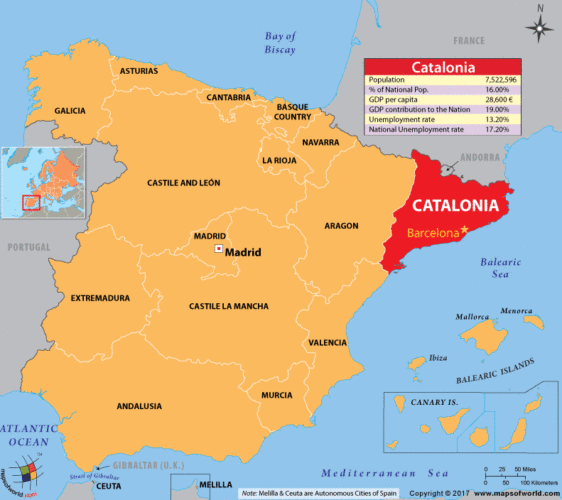
This map shows the location of Catalonia in Spain.

How does one explain the fierce nationalism of the Catalan people?  It is deeply anchored in their history.  Until the early 16th century, the county of Barcelona was at the center of power in Spain and closely united to the Aragon crown.  After the War of the Spanish Succession, the Catalans had to surrender to the Bourbons on Sept. 11, 1714.  The Catalonians remember that heroic battle by naming that day their National Day, calling it Diadia.  The civil war from 1936 to 1939, followed by 39 years of Franco’s fascist dictatorship, crystallized even further the Catalonians’ dream of autonomy.   

The European Union (EU) is keeping silent and uninvolved in what it considers as an internal problem for Spain.  Doomsday commentators had predicted that other regions of Europe such as Venetia, Lombardy or Corsica, would emulate Brexit. It is interesting to note that  Spain never recognized Kosovo for fear that Catalonia would follow suit.

When democracy was reinstated by King Juan Carlos, a new constitution and special self-rule status were granted to the Basque country, Catalonia and Cerdanya in 1978.  It is hard to understand why Catalonia did not accept the  favorable  terms offered by Madrid.  The ETA (Basque independence movement) did thus putting an end to their armed resistance, which had lasted for more than 50 years.

A visit to Barcelona helps understand the dynamic, feisty, almost turbulent temperament of the Catalan people.  Just mingle with the crowds on La Rambia – the heart of the city – or discover the extravagant architecture of Anton Gaudi in the Sagrada Familia cathedral. 

Catalonia can claim three artists, all larger than life and with strong personalities.  Joan Miro, the abstract artist creator of distinctive playful forms, was extremely proud of his Catalan origins.  Picasso spent several years as a teenager in Barcelona.  In 1905, he found the models for his “Les Demoiselles d’Avignon” among the prostitutes of a small street by that name located near the port.  The surrealist Salvador Dali went totally wild with the design of his museum in Figueres, his hometown.

Unfortunately, the project of the Catalan separatists did not take into account the long-term problems.  By early November of this year, 2,000 companies and banks had already left the province: tourism is being affected: the stock market has plummeted, and if Catalonia were to secede from Spain, it could not become part of the EU. 

In the simplest of terms, Catalonia may now, as a result of the most recent developments, find itself in a worse situation than before its declaration of independence.

Editor’s Note: This is the opinion of Nicole Prévost Logan.

Nicole Prévost Logan

About the author: Nicole Prévost Logan divides her time between Essex and Paris, spending summers in the former and winters in the latter. She writes a regular column for us from her Paris home where her topics will include politics, economy, social unrest — mostly in France — but also in other European countries. She also covers a variety of art exhibits and the performing arts in Europe. Logan is the author of ‘Forever on the Road: A Franco-American Family’s Thirty Years in the Foreign Service,’ an autobiography of her life as the wife of an overseas diplomat, who lived in 10 foreign countries on three continents. Her experiences during her foreign service life included being in Lebanon when civil war erupted, excavating a medieval city in Moscow and spending a week under house arrest in Guinea.