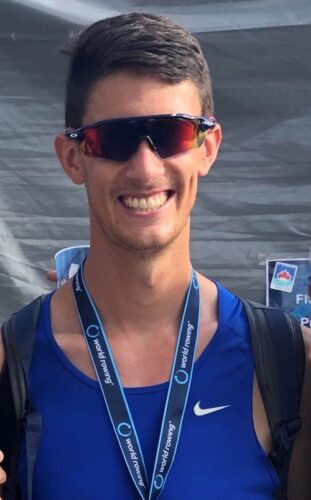
Hundreds Celebrate Summer Solstice With Stroll Down Lyme St. Enjoying ‘Make Music Day’

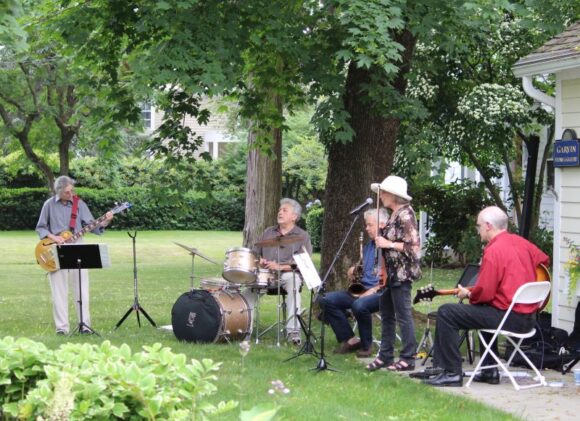
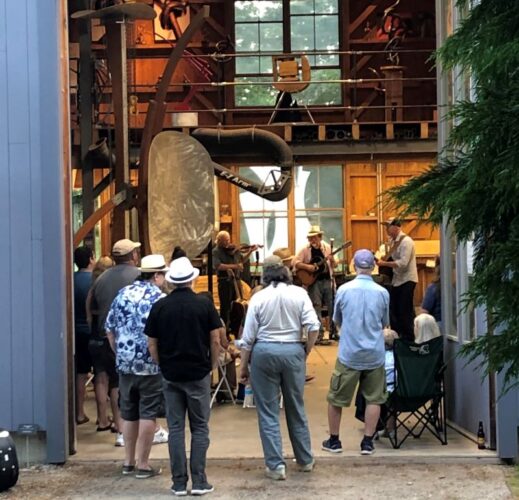
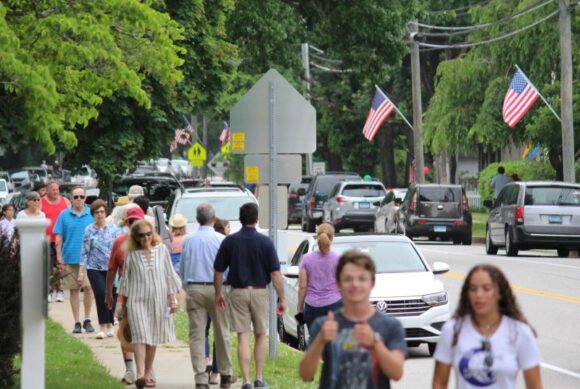
Lyme Street was filled with cheerful folk enjoying the sounds of ‘Make Music Old Lyme’ and visiting with friends they had not seen in a long time due to pandemic restrictions. Photo by Cheryl Poirier.

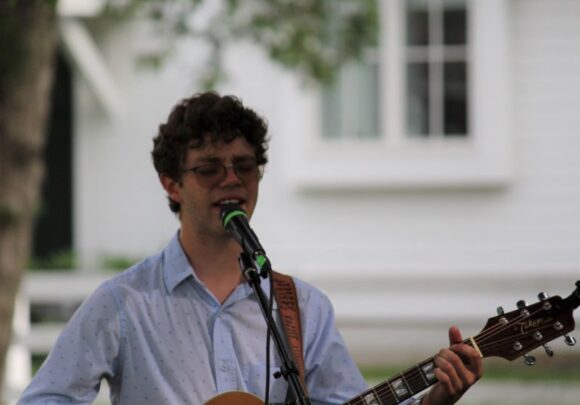
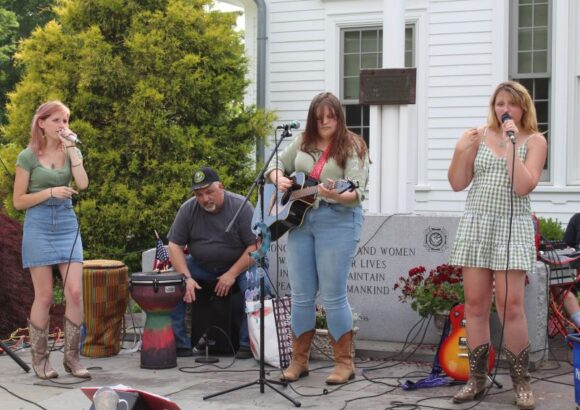
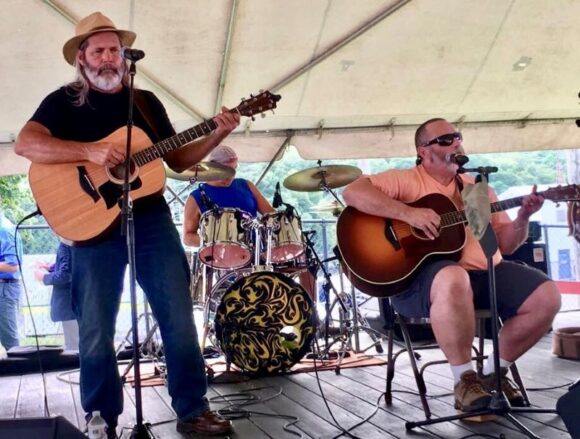
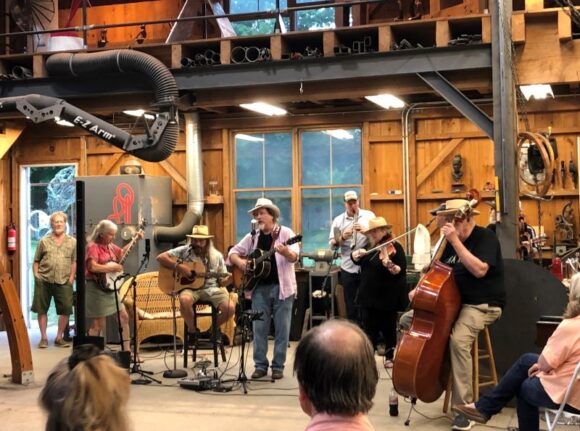
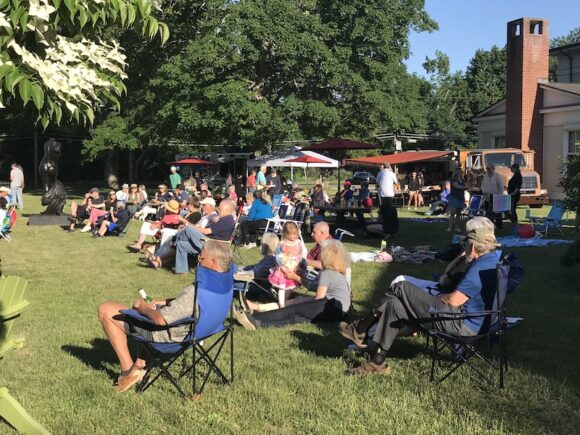
OLD LYME — ARTICLE UPDATED, PHOTOS ADDED: The air was warm and spirits were high early on Monday evening when more than 500 people took a stroll on Lyme Street to enjoy the music of a dozen bands and solo performers, who together created Make Music Old Lyme. 

‘The Voice’ finalist Braiden Sunshine drew a large crowd in front of Center School. All photos by Alan Poirier except where otherwise indicated.

It turned into an evening of wonderful musical entertainment and also the opportunity to reconnect with friends after a very long and challenging year.

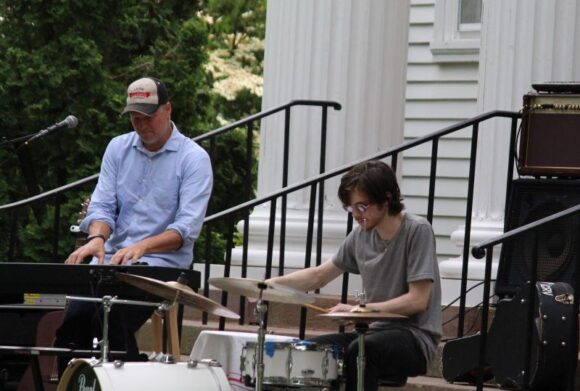
Plywood Cowboy played on the steps of the First Congregational Church of Old Lyme.

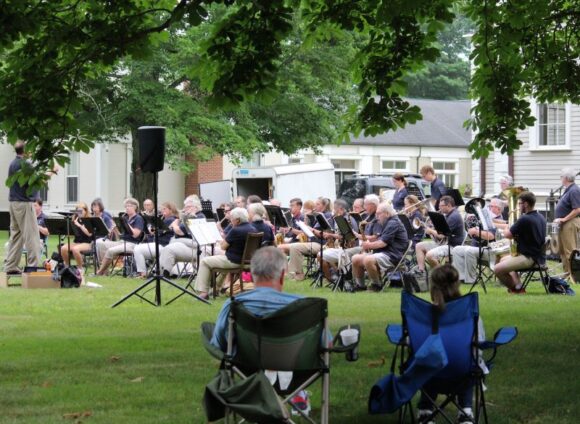
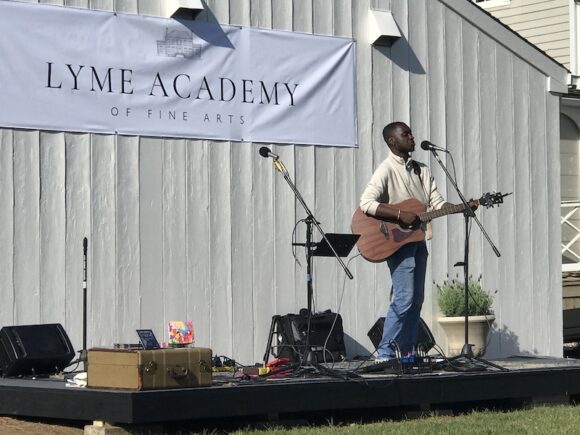
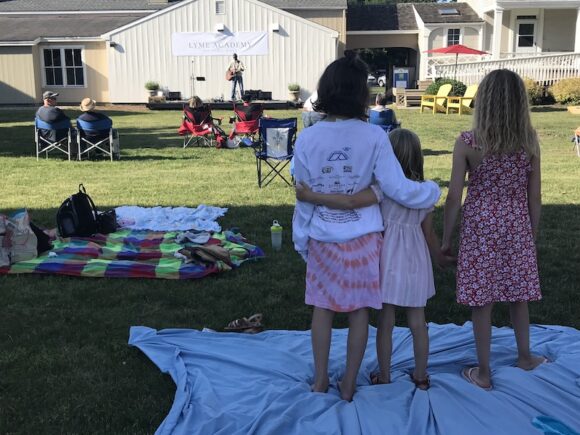
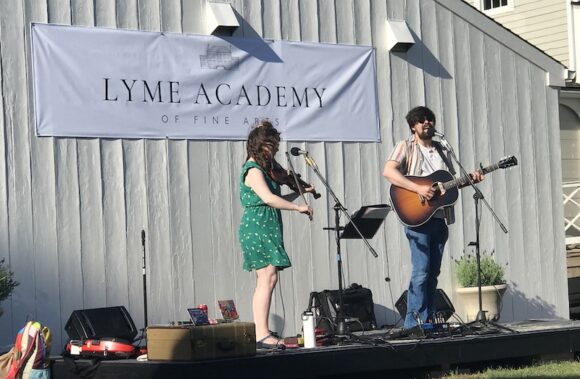
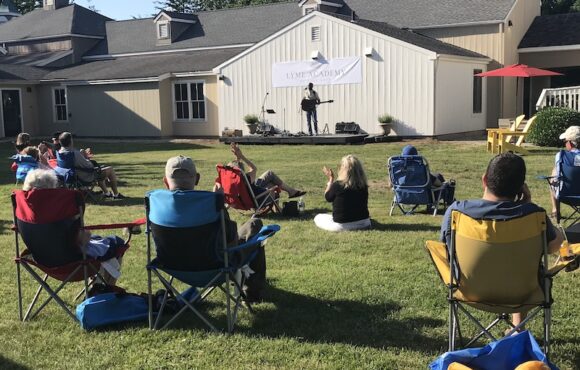
The celebration spanned the length of Lyme Street from the First Congregational Church of Old Lyme, where Steve Dedman of Plywood Cowboy played all the way up to the Lyme Academy of Fine Arts where the Old Lyme Town Band entertained on the front lawn.

The Old Lyme Town Band gave a rousing performance in front of Lyme Academy of Fine Arts.

A number of people brought chairs and moved from performance to performance to enjoy the evening full of folk, indie rock, Americana, and more.

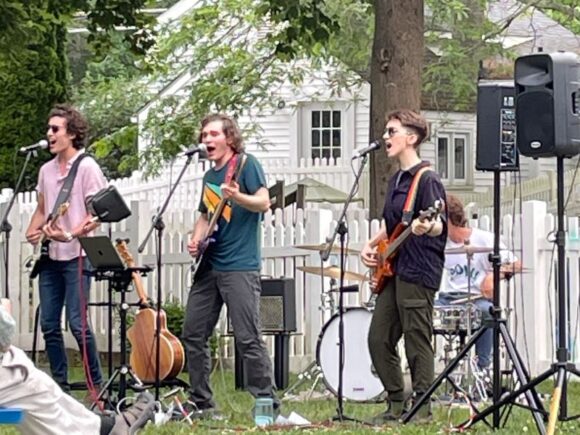
Welcome to Space performed at Lymes’ Youth Service Bureau as part of ‘Make Music Old Lyme.’ From left to right are Thomas Pennie, Colin Hallahan and Jess Kegley with Noah Rumm on drums. All four are members of the Lyme-Old Lyme High School Class of 2019. Photo by Tracy McGlinchey.

Many residents were surprised to learn that all of the musicians donated their time and talent to support the international Make Music Day credo of free music for all.

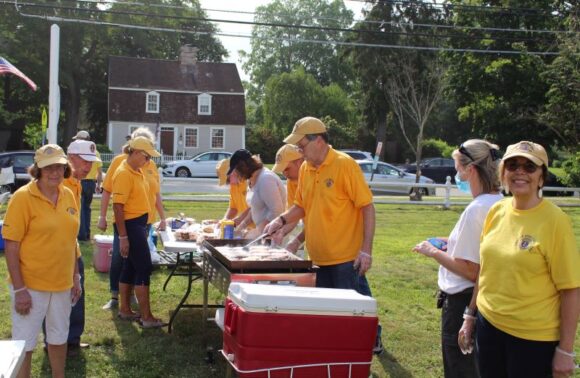
The Lyme-Old Lyme Lions did brisk business selling hot dogs and hamburgers.

The Lyme-Old Lyme Lions Club sold over 100 hamburgers and more than 100 hot dogs …

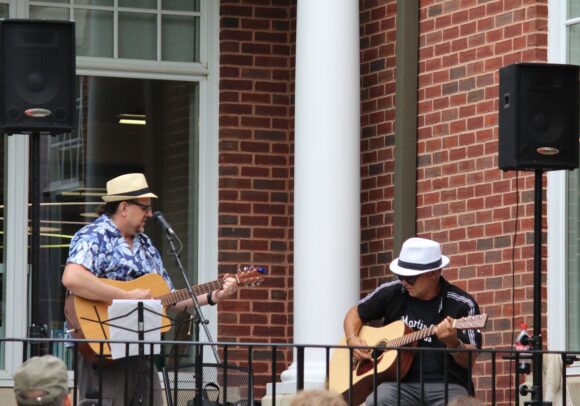
Steve Patarini and Dean Montgomery performed on the new patio of the Phoebe Griffin Noyes Library.

… and meanwhile, The Chocolate Shell generously offered a 10 percent on all purchases.

Hot Strings Café could be found in front of Patricia Spratt for the Home.

Cheryl Poirier, a lead organizer of Make Music Old Lyme, told LymeLine after the event that she felt it was, “A highly successful night  … [and] a great time was had by all!”

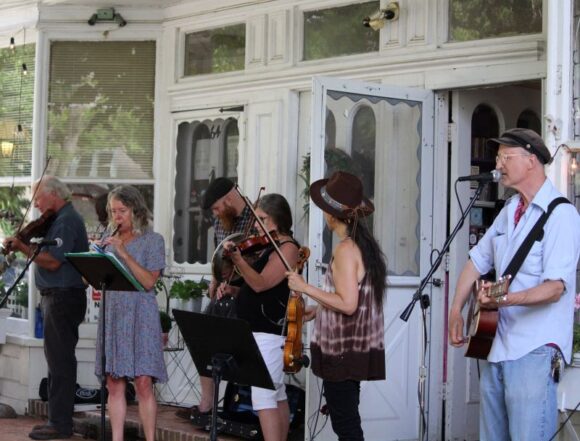
The Nightingale Fiddlers and Friends played in front of … where else, but Nightingale’s Acoustic Cafe?!

The comments we have seen about the event on our Facebook page and here on LymeLine strongly suggest that was the universal opinion!

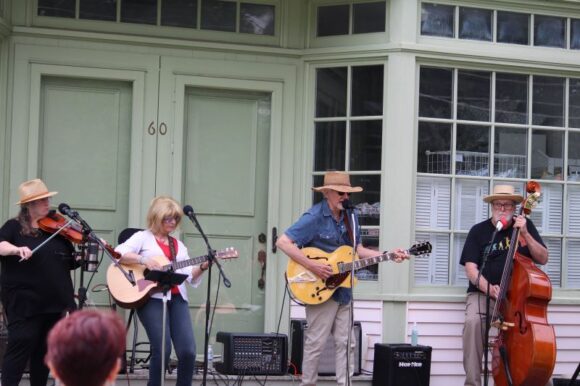
The Moving Target Band played in front of The Village Shops.

The event was part of an international celebration of free music for all produced by the Old Lyme Arts District in conjunction with the Southeastern Connecticut Cultural Coalition and Nightingale’s Acoustic Cafe arranged the musical lineup.

The Midnight Anthem delighted crowds in front of Old Lyme’s Memorial Town Hall. Photo by Cheryl Poirier.

This was the third year Make Music Old Lyme has been presented; it was cancelled last year due to the COVID-19 pandemic.

Whiskey and Aspirin and friends performed in front of The Cooley Gallery.

At the end of the two-hour event, a ‘Kazoo Parade’ led by Dan Stevens brought people to Studio 80+ Sculpture Grounds, where a final jam session involving many of the performers continued.

After a jovial musical march up Lyme Street, several of the musicians stopped a while at Gil Boro’s studio to make more music. Photo by Cheryl Poirier.

Make Music Old Lyme returns next year on the Summer Solstice, Tuesday, June 21, 2022.

The grand, unplanned finale at Studio 80 + Sculpture Grounds made for a perfect end to an amazing evening. Photo by Cheryl Poirier.

Old Lyme’s ‘Crosby Fund for Haitian Education’ Changes Lives in One of Poorest Parts of Globe

The Crosby Fund for Haitian Education is guided by the deep conviction that a brighter future for Haiti depends on educating its youth and preparing them for professional careers in Haiti.

How has an idea conceived in Old Lyme, Conn. been able to grow into an organization that is making a critical difference in the lives of more than 500 students in one of the most economically-deprived parts of the Caribbean island of Haiti, which, in turn, is one of the poorest countries in the world?

The answer lies with one woman, Rebecca ‘Becky’ Crosby, who along with her husband Ted, founded the Crosby Fund for Haitian Education (CFHE) back in 2003.

How did it all begin?

Crosby explains her first trip to Haiti was in 1999 and came about through the First Congregational Church of Old Lyme (FCCOL) when Amy Bruch was working there as an Associate Minister. Bruch had connected with the late Dr. Wayne Southwick of Old Lyme, the retired chairman of the Department of Orthopedics and Rehabilitation at Yale University.

Annually, Dr. Southwick led a team of doctors from Yale to the Albert Schweitzer Hospital in Deschappelles, Haiti, where they performed surgeries round the clock and at no charge for local people. Deschappelles is located in the rural Artibonite Valley about 90 miles north of the nation’s capital, Port-au-Prince.

Inspired by Southwick’s work, Bruch decided she, in turn, wanted to take a team of volunteers to the same hospital to support his efforts. She successfully organized the trip pulling together a group through the church, one of whom was Becky Crosby. They took a sewing machine with them, Becky recalls, and their primary task was to make privacy curtains for the hospital.
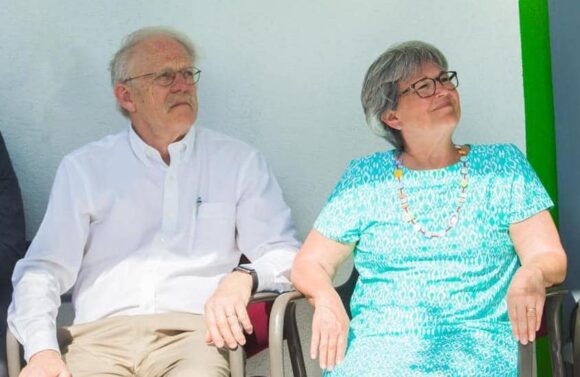
Ted and Becky Crosby attended the opening of a new Medical Center in Liancourt, Haiti in May 2021. The Center was founded by one of the graduates of the Crosby Fund for Haitian Education program, Dr. James Kerby Estimé, who named the Center in Becky’s honor.

During their time on the island, Becky noticed a young man, who was regularly sitting outside the place the volunteers were staying. One day Crosby asked him why he was not in school and he explained that he had previously been fortunate to have a sponsor from the US, but that those funds had ceased. Since school is not free for anyone in Haiti, he was no longer able to attend as his family simply could not afford it, and he hoped by interacting with some of the American visitors in town that he might be able to find a new sponsor.

Becky says, “I was surprised to learn that school was not free,” and made the decision almost on the spot to pay for the young man — Oltin — to finish his high school education. Doing that turned out to be harder than she thought since there was no postal service in Haiti and the young man had no bank account. Becky, however, was determined and finally found a way to pay his tuition through an American doctor working in Haiti.

Three years later in 2002, Becky returned to Deschappelles to meet with Oltin on his graduation from high school. She recalls, “I saw him and it was a wonderful visit.” She adds significantly, “I could not believe what the gift of an education could do.”

She started to research the overall statistics for education in Haiti and was stunned to find that only 55 percent of children in the country attend elementary school, a number which drops to 15 percent for those who graduate from high school, and finally falling to a mere 2 percent, who go onto university.

Less than half of Haitian families can afford school for their children, therefore, one of the Crosby Fund for Haitian Education’s main goals is to provide full scholarships for students from Pre-K through university.

It suddenly became crystal clear to Crosby that, “If you want to build Haiti, you need to educate the youth.” At that transformative moment in her life, she made a personal commitment to try and do something to meet that almost overwhelming objective.

Returning home, she shared the idea with her husband Ted, who was supportive of the concept, and in response set off on his own fact-finding trip to Haiti in 2003.

After Ted returned and expressed his full commitment for the project, Becky returned to Haiti again and began to, “Come up with ways to create the organization” there and “Form a board to select the students [who would receive scholarships.]

Returning to her home in Old Lyme, a determined Becky started work to find donors locally, who were willing to fund students in Haiti, who would otherwise not finish high school.

Not an easy task by any standard, but a short while later, she had successfully recruited 32 people willing to do just that and thus were formed the first seeds of the Crosby Fund for Haitian Education. Becky says, “We started with 32 friends who sponsored 32 students,” adding with a chuckle, “I had no idea when I started where this was leading.”

The Crosby Fund for Haitian Education also offers a wide range of additional academic support at their Education Center in Haiti’s Artibonite Valley.

Where is the organization today?

The numbers are nothing short of staggering.

A total of 523 students are now supported under the organization’s banner including 98 in post-secondary schools, 53 at university and 45 in medical technician or vocational training facilities. More than 80 schools across the Artibonite Valley are now involved in the program.

More than 90 percent of the Crosby Fund’s scholarship students advance to university or technical school and subsequently, CFHE graduates are employed at three times the national average.

Moreover, Faulkner Hunt of Lyme, who serves as CFHE’s Marketing Director, states, “Our goal is to get kids educated,” not just as an end in itself, but, “To get them to a place where they are gainfully employed.”

Has establishing the CFHE had any unexpected effects?

The project has been life-changing for Becky on a personal level in many ways.

Most significantly, when the CFHE had reached a total of around 300 students under its wing, she felt she had to step down from her role as Associate Minister at the FCCOL — a position she had taken after Catherine Zall’s departure (Zall had followed Bruch) — and devote her energies full-time to the fast-growing organization.
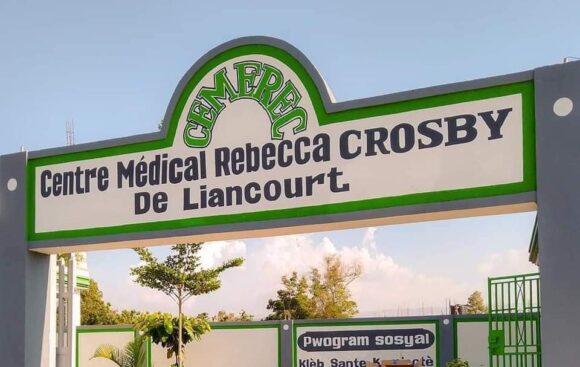
The Medical Center in Liancourt, Haiti, which is named after Becky Crosby.

She explains that she stepped down with three clear objectives in mind.

The first was to find or build some sort of “permanent place” for the CFHE, which could both house the staff and offer classroom space. The second was to establish an endowment fund and the third, and perhaps most important, to set up “some sort of staff in the US” to work on “succession planning” for the organization to establish continuity for it in perpetuity.

Becky says proudly, “All of this things are now in place,” which in turn has helped enormously with “Planning for the future.”

Building the Education Center in Deschapelles met the first goal. The three classrooms and and computer lab allow for a wide range of tutoring opportunities, which Becky emphasizes are extremely important, mentioning, “Math is a huge problem.”

Literacy, especially among adults, is another major challenge. “The students’ parents could not read or write … they had no idea how to read a report card,” Becky explains. The CFHE follows a state-run literacy program for adults, which currently has 56 students enrolled, but has recently adopted a youth literacy program sponsored by USAID, which had 52 students registered in January 2021.

With more than a trace of emotion in her voice, Becky said, “It is so moving to see someone my own age struggling to write their own name … and then go back [after the program has been completed] and see them writing easily. It is very, very touching.”

How are the students selected who are to receive scholarships?

Becky explains, “We have a great staff in Haiti, which includes six graduates of our program.” Using their knowledge of the community, they select candidates whom they determine will benefit from financial support. The process clearly works since the graduation rate of students supported by CFHE is significantly higher than the national average.

The 2020-2021 academic year saw 221 scholarships granted to secondary students in grades 7 to Philo (a 13th college preparatory year.) These students attend 37 schools in the region.

Apart from scholarships and tutoring, another piece of the Crosby Foundation’s work is their career development program. Becky says passionately, “Graduates need jobs … it’s tough to get a job … we’re trying to keep them in Haiti.” The program assists graduates in securing internships and jobs across Haiti, and Crosby points out it has already produced doctors, nurses, computer programmers and administrators, most of whom are now employed in Haiti.

She adds the CFHE has also helped students along other career paths including assisting four agronomy students set up a farming business.

What is the impact of donations from Lyme, Old Lyme?

An extraordinary aspect of the financial support for CFHE is that the “vast majority” comes from Lyme and Old Lyme according to Hunt. He comments it is remarkable, “These two little towns  can take up so much compassion for a little area in Haiti,” adding, “It’s such a great example of selflessness.”

Referring to all the CFHE donors, Becky says, “I wish I could bring them all to Haiti so they could see what they’re doing for the youth of Haiti. I wish I could share that experience with the people, who have helped us.”

Looking Ahead

Becky expands enthusiastically on what she calls “the real joy” of the achievements of the CFHE, saying, “When a kid you’ve picked off the streets does really well at school, even university, gets a job, gets married, has kids that go to school … Bingo, that’s the dream! This is what we are trying to do. It’s not going to happen overnight … we don’t expect miracles … but ultimately it’s nation-building one step at a time.”

Editor’s Note: For more information about the Crosby Fund for Haitian Education, visit their website or follow them on their Facebook page. If you would like to donate to support the work of the CFHE, visit this link. All contributions regardless of size are gratefully accepted.

June 17 COVID-19 Update: Only One Town in State in Yellow Case Rate Zone, All Others in Gray (Lowest); No New Cases in Lyme, Old Lyme

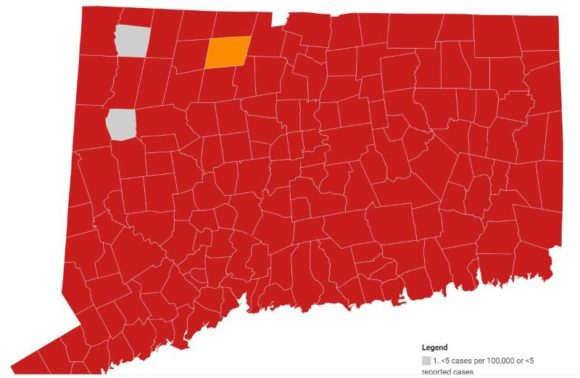
This map, updated June 17, shows the average daily rate of new cases of COVID-19 by town during the past two weeks. Both Lyme and Old Lyme are still in the (lowest) Gray Zone. (Only cases among persons living in community settings are included in this map; the map does not include cases among people who reside in nursing home, assisted living, or correctional facilities.) Map: Ver 12.1.2020 Source: CT Department of Public Health Get the data Created with Datawrapper. Details in italics are the same for each of the maps shown.

LYME/OLD LYME — The report issued Thursday, June 17, by the Connecticut Department of Public Health (CT DPH) for the average daily rate of new cases of COVID-19 by town during the past two weeks shows another major improvement for the state as whole with just one town — Bolton — in the Yellow Zone (indicating the lowest but one rate of COVID-19 new cases.)

All remaining 168 towns in Connecticut, including Lyme and Old Lyme, are in the Gray (lowest rate) Zone for two-week new case rates. It is the sixth week in succession for Old Lyme in that Zone, while Lyme is in the Gray Zone for a 14th straight week.

Neither Lyme nor Old Lyme reported any new cases in the June 17 report meaning Lyme holds steady at 107 cases and Old Lyme at 341 (this number has been corrected from the 342 reported on June 7.)

  • The Gray category is defined as when the Average Daily Rate of COVID-19 Cases Among Persons Living in Community Settings per 100,000 Population By Town is less than five or less than five reported cases.
  • The Yellow category is defined as when the Average Daily Rate of COVID-19 Cases Among Persons Living in Community Settings per 100,000 Population By Town is between five and nine reported cases.
  • The Orange category is defined as when the Average Daily Rate of COVID-19 Cases Among Persons Living in Community Settings per 100,000 Population By Town is between 10 and 14.
  • The Red category is defined as when the Average Daily Rate of COVID-19 Cases Among Persons Living in Community Settings per 100,000 Population By Town exceeds 15.

In all cases, this rate does not include cases or tests among residents of nursing home, assisted living, or correctional facilities.

For comparison, the map below is from June 3 and shows one town, Waterbury, in the Orange Zone and 21 towns in the Yellow Zone, down from 48 the previous week. They were: Ansonia, Beacon Falls, Bloomfield, Brooklyn, Coventry, Cromwell, Derby, East Hartford, East Haven, Granby, Hamden, Hartford, Manchester, New Britain, New Haven, New London, Putnam, Rocky Hill, Shelton, Waterford and Windsor.

This map, updated June 3, shows the average daily rate of new cases of COVID-19 by town during the previous two weeks. Both Lyme and Old Lyme are in the (lowest) Gray Zone. (Only cases among persons living in community settings are included in this map; the map does not include cases among people who reside in nursing home, assisted living, or correctional facilities.) Map: Ver 12.1.2020 Source: CT Department of Public Health Get the data Created with Datawrapper. Details in italics are the same for each of the maps shown.

Below is the map from May 27 that showed one town in the Red Zone, Putnam, and 10 towns in the Orange Zone.

This map, updated May 27, shows the average daily rate of new cases of COVID-19 by town during the past two weeks. Both Lyme and Old Lyme were still in the (lowest) Gray Zone. (Only cases among persons living in community settings are included in this map; the map does not include cases among people who reside in nursing home, assisted living, or correctional facilities.) Map: Ver 12.1.2020 Source: CT Department of Public Health Get the data Created with Datawrapper. Details in italics are the same for each of the maps shown.

Compare the maps above with the one we published Dec. 18, 2020 to see the remarkable progress that has been made with controlling the spread of the virus through expansion of vaccination rates and improved mitigation strategies.

Map of Connecticut dated Dec. 17, 2020 showing both Lyme and Old Lyme now in the CT DPH-identified ‘Red Zone.’ This is defined as when the Average Daily Rate of COVID-19 Cases Among Persons Living in Community Settings per 100,000 Population By Town is over 15.

On June 17, Ledge Light Health District (LLHD) also issued their latest weekly report of COVID data for the municipalities within their District.

All towns in the nine-town district (which includes Lyme and Old Lyme) except Groton and New London, now have less than five new cases in the past two weeks.

Ledge Light Director of Health Stephen Mansfield prefaces the report with the comment, “We are happy to see a continued decrease in the number of new cases throughout our jurisdiction and encourage everyone to get vaccinated!”

Mansfield also notes, “The demand for vaccine is declining, and many providers are reporting that they have unfilled vaccination appointments at scheduled clinics. At this time, LLHD is vaccinating all individuals 18 and older.”

He adds, “Information regarding vaccination opportunities and other relevant information can be found at https://llhd.org/coronavirus-covid-19-situation/covid-19-vaccine/

The following link provides centralized access to Connecticut COVID data: https://data.ct.gov/stories/s/COVID-19-data/wa3g-tfvc/

Vaccination rates in Lyme and Old Lyme are also extremely encouraging with 81 percent of the population in Lyme having received at least one dose of the COVID-19 vaccine and the equivalent number for Old Lyme being 72.47 percent.

These are some of the highest percentages in the state.

Lyme Academy Welcomes Community Back to Campus with Upbeat Concert

OLD LYME — Hundred came out yesterday evening to enjoy a free concert hosted by Lyme Academy of Fine Arts featuring singer Chris Gregor on guitar, who was followed by Brad Bensko and Kathleen Parks.

The crowd seemed genuinely pleased to be back on the grounds of the beloved institution, which has experienced a period of uncertainty in recent years as it transitioned back from a degree-granting college to a fine arts academy.

It was an evening for all ages …

… with something for everyone.

The music delighted the audience …

… and a wonderful evening was had by all.

There will be another free concert next Thursday evening, June 17, from 5 to 7 p.m. on the grounds of the Academy featuring the Java Groove.

Don’t miss it!

Two Lyme-Old Lyme HS Grads Selected for Team US Men’s Eight Competing at Tokyo Olympics

LYME/OLD LYME — In a truly remarkable achievement, two Lyme-Old Lyme High School (LOLHS) graduates have been selected to represent the US in the Men’s Eight at the 2021 Tokyo Olympics.

Austin Hack, LOLHS Class of 2010.

Austin Hack, who graduated from LOLHS in 2010, and Liam Corrigan, a member of the LOLHS Class of 2014, both rowed for LOLHS and then went on to represent their respective universities at Stanford (Hack) and Harvard (Corrigan).

Hack is the only returning member of the 2021 US Men’s Eight. He was a member of the 2016 US Men’s Eight team, which came in fourth in the Rio de Janeiro Olympics in Brazil.

His list of rowing accomplishments is encyclopedic with an abbreviated version including membership of the following national teams: Junior, 2009-10; Under 23, 2011-12; Senior, 2013-15, 2019; and Olympic, 2016, 2020.

In terms of international results, Hack finished fifth in the the eight at the 2019 World Rowing Championships and also fifth in the four at the 2019 World Rowing Cup II.

He won bronze in the eight at the 2016 World Rowing Cup II and won the eight at the 2016 Final Olympic Qualification Regatta.

Going back further than 2016, the list is equally extensive and can be viewed in detail at this link.

Hack has been working part time for McKinsey and Company, but during the COVID-19 pandemic, he was living and training in Old Lyme. Part of his training was on a bicycle adapted by Steve Morrissey of Old Lyme on which Hack ultimately set new records on all the Strava segments in town.

Asked how they felt about their son, Austin, and Corrigan’s success in being named to the US Men’s Eight, Dr. Gregory Hack and Dr. Barbara Hack told LymeLine exclusively, “We are beyond thrilled for both Austin and Liam! On the men’s side of rowing, the US will only be sending an 8+ and a 4- to Tokyo.  To think that of those 12 seats, two of them will be occupied by sons of Old Lyme is just incredible!”

The Hacks added, “It’s a testament not only to their grit and strength, but also to their years of training/coaching starting right here at Lyme-Old Lyme High School.”

Liam Corrigan, LOLHS Class of 2014.

Corrigan graduated from Harvard with an honors degree in Physics and Astrophysics and while at Harvard, he was captain of the men’s crew.

Since graduating, he has moved to Oakland, Calif. to train with the men’s training center for the upcoming Olympics. His accomplishments with Team USA include finishing fourth in the pair at the 2017 World Rowing Under 23 Championships, placing fifth in the four at the 2015 World Rowing Junior Championships, taking eighth in the pair at the 2014 Youth Olympic Games and finishing ninth in the eight at the 2014 World Rowing Junior Championships.

Corrigan recently rowed in the men’s four that won the B final at the 2019 World Rowing Under 23 Championships.

Responding to a question about how they felt after learning Liam had been selected for the US Men’s Eight, Brian and Joan Corrigan said, “It is difficult to describe how overjoyed and proud we are to see Liam on his way to achieving goals, which he set for himself many years ago. We have watched him work diligently over the years, and are ecstatic that he is finding success.”

They noted, “We are grateful to LOLHS, the Old Lyme Rowing Association (OLRA) and the Town of Lyme for their support over many years,” concluding, “We feel so fortunate to live in such a wonderful community.”

Liam Corrigan is at the front right of this photo of the Harvard boat.

Speaking on behalf of the OLRA, Candace and Paul Fuchs commented, “‘The Old Lyme Rowing Association is bursting with pride over the dedication and perseverance of our athletes and their families, which brought us to this historic moment. In partnership with the Town of Old Lyme and Regional School District 18, our little organization is pleased to provide a place for big kids to play and find success.’

Sadly, neither family can attend the Olympics in person due to COVID-19 restrictions, but Barbara and Greg Hack ended their email to us enthusiastically with the words, “Go Old Lyme!  Go USA!”  We wholeheartedly second that sentiment and wish Austin and Liam every success in their Olympic endeavors!

Editor’s Note: Old Lyme Rowing Association (OLRA) oversees LOLHS crew, and Blood Street Sculls. Blood  Street Sculls was established by Fred Emerson (on Blood Street) around 1965, for the cultivation of rowing for local high school students, college students and adults.  

Some of the country’s most notable athletes called Blood Street Sculls home in the early days including  Jim Dietz who is one of the most decorated scullers in US history (named to three US Olympic teams).  

A strong supporter of the nascent sport of women’s rowing, Fred Emerson organized some of the first  women’s national championships to be held on Rogers Lake in 1971, which included athletes who would  ultimately represent the US in Olympic competition.  

Blood Street Sculls was an incubator for rowing programs for high schools and colleges across New England. USCGA and Connecticut College got their start in this manner.

Anita DeFrantz first learned to row as a Connecticut College student, rowing on Rogers Lake. DeFrantz went on to represent the US in the 1976 women’s eight. She was a vocal legal authority when US athletes were prohibited from  competition in 1980 and she has risen through the ranks of international rowing and is currently the vice  president of the IOC.  

Significant achievements — excluding those by Hack and Corrigan —  by OLRA athletes since 2000 include:

Olympic Athletes
2008: Andrew Bolton Men’s lightweight four spare
2012: Sarah Trowbridge Women’s Open double sculls  

World Championships  
Sarah Trowbridge: 2008, 2009, 2010, 2011  

Under 23 World Championships 
Hannah Paynter: 2019  

Junior World Championships  
Christiana Congdon: 2017  

Since record-keeping was initiated in 1997, over 100 athletes in OLRA programs have gone on to  represent their university in collegiate rowing competition.  

Paul Fuchs, Director of Rowing, holds the men’s lightweight course record for Head of the Charles, and competed on seven US World Championship teams. He has coached at the Olympic and World  championship levels and serves on the Executive Council of FISA, the international governing body for  the sport of rowing.