New London County Stays at Medium COVID-19 Community Alert, All Remaining CT Counties at Highest Level

The COVID-19 Community Levels map above, produced by the CDC and dated Jan. 13, 2023, shows New London as the only remaining County in Connecticut in the Medium/Yellow category.

CDC Continues to Recommend All CT Residents Wear a Mask in Public Indoor Spaces  

LYME/OLD LYME — The Centers for Disease Control and Prevention (CDC)’s latest COVID-19 Community Levels Map, pictured above, which was updated today (Jan. 13), shows that New London is the only County remaining in Connecticut, which is not in the High/Orange level.

Last week’s map dated Jan. 7, showed Fairfield County in the Yellow/Medium category along with New London, but this week, Fairfield has moved into the highest Orange category joining all six of the state’s remaining counties.

This means seven counties in Connecticut are in the Orange/ High Category while the eighth (New London) is still Medium/Yellow.

Because all eight Connecticut counties are either in the High or Medium categories, the Connecticut Department of Public Health recommends that all residents consider wearing a mask in public indoor spaces. People who are at high risk for severe illness should consider additional measures to minimize their exposure to COVID-19 and other respiratory illnesses.   

To help protect themselves, their families, and the state’s most vulnerable residents and to preserve capacity in the CT health care system, people are also advised to stay up to date with COVID-19 vaccines and get tested if they have symptoms.  

Connecticut DPH officials stress there are numerous tools for residents to deal effectively with COVID-19, including vaccines and updated boosters, Test to Treat locations, the mobile vaccination van clinics, and the wide availability of COVID-19 self-test kits. 

The links to all these resources can be found in the DPH COVID-19 toolbox at www.ct.gov/coronavirus.

Additionally, the Federal Government has now made available four free self-test kits per household.  These free self-test kits can be ordered by visiting www.covid.gov/tests. 

The COVID-19 Community Levels inform CDC recommendations on prevention measures, such as masking and testing. The guidelines include a color-coded system available on the CDC website of “Low,” “Medium,” and “High.” This approach focuses on preventing hospitals and health care systems from being overwhelmed and directing prevention efforts toward protecting people at high risk for severe illness.   

Editor’s Note: This article is based on a news release issued Jan. 7, 2023 by the Connecticut Department of Public Health and sent to LymeLine by Ledge Light Health District.

Lyme-Old Lyme BOE Agrees on Eight Voting Members of PK-8 Building Committee, Ninth Proves More Contentious

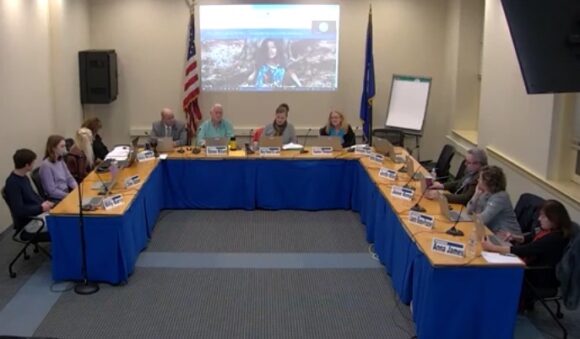
Members of the Region 18 Board of Education met Wednesday evening, Jan. 4, with the selection of members of the PK-8 Building Committee as an agenda item. Photo is screenshot taken from live stream of meeting.

OLD LYME — At their meeting Wednesday evening, Jan. 4, the Region 18 Board of Education (BOE) found they had conflicting views on whom should be appointed to the last voting spot on the PK-8 Building Committee.

Twenty-three people had applied to join the committee and each BOE member had been given all the applications to review and score individually over the winter vacation. The Superintendent’s office had then analyzed the scores and produced both weighted and non-weighted summaries of the results.

There was a clear consensus on the top eight places but the ninth caused considerable discussion.

Prior to that conversation taking place, newly-elected board vice-chair Mary Powell St. Louis expressed concern that only four of the applicants were women and also that there was a “very heavy presence” of engineering and construction backgrounds in the male applicants. She said, “This has bothered me” and proposed that the application process should be opened up for another week in the hope of attracting more female applicants.

Board member Laura Dean-Frazier agreed with Powell St.Louis, saying she too wished there were more women. Dean-Frazier commented, “Diversity is an asset in any group,” but noted, “Women have a tendency to have too much on their plate … I just don’t think we’re going to get them. They’re just a little bit weary doing this type of commitment.”

Another board member, Martha Shoemaker, remarked that she felt the committee needed more women, “Because they have a different way of thinking.”

There was a general concern about the shortage of women applicants, but still little enthusiasm for extending the application period. Board treasurer Christopher Staab pointed out that the board had already been through the process of ranking the candidates and felt it should therefore stand by those results.

With eight committee members agreed, the conversation turned to the choice of the ninth. David Kelsey was the applicant that came in at ninth place on the weighted average ranking but when the non-weighted averages were considered, there was a four-way tie including Kelsey for the ninth spot. The three (other than Kelsey) included interior designer Cara Zimmermann.

Board member Anna James proposed switching Zimmermann for Kelsey since, apart from being female, Zimmerman had a wide range of relevant knowledge as well as experience in bidding processes. Fellow board member Jason Kemp supported James’s position saying Kelsey had been outspoken against the project but board chairman Steve Wilson gave a forceful endorsement of Kelsey saying, “He was not against the project at all costs … He started asking ‘What do we really need?’ … He really does his homework.” Wilson concluded firmly, “He [Kelsey] would be a better voting member.”

Referencing the fact that Andy Russell, who was one of the top eight applicants, and Kelsey are both members of the Old Lyme Board of Finance, James countered that she felt having two people, who are “affiliated,” was also not promoting “diversity of thought” on the committee. Wilson immediately challenged her use of the word “affiliated.”

Moving the discussion forward, the board first unanimously agreed to appoint 12 members to the committee with three of the 12 being alternates. This was to give the committee “structure” in board secretary Suzanne Thompson’s words.

Then BOE members voted on the ninth Building Committee member with all the members except Staab and Jennifer Miller supporting Zimmermann for that spot. Wilson said he did not need to vote as a majority in support of Zimmermann had already been established.

The board then unanimously supported the appointment of Ken Biega, Richard Conniff, John Hartman, Sara Hrinak, Andy Russell, Alan Sheiness, Powell St. Louis, and Wilson as voting members. In the same vote, Darren Favello, Thomas Kelo and Kelsey were appointed as alternates.

Finally, board members elected Wilson as chair of the committee and Powell St. Louis as vice chair.

On Thursday, when the names of those appointed to the Building Committee were posted on the Region 18 website, Kelsey’s name was missing. We asked Lyme-Old Lyme Superintendent of Schools Ian Neviaser why that was the case. He replied by email saying that Kelsey had, ” … notified Steve Wilson on Thursday morning that he was withdrawing his application.”

Halls Rd. Improvements Cttee. Submits Response to Old Lyme Planning Commission’s Concerns Regarding Halls Rd. Overlay District (HROD)

Old Lyme Zoning Commission to Open Public Hearing on HROD Proposal at its Upcoming Monday Meeting

OLD LYME — The Halls Road Improvements Committee (HRIC) has shared with us a letter that the chair of the committee, Edie Twining, recently submitted to the Old Lyme (OL) Planning Commission. Her letter was in response to concerns raised by the Planning Commission in the minutes of their Nov.10, 2022 meeting. Those minutes state that the Planning Commission would be issuing a negative referral of the application.

According to the minutes, the reason for the negative referral was that, “… while the idea of this [Halls Road Overlay District (HROD)] zone had merit, many of the specifics were problematic and would not result in the desired outcome. As a result, the Commission discussed how best to relate its concerns to the Zoning Commission. The Commission members’ consensus was that giving a negative referral would obligate the Zoning Commission to see that these comments were addressed.”

A Public Hearing for the application to create a HROD is on the OL Zoning Commission’s agenda for Monday, Jan. 9, 2023.

The Zoning Commission’s meeting will be held in the Meeting Hall at OL Town Hall starting at 6:30 p.m. The full agenda for the meeting can be viewed at this link.

The letter from the HRIC Chair to the OL Planning Commission members, which is expected to be discussed at Monday’s meeting, reads as follows:

Atty. William Sweeney (for the Halls Road Improvements Committee) and Atty. Matt Willis (Council for the Zoning Commission) have gone over the proposal for the Halls Road Overlay District (HROD) in detail, making some minor changes (e.g. bringing capitalization and use of terms more in line with existing Old Lyme zoning regulations). The amended document now meets with the approval of Council for the Zoning Commission and Eric Knapp, the Zoning Enforcement Officer (ZEO). 

We wanted to wait until the conference of the attorneys was complete before responding in detail to the concerns raised in the minutes of the Planning Commission’s November 10th meeting. This letter takes each item in turn. 

“As drafted, it was unclear how the new overlay zone affected future development along Halls Road, and whether future developers would be obligated to use the HROD or could continue to use the C-30S requirements.” 

The attorneys and the ZEO are agreed that the HROD creates an alternative to the C-30S zoning along Halls Road that is available to qualifying lots in the district through the established Special Permit process. Unless and until an owner applies for and receives a special permit to use the HROD zoning, the zoning remains C-30S. The granting of such a permit in one lot does not have any effect on the zoning for any other lot in the district. The original C-30S zoning remains in force for all lots that have not asked for and received a special permit to use the alternative HROD regulations. 

As to the effect of the HROD on future development along Halls Road more broadly, it is the clear intention of the proposal that it will encourage investment creating, over time, a pedestrian-friendly shopping street along Halls Road in a mixed-use neighborhood including some of the smaller-scale multi-family housing in such short supply in Old Lyme today. We believe this mix will help ensure a more vibrant business climate for the types of businesses that serve Old Lyme residents, rather than businesses focused on highway traffic. The C-30S district in today’s business climate is most attractive to businesses serving highway traffic—a use the Planning Commission’s decennial Plan of Conservation and Development (POCD) has always deprecated. With the HROD, property owners can expect investors with other aims to join in the bidding, giving Old Lyme some protection against Halls Road becoming a set of truck stops. The POCDs have repeatedly called for a broader range of housing types in Old Lyme. The Halls Road district is one place where smaller-scale housing would be appropriate. Its presence there would be a significant support for retail business, and would help to re-integrate our main shopping district with the rest of Old Lyme. 

“Related to this, it was unclear what the unifying architectural theme was supposed to be. Given that implementation of the new zoning requirements would be piecemeal, it would be difficult to create the consistency required by the draft regulation, and the combination of old and new uses would not be an improvement to the existing conditions.” 

The one attribute of new development that nearly all Old Lyme residents find important is that it should “look like Old Lyme.” The HROD addresses this shared concern by creating Design Guidelines with a clear design review process. The model is Lyme Street with all its range of styles. The proposed Design Guidelines present multiple examples of what is acceptable and what is not. The aim is to get tasteful, proportional designs that meet accepted professional architectural standards. The design review standards and process for HROD are explicit and clear. This makes life easier for prospective investors, as they can tell what is wanted from early on in their design process. 

The HROD provides incentives to developers. It cannot order anyone to invest, it can only provide opportunities. The transformation of Halls Road from strip centers to a walkable shopping street may take decades. The current Halls Road is itself the result of decades of one-off designs: some better, some worse, and all different. It may be years before the basic look and feel of Halls Road is dominated by buildings made in accordance with the Design Guidelines. Does that interim period mean we should never start? We think not. We must start somewhere, and HROD is a good place to do so. 

“Further, many of the obligations created by the new regulations would be cost-prohibitive or unfeasible, therefore the Commission urged the Zoning Commission to consider whether any of the “shalls” included in the draft regulation could be changed to “may” without altering the impact of the regulation.” 

Investors determine what is “cost-prohibitive or unfeasible” and what is not. Their view of the matter is what counts. Given the size of the investment required, we expect these primarily will be professional developers. So far, we have received favorable signs of interest from professional developers. They are encouraged by the Town’s embrace of a master plan and look forward to seeing the details of the HROD. 

In 2023 no developer of any size expects to find no restrictions or “obligations” associated with a mixed-use design-build opportunity—certainly not in New England. What they do want is clarity and as little ambiguity as possible in the business proposition. The HROD is very clear on this point. In exchange for building a small amount of first-floor front retail along Halls Road, investors can develop multi-family residential above that and/or on the land behind it. This is an attractive proposition, particularly to anyone with experience in mixed-use development—an increasingly active sector of real estate development. 

The existing housing stock in Old Lyme (and in many shoreline towns) is so skewed toward single-family homes that there is a large pent-up demand for smaller-scale housing. That opportunity is the incentive in HROD. The price (building a bit of retail space) is relatively low. Both types of construction can be profitable, but a developer who knows nothing about retail might find the requirement to build retail space daunting. One with experience would not. The restrictions in the HROD are not daunting, they are clarifying. The developer who knows how to pursue the opportunity will take it, even if it means partnering with another who knows retail or residential better than they do. That is the nature of business. Our aim is to set the conditions so that investors make a profit and the Town gets the Halls Road it wants and needs. We believe we have done that. 

“The thirty-five-day period for referral to the Design Review Committee is unworkable and will lead to poor results.” 

This is a misunderstanding of the actual working process followed in commercial and multi-family residential development. When an owner or developer considers a new project, among the first steps is to find out what the town says can or cannot be done. Long before any formal application is submitted, developers work with the ZEO and other regulators to review their plans. At this early stage the ZEO would engage the Design Review Committee to review the preliminary concepts to assist the applicant in creating a successful project. Most of the design concepts should be worked out and meet the HROD guidelines well ahead of the formal submission of the application for a special permit. Thirty-five days from formal submission is the period of time in which the Committee must submit its recommendation to the Zoning Commission or default to an approval. It does not prevent prospective investors from working with the Design Review Committee well in advance of a formal application. 

We hope this note helps to clarify any misunderstandings of the HROD proposal. We would welcome the chance to discuss further with the Planning Commission to gain your support of this important new regulation.

Thank you

Respectfully 

Edie Twining
HRIC Chair

Old Lyme Boys Pull Off First Basketball Win of Season Against Hale-Ray


OLD LYME — Playing at home on Monday night, the Old Lyme boys ended up defeating Hale Ray 68 – 60, but it was a close call.

Old Lyme struck early and hard with some good post offense from the Monte twins — Calvin and Caden — to open up a first quarter 24-15 lead. Calvin ended the game with 19 points,15 rebounds, three assists along with a steal and block apiece, Meanwhile, Caden notched 17 points, eight rebounds, two blocks and an assist.

Hale Ray, however, refused to go quietly spurred on by some outstanding shot-making by their leader Mamush Ciccerello, who scored a game-high 27 points.

Old Lyme was simply not able to pull away from Hale-Ray and in the fourth quarter, Hale Ray moved to within three. points of the Wildcats.

Ultimately though, thanks to a few timely press-breaks, Old Lyme was able to survive and come away with their first victory of the season.

After the game, Old Lyme coach Ken Beeman commented, ‘’I mentioned to the guys that in my book this is no such thing as a bad win. A win is a win. They are not always pretty but they all count. And thankfully it did not turn into a bad loss.’

Old Lyme’s next game is Thursday against Westbrook.

The ‘Cats record stands at 1-1, after their season-opening 7-45 loss to Portland. After that game, Beeman predicted, “Portland is an experienced, aggressive, confident group that is going to win a lot of shoreline games this season.”

Republicans Take All Four Officer Spots on Lyme-Old Lyme Schools BOE, Democrat Shoemaker Loses Vice-Chair Position

OLD LYME — At the Dec. 7 Region 18 Regular Board of Education meeting, the usual election of officers was held, but this year, despite no election having been held in November and therefore no new members seated, it brought some changes.

Steve Wilson was re-elected as Region 18 Board of Education Chairman at Wednesday’s meeting.

After the confirmation of incumbent Steve Wilson (R) as chair, he asked for nominations for the position of Vice-Chair. Jennifer Miller (R) immediately nominated Lyme Republican member Dr. Mary Powell St. Louis while no nominations for incumbent Democrat Martha Shoemaker were offered. The subsequent vote saw Powell St. Louis, who had previously served as Treasurer, elected.

Powell St. Louis herself then nominated Republican Christopher Staab to fill the position of Treasurer that she was vacating and again the voting supported that nomination.

Finally, Staab rounded off the election by proposing that Republican Suzanne Thompson be nominated for the position of Secretary, which she has held for the prior year. That motion was similarly approved.

Thus Shoemaker, who also serves as a Selectwoman on the Town of Old Lyme’s Board of Selectmen and is one of the longest serving board of education members, found herself without a position as an Officer of the board.

The new slate of officers for the Region 18 Board of Education for the upcoming year is as follows:

Chair: Steve Wilson (R)
Vice-Chair: Mary Powell St. Louis (R)
Treasurer: Christopher Staab (R)
Secretary: Suzanne Thompson (R)