23rd House District Candidates Carney, Stone Face Off in First Debate

DSC00170

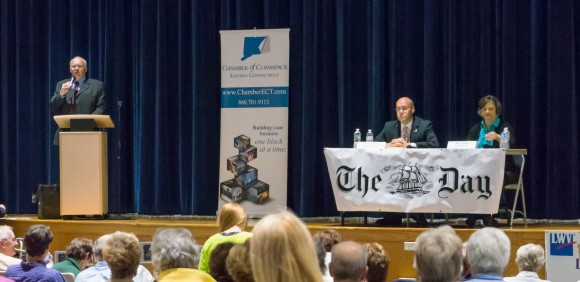
23 rd House District candidates Devin Carney (R) and Mary Stone (D) respond to audience questions in Tuesday night’s debate at Lyme-Old Lyme Middle School.

An almost capacity audience of around 200 people gathered Tuesday at the Lyme-Old Lyme Middle School for an hour-long debate between 23rd House seat candidates Democrat Mary Stone and Republican Devin Carney. The debate was co-sponsored by the New London Day and the Eastern Connecticut Chamber of Commerce.  The Day Editor Paul Choinere, who moderated the debate, asked the candidates written questions submitted by the audience.

The 23rd seat has been held for the past 12 years by state representative Marilyn Giuliano (R), who will be retiring after completing her current term.

In a relatively quiet, respectful debate, candidates responded to audience questions on a wide range of topics including education, job creation and taxation.

Carney described his array of political and business experience, adding that he has “done all this while working part-time jobs to help pay the bills.”

“We need a state rep. to carry on Marilyn’s legacy of strong constituent services and passionate public service,” Carney noted, adding “It’s time that my generation steps up and takes hold of the debt we will have to shoulder and the future of our state.”

Stone said that the extensive experience she has gained in volunteer and elected positions over some 20 years in the town, including on the Board of Education, Zoning Board of Appeals, Old Lyme Libray and Open Space Commission, has demonstrated her, “ability to lead and work hard with proven results.”  She submitted that “everything I have accomplished in our towns … has been because of my ability to work with others across party lines, to make real and lasting changes.” She summed up her candidacy in the words, “I do not make huge, unrealistic promises just to get your vote. But, as your full-time legislator, I will work as hard as I possibly can to serve your needs and get the best results for our towns.”

U.S. Sen. Chris Murphy Tours ‘The Preserve’ in Old Saybrook

Chris_Murphy

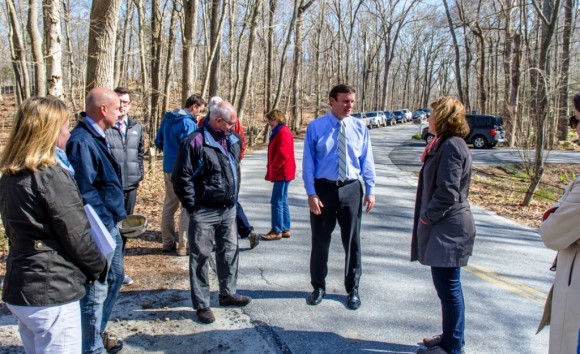
U.S. Senator Chris Murphy (D-Conn.) joined representatives from the Trust for Public Land and the Connecticut Fund for the Environment, and about 40 other environmentalists and town officials on Thursday afternoon on a short guided tour of ‘The Preserve’ in Old Saybrook.  The Trust for Public Land is currently working with the towns of Old Saybrook, Essex and Westbrook to acquire the 1,000-acre forest for public enjoyment and to prevent it from further development.

“I’m thrilled to be here with you today.  My family, for as long as I’ve been alive, has had a little tiny summer house in Old Lyme, so this part of the world is like a second home to me,” said Murphy.

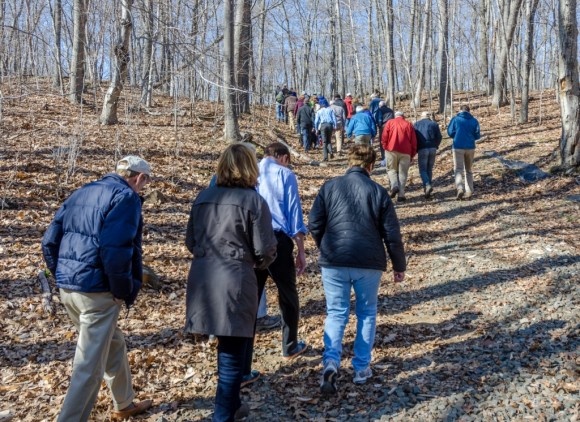
Sen. Murphy took off his office shoes and replaced them with hiking footwear as he joined the rest of the group on the hike through to the middle of ‘The Preserve.’

1404_untitled_014

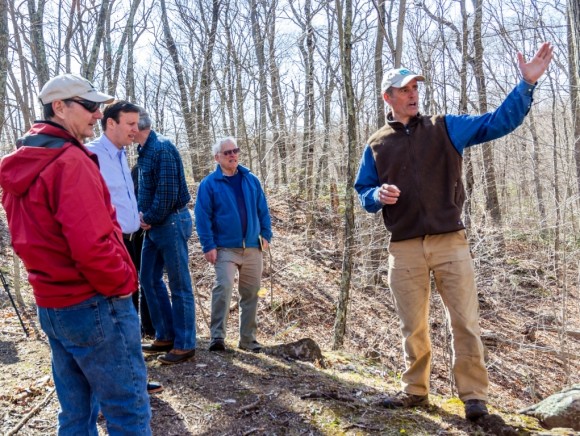
Senator Murphy joins the group on the short hike through ‘The Preserve.’

After a short hike, the group reached the center of the 1,000 acre property, overlooking Pequot Swamp.  Chris Cryder, Special Projects Coordinator for Connecticut Fund for the Environment, described the swamp as an area of particular environmental significance.  “Pequot Swamp is a 113-acre wetland area that feeds two tributaries of the Connecticut River and is an important resting site for migratory birds,” said Cryder.

Chris Cryder, Special Projects Coordinator for Connecticut Fund for the Environment, explains the environmental significance of Pequot Swmap to Senator Chris Murphy

Chris Cryder, Special Projects Coordinator for Connecticut Fund for the Environment, explains the environmental significance of Pequot Swamp to Senator Chris Murphy.

The Trust for Public Land has been working with the towns of Old Saybrook, Westbrook and Essex, Land Trusts for the three towns, the Connecticut Fund for the Environment, Audubon Connecticut, The Nature Conservancy and the State of Connecticut to raise the necessary funds to purchase the property.  The Trust hopes to raise $2 million -$3 million in private donations towards the re-negotiated price of $8.1 million.  The remaining funds could potentially come from the state and from the town of Old Saybrook, who will be holding a referendum in June when town voters will be asked to vote on the issue.  If successful, the land would be owned by the town and would be kept open to the public for hiking and recreation purposes.

“In our office, we eat, sleep and breathe land conservation,” said Murphy, “so this is really exciting when we have a big piece of iconic property like this that, hopefully with a little bit of luck and some good partnership, we can preserve for the ages.”

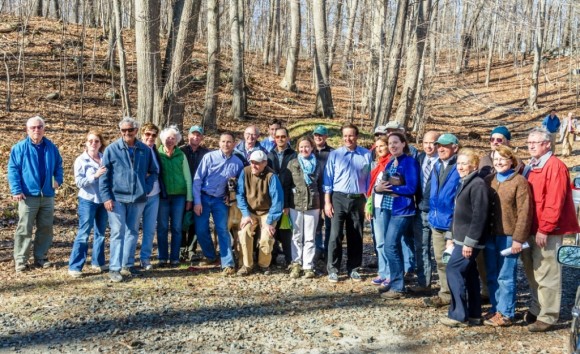
After returning to the trailhead, the group posed for a photo with Senator Murphy.

1404_untitled_037

Raising the Flag in Old Lyme for ‘National Donate Life Month’

Donate life 2
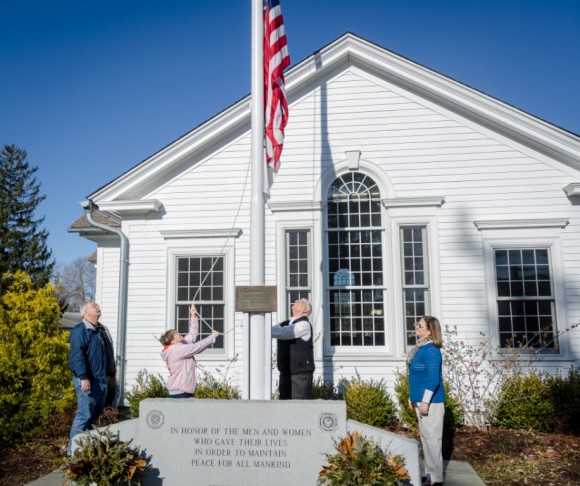
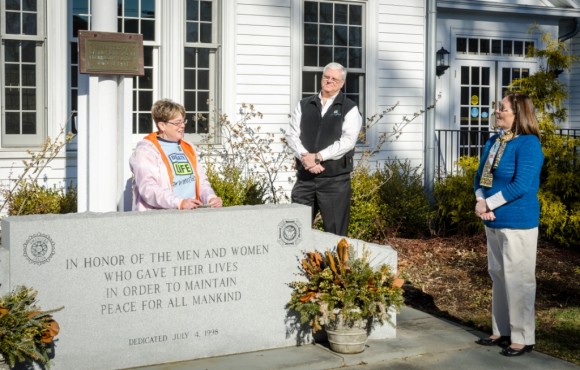
Around a dozen people gathered outside Old Lyme’s Memorial Town Hall on Tuesday morning, April 1, to acknowledge and celebrate the start of ‘National Donate Life Month’ (NDLM), which was instituted by Donate Life America and its partnering organizations in 2003.  Celebrated in April each year, NDLM features an entire month of local, regional and national activities to help encourage Americans to register as organ, eye and tissue donors and to celebrate those that have saved lives through the gift of donation.

Donate life 1

Old Lyme First Selectwoman Bonnie Reemsnyder welcomed everyone and then led a moment of silence prior to the flag being raised.  Tom Kasprzak from East Lyme  (left in photo above), who is a Community Relations Specialist for CL&P, lost his daughter Mary (aged 15) nine years ago.  He and his wife, Joanne, donated Mary’s organs to other people, thus saving the lives of five people who received her organs.

Donate life 4

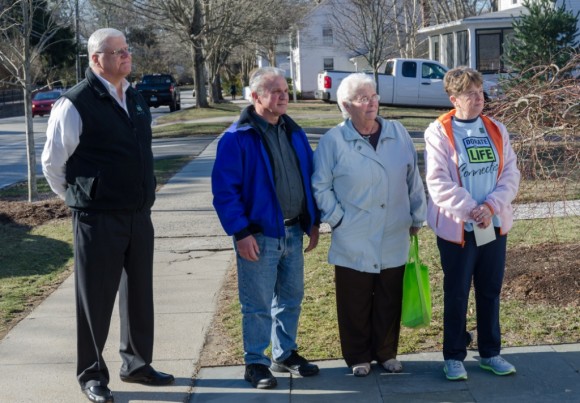
Lymes’ Senior Center Coordinator Stephanie Lyon (pictured left in photo above) noted her mother received a new heart five years ago.  The procedure changed her mother’s life and she now regularly swims for up to one and a half hours each day.

Donate life 3

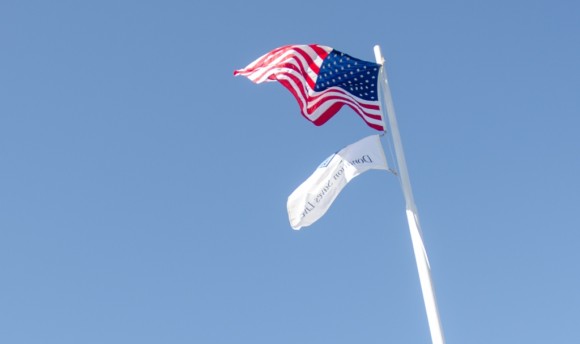
The “Donate Life” flag will fly at the town hall throughout the month of April.  Kasprzak said, “By raising the flag we honor the thousands of donors who have saved the lives of countless others through their simple acts of kindness and compassion.”

I-95 Southbound Closed in Old Lyme After Tractor-Trailer Fire

1307_untitled_001

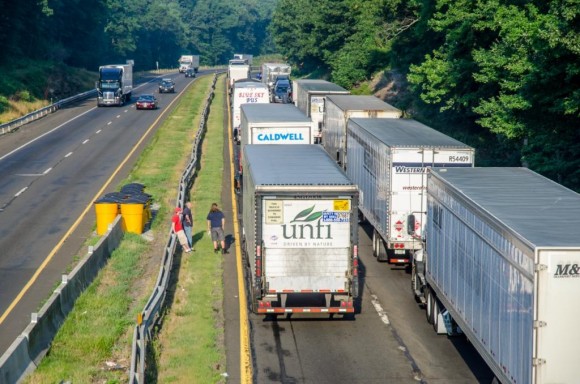
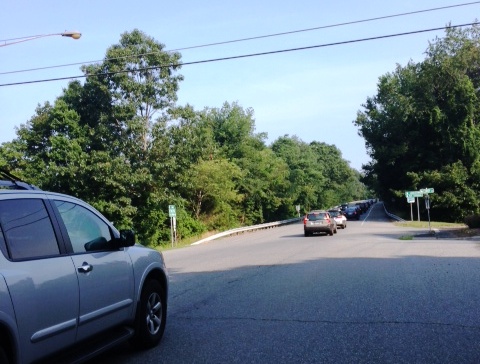
At 11 a.m. Friday, I-95 remained closed southbound between exits 70 and 71 after a tractor-trailer fire at around 4.20 a.m.   Southbound traffic was diverted off the highway at exit 71, causing significant traffic back-up.

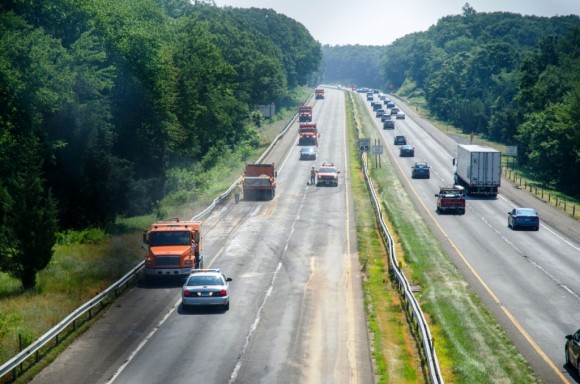
The tractor-trailer, which was carrying frozen crab legs, became fully engulfed in flames.  No injuries were reported, but an amount of fuel was spilled on the highway, requiring DEEP staff to conduct a clean-up operation.

Emergency crews conduct clean-up operation on I-95 southbound following tractor-trailer fire.

Emergency crews conduct clean-up operations on I-95 southbound following an early morning tractor-trailer fire.

Rte. 156 and Boston Post Rd. were heavily congested throughout the morning as southbound traffic was diverted off I-95 at exit 71 and directed either south on Four Mile River Rd. to Rte. 156 or north on Four Mile River Rd. to Boston Post Rd.

IMG_1021

Heavy traffic was frequently stationary throughout the morning on Rte. 156 heading west.

Enjoy an Exciting, Educational ‘Eagle Watch’ Cruise with the Connecticut River Museum

1302_2013FebEagleWatch_076-7

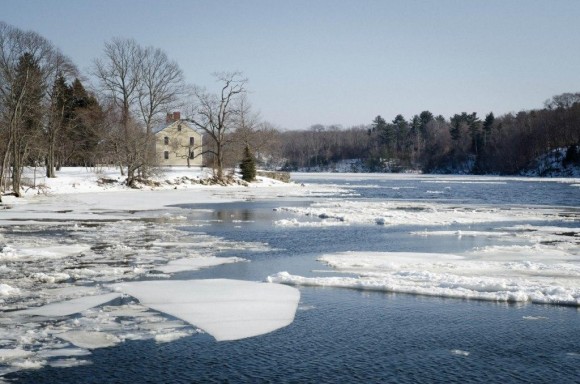
The picturesque view east into Hamburg Cove from the Connecticut River.

Last Friday was the perfect winter weather for a boat trip on the lower Connecticut River to view the wildlife and enjoy the experience of being one of the very few boats on the river during mid-February.  I was a guest aboard the 65 ft. Project Oceanology vessel Enviro-Lab III  for one of the “Eagle Watch” boat trips offered by Connecticut River Museum in partnership with Project Oceanology during February and March each year.  This is the fourth season the Connecticut River Museum has teamed up with the Groton-based marine science and environmental education organization, Project Oceanology, to provide a dynamic on-water experience.
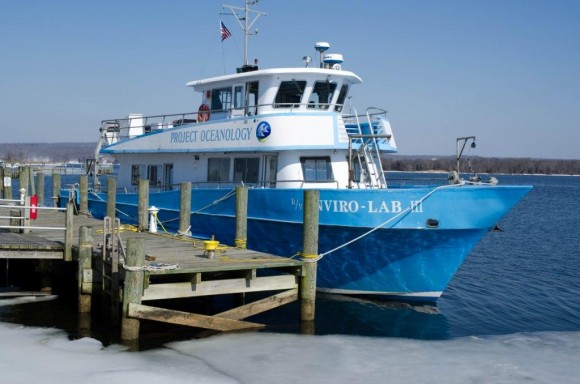
The 65 ft Enviro-Lab III owned by Project Oceanology who have partnered with Connecticut River Museum to offer the Eagle Watch trips

The 65 ft. Enviro-Lab III is owned by Project Oceanology, who have partnered with Connecticut River Museum to offer Eagle Watch trips.

Although visitors to the river in winter can see many interesting avian species, the bald eagle is the one most visitors hope to see.   Declared an endangered species in 1973 with the passage of the federal Endangered Species Act, populations began to recover following the ban on DDT, and by 2007,  the bald eagle populations had recovered to the extent that they have now been removed from the endangered species list.  They are, however, still protected on the federal level by the Bald Eagle and Golden Eagle Protection Act of 1940 and the Migratory Bird Treaty Act of 1918.

Every winter a number of bald eagles migrate south looking for open water to feed as the lakes and rivers in Canada and northern New England  freeze.  Many of these birds stop in Connecticut and winter along major rivers and large reservoirs, and can been seen feeding and occasionally nesting on the banks of the Connecticut river.
1302_2013FebEagleWatch_024-3a

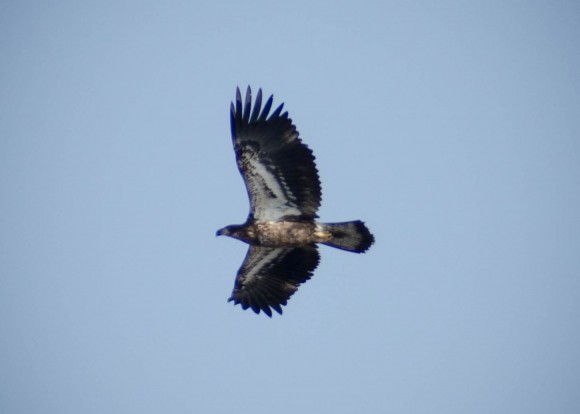
A juvenile bald eagle flies gracefully over the Connecticut River.

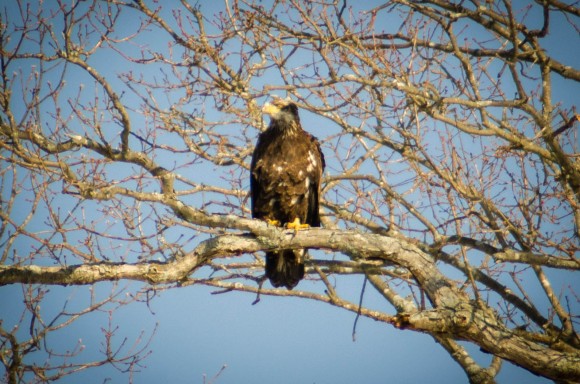
Although a sighting is not guaranteed, eagles are spotted on most trips.  On the first trip of the season, six adult eagles and eight juveniles were spotted.  On this trip, we were fortunate to spot our first young eagle soaring high above the boat minutes after casting off from the town dock as the boat headed north up river and then we saw several more eagles throughout the trip, some roosting in riverside trees and some gracefully circling above the river.
1302_2013FebEagleWatch_041-9

A juvenile bald eagle perches on a tree along the river bank.

Eagles nesting on Nott Island

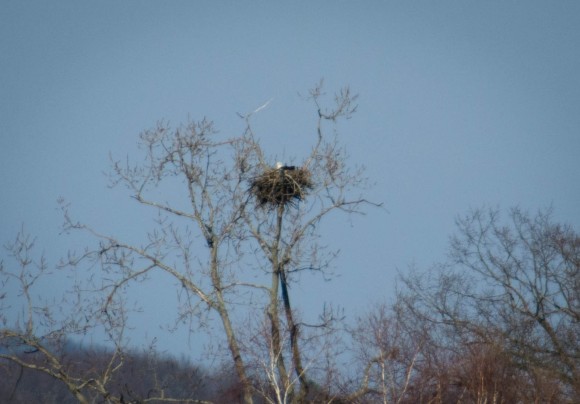
One of the highlights of the trip was to observe, from a distance, the rare sight of an eagle on her nest on the eastern side on Nott island, just across the river from Essex harbor.  In the 1950s the bald eagle was no longer a nesting species in Connecticut but, according to the CT Department of Energy and Environmental Protection, in 1992 the state documented its first successful nesting of bald eagles since the 1950s when a pair raised two young birds in Litchfield County.  Since then, the nesting population has increased gradually and, in 2010, 18 pairs of bald eagles made nesting attempts in the state.
1302_2013FebEagleWatch_096-8

A female bald eagle sits atop her nest on Nott Island in the Connecticut River.

One such nesting pair is seen above on Nott Island.  The female was about to lay her eggs a week or so ago but was temporarily disrupted by Winter Storm Charlotte.  Hopefully, now that she is back on her nest, the eggs have been successfully produced.

“Let’s go out on the river and have some fun!”

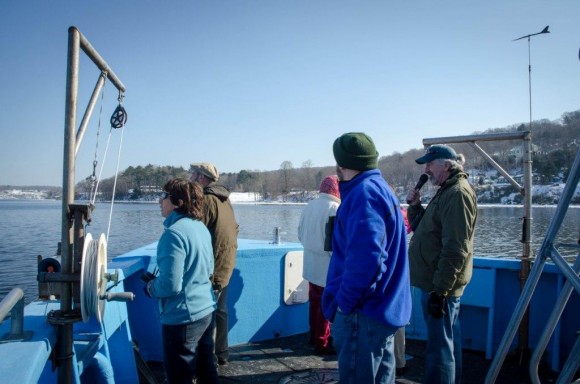
The Eagle Watch boat trips are led by local expert naturalist and lecturer Bill Yule, who is an educator at the Connecticut River Museum.  He is not only an expert on most wildlife species found along the Connecticut River but also a renowned expert on local mushrooms and fungi.  Yule welcomed visitors aboard the trip with the invitation, “Let’s go out on the river and have some fun,” and throughout the trip he helped locate and identify birds, related historical stories about life along the river and made sure all the passengers were warm and comfortable with plenty of hot coffee.
Naturalist and lecturer Bill Yule provides interesting and informative information on all wildlife species seen along the river throughout the cruise

Naturalist and lecturer Bill Yule (right) provides interesting and informative details about all the wildlife species seen along the river throughout the cruise.

Yule was accompanied by two educators from Project Oceanology, Chris Dodge and Danielle Banco, who cheerfully helped identify interesting birds and assisted the boat captain with docking and navigating up and down the river between the ice flows.

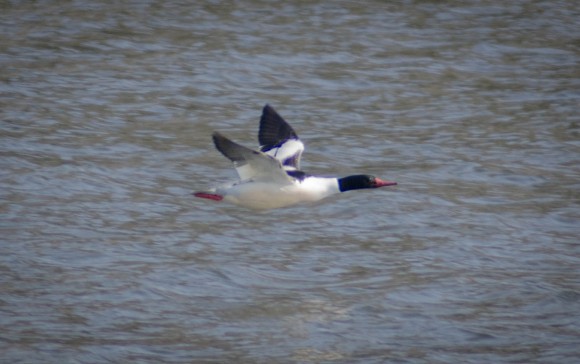
Bald eagles are certainly not the only avian species guests can enjoy on the trip and on this particular voyage, we enjoyed numerous sightings of  cormorants, black-backed gulls, red-tailed hawks and common merganser ducks.

We returned to the town dock some 90 minutes after departure excited by all the birds we had seen and moreover, educated about them, and, despite the cold, I am confident I am not the only traveler on that voyage who will be taking another trip later in the season.  All in all, it was an awesome experience!
1302_2013FebEagleWatch_026-4

A common merganser duck in full flight above the river.

February Vacation Week Programs

The Connecticut River Museum is also offering a week-long program of vacation week activity for the February school break starting tomorrow, Feb. 19.  In addition to an Eagle Watch adventure on Friday, Feb. 22, the program will also include a day exploring the many galleries in the museum, an outdoor exploration day including a nature hike and animal tracking, and an arts and crafts day building models boats, learning knot tying and other maritime arts.
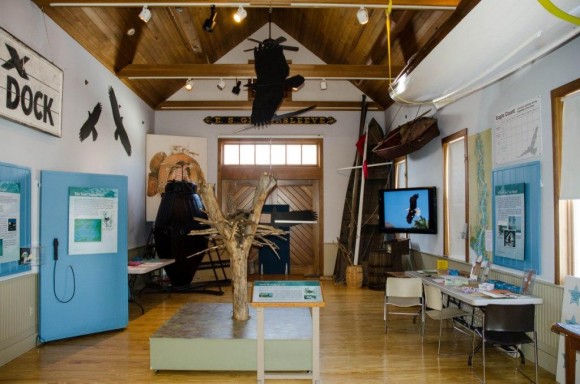
1302_2013FebEagleWatch_009-2

An avian wildlife exhibit in a Connecticut River Museum gallery.

To make reservations for the vacation week program or for more information about Connecticut River Museum educational programs or Eagle Watch Tours, visit www.ctrivermuseum.org or contact Jennifer White Dobbs in the Education Department at jwhitedobbs@ctrivermuseum.org or Bill Yule, also in the Education Department, atbyule@ctrivermuseum.org.

Project Oceanology in Groton also offers Winter Seal Watch trips during weekends in February and March.  These two and a half hour trips travel out into Fishers Island Sound to view these playful creatures, which are abundant in this area.  The ticket price of $25 (adults) and $20 (children) also includes a 20-minute slide presentation.