Nicole Prévost Logan
In spite of lively street scenes in Paris, crowds strolling in the Tuileries gardens, restaurant terraces full of people enjoying a copious lunch and long lines at museums and movie theaters, the ongoing austerity measures imposed by the Socialist government contribute to a morose mood in France .
In the past two years, new taxes have multiplied. More people have to file income taxes, some retirees are struggling to survive on their pensions, the Taxe sur la Valeur Ajoutée (TVA – the equivalent of sales tax in the US) on restaurants — after being lowered — is going up again to reach 10% next January. Corporate taxes have also increased.
The population was encouraged to invest its savings into special accounts. Promises of a guaranteed interest of 3 percent on these savings accounts have gradually vanished. It is today below 1 percent.
The northwest region of Brittany is in in uproar following a new “eco-tax” imposed on truckers, fishermen and farmers.
A tax of 75 percent on annual incomes higher than one million will hit particularly the stars soccer players, who threatened to go on strike for one week-end in November. When one knows how fanatic the public here is about its soccer matches, one might expect violent scenes.
The TV series called “A Village Français,” now in its third season, continues to enjoy top ratings. It shows how the average French people behaved during the German occupation. It depicts the whole spectrum of the population, ranging from despicable collaborators to courageous “resistants” with — in between — the vast majority just trying to survive and protect their families. The show is done with honesty, avoiding black and white judgments. By 1943 the French became more daring , as their spirits were lifted by the London broadcasts.
This is a great idea: for a small fee, courses in the English language are offered to the passengers riding the Train à Grande Vitesse (TGV – high speed train) from Rheims to Paris – a facility to be extended to other railroad lines.
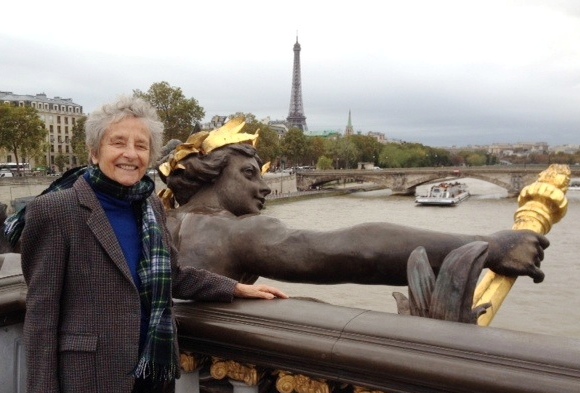
Nicole Prévost Logan divides her time between Essex and Paris, spending summers in the former and winters in the latter. She will write a regular column for us from her Paris home where her topics will include politics, economy, social unrest — mostly in France — but also in other European countries. She also will cover a variety of art exhibits and the performing arts in Europe. Logan is the author of ‘Forever on the Road: A Franco-American Family’s Thirty Years in the Foreign Service,’ an autobiography of her life as the wife of an overseas diplomat, who lived in 10 foreign countries on three continents. Her experiences during her foreign service life included being in Lebanon when civil war erupted, excavating a medieval city in Moscow and spending a week under house arrest in Guinea.