Letter From Paris … or, in this case, Saint-Émilion: A Day In Wine Country

Nicole Prévost Logan

Saint-Émilion is a small village perched on the hills overlooking the Dordogne river about 28 miles east of Bordeaux It is surrounded by some of the most prestigious  vineyards in the world and in 1999, the “cultural village”of St. Emilion was added to the list of UNESCO World Heritage sites.

In winter, the population of Saint-Émilion is not more than 200 but in summer the place turns into one of the tourist hot spots of France. Crowds start showing up early in the morning and people fill the café terraces, climb the steep and narrow streets, and look at the small shops selling cannelets and macarons. Unwelcome cars, bumper to bumper, search desperately for a parking place.

The town has over 1.3. million visitors a year.  
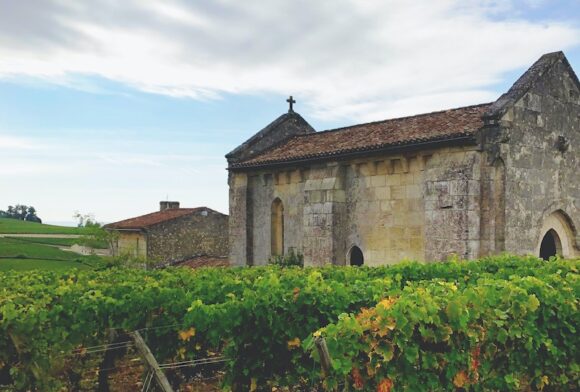
A view of Saint-Émilion. Photo by Sigmund on Unsplash.

 A family friend, now an enthusiastic guide, led us through the long history of the village with a series of colorful anecdotes. The first traces of human occupation in Saint-Émilion date back 35,000 years. We plunged into the past with our guide, who showed us the catacombs and some of the 200-km long tunnels, which turn the hill into something resembling a Gruyère cheese .

Saint-Émilion acquired its name from brother Aemilianus or Emilion — a monk who arrived from Brittany in the 8th century AD. He was a master in the art of making bread. In doing so he earned money, which was stolen by other monks, according to our guide. He then became a hermit and lived in a cave. He is remembered for accomplishing several miracles. 

Word of these miracles attracted other monks and pilgrims on their way to Santiago de Compostela in Spain. Vestiges from the 8th to the 12th century are still visible underground, including wall paintings, wall carvings, altars and medieval chapels. The most striking is the “Monolith church” built in the early 12th century. Its gigantic 12-meter-high arch is made of a single block of stone. The best residences of Bordeaux are built out of the limestone found in the Saint-Émilion quarry.   

In 1152 Eleanor of Aquitaine married Henri II Plantagenet. Two years later Henry became king of England and the region fell under British rule, where it remained for three centuries.This perhaps explains why the British still feel very much at home in this area.

The “One Hundred Year War” ended when the English army was defeated by the French at battle of Castillion in 1453.

In 1199, the youngest son of Eleanor, John Lackland, sealed the “Charter of Falaise” (Falaise is a town in Normandy) conferring rights to the Jurade – an association that is unique in the world. The Jurats of Saint-Émilion controlled all civic, legal and administrative affairs of the city. In the 15th century, the French kings reaffirmed those rights. The association was dissolved during the French Revolution. 

Today the Jurade association exists again. Its 140 Jurats members wear the medieval scarlet robes during their annual celebration the third week in June. Quite a spectacle to watch on the top of the ruin of the Tour du Roy – the only intact Roman donjon (the great tower or innermost keep of a castle) remaining in the Gironde Département.  
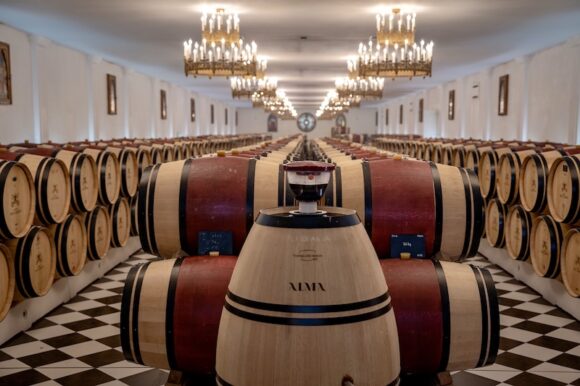
Barrels of Saint-Émilion wine are left to age in cool cellars. Photo by Brian Ashley Harris, www.brian-ashley.com.

The art of wine-making started as far back as 6,000 BC. In the Saint-Émilion area, the first wine amphora date from 56BC. The culture of wine intensified after the spread of Christianity in the 5th century AD.  Archaeological excavations are ongoing in the Gallo-Roman villa du Pilat. Beautiful mosaics reveal the great wealth of that villa, which is probably related to the production of wine. 

Wine-growing is a multimillion industry. It is highly regulated and fiercely competitive. It is also a vulnerable industry.

In the 1870s, a pest insect called phylloxera devastated French vineyards. It took them 30 years to recover by grafting resistant American rootstocks. Today close to up one third of the Bordeaux wine is again threatened by a double crisis, over-production and the vagaries of climate changes. A “sanitary plan” consisting of pulling vines, started in June 2023.  

I obtained lots of information about Saint-Émilion while talking to a young student pursuing her university studies in Bordeaux in tourism, culinary art and oenology.

How are the Saint-Émilion wines ranked? At the 1855 Exposition Universelle held in Paris, Napoleon III, appointed a commission to rank the Bordeaux wines. That ranking has remained frozen since then for the Bordeaux wines, but only on the left bank of the Garonne River (Medoc and Graves.) 

But since 1955 the ranking of the Saint-Émilion wines can be revised every 10 years. In 2022, the latest selection retained only two Premiers Grands Crus classés A: Chateau Pavie and Chateau Figeac, 12 “Premiers Grands Crus Classés B, and 72 “Grands Crus Classés. The expression “grand cru” can. be translated “first growth” in English.
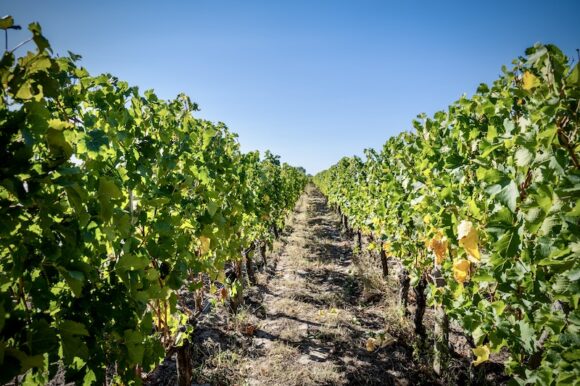
Looking down the neat rows of vines in a Saint-Émilion vineyard. Photo by Brian Ashley Harris, www.brian-ashley.com.

Saint-Émilion vineyards cover 5,400 hectares (out of 115,000 for the entire Bordelais region.) One hectare (or Ha) is the equivalent of three acres. Most of the plots in Saint-Émilion are small at 20 Ha or less. 

In fact, keeping down the size helps make the wine rare and therefore more expensive. 

The gaps between rows of vines are one meter or less to force the work to be done manually and not by machine. 

To keep production as low as possible, the workers may even trim bunch of grapes if they are not in exact alignment. The lifespan of a wine can reach 65 years, but on our country road, I saw plots planted with brand new vines.

We approached Saint-Émilion from the main BergeracLibourne road in the lower plain on the right bank of the Dordogne river. A 68-meter high church steeple dominates a skyline of houses nestled among ruins of cloisters and medieval fortifications. It felt as if the winding road was taking us to the Holy Grail. On each side, we could see manicured rows of vines. Here land is worth gold and one hectare (about three acres) can be worth seven million Euros.

On top of the ridge, we notice an elegant house with a turret. Unfolding down the hill are impeccable rows of vines and low sustaining walls. This if the Chateau Belair-Monange, the residence of the Moueix family. They have been wine growers for three generations, as well as “négociants”  (wine merchants) doing business in France and also the Napa valley. Their wine is “only” Premier Grand Cru Classé.

What makes the Moueix family different from other producers is that they keep buying plots and now own 10 vineyards. In the 1960s, Jean Pierre, the head of the dynasty, made the brilliant move of buying Chateau Petrus located in Pomerol, an area adjacent to Saint-Émilion in the west. 

To the surprise of everybody, the family sold 20 percent of the Petrus vineyard to a Colombian-American businessman in 2018.

Edouard Moueix, born in 1977, heads wine production today. His wife, Kelley, is American and runs a store in the village that sells bags and other luxury items. 

Chateau Angelus is big in Saint-Émilion. In fact, very big.

Its offices, chais (local term for storerooms), shops and showrooms are quite conspicuous in the area. On the hill, the imposing main building where clients come to taste the wines has a beautiful roof. When foreign guests enter the building, the bells in the belfry above the entrance door will play the music of their country. The 85-Ha. vineyard is situated in a natural amphitheater near the center of town — a priceless location. 

Until last year it ranked in the highest category of St Emilion wines but was excluded in 2022 and lost its “A”. The owner – Hubert Boüard de la Foresti – is the last of eight generations since 1785.

The reason for this earth-shaking development is that M. Bouard de la Foresti violated his responsibilities as head of the Confrérie du Grand Conseil du vin de Bordeaux where he served three years. He was convicted of fraud.
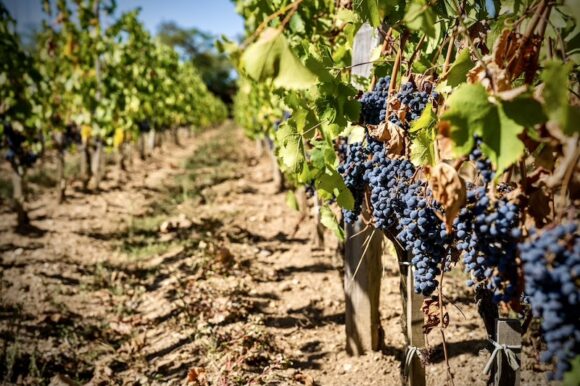
The vines are loaded with grapes prior to the ‘vendage’ when the grapes are harvested. Photo by Brian Ashley Harris, www.brian-ashley.com.

Although located not in Saint-Émilion proper but nearby in the west in the Pomerol region, Chateau Petrus is well worth mentioning. Its path to celebrity is different from the others since it received remarkable publicity through some really high-profile events.

Queen Elizabeth II chose Chateau Petrus to be served at her marriage in 1947.

John F. Kennedy offered Chateau Petrus as a gift to Jackie. 

James Bond was served the Chateau Petrus in one of his films. 

The acreage is quite small:- only 11 Ha.but a bottle can reach 2,300 to 5,000 Euros — and as much as 10,000 Euros — at auction.

Bernard Arnault, the richest man in France (LVMH), until 2022 owned a small plot in Saint-Émilion producing Cheval Blanc, Grand Cru Classé Catégorie A, until 2022. A 1947 bottle sells for $770.

The culture of wine in Saint-Émilion is strictly regulated. Fertilizers are not permitted, composts are but not more than every three to four years, since the earth does not need many nutrients. Watering is only allowed at times of drought. 

Besides the wine growers must abide by the European Union blueprint to generate a sustainable production by respecting the environment. The label  “AOC” or Appelation d’ Origine Controlée is granted to protect the production of a defined area – the terroir – using traditional know-how specific to the geographical area.

Do not miss a chance, next time you are in Saint-Émilion to do some wine-tasting by tilting the glass to see the color, twirl the glass to bring out the flavor and/or smell the wine to detect its alcohol content, aroma or acidity. You can taste the wine in one of the many wine caves àvins (wine cellars) in the village.

One can also visit estates such as the elegant Chateau Soutard — their wine-tasting package costs $800 for a group of four. A votre santé!

Editor’s Note:This is the opinion of Nicole Prévost Logan.

Nicole Prévost Logan

About the author: Nicole Prévost Logan divides her time between Essex and Paris, spending summers in the former and winters in the latter. She writes an occasional column for us from her Paris home where her topics will include politics, economy, social unrest — mostly in France — but also in other European countries. She also covers a variety of art exhibits and the performing arts in Europe. Logan is the author of ‘Forever on the Road: A Franco-American Family’s Thirty Years in the Foreign Service,’ an autobiography of her life as the wife of an overseas diplomat, who lived in 10 foreign countries on three continents. Her experiences during her foreign service life included being in Lebanon when civil war erupted, excavating a medieval city in Moscow and spending a week under house arrest in Guinea.

Letter From Paris: Let the Games Begin … in Paris … in 2024!

Nicole Prévost Logan

The countdown has started for the Summer Olympic Games 2024 (or J.O. [Jeux Olympiques] 2024 as the French say) and the excitement is growing. The dates are July 26 through Aug. 11, and Aug. 28 through Sept. 8 for the Special Olympics . Paris will be the host of the events.

The interface of an historical city like Paris with venues for sporting events should be magical while also being a challenge.  Imagine watching beach volley ball under the Tour Eiffel or breakdancing on the Place de la Concorde !

Photo by Luca Dugaro on Unsplash.

The J.O. 2024 mark the centenary of 1924 inauguration of the first modern Olympic games. It will be the sixth time for France to host the event, and also represents the  largest event ever organized in the country. There will be total parity between men and women athletes – a first in the history of the games.   

On Aug.  26, 2023, a disappointing announcement was made: because of a series of spring downpours, the sewers overflowed and ran into the Seine, which was declared too polluted to serve as a venue for water sports. The preparatory work for the competition on the Alexander III bridge had to be dismantled. 

In order to prevent the recurrent surge of polluting water into the Seine after storms, a gigantic project has been undertaken.  Between the Gare d’Austerlitz and the Hopital Salpêtrière east of the city, several blocks of apartment buildings were razed to make room for a “bassin de rétention”  50 meters in diameter. At the bottom of a 30 meter-deep well a massive “tunnnelier” machine will dig a tunnel under the Seine for huge pipes to be laid.   Other bassins will be constructed upstream east of Paris.

In a way the scheduling of the games in 2024 is helping to speed up this huge project of assainissement (sanitation).  Some day soon, maybe one will be able to swim in the Seine!

Logistics will be a major headache for the games officials, mostly to organize transport. Flying taxis will turn the skies of summer 2024 into a science-fiction scene of the future. A 10-minute flight from Charles DeGaulle airport can certainly beat a two-hour long ride by public transport.

Additional buses and trams will compensate for the closure of many metro and bus stops in central Paris and on the Périph (Beltway), a special lane will be reserved for athletes and games officials. 

The fully automated subway ligne 14 will be extended to include Orly airport and a new métro station will open near the Stade de France.

In order to assist in welcoming at least 13 million visitors, 40,000 volunteers positions were offered and filled up immediately.   

Security will be a top priority , particularly during the opening ceremony which will be watched by 600,000 spectators. All of them are obliged to have a ticket, including the 400,000, holding free tickets. 

Photo by Sebastien Gabriel on Unsplash.

Order will be maintained by 35,000 police. According to Gerald Darmanin, Minister of the Interior, the scope of the security plan is unprecedented, since it will cover six kilometers along the banks of the Seine when a parade of 115 boats will end up at the Trocadéro and the foot of the Tour Eiffel

A security perimeter will be installed around the city against any possible acts of terrorism. More than 4,000 video-surveillance cameras will function with “smart” AI algorithms to protect private data.

Anti-drones will be there also. During the Tokyo games, 400 million cyberattacks were detected. In Paris, the organizers will be ready for such a possibility. 

How expensive will the tickets be?  It is hard to give the exact prices since they depend on the competition. Just to give an idea, the most expensive seat at the opening ceremony will cost 2,700 Euros and the cheapest 90. 

At the closing ceremony, the respective prices are 1,600 and 45 Euros. 

Two of the most expensive competitions to watch will be Athletics at 900 Euros and swimming at 690 Euros. At the other end of the price range, tickets to watch the marathon or the urban games on Place de la Concorde will be either quite low or even free. In spite of the fact that many tickets have been made available for free,  people complain that prices are much too high. 

Given the politically-poisoned environment existing at present in France, it is hoped that the social unrest in the streets will not flare up again and add to the huge logistics problems of managing millions of spectators. As expected, criticisms of Paris 2024 abound centered primarily on protests against the entrance tickets being so expensive that the average person cannot afford them.

In fact, most Parisians will probably want to flee the capital during the games. Hotel rooms and AirBnB apartments will be offered at exorbitant prices. 

Most of the infrastructure to accommodate the Olympic sporting events already exists. The Aquatics Center for swimming and diving competitions is an exception. 

Close to 95 percent of the financing comes from the private sector. Private investors will bear the cost – estimated at 1.3 billion Euros – of the Olympic village. This is where the 10,500 athletes will stay in the Saint Dénis area, north-west of Paris. Architects have designed the temporary lodgings to be easily transformed into permanent apartments for low-income French residents. 

Except for the surfing competitions, which will be held in Tahiti, 9,800  miles away from Paris  (certainly not next door!), all the sporting events will take place in 30 sites equally divided between Olympic and Special Olympics throughout France but mostly in and around Paris. 

If you enjoy sightseeing in the old city, you might be interested in knowing that some key historical sites will be turned into “Sport Arenas” for various disciplines. Examples are:-

Place de la Concorde : skateboard (first time in J.O.) ; breakdancing; BMX bicycle free style,  basketball

Les Invalides: Archery

Eiffel Tower stadium and Champ de Mars: Judo and Wrestling;  Special Olympics (wheelchair rugby) 

Rolland Garros: Tennis

Chateau de Versailles:  Equestrian events, Dressage, Horse-jumping

Hotel de Ville to Les Invalides:  a 42km-long marathon touching on many historical monuments of Paris. On the first day, 80 men will run.  On the second day, 80 women .

Pont d’Iena: a beautiful location for spectator stands

Grand Palais: Fencing, Taekwondo  (Korean martial art)

Trocadero: Start of the road cycling races, 273 km

Parc de la Villette (north of Paris) largest cultural park in Europe.

Celebration Centers during the Games to meet athletes are:

Parc des Princes: Football

Vaires sur Marne Nautical Stadium: Rowing, Canoeing/Kayaking

Marseille: Sailing

La Défense Arena, Aquatics Center: Swimming and diving

Stade de France (also called Stade Olympique):  Athletics. This is the oldest discipline, going back to 776 BC in Greece

St Quentin-en-Yvelines: cycling track

A view of Notre Dame before the devastating fire.

To top it all, President Emmanuel Macron has a vision of Notre Cathedral opening for the public with a celebration of mass to coincide with J.O. 2024.  That would indeed make these ‘The Games of the Century’!

Editor’s Note:This is the opinion of Nicole Prévost Logan.

Nicole Prévost Logan

About the author: Nicole Prévost Logan divides her time between Essex and Paris, spending summers in the former and winters in the latter. She writes an occasional column for us from her Paris home where her topics will include politics, economy, social unrest — mostly in France — but also in other European countries. She also covers a variety of art exhibits and the performing arts in Europe. Logan is the author of ‘Forever on the Road: A Franco-American Family’s Thirty Years in the Foreign Service,’ an autobiography of her life as the wife of an overseas diplomat, who lived in 10 foreign countries on three continents. Her experiences during her foreign service life included being in Lebanon when civil war erupted, excavating a medieval city in Moscow and spending a week under house arrest in Guinea.

Letter From Paris: For Five Days in June, France Burned

Nicole Prévost Logan

“You should not go to France.  it is too dangerous.”  My American friends expressed their concern when I flew out to France for a summer vacation in early July.

I must admit that the news coverage of what happened in that country in late June was pretty scary: riots for five days and nights, hundreds of burnt cars, carcasses of buses left on the streets, black débris remaining after the many acts of arson, smashed storefronts and bus stops, and plundered shops and supermarkets.

In Montreuil, a suburb east of Paris, the demonstrators had used fireworks as a shield of smoke against the police. Videos showed children as young as 12 taking part in this wild rampage, running away from looted stores loaded with clothes and other goods. 

After I landed at Charles de Gaulle Airport in Paris, I expected to find widespread devastation with violence and vandalism still apparent. 

But no, the country seemed normal, traffic was as heavy as usual, restaurants full, people were flocking to outdoor markets and golf fans were eager to play their 18 holes over the weekend.

The explosion of anger against the police is not new in France with recurrent complaints against alleged police brutality and racial profiling. But this time it reached an unprecedented intensity. 

It all started when Nahel Merzouk was shot on June 27 after refusing to stop his car when summoned to do so by police officers. One month after the shooting, Le Monde published a description of what happened, based on the preliminary results of the inquiry. 

The traffic police had been alerted that a Mercedes was speeding through Nanterre, a suburb west of Paris, and that it carried guns. The traffic police then started chasing the car, which entered the bus lane, ran red lights and crossed a junction without slowing down. Finally the police managed to stop the yellow Mercedes AM, as shown on a video. This particular model has an incredible acceleration capacity and can reach a speed of 100 km per hour within less than four seconds. 

As the police officers, with blaring sirens, ordered Algerian-born Nahel Merzouk to pull over, the latter Instead made his vehicle surge away and attempted to flee. This is when the police shot the young man.  

Apparently the Mercedes had been rented the day before from a place, which opened for business just three months prior. It seems odd that a 17-year old would rent such a fancy car, particularly when, in France, the age to get a driver’s license is 18. 

Riots and pillaging occurred in cities all over France including in the capital city of Paris. File photo by Randy Colas on Unsplash

The atmosphere of hatred was also directed against any symbol of public authority vested in central or local governments, such as town halls and police barracks were sacked. Schools, gyms, social centers, and 300 bank branches were destroyed. Public buildings were damaged. In Nanterre, the rioters vandalized a memorial to the victims of the Holocaust. In Marseilles, the largest public library, named Alcazar, was also damaged.

After the violence abated, the population was left with a feeling of total paralysis. It was the middle class that had been primarily hit. Hundreds of shopkeepers saw their merchandise and also their stocks pillaged. Curfews and closures of public transport affected mostly the working population in poor suburbs.  

Threat and insults were hurled at local elected officials among the 35,000 municipalities existing in France. The private home of the mayor of l’Hay-les-Roses, a small town south of Paris, went up in smoke and his family was attacked.  

On June 30, President Macron had to cancel his official visit to Germany – the first time that has ever happened. 

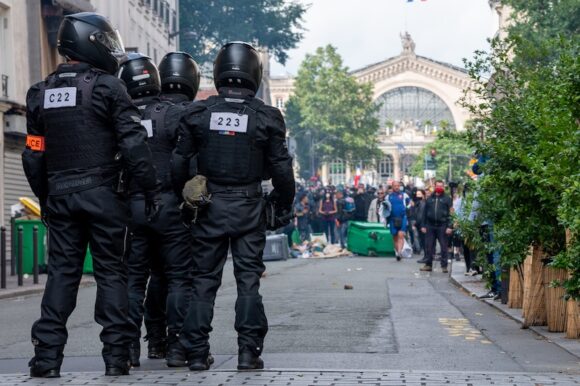
French police face protesters on a street blocked with garbage cans. Photo by Oscar Brouchot on Unsplash

The government deployed 45,000 police, including RAID ( Research, Assistance, Intervention, Dissuasion), which is an élite unit of the French police, and GIGN ( Groupe d’Intervention de la Gendarmerie Nationale). Since 2016, the law has authorized police to use firearms in cases of self-defense and to shoot a vehicle fleeing at traffic stops. More than 3,500 demonstrators were arrested. Macron threatened to cut off social networks at times of riots. He was he was accused of authoritarianism for saying that.

The financial sequels of the unrest are enormous. It is estimated at about one billion Euros, including the anticipated loss on future business. Who is going to pay? As usual, the taxpayers and mostly the little guy. The close to 1,000 shopkeepers, who suffered loss and damage, may get 10,000 Euros compensation paid by insurance .  Financial aid will be provided by chambers of commerce  and private associations. The cost of all this assistance will eventually be borne by the community.

The French population is deeply divided on the topic of police responsibility. Attempting a discussion is like entering a mine-field and you feel like you are walking on eggshells whenever you dare to express an opinion.

Conservatives and middle of the road people want law and order. They want scenes of violence in the street to be curbed. They admire the courage of police, who are so often exposed to angry mobs and to a society increasingly hostile. Hundreds of those police have been injured in recent years. The police should not be “above” the law but, at the same time, should not be “under” the law, they say. For the other segment of the population, police are the enemy with the presumption of culpability against them latent. 

The two sides of public opinion are so irreconcilable that they create immense tension and the possibility that a clash may happen at any time.

Nicole Prévost Logan

About the author: Nicole Prévost Logan divides her time between Essex and Paris, spending summers in the former and winters in the latter. She writes an occasional column for us from her Paris home where her topics will include politics, economy, social unrest — mostly in France — but also in other European countries. She also covers a variety of art exhibits and the performing arts in Europe. Logan is the author of ‘Forever on the Road: A Franco-American Family’s Thirty Years in the Foreign Service,’ an autobiography of her life as the wife of an overseas diplomat, who lived in 10 foreign countries on three continents. Her experiences during her foreign service life included being in Lebanon when civil war erupted, excavating a medieval city in Moscow and spending a week under house arrest in Guinea.

Editor’s Note:This is the opinion of Nicole Prévost Logan.

Letter From Paris: Memories of Crimea … a Strategic Peninsula Steeped in History, Culture

Nicole Prévost Logan

Subsequent to the Russian occupation of Crimea in 2014, which took place 60 years after USSR First Secretary Nikita Khrushchev transferred it to Ukraine in 1944, the strategically-important peninsula has frequently made news headlines.

I visited the region twice and have always been fascinated by the important events and famous people with which it is associated.

Map of the Crimea with inset showing the broader geographic location of the peninsula. Image published under the Creative Commons Attribution-Share Alike 2.0 Generic license.

In July 1990, my husband Alan, four friends and myself were sailing around the Black Sea on “Katy II”, our French-built 44 ft. ketch. After a 24-hour stretch from Sochi, we proceeded south through the Sea of Azov. Lightning followed us throughout the night. (Alan’s comment was, “That was a hell of a good sail,” while mine was along the lines of, “That was a hellish sail in spades!” ) 

We reached the Crimean coast, carefully keeping away from the naval base of Feodosia. We passed Koktebel, famous for its writers’ colony, which has existed there since 1911. Some of the greatest Russian poets, among them Anna Akhmatova and Marina Tsetaeva, spent time at the colony.

As we approached the port town of Alushta, a booming voice from a loudspeaker barked, ” What are you doing there?” 

Soon after, we were boarded by the Soviet Coast Guard. Their metal launch rammed violently into our boat.  

But the encounter turned out to be pleasant. The  sailors enjoyed having their picture taken with Jane, our young crew member from California.

Then we sailed along a beautiful coast, reminiscent of the French Riviera. with elegant residences, hotels and casinos. This was the resort of Gurzuf  where Alexander Pushkin spent a few months in exile in 1821 for having written a piece about freedom. 

Yalta is located in a spectacular setting, with a mountainous backdrop reminding  me of Table Mountain in Cape Town. Initially, we tied “Katy II” near a boardwalk in the center of town. The people had never seen a foreign sail boat before, so you can imagine the crowd. 

It was on Yalta‘s boardwalk that Anton Chekhov staged one his most charming short stories entitled, ” The Lady and the Dog.”  The Russian playwright, sick with tuberculosis, spent his final days in the mild Mediterranean climate of Crimea. 

While staying in Yalta, we toured the vineyards’ cellars to taste some of the many sweet wines, like Porto, Tokaï or Muscat, grown on the sun-drenched hills.

Nicholas II, Alexandra and their five children spent several blissful summers in their Livadia palace, near Yalta. The elegant, neo-classical buildings overlook the Black Sea. 

In February 1945, the conference of the “Big Three” took place in this gorgeous area. US President Roosevelt stayed in the last Tsar’s summer residence. A special apartment was arranged for him on the ground floor. A few miles away, British Prime Minister Winston Churchill settled in the Vorontsov Palace – an extravagant architectural complex combining Moorish and gothic styles. S0viet Union Premiiiapi Stalin took his lodgings in the Koreiz palace also nearby. 

As we cleared a rocky promontory, west of Yalta, the Russian Coast Guard paid us another “visit”. The reason this time was that we were too close to the seaside “dacha” of Gorbachev in Soros.

In 1992, I accompanied the team from the Pushkin museum Department of Ancient Art and Archaeology to the ancient site of Pantikapeon * (or modern Kerch) on the most eastern point of the Crimean peninsula. I knew the team since I had taken part in the excavation of a 17th century estate located on the grounds of the Pushkin museum in Moscow. 

After a 28-hour train ride with the friendly group, lots of singing and a fair amount of vodka, we reached our dig-house at the foot of Mount Mithridates. 

In the 7th century BC, Pantikapeon was one of the most important settlements created by the wealthy Greek cities of Asia Minor (or modern Turkey) on the northern shore of the Black Sea. Numerous archaeological sites are being excavated by Russians, Ukrainians as well as Westerners in this part of the world. 

Offset poster for US lecture-series Energy Plan for the Western Man (1974) by Joseph Beuys,.

The Kerch region still shows traces of the fierce combats, which took place between the German and Soviet forces, particularly between 1941and 1942. Out of the tragic scenes of devastation and killings came an amazing story of redemption though it is disputed by German military sources. 

It is the story of the controversial modern German artist Joseph Beuys (1921-1985). He was flying with the Luftwaffe during World War II over Crimea. His plane was shot down and a Tatar shaman rescued him. (A shaman is someone who interacts with the spirit world through altered states of consciousness, such as trance.)

The shaman saved the pilot’s life by rubbing sheep fat on his skin and covering him with a felt blanket. From then on, felt and grease constituted the central part of the artist’s works and “installations.”

Wikipedia notes, however, that, “Records state that Beuys remained conscious, was recovered by a German search commando, and that there were no Tatars in the village at the time.”

Today, Beuys is considered an icon in Berlin.  

Author’s Note: For more information about the Pantikapeon excavation, access my article titled, ‘The View from Mount Mithridates’, published in the November/December 1994 edition of ‘Archaeology’ magazine.

Nicole Prévost Logan

About the author: Nicole Prévost Logan divides her time between Essex and Paris, spending summers in the former and winters in the latter. She writes an occasional column for us from her Paris home where her topics will include politics, economy, social unrest — mostly in France — but also in other European countries. She also covers a variety of art exhibits and the performing arts in Europe. Logan is the author of ‘Forever on the Road: A Franco-American Family’s Thirty Years in the Foreign Service,’ an autobiography of her life as the wife of an overseas diplomat, who lived in 10 foreign countries on three continents. Her experiences during her foreign service life included being in Lebanon when civil war erupted, excavating a medieval city in Moscow and spending a week under house arrest in Guinea.
Editor’s Notes: i) This is the opinion of Nicole Prévost Logan.

ii) The offset poster for US lecture-series ‘Energy Plan for the Western Man’ (1974) by Joseph Beuys, organised by Ronald Feldman Gallery, New York is published courtesy pf Ronald Feldman Fine Arts, New York. This file is licensed under the Creative Commons Attribution-Share Alike 3.0 Unported license.

Letter From Paris: A New Spire – and Rooster – Set to Rise Above Notre Dame Cathedral

Nicole Prévost Logan

The spire and the rooster of Notre Dame will soon be back in the sky of Paris. 

The 2019 fire destroyed Notre-Dame’s wooden roof and spire but left the outer structure largely intact. This photo was taken on April 15, 2019 from the Quai de Montebello by Wandrille de Préville.This file is licensed under the Creative Commons Attribution-Share Alike 4.0 International license.

On April 15, 2019, the world watched in horror as the spire of Notre Dame was consumed by flames and finally crumbled down. It left a gaping hole in the cathedral at the center of its vault. 

Four years later, the installation of a tabouret — (literally, a stool) — which, in this case, is a huge wood contraption intended to serve as the base of the new flèche  (or spire), marked the beginning of a crucial stage in the restoration of the church. 

The first flèche (spire) was erected in 1220-30 and removed at the end of the18th century. In 1859, architect Eugène-Emmanuel Viollet-le-Duc , carried by the revival of medieval art inspired by Romanticism and the publication in 1831 of “Notre Dame de Paris” by Victor Hugo , brought the dilapidated cathedral back to life and rendered it more medieval than before with new features like chimeras and gargoyles. His main creation was the flèche.

By the spring of 2018, the spire was in a state of disrepair. The 12-ft.-tall copper statues of 12 apostles and four evangelists, including a St. Thomas, which was the architect’s self portrait, were lifted by cranes creating something like a ballet in the sky. Scaffolding was put in place at the base of the spire to start the future restoration. It is believed that it was the exact place where the fire originated in April 2019 and spread to the wood frame or forêt under the roofs.   

After heated debates between the world’s architects, engineers and art historians, it was decided to reconstruct the spire identical to its original appearance , including Viollet-le- Duc’s own vision of medieval art.  

After all these years spent stabilizing the structure, putting robots to work to remove debris and toxic lead dust, recreating the stone sculptures, which had exploded under intense heat; reviving the brilliant colors of the stained glass windows; cleaning up the 15th century organ; and stripping walls, columns and 16th century paintings from the dark, slimy layer of dirt accumulated by tens of millions of visitors tramping through the building for centuries, five-star General Jean Louis Georgelin — appointed to oversee the restoration project by the French government — was able to announce, “Now, for the first time, we are starting to rebuild.”

Reconstruction is well underway in 2023 at the Cathedral of Notre Dame. Photo by Sylvia Logan.

TF1, one of the main French TV channels, aired a series of fascinating videos over several days during the week of April 14. Senior international reporter and historian Michel Izard took the viewers through the step by step restoration process of the new flèche, which will soar again into the sky by the end of 2023.

At 40 meters (131 ft.) from the ground, the installation of the tabouret at the intersection of the transept and nave is an impressive piece of work, weighing 80 tons and measuring 15 by 13 meters (49 x 43 ft.) The two beams of solid oak 10 meters long (33 ft.) are placed in the form of a  cross. At the center a poinçon (a tool used to make holes ) will act as the spinal cord of the structure.. 

The installation of the spire was preceded by months of intense work in workshops outside Paris. For this operation, the best know-how and the best trees were required. France is lucky to have both. One thousand trees were selected in the oak forests of Lorraine. Those trees were out of the ordinary for the length of their trunks uninterrupted by branches.

After being felled, the 250-year-old trees had to be “squared” by hand, using an axe. It is a skill transmitted through generations. The few lumberjacks, who still know how to do this type of work are usually foreign. They live in the forest. The video showed a lumberjack from Croatia squaring the trunks in 1985. The Association of Carpenters Without Borders helps preserve the ancient wood-working methods.  

The trees are worked while still green and soft, then dried for a period of one and half years. For the carpenters, working the wood while still alive, is a challenge. Working manually allows them to respect the grain of the wood and know each knot. 

The logs of unusual length of 20 meters (or 60 ft.) had to be processed in special sawmills since very few mills are equipped to accommodate such operations.  

A trial run of assembling the 110 pieces of the tabouret was carried out while they were lying flat on the ground, then that piece was dismantled to be lifted and put together again on top of the transept, at 30 meters (99 ft.) from ground level. This huge object was to be put in place with the precision of a Swiss watch-maker and fitted with specific measurements calculated in millimeters. As previously mentioned, the wood was still “alive” and allowances had to be made on occasion for a few millimeters resistance, since the wood — not being totally dry — could contract   

Around 30 carpenters were selected from among the best in the world. They seemed enthusiastic and proud to work on Notre Dame. “We are going to go much higher,” one of them said with much excitement. Many of them are Compagnons du Devoir et du Tour de France, an élite school of craftsmen, who are taught methods used by generations of artisans going back to the Middle Ages.

The prestige of this school is comparable to the élite Grandes Ecoles. The school used to function in 49 countries but today, it is particularly active in France. The Compagnons learn a trade under a master as apprentices. They share their knowledge by traveling throughout France and live in hostels. In the Middle Ages, they helped build castles and churches. UNESCO wrote their charter.

This view of Notre Dame Cathedral before the devastating fire clearly shows the spire, which was destroyed in the fire and is now being reconstructed. Photo by Robin Garnier on Unsplash.

Carpenters from four different companies from several countries are taking part in the spire’s reconstruction. The video showed carpenters from The Netherlands and England. Hank Silver and Miles Jenners, respectively from Vermont and Massachusetts, were beaming during an interview. They emanated pride for having being selected. They gave up their jobs to come to Paris. Today 1,000 people are working on the Notre Dame site, half of them inside the cathedral.  

Women were also present on the flèche worksite. They variously draw épures  (working draughts), are architects or site supervisors. Women were not accepted in the Compagnons du Devoir until 2005. 

Like their 13th century medieval ancestors,  the carpenters find the pencil and plumb-line their most dependable tools. But they also use oversized tools fabricated especially for this work. They need to use circular saws, mortaiseuses, to create notches, and laser beam to ensure the lines are straight.

Under the tabouret described above, a temporary floor was installed at 26 meters (85 ft.) from ground level. 

It is at 31 meters (102 ft.) under the tabouret, that we find the complex vaulting system, which makes the gothic architecture so unique. The vault arches and rib vaulting rest on four pillars and on pieds de gerbe (sheaf foot) placed on top of each pillar that will support the whole weight of the spire structure.

The skilled grutier (crane driver) does a perilous job when he lifts and carries each stone of the ronde de pierre which supports the vault. The arches meet at the center at the clé de voûte or keystone. A medallion representing the Virgin Mary will again be painted with an azure background dotted with gold stars. 

Similar to the wood cintres (half hangers), which had been custom-made to reinforce the flying buttresses in the early stage of the Notre Dame restoration, four large, custom-made pieces of wood or cintres each weighing one and a half tons were laid at the bottom of the hole left by the collapse of the spire in 2019 in order to reinforce the vaulting arches, which had also collapsed.  

The 320-tons flèche, carved out of solid oak , will soar again into the sky at a height of 96 meters (315 ft.) The intricate framework will be pulled upward by giant beams.  

The Cathedral of Notre Dame de Paris prior to the fire. This file is licensed under the Creative Commons Attribution-Share Alike 2.0 Generic license.

The viewer of the video is invited to start his or her virtual ascent of the flèche. At 60 meters (197 ft.) one reaches an openwork balcony decorated with floral motives. From there, the view over Paris is breathtaking.

As one continues the virtual ascent, at 89 meters (292 ft.), one reaches a tiny platform big enough to stand with two feet … and free of vertigo. 

The original rooster from the Notre Dame Cathedral s now exhibited at the Cité of Architecture and Patrimoine.
Photo by Nicole Prévost Logan. 

A copper rooster will again be perched on top of a rod and pivot in the wind. This will only be a replica. In 2021, a photo showed chief architect Philippe Villeneuve cradling the damaged rooster rescued from the debris. The original bird is now safe and permanently on display at the Cité de l’Architecture et du Patrimoine, Place du Tocadéro. In 1935, relics of the Holy Cross were placed inside the rooster, as well as relics of St Denis and Ste. Geneviève, patrons of Paris. 

The wood framework of the new spire will be protected from rain by 140 tons of lead. On the video, the workers are shown doing what seems like a very dangerous process when, in a bucket, they mix the lead, which has been melted to a temperature of 320 degrees.

None of the construction of the spire will be shown to the public until completion. Like a rocket about to take off to the moon, the structure will be hidden behind scaffolding.   

The flèche will be completed at the end of 2023.  During that time, work will continue around the cathedral. Light will again pour into the apse choir as the tall windows are reinstalled. The tarp covering the whole structure, like a giant umbrella, will be removed. There will be a last chance to have a close look on the newly-refreshed colors of the rose windows before the scaffolding is dismantled.  

The stone work will return to its original, blonde color. For the first time, one will be able to see a Notre Dame not seen since eight centuries ago.  

The fire at Notre Dame provoked a new awareness of the danger of fires and drastic measures are being taken in 90 French churches to prevent from the danger of fire such as coupe-feu or firewalls, treating charpente or framework under the roofs with fire-resistant products and amplifying the alarm system.  

On April 16, French president Emmanuel Macron climbed up to the tabouret with his wife Brigitte. Two days later, on TV,  he reiterated the  promise made just one day after the fire that the cathedral would be whole again in 2024 .

By comparison, Notre Dame is 96 meters high (315 ft.), much smaller than Cologne cathedral with its 157 meters (515 ft.) spire. The latter’s construction ceased in 1473 and was not finished until 1880. Therefore it remained incomplete during medieval times.

Before the fire, Notre Dame received between 30,000 and 45,000 visitors per day or about 13 million a year – numbers comparable to the Louvre’s. This museum is thinking of capping the numbers of visitors at 30,000 a day.

Food for thought — perhaps it might be a good idea to apply the same rule to the cathedral both to preserve its pristine beauty and also remind the visitors that it is first and foremost a place of prayer and worship.

tor’s Note: This is the opinion of Nicole Prévost Logan.

Nicole Prévost Logan

About the author: Nicole Prévost Logan divides her time between Essex and Paris, spending summers in the former and winters in the latter. She writes an occasional column for us from her Paris home where her topics will include politics, economy, social unrest — mostly in France — but also in other European countries. She also covers a variety of art exhibits and the performing arts in Europe. Logan is the author of ‘Forever on the Road: A Franco-American Family’s Thirty Years in the Foreign Service,’ an autobiography of her life as the wife of an overseas diplomat, who lived in 10 foreign countries on three continents. Her experiences during her foreign service life included being in Lebanon when civil war erupted, excavating a medieval city in Moscow and spending a week under house arrest in Guinea.