#1
 It has been a pretty wonderful seven-day period. My daughter had given me tickets to see Bette Midler at the TD Center in Boston, along with a lovely room at the Onyx, right next to the arena. I took my daughter-in-law, Nancy, with me. We had a wonderful dinner at Bricco, walking distance to both hotel and Bette, loved the show, and had cocktails at 11 pm in the hotel lobby.
We slept ‘til 9:17 the next morning, then heading home, she via Amtrak to pick up her car at GE and I in my car to Connecticut. (If you are a dog lover, Onyx, a Kimpton Hotel, not only allows pups in the rooms, but the manager’s own 100-pound-plus Alaskan malamute greeted all visitors and looked into my handbag to see if there was anything good to eat.)
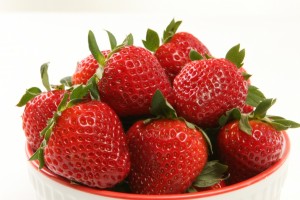
On the way home, I stopped at Whittle’s in Mystic to buy strawberries, but it was not open and didn’t look like it has plans to do so. I hope I am wrong.
Instead, I drove down to East Lyme and bought two quarts of gorgeous, ruby-red berries, hulled them, mashed about a quarter of them, added a little water and a little sugar. Four hours later I juiced the strawberries, used half of them along with rhubarb to make a crisp, and then froze the berries and juice separately for next winter.
As I mentioned last week, I will do that often before the season is gone.
I found two new recipes for the strawberries, both simple, as all recipes should be in the summer. I also found out that rhubarb can also be frozen easily: wash it, cut the bottoms and tops, slice the stalk into one-half to one-inch pieces and froze in plastic bags.
Strawberry Rhubarb Compote with Greek Yogurt
From Ina Garten Make It Ahead (Clarkson Potter, New York, 2014)
Yield: serves 4
1 pound fresh strawberries
2 cups fresh rhubarb, three-quarter-inch-diced
1 and one-half cups sugar
1 tablespoon freshly squeezed lemon juice
Pinch of kosher salt
1 teaspoon grated orange zest
17 ounces \Greek yogurt, for serving
Good granola
Hull the strawberries and cut them in half or. If large, in quarters. Place the berries and rhubarb in a small (9-inch) heavy-bottomed pot and heat over medium-high heat. Cook for 5 minutes, stirring occasionally, until the juices release from the fruit and start to boil. (Winter fruit doesn’t release as much juice as it does in the summer, so you may need to add one-quarter cup of water.) The fruit should still remain most of its shapes. Off the heat, stir in the sugar, lemon juice and salt and stir to combine. Cover pot tightly and allow preserves to sit overnight at room temperature.
The next day, bring the preserves to a boil, then lower heat and simmer for 10 to 15 minutes, until mixture thickens (it will be about 220 degrees on a candy thermometer. Stir in orange zest and serve warm or cold over Greek yogurt and sprinkled with granola.
Strawberry Sour Cream Sherbet
From Moosewood Restaurant Book of Desserts (Clarkson Potter, New York, 1997)
Yield: 6 to 8 servings
1 pint fresh strawberries, hulled and rinsed
Three-quarter cup sugar
1 cup sour cream
One-half teaspoon pure vanilla extract
In a food processor or blender, puree strawberries until smooth. Add sugar and whirl for another minute. For best flavor, refrigerate for about an hour. Stir sour cream and vanilla into the strawberries and whisk well until smooth.
Transfer to an ice cream machine and freeze according to manufacturer’s directions. Store in freezer in a covered container until ready to serve.
Note: the sherbet can be served straight out of the ice cream maker, but it keeps well in the freezer, too. If your freezer is particularly cold, let the sherbet soften a little, at room temperature or in the refrigerator before scooping it.
#2
Oh, summer is here and native strawberries are in. I haven’t bought them yet, but I will buy quarts during the next couple of weeks. I will come up with a new recipe for you in my next column.
In the meantime, here is how to freeze native strawberry juice so you can add it to those not-so-wonderful strawberries next winter: Take a quart of strawberries, wash them, hull them and cut them in half (or smaller if they are big), put them in a stainless steel bowl. Mash about a quarter of them, add maybe a quarter cup of sugar and about half a cup of water; stir the mixture. Put the bowl on the counter and let them marinate for a couple of hours. Pour the juice into little Mason-type jars. Put the lids on and freeze them.
When you buy those winter strawberries, thaw the juice and mix it with the berries. Close your eyes and pretend it is summer.
I did have my first fried oysters at Starboard Galley in Newburyport, Mass. Within days I will have my first lobster roll at Captain Scott in New London or, depending where I am, at Lobster Landing in Clinton. At Captain Scott’s, the roll goes to the geese or swans or gulls as I eat the lobster. I love gulls.
In any case, summer is here. This afternoon I thawed (and drained) about a pound of sweet corn kernels I had frozen last summer. I cooked a corn chowder I hadn’t made in years. It was absolutely delicious. I still have about five or six pounds of corn and will make this often until it’s time for native sweet corn, maybe four weeks from now?
Corn Chowder
Adapted a lot from an 1964 edition of Joy of Cooking
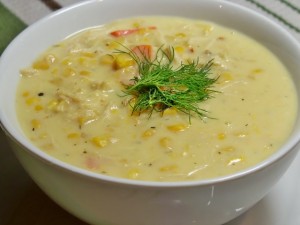 One of the best things about this recipe is there is no butter or heavy cream in this recipe. Sure, some salt pork for flavoring, but this is pretty healthy after all.
Yield: serves 6 to 8 as a main dish with a salad and maybe some good bread
2 tablespoons olive oil
6 to 8 ounces salt pork, diced
one-half cup chopped onions
one-half cup chopped celery
1 green pepper, seeded and chopped
1 and one-half cups peeled diced raw potatoes (with Yukon Gold, you needn’t peel)
2 cups water
one-half teaspoon salt
one-half teaspoon paprika
1 bay leaf
3 tablespoons flour
1 cup milk*
6 to 8 ears of fresh corn, blanched for 2 minutes in boiling water, then drained in iced water
3 cups hot milk*
chopped fresh tarragon (fresh tarragon if you have it, dried if you don’t)
salt and pepper to taste
Pour oil into a heated heavy-bottomed stock pot, add salt pork and saute until browned. Add onions, celery and green pepper and saute until lightly brown, Add potatoes, water, salt, paprika and bay leaf and simmer until potatoes are soft, around 15 minutes. Add flour and 1 cup of milk and stir until mixture is thick.
Remove kernels from ears and add kernels to stock pot, along with hot milk. Toss fresh chopped tarragon into soup. Taste and adjust for seasoning.
*I used 2 percent milk, but 1 percent might be fine
#3
One of the most amazing about cooking is learning how little you actually know, or how much you can still learn. Last Sunday I went to the Gordons for leftovers. I have already said, in print, that going to Michael and Joan’s for leftovers is better than having dinner at my house before leftovers.
Among the leftovers were chicken filled with pancetta and cheese, a scalloped potato dish with fresh mussels (trust me, it was luscious) and a fava bean and chickpea salad.
Flossie Betten had brought a yeast bread with onions, black olives, chopped tomatoes and dried chiles that was terrific, but even better was her strawberry-rhubarb pie made just for us. I make that, too, but hers was way better.
The pie was a one-crust dessert, filled with the filling and topped with a crumble. Here are the differences: the crust was an all-butter one with the addition of a little sugar and cold buttermilk (instead of water.)
For the topping she added shredded coconut instead of nuts. She added some of the topping into the filling. For the filling, she added brown sugar and granulated sugar and some cornstarch.
Now, I make my crust in my food processor. I quadruple the recipe of my topping and freeze most of it in little baggies. I am going to give you the recipes for the filling and the topping.
Please e-mail me at leeawhite@aol.com for her crust recipe and my own, which Deb Jensen gave to me years ago
Strawberry-Rhubarb Filling and Topping
From Flossie Betten of Norwich
Filling
3 cups one-inch thick slices rhubarb (about 1 pound)
1 pound strawberries, hulled and sliced in half
One-third cup light brown sugar
One-half cup granulated sugar
One-quarter cup cornstarch
Large pinch salt
2 tablespoons fresh lemon juice
In a medium bowl, toss together all the ingredients. Toss until all the fruit is covered in a coating of sugar and cornstarch. The cornstarch will disappear and the sugars will begin to make juice with the fruit. Allow to rest at room temperature while you make the toppings.
Topping
Three-quarter cup all-purpose flour
Three-quarter cup old-fashioned oats
Two-third cup granulated sugar
Large pinch of salt
8 tablespoons cold unsalted butter, cut into small chunks
One-half cup unsweetened coconut flakes
In a medium bowl, whisk together flour, oats, sugar and salt, Add cold butter chunks and, using your fingers, work the butter into the flour mixture. Quickly break the butter into the mixture until well incorporated. Some butter bits will be the size of peas and smaller. Add the coconut and toss to combine.
Preheat oven to 400 degrees. When the crust is in the pie pan, add a handful (about one-half cup) of topping into the fruit filling and toss. Dump the fruit mixture into the pie crust. Top generously with topping mixture. Place on a preparing baking sheet. ( I put the baking sheet in the oven while preheating to give the bottom of the pie a bit of a searing.) It is important to use the middle rack because if the pie is too close to the top of the oven, the coconut will burn quickly.
Bake in a preheated 400 degree oven for 20 minutes, then reduce heat to 350 degrees and bake for another 35 to 45 minutes, or until the pie is juicy, bubbling and golden brown.
(Please e-mail me at leeawhite@aol.com for two crust recipes. Also, Oronoque makes an incredible frozen pie crust. I have at least three of them in my freezer at all time.)

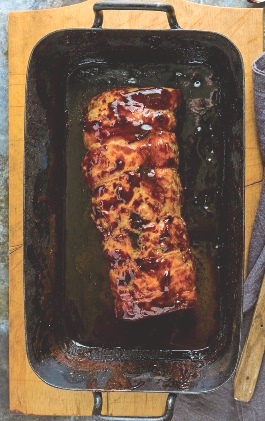
 Many of my 500 cookbooks are gone, too, living at the Book Barn. But two food memoirs I bought recently, and which I cannot recommend highly enough, are Jacques Pepin’s “Heart and Soul in the Kitchen” and Ruth Reichl’s “My Kitchen Year.” I read each of these books in bed. I am hungry while I read them, both for the recipes (which “taste” lovely) and the prose, which is glorious.
 Ruth Reichl’s memoir is pretty much about one year in her kitchen in upstate New York, one year during which she and all her colleagues lost their jobs, and we lost Gourmet magazine. She wrote and cooked and wrote and cooked, through fierce winter storms and power outages. She learned how a pantry and some great recipes can keep sadness at bay. Both books should be under your menorah or Christmas tree this year…