

Talking Transportation: A Conversation With CT DOT Commissioner Giulietti, Part 2

Jim Cameron

Editor’s Note:  This is the second of two articles written by Jim Cameron reporting on his conversation with CDOT Commissioner Joseph Giulietti. Read the first article at this link.

Connecticut’s Department of Transportation (CDOT) Commissioner Joseph Giulietti is about to finish his first year on the job and his plate is more than full.  It’s overflowing with controversy.

In my last column, in part one of an exclusive, no-holds barred interview he spoke of his challenges in speeding up Metro-North, coping with the over-budget, behind-schedule Walk Bridge replacement and ordering new rail cars.

This week, in part two of our conversation he speaks of the biggest issue of all … getting the legislature to pass truck tolls to raise money to replenish the Special Transportation Fund, which pays for transportation in our state.

I asked the Commissioner if Governor Lamont had “bungled” this initiative by his constant flip-flopping on what to toll and where.

Choosing his words very carefully, he said, “The Governor has admitted that there were some things he wished had been done differently.  If it was bungled, it was because he was trying to come up with bipartisan support for a solution everyone could buy into.”

Giulietti said nobody expected how pervasive and organized the opposition forces would be against tolling.

As for Mr. Sasser, leader of the #NoTollsCT movement, “I’ve never met him. This is never a personal issue.” But when the initial tolling plan was unveiled, he said the #NoTollsCT forces “ran with the paranoia.”  But if not tolls: “How do you want to pay for it [transportation]? Connecticut drivers have been subsidizing out of state drivers for years. Tolls are the closest thing we have to a user fee.”

As for the claim that truck tolls will lead to car tolls and the money will be misspent, “The Federal government determines that and that those funds must be spent on the roads [where the tolls would be.]”  Trucks don’t buy gas in Connecticut, so they’re getting a free ride.

On the claim that the CDOT wastes money: “We used to have 5000 people at the CDOT.  Now we have 2700.” Even snow plowing is done with one driver, guided by a computer on where to deploy brine and how to best clear the snow.  One truck can now even handle three lanes of pavement.”

“We’ve always looked how we can be more efficient. That’s the type of department CDOT has become. We always want to be good stewards of the public’s money.”

“I don’t know of a better way [to pay for transportation] than tolls.  The Governor has always said, ‘If you have a better idea, come to me with it,’ so if we’re not going to do tolling, what’s the alternative … gas tax, income tax, sales tax?  But there don’t seem to be any alternate ideas on how to get this thing [funding] through.”

Giulietti says he has a good working relationship with Governor Lamont. “I’m not a politician, I don’t run for office,” he said. “But I know of very honorable people who do the right thing [like voting in favor of tolls] despite the threats of being voted out of their jobs.”

“I’ve worked now for six or seven governors. Lamont is one of the most honest and decent people I’ve worked with … a genuine good guy who truly wants bipartisan support to try and get this thing through.  It makes it easy [for me] to face the criticism because I know he’s trying to do the right thing.”

To which I can only add … Amen!

Posted with permission of Hearst CT Media.

About the author: Jim Cameron is founder of The Commuter Action Group, and a member of the Darien RTM.  The opinions expressed in this column are only his own. You can reach him at CommuterActionGroup@gmail.com  For a full collection of  “Talking Transportation” columns, visit www.talkingtransportation.blogspot.com

Talking Transportation: A Conversation With CT DOT Commissioner Giulietti, Part 1

Jim Cameron

Joseph Giulietti is finishing his first year as Commissioner of the Connecticut Department of Transportation — CDOT.  He’s been busy and less visible in recent months, so imagine my surprise when he offered me a one-on-one, no-holds-barred interview.

“You’ve always been fair, Jim.  You’ve hit me hard but you’ve always been fair,” said the Commissioner.  That’s music to my ears and I hope he feels the same way after reading this column.

Our conversation covered every aspect of CDOT’s operations from Metro-North to CT 2030 to tolls (which we will cover next week in Part Two).  Here are some highlights from our conversation.

I reminded the Commissioner that before he joined CDOT he authored the infamous “30-30-30” report as a consultant to the Business Council of Fairfield County, arguing that it was possible to speed up trains to be able to go between Grand Central, Stamford, New Haven and Hartford in 30 minutes per leg.  Any regrets at such a promise?

Giulietti said such speeds are still possible … in a few years.  He wants to increase train speeds, re-do some bridges to avoid slowing down and save “five minutes here and 10 minutes there.” He also held out hope for faster service on Metro-North trains to Penn Station (after the Long Island Rail Road’s East Side Access project is finished going into Grand Central.)

“We’ve got cell-phone data from the Feds showing that 40 percent of riders to Grand Central continue south to Wall Street but 20 percent go west toward Penn Station,” he added.

He also held out hope for limited, rush-hour non-stop express service from New Haven to GCT and Stamford to GCT.

As for new rail cars… the additional 66 M8 cars that were to be delivered this year “are running a bit late”, but he called the M8’s a tremendous success.  Those M8 cars were supposed to also run on Shore Line East, but even with 405 M8s CDOT doesn’t have enough of them even for the mainline given increased ridership.  The Commissioner said he’s still looking at diesel push-pull double-decker cars where a ten-car train could carry almost 2000 passengers.

But he says that electrification of the Danbury and Waterbury branch lines just isn’t on the cards due to the cost.

As for fares:  he couldn’t say if they’d go up because he doesn’t know what funding in the Special Transportation Fund will be like.  But he did pledge cost savings in his department calling possible rail service cuts “the worst of all worlds.”

While the Walk Bridge project in Norwalk is running late and over-budget, he blamed litigation and said he has firm funding commitments from Amtrak on that bridge and the one over the Connecticut River.

But will CDOT have enough talented engineers after 2022 when 40 percent of the department’s most experienced staffers will be up for retirement?  The Commissioner said that succession planning is a huge priority for him.  He’s even grooming replacements for his own job.

But among the rank-and-file, it’s hard to keep talent.  “I can’t hold onto someone with a CDL (Commercial Drivers License.)  “Some of the towns are paying more [than CDOT.]”

With a special session of the legislature coming up in January to consider tolls, there’s a lot hanging in the balance.  What does Giulietti think of his boss [the Governor] and Mr Sasser’s “No Tolls CT” movement?

Read those frank comments next week in Part Two of our conversation.

Posted with permission of Hearst CT Media.

About the author: Jim Cameron is founder of The Commuter Action Group, and a member of the Darien RTM.  The opinions expressed in this column are only his own. You can reach him at CommuterActionGroup@gmail.com  For a full collection of  “Talking Transportation” columns, visit www.talkingtransportation.blogspot.com
Talking Transportation: Pre-Cursor of the Tesla, the Dymaxion Car has Connecticut Roots

Jim Cameron

Did you know that Bridgeport was once the home of “the car of the future”?  It was the Tesla of its era, but only three were ever built.

This mystery vehicle?  The Dymaxion Car.  The designer?  Buckminster Fuller.

Best known for his pioneering 1940s architectural design of the geodesic dome, a decade earlier Fuller was already inventing other things.  It was the 1930s and the country was struggling through the Depression.  Fuller saw the need for innovation, for “doing more with less,” and conceived of a mass-produced, pre-fabricated circular house modeled after a grain silo.

Built with aluminum, Fuller only saw two prototypes of the dwelling constructed and even those weren’t actually built until 1945.  Fuller called his design The Dymaxion House Dy for Dynamic, Max for Maximum and Ion for tension.

It was a major flop.

The Dymaxion Car

Next, Fuller moved on to transportation, conceiving the Dymaxion Car, an 11-person, three-wheeled vehicle that he hoped might one day would even be able to fly using what he called “jet stilts”… and this was decades before the invention of the jet engine.

Indeed, the Dymaxion Car looked a lot like a stubby zeppelin with a forward-facing cockpit and tapered, aerodynamic tail.  Equipped with a rear-mounted engine that could run on alcohol, it could go 90 mph and get 30 miles to the gallon.  The car had dual steel frames while a wooden lattice-work held the outside aluminum panels in place.  The single rear wheel could pivot 90 degrees making parking a breeze.

Bankrolled with $5000 from wealthy investor and socialite Philip Pearson of Philadelphia, Fuller needed a place to build a prototype and ended up at the old Locomobile plant on Atlantic Street in Bridgeport’s Tongue Point neighborhood.  Don’t bother looking for this piece of history.  It’s long gone as the land is now home to the PG&E power plant.

When Fuller set up the auto workshop in March 1933, he hired naval architect Starling Burgess, who recruited 27 workmen, many of them from Rolls Royce, from the 1,000 applications he received.  In just three months, the first prototype was completed and rolled out onto the streets of Bridgeport on Fuller’s 38th birthday.  The car was immediately shipped to Chicago for display at the World Fair.

Sadly, the prototype was totaled after it was involved in a car crash, flipped over and killed its driver and left VIP passengers injured.  Initial orders for the Dymaxion started to evaporate over safety fears even though it turns out the Fuller car had been sideswiped.

A second prototype emerged from the Bridgeport plant six months later.  Fuller had hoped to display the Dymaxion at the 1934 New York Auto Show but pressure from Chrysler locked him out, literally.  Not to be outdone, Fuller parked prototype #2 right by the front door of the show and got more attention than he might have done on the exhibit floor.

Fuller even brought the car back for the last year of the Chicago World Fair in 1934 but public curiosity didn’t turn into sales.  Fuller eventually sold this second prototype to his plant workers while a third model — this one equipped with a stabilizing vertical fin — went to conductor Leopold Stokowski.

Only one of the three Dymaxions survived, car #2, which is now at an auto museum in Reno, NV.  But Bucky Fuller fans have built replicas, some of which are still on the roads today 80 years later.

Posted with permission of Hearst CT Media.

About the author: Jim Cameron is founder of The Commuter Action Group, and a member of the Darien RTM.  The opinions expressed in this column are only his own. You can reach him at CommuterActionGroup@gmail.com  For a full collection of  “Talking Transportation” columns, visit www.talkingtransportation.blogspot.com

Talking Transportation: Reading Old Timetables

Jim Cameron

I love reading timetables.  Not the new ones on smartphone apps, but the old printed ones.  Reading about a train or plane’s journey on paper is almost like taking the ride itself.

Growing up in Canada, I was fascinated with the two major passenger railroads, the quasi-government owned “crown corporation” Canadian National Railroad (CNR) and the private Canadian Pacific Railroad (CPR).  Both ran transcontinental trains from Montreal and Toronto to Vancouver, a journey of 70+ hours … if they were on time.

I wondered why the CPR’s streamliner “The Canadian” left Toronto at 4:15 p.m. while its CNR competitor “The Super Continental” left at 6 p.m.  And why did the CNR’s later-leaving train arrive four hours earlier into Vancouver than the CPR’s?  Reading the 31 stop itinerary explained why: they took much different routes through the Canadian Rockies.  The CPR’s more southerly, scenic route was the highlight of the trip so they timed the journey for daylight hours.

Canada has two official languages, English and French, so it was by reading those timetables I learned that “quotidien” meant daily, “repas” meant meal and “douane” translated as customs, as in crossing an international border.

Fast forward 50 years and I’m still intrigued with old New Haven Railroad timetables, comparing that crack (private) railroad’s speeds with those of present-day Metro-North and Amtrak.  How did the New Haven make it from New Haven to Penn Station in 90 minutes while it today takes Amtrak 109 minutes?

But old timetables contain more than train times.  They also talk about the entire travel experience.

Did it really (in 1955) cost just $7.75 to go from Boston to NY in coach ($14 in a lower berth, $13 in an upper)?  The old timetables also list the trains’ “consists”… what kind of rail cars made up each run: coaches, Pullmans, Parlor-Lounge car (some equipped with two-way radio telephones) and diners.

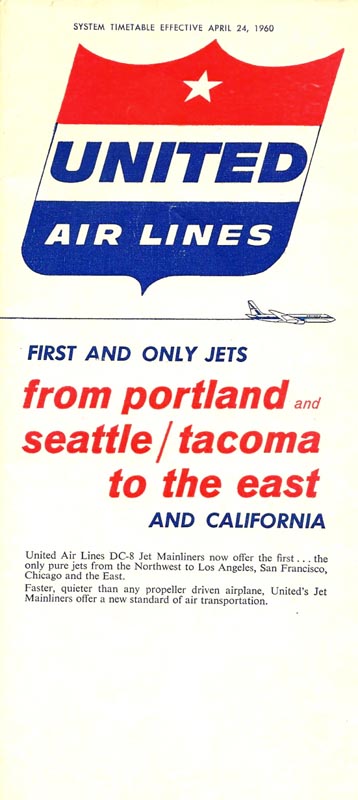
On the aviation side, I remember when airlines published their own timetables too, often promoting their advanced aircraft: American Airline’s 707 Astrojet, United’s DC-8 Mainliner and Braniff Airlines “Conquistador” DC-6.

The illustrations were always of well-dressed travelers smiling as they boarded their planes using ground-stairs, long before airports had jetways.  The seating looked roomy and comfortable, and was tended by well-coiffed stewardesses serving elaborate meals.

But the grand-daddy of all airline timetables was the OAG, the Official Airlines Guide, a phone book-sized (look it up, kids) compendium of every flight in the country.  As a one-time road warrior, I even subscribed to the “pocket” version, which was about an inch thick.  Miss a flight?  Your OAG would show you the alternatives.

What I enjoyed most reading the OAG’s railroad-style timetable wasn’t the flight times, and later, the on-time performance percentage, but the kind of aircraft used on each flight.  I took a liking to TWA’s iconic L-1011’s and avoided American’s DC-10’s after the deadly 1979 crash at O’Hare.

And after 9/11, I always opted for any airline flying Airbus equipment.  The reason?  The 9/11 terrorists had gone to flight school to learn how to fly traditional “yolk” flight controls, but only the airlines’ own simulators could train pilots on the Airbus fly-by-wire joystick controls:  i.e., Airbus jets were not going to get hijacked.  Or so I hoped.

Today there are no paper timetables.  All the information is online and on my phone … handy, yes, but definitely not as romantic.

Posted with permission of Hearst CT Media.

About the author: Jim Cameron is founder of The Commuter Action Group, and a member of the Darien RTM.  The opinions expressed in this column are only his own. You can reach him at CommuterActionGroup@gmail.com  For a full collection of  “Talking Transportation” columns, visit www.talkingtransportation.blogspot.com
Talking Transportation: Connecticut’s Own … Igor Sikorsky

Photo by Adam Bignell on Unsplash.

Jim Cameron

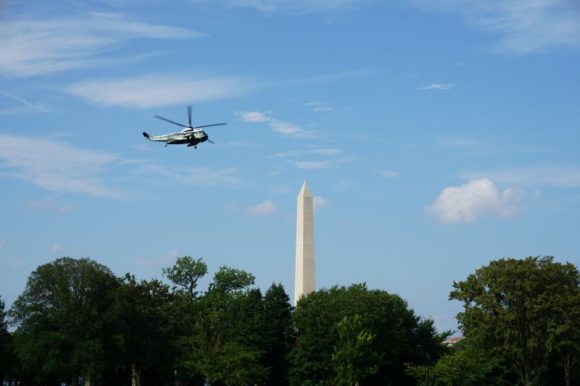
Have you ever flown in a helicopter?

They seem such a glamorous (if expensive) way to travel, by-passing the traffic en route to the airport or sightseeing over rugged terrain.

But do you know that the helicopter had its first flight ever right here in Connecticut, the creation of Russian immigrant and inventor Igor Sikorsky, 80 years ago.

Sure, Leonardo da Vinci made early drawings of a vertical flying machine, but that was in the 1480s.  And kids had been playing with hand-turned, propeller-driven toys for centuries before that.

Sikorsky drew his earliest concept drawings of a helicopter years before the Wright brothers ever flew at Kitty Hawk.  But when he fled Russia with his family, it was fixed-wing aircraft that gave Sikorsky his start in aviation.

At the age of 21 he designed his first airplane, the S-1, a single-engine pusher biplane. Twenty-three designs later he built the S-42 flying boat, made famous by Pan American as “The Flying Clipper”.  The four-engined craft had a range of 1200 miles carrying 37 passengers by day or 14 by night in berths, cruising at 170 mph.

Even as Pan Am was opening literally over-seas markets, Sikorsky was still working on his dreams of a helicopter.  At his plant in Stratford his VS-300 made its first flight, albeit tied to the ground, in September of 1939.

A 1942 version, the Sikorsky R-4, became the first mass-produced helicopter, quickly adopted by the armed forces of the US and UK. It had only one crew member, could carry just 500 pounds, but had a range of 130 miles flying 65 mph at up to 8000 feet.

Flash forward to the present and Sikorsky’s old company, now part of Lockheed Martin, still produces helicopters. Sikorsky’s successor companies, then part of United Aircraft Corp, even designed the short-lived (1968 -1976) Turbotrain, powered by a Pratt & Whitney turbine “jet engine.”  The train could make the 230-mile New York to Boston run in three hours and 39 minutes.  Today’s Acela can do the same run in no less than 3 hours 55 minutes.

In a competition with the electric-powered Metroliner in 1967, the Turbotrain hit 170 mph, a land-speed record for a gas turbine-powered rail vehicle. Acela does no better than 145 mph.

Today’s modern helicopters come in all sizes and speeds … from the beefy Seahawk SH-3 “Sea King” which can carry five tons over 600 miles at 166 mph … to “personal” helicopters for one person flying 60 miles at 80 mph.

For helicopter fans, New York’s east-side heliports at Wall Street and 34th Street offer the chance to see luxury craft in action, some privately owned, others offering passenger service.  BLADE Helicopters will get you to the Hamptons from midtown in 33 minutes starting at $695 one-way.

In the 1960s, NY Helicopter flew from the NY airports to the top of the Pan Am building. I took that flight once, transferred to an elevator and walked onto a train in Grand Central.  For a while they even choppered to Stamford’s heliport on Canal Street in the South End.

Much has changed in aviation in the last 80 years since Sikorsky’s first helicopter took to the air.  And to think that it all started here in Connecticut.

Posted with permission of Hearst CT Media

About the author: Jim Cameron is founder of The Commuter Action Group, and a member of the Darien RTM.  The opinions expressed in this column are only his own. You can reach him at CommuterActionGroup@gmail.com  For a full collection of  “Talking Transportation” columns, visit www.talkingtransportation.blogspot.com