
Talking Transportation: Trucks as Traffic Scapegoats

“Why don’t we just ban all trucks from our interstate highways in rush hour?”

The question was asked of me by a small town mayor in Fairfield County who’d obviously given a lot of thought to solutions to our traffic woes. He’s a smart guy and thought he’d come up with “the answer” to our transportation crisis.

He said he wasn’t in favor of tolls, but liked them as a traffic mitigation tool.  By charging trucks more to drive our highways in rush hour, they’d be incentivized to instead go off-peak.  He was just taking the idea a step further:  ban them completely at certain hours.

Well, I explained, that’s probably illegal.  This is an interstate, federal highway built to carry trucks.  Wouldn’t it be a better idea to tell the merchants where they are going to only accept deliveries at, say, 3 a.m. instead of 9 to 5, which is more convenient for the stores?

But the truck-haters are not satisfied.  Any number of candidates are calling for truck-only tolls, pointing to Rhode Island’s recent launch of such as system.  It’s been a huge success, raking in $625,000 in its first month of operation.

But it’s also attracted lawsuits, because it is illegal, just like the Mayor’s idea.  Tolling only big-rigs is a violation of the US Constitution’s “Commerce Clause”.  The truckers and big-box stores say it’s not fair to toll them and not charge drivers of cars and small trucks.  I’m no lawyer, but I think they’re right.

Trucks are not the problem.  Cars are.

But it’s so easy to blame the trucks for delays on our roads, isn’t it?  Blame them, instead of ourselves.  Toll them, not me. I’m not creating the traffic, they are.

Trucks are not allowed on the Merritt and Wilbur Cross Parkways, so why are those roads so congested?  Look at I-95 in rush hour and count the number of trucks vs. single-occupancy-vehicles.  Again, it’s the volume of the traffic, not the kind of vehicles that are causing the delays. It’s the geometry of the highway … too many exits and entrances … and too few alternatives (aside from rail).

Truckers don’t want to be on the interstates in bumper-to-bumper traffic any more than you do.  They are not out there, driving on I-95 and I-84, just to annoy you.  Compared to you, driving solo in your automobile, they are high-occupancy vehicles carrying your Amazon orders and making deliveries to the big box stores.  You put those trucks on the road, and now you want to ban them at certain hours?  Then you’ll be moaning about late deliveries.

You don’t want to pay tolls?  Trucks already do, even in Connecticut.  They pay higher state gas taxes (44 cents for diesel vs. 25 cents for gasoline), even if they don’t buy that gas in Connecticut.  And they must pay to register their trucks in CT, even if they are from out of state, thanks to the International Fuel Tax Agreement, or IFTA.

Add a layer of tolls on top of those costs and guess who’s going to pay?  You!

There’s no free lunch, folks.  And the solution to our traffic is not to blame others … but to look in the mirror.

 

Jim Cameron

About the author: 

Jim Cameron is founder of The Commuter Action Group, and a member of the Darien RTM.  The opinions expressed in this column are only his own.  You can reach him at CommuterActionGroup@gmail.com

For a full collection of “Talking Transportation” columns, visit www.talkingtransportation.blogspot.com

Posted with permission of Hearst CT Media.
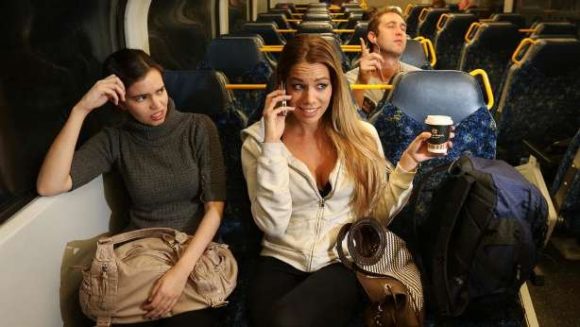
Talking Transportation: ‘Train Time is Your Own Time’ … True or False?


Train time is your own time” was the old marketing slogan of Metro-North, encouraging commuters to kick back and enjoy the ride while reading, working or taking a snooze.

But in reality, train time is shared time.  They don’t call it “mass transit” for nothing as passengers much share their space with a hundred other commuters on each railcar.

Assuming you get a seat, this means you’re squeezed in next to one or two fellow riders.

Usually commuters are respectful of each other and don’t blare their radios or carry on loud conversations, with each other or on cell-phones.  Or so we’d hope.

It was almost 20 years ago that Amtrak first introduced the concept of The Quiet Car, following suggestions of daily commuters riding to DC.  It was such a success that quiet cars were soon added to other Northeast Corridor trains and Acela.

The concept was simple, as conductors reminded passengers on every trip:  maintain a “library like atmosphere”.  That meant no cell phone calls and only quiet, subdued conversation.  You want to yuck it up over a beer, go to the Café Car.  Got an important phone call … sit in any other coach.

Other commuter railroads picked up Amtrak’s cue … but not Metro-North. While serving on the CT Metro-North Commuter Council, I regularly beseeched the railroad to give us a break and dedicate just one car to peace and quiet, convinced it would attract riders.  Finally in 2011, the railroad took the hint and launched such a car, branded as a “Quiet CALMmute”.

Victory for the sonically overloaded?  Not by a long shot.  This is Metro-North and if anyone can screw up a good idea, they can.

First, they offered the worst car location on the train to their CALMmute:  the last car in-bound and the first car out-bound from GCT.  And there were no signs indicating which car was “quiet”.  Worst of all, conductors all but refused to enforce the quiet rules, leading to altercations between passengers.

Conductors have no trouble enforcing other rules:  luggage on the overhead racks, no feet on the seats, no smoking etc.  But asking people to keep down the chatter was apparently too much.  All they would do, at first, was hand “Shhh cards” to offenders.

In 2016 the quiet car program was expanded to two cars per train, peak and off-peak.  But, still no signage (until just recently) and no enforcement.

Now, a major change.  The railroad announced that effective immediately there would be only one quiet car per off-peak train.  And the PR team at MNRR spun the story so well that some local media made it sound like the program was being expanded, not cut in half.  Brilliant.

There was no explanation for the cut in quiet cars though one official told me, “We have had no reports of quiet car demand exceeding availability in the off-peak.”  In other words, people who ride off-peak just prefer to yap.

That’s an amazing PR “spin” on what is really an admission of failure.  Metro-North never wanted quiet cars and clearly didn’t want to enforce the rules.  The people have literally “spoken” and the Quiet CALMmute won’t be as accessible anymore.

This is what happens when you have a monopoly, answerable to nobody, especially its customers.  I’d raise my voice in protest but … I’m in the quiet car.

Posted with permission of Hearst CT Media

Jim Cameron

About the author: 

Jim Cameron is founder of The Commuter Action Group, and a member of the Darien RTM.  The opinions expressed in this column are only his own.  You can reach him at CommuterActionGroup@gmail.com

For a full collection of “Talking Transportation” columns, visit www.talkingtransportation.blogspot.com

Posted with permission of Hearst CT Media.

Talking Transportation: “The Automotive-Construction Complex”

How did Americans develop their love affair with driving?

Visit the Smithsonian’s National Museum of American History in Washington and the transportation exhibit, “America on the Move,” will sell you on the commonly-held theory that when Henry Ford made cars affordable, Americans loved them and demanded more and more highways.

Of course, that exhibit is sponsored by General Motors, which donated millions to put its name on the collection.

But University of Virginia history Professor Peter Norton, author of “Fighting Traffic: The Dawn of the Motor Age in American Cities,” says that’s a myth.  Just as outgoing President Eisenhower warned us of the military industrial complex, Norton says an automotive-construction complex took over our country, paving from coast to coast.

Sure, Americans like their cars.  But it was a conspiracy of economic interests that turned us into a car culture.  Where cities once enjoyed a network of cheap, fast streetcars, GM, Firestone and the oil companies bought and wiped them out, replacing them with buses and cars.

“This country destroyed and rebuilt its cities in the 20th century to serve automobiles,” says Norton.  And those same interest groups are alive and well today in Connecticut.

Groups like “Move CT Forward” aren’t pro-transportation as much as they are pro jobs … their jobs, in construction.  And they’ve spent a lot of money lobbying in Hartford to keep their members, the unions and contractors, busy.   While I’m happy they’re promoting transportation, their motives are hardly altruistic.

This is nothing new, says Norton.  The original interstate highways built in the 1950s used Portland Cement because that company lobbied so hard for its product over cheaper asphalt.  And now that rusting rebar and crumbling cement is costing us a fortune.

Another myth from that era was that President Eisenhower built the interstates to move troops quickly for national defense.  That may have been the pitch to Congress, but the real reason for the highways was to evacuate civilians from the big cities in the event of nuclear war.  Lucky we never had to test that idea.

Last August when Hurricane Harvey hit Houston … the most urbanized highway city in the country … authorities didn’t even try to evacuate people because they knew more would die on congested roads than in the storm.

Who pays for all this road building?  You do, in the form of income taxes and, yes, gasoline taxes.  But Norton says gas taxes are hardly a fair way to pay for all this.

Why does the motorist driving on a dirt road pay the same gas tax as one driving I-95?  The costs they place on road maintenance, the environment and our stress levels are grossly different, so why isn’t the cost?

“It would be like having Best Buy selling everything by the pound.  People would flock to the electronics (our crowded interstates) instead of the towels,” he notes (though I’m not sure Best Buy even sells towels, but I take his point.)

He reminds us that before the interstates, the nation’s first “super highways” like the Pennsylvania Turnpike and the New Jersey Turnpike were built – not as freeways – but toll roads, and they still are today.

Driving may seem to be free, but it isn’t.  And until we ask drivers to pay for its real cost, there is no incentive to do anything but drive (and pave) more.

Jim Cameron

About the author: 

Jim Cameron is founder of The Commuter Action Group, and a member of the Darien RTM.  The opinions expressed in this column are only his own.  You can reach him at CommuterActionGroup@gmail.com

For a full collection of “Talking Transportation” columns, visit www.talkingtransportation.blogspot.com

Posted with permission of Hearst CT Media.

Talking Transportation: Federal Air Marshals? Worthwhile or Worthless?

Do you feel safe when you fly?

Forget about exploding jet engines, cracked aircraft windows and clear-air turbulence.  What about terrorists?

We haven’t seen a domestic case of terrorists attacking jetliners in years, thanks to increased scrutiny of passengers by the TSA, the Transportation Security Administration.  From the moment you book a flight, you are being screened.  If you’re on the “No Fly List”, you’d better switch your travel plans to Amtrak or MegaBus.  And when you get to the airport, get ready for a full pat-down search.

But airlines’ last line of defense against terrorists is FAM, the Federal Air Marshal Service.  Created in 1961 after a spate of skyjackings to Cuba, the air marshal program, now administered by the TSA, has grown to 3000 marshals and an $800 million budget.

But the program is now in trouble.

The Government Accounting Office last year reported that even TSA could not demonstrate that FAM is effective or even served as a deterrent to bad guys.  Since the program was accelerated (from 33 marshals before 9/11), air marshals have not made a single terrorist arrest, though the armed, undercover agents have thwarted several “disruptive passenger” incidents.

In April, a deranged woman on a Delta flight from London to Salt Lake City jumped on an air marshal who had been supervising her after she overturned a drink cart.  She was cuffed (by another marshal) for the duration of the flight and faces a year in prison.

In December 2005, air marshals shot and killed a man as he ran off an American Airlines flight in Miami, claiming he had a bomb.  Ignoring calls to “stop” and “get down”, the shooting was declared “legally justified” in a 46-page follow-up report.  The man had no explosives, but was found to have missed his meds for a bipolar condition.

Even with 3000 marshals, there is no way the TSA can cover the 42,000 daily flights in the US.  There were no marshals on shoe-bomber Richard Reid’s (2001) or underwear bomber Umar Farouk’s (2009) trans-Atlantic flights.

One of the criticisms of FAM is that they waste their time policing “flights to nowhere” on regional 50-seat aircraft when it’s the longer, bigger jets that need attention.

FAM is also sullied by low morale and allegations of alcohol abuse.  Between 2002 and 2012  air marshals were arrested 148 times and charged with 5000 cases of misconduct including 1200 cases of lost equipment — including their weapons.

If you travel for a living, imagine their job.  They can’t sleep in-flight, suffer from the same delays as the rest of us and have to be ready on seconds’ notice to discharge their weapons at 30,000 feet.

Some marshals say FAM’s problems are due to its ties with TSA.  They suggest the service would be better off as part of Customs and Border Protection or the FBI.

But Robert MacLean, an air marshal fired in 2006 after disclosing that the service was cutting back on coverage of overnight flights, calls FAM “security theater serving absolutely no purpose other than showing they (TSA) are doing something”.  (MacLean was finally taken back into FAM after a 10-year legal fight that went all the way to the Supreme Court.)

Jim Cameron

About the author: 

Jim Cameron is founder of The Commuter Action Group, and a member of the Darien RTM.  The opinions expressed in this column are only his own.  You can reach him at CommuterActionGroup@gmail.com

For a full collection of “Talking Transportation” columns, visit www.talkingtransportation.blogspot.com

Posted with permission of Hearst CT Media.

Talking Transportation: Connecticut: Love It or Leave It

The recent debate over tolling our highways should remind us of just how divided our state has become.  Not red vs. blue and not even just upstate vs. downstate.  The real divide is between those who commute by car vs. those who take mass transit.

I’ve written for years about the fact that riders on Metro-North pay the highest commuter rail fares in the US, and those fares will only keep going up.  Most rail riders have little choice, especially if headed to New York City.  What are they going to do … drive?

Yet every time the fares go up … and they have increased 55 percent since 2002 … ridership goes up as well.  Why?  Because conditions on the highways keep getting worse and worse.

But those who chose to drive, or must because there’s no viable mass transit option, seem literally to hate rail commuters.  I think it’s jealousy.  During the tolls debate, the venom was dripping and one Tweet in particular hit home.

“Just because your commute (by train) is so expensive doesn’t mean mine (by car) should be too (because of tolling),” read the post.

The driver had clearly missed the point.  We aren’t looking for tolls to subsidize rail fares, just to get motorists to pay for the upkeep of their roads and bridges before we have another Mianus River Bridge collapse, which we will.

But it gets worse.

The anti-toll forces now sound like Howard Beale, the deranged newsman from the movie “Network” who was “mad as hell and not going to take it anymore.”   Doubtless, much of this is directed at Governor Malloy who enjoys (suffers from?) the lowest popularity rating in the history of polling.  Sure, the economy of our state is in bad shape.   But Malloy didn’t create this economic mess.  He just inherited it and mishandled it.

And it will get far worse, whoever succeeds Malloy in the fall.  The solutions will be few and all will be painful.  Forestalling tolls and gasoline taxes today won’t stop the bridges from rotting.

But this opposition to tolls or modest gasoline tax increases to pay for roads has now been taken to a maniacal pitch predicting that “everyone is leaving the state,” conditions are so bad.   That’s fine with me.

I was recently at our town dump and saw a young man unloading a bunch of items.  “My parents are moving,” he told me.  “Everyone is leaving Connecticut!” he exclaimed.

“Really?”, I asked.

“It’s all Malloy’s fault,” he said, sounding like a Pied Piper leading a caravan down I-95 to some Promised Land.

I asked him one question:  “Did your parents sell their house?”   “Sure,” he said.  “And at a profit over what they paid for it.”

“Well,” I said, “I guess not everyone is leaving.  Your folks are moving out and someone else is moving in.”  Someone who wants to live here.

To those who hate it so much living in Connecticut, I extend an invitation:  please leave.  Enjoy your low-tax destination.  And don’t forget to pay those highway tolls as you drive down I-95 through NY, NJ, etc.

But enough already with the “I hate Connecticut” mantra.  Some of us actually like living here.  And losing ‘the haters” will only mean fewer cars on our roadways.

Posted with permission of Hearst CT Media.

Jim Cameron

About the author: Jim Cameron is founder of The Commuter Action Group, and a member of the Darien RTM.  The opinions expressed in this column are only his own.  You can reach him at CommuterActionGroup@gmail.com

For a full collection of “Talking Transportation” columns, visit www.talkingtransportation.blogspot.com