Parking Fee Price Hike Threatened at Old Saybrook Railroad Station

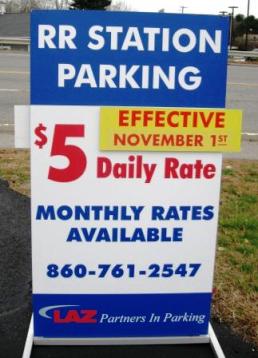
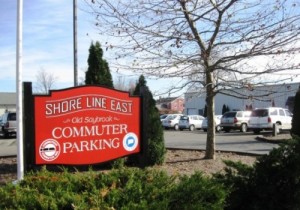
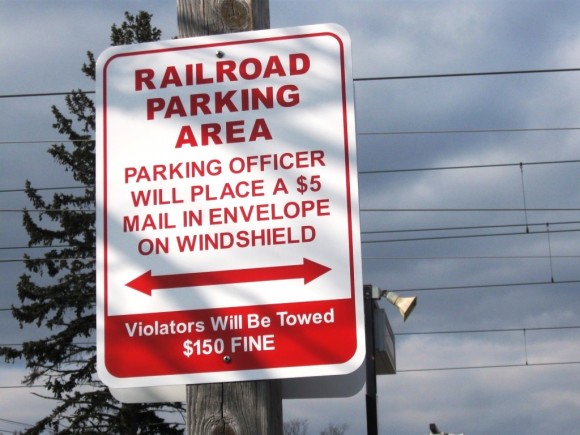
Railroad Parking Area sign

Railroad Parking Area sign

One hundred percent increase from $5 to $10 per day under consideration

The daily parking fee on the privately owned parking lot, which is closest to the tracks at the Old Saybrook railroad station, could increase in the near future.  The present parking fee of $5 a day could rise to $10 a day, according to Sebastian Lobo, the privately employed, parking attendant at the lot.

Lobo said that even with the increase, the cost for parking at Old Saybrook station would be far less than the amount charged at the New Haven railroad station.

However, a parking fee increase at one of the lots at the station would have no effect on the free-of-charge parking lots at the station, including, the Shore Line East Old Saybrook Commuter parking lot and the AMTRAK parking spaces at the station.  Nor would it affect the informal, free parking lot that extends along North Main Street from the Upper Cemetery almost all the way down to the tracks.

As for the 200 new parking spaces, which the state Department of Transportation plans to add at Old Saybrook rail station, it remains undecided as to whether there will be a parking fee or not for these spaces.

Paying to Park

The parking lot, where there is presently a $5 a day parking fee, is located right next to the relatively new, over the tracks terminal at the station.  For train passengers, it is clearly the most convenient place to park at the station.

These parking spaces are owned by Saybrook Realty Partners, whose address is 455 Boston Post Rd. in Old Saybrook, according to the collection envelopes put under the windshields of the cars parking there.

Collection envelopes can pile up under windshields

Collection envelopes can pile up under windshields

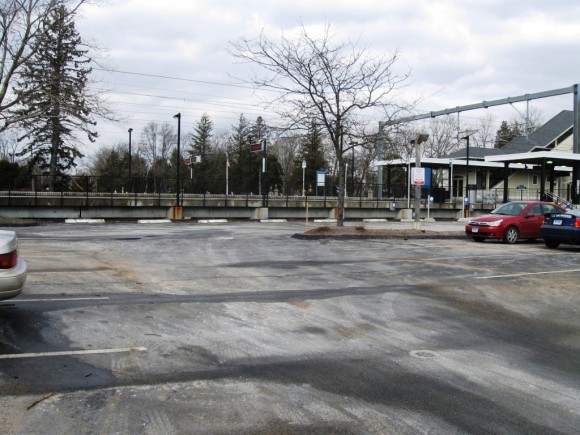
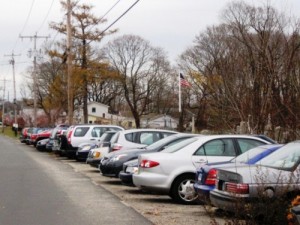
The border lines around the spaces owned by this group are white in color, and, generally, they are far from full.  This is likely because most people parking at the station have found free spaces at other areas of the station.

Empty parking spaces at the pay for parking area

Empty parking spaces at the pay for parking area

Pay to Park Collection Method

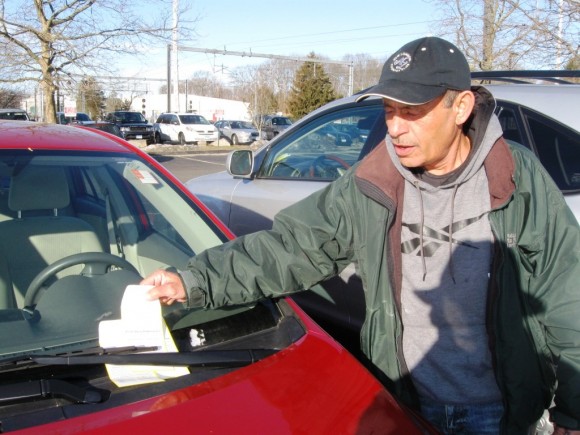
For those who pay for their parking at the station, there is a unique system of collecting parking fees.  First, parking attendant Lobo in his red car scoots around the lot, placing collection envelopes behind the windshields of the cars that are parked there.

Parking Attendant Lobo puts in place a collection envelope

Parking Attendant Lobo puts in place a collection envelope

These addressed envelopes instruct parkers to do three things: (1) put a $5 per day parking fee in the envelope, (2) place a stamp on the envelope, and (3) mail it.

The formal printed instructions on these envelopes read as follows:

$5.00 Daily Parking fee     

Please mail the $5.00 a day parking fee in this envelope. This parking lot is PRIVATE AND NO LONGER FREE. Amtrak travelers may park in the yellow lined designated area or pay the fee to park at will. Parking fees not paid within 14 days will be assessed an additional late fee of $10.00 per day.  YOUR LICENSE PLATE HAS BEEN NOTED Violators subject to tow at owner’s expense. For further information email parking@saybrookrealtypartners.com.

Plate Number _______________________________________________

Date _______________________________________________________

Enforcement Signs Threaten $150 Fine

Signs around this Railroad Parking Area, as it is called, threaten significant consequences if parking fees are not paid.  “Violators Will Be Towed” and a “$150 Fine” will be imposed the signs say around the parking lot.

In an effort to obtain further information about this pay for parking organization, who declined an interview, we posed by email the following questions to Saybrook Realty Partners:

1) How many $150 fines have you imposed on persons who park on your spaces at the Old Saybrook railroad station?

2) How many $150 fines have you collected since you inaugurated a payment for parking scheme at the station?

3) How many cars have you towed for non-payment of parking fees?

4) How successful, generally, has been your return envelope payment system?

Saybrook Realty Partners – Parking Lot Owner – Responds

David M. Adams, owner of Saybrook Realty Partners, which owns and manages Saybrook Junction, provided the following response, “The [Saybrook Realty  Partners’ parking] system has been very effective in preserving the integrity of the parking at Saybrook Junction for our 16 tenants. Saybrook Junction is a private business and has an obligation to provide parking for its business tenants and their customers, while also supporting Amtrak and overflow parking for Shoreline East commuters.  We continue to make progress to alleviate some of the parking concerns voiced by our tenants as well as commuters.”

A final article on the parking situation at the Old Saybrook railroad station will discuss the parking spaces that are controlled by the award-winning Pizza Works restaurant at the station. The restaurant has 38 reserved parking spaces close to the tracks.

Essex Meadows Celebrates Its 25th Anniversary This Year

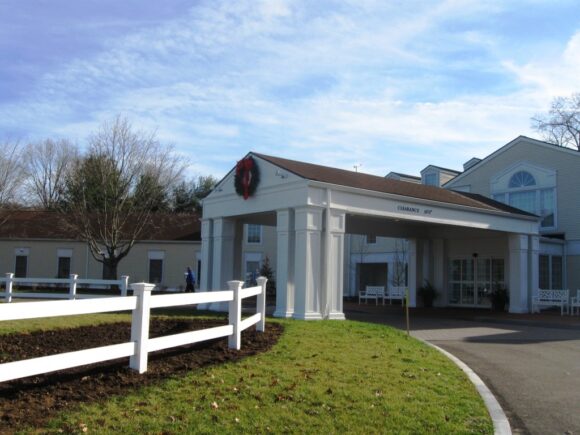
The impressive portico at the entrance of Essex Meadows.

The impressive portico at the entrance of Essex Meadows.

Essex Meadows, located at 30 Bokum Road in Essex, is widely regarded as a treasure in our midst. This year “The Meadows,” as everyone calls it, will celebrate its 25th anniversary. We therefore decided to try and give readers a perspective into how the Meadows operates and why it has achieved nationally recognized stature as a retirement community

We submitted some questions to the Meadow’s Director of Marketing, Susan Carpenter. Our questions are in bold face type, and Carpenter’s answers follow each question … so let us begin:

1) How many residents in total are there at Essex Meadows?

There are approximately 240 residents. Several live in Essex year round, and many maintain second homes in places like Fishers Island, Florida, Vermont, New Hampshire, and Maine.

Essex Meadows resident Jean Ryan by the entrance Christmas Tree at the Meadows.

Essex Meadows resident Jean Ryan by the entrance Christmas Tree at the Meadows.

2) How many residential apartments, and how many individual homes, are there at the Meadows, and what is the size and layout of each category?

We have 183 apartments, 13 cottages, and 45 skilled nursing beds in our Health Center. Two thirds of the apartments, and all of the cottages, feature two bedrooms and two bathrooms, and they range in size from 1,050 to 2,400 square feet. We also offer several different one bedroom layouts, some with dens, ranging from 600 to 900 square feet. Some of these have one bath while others offer 1 ½ baths.

3) What are some of the amenities at the Meadows, such the golf course (How many holes?), library and dining room?

Our Executive Golf Course is a “par three,” and it is home to the annual Essex Fire Department Golf Tournament. We also offer croquet, walking trails, and a large garden area with raised and traditional flower beds for our outdoor enthusiasts. For those who prefer indoor activities we have a swimming pool, fitness center, art studio, library, Pub, and woodworking shop.

C. Allan Borchet, former Chairman, Residents Council of Essex Meadows and model shipbuilder.

C. Allan Borchet, former Chairman, Residents Council of Essex Meadows and model shipbuilder.

4) Anything else?The Community has everything you need for an active lifestyle right at your fingertips. The Niagara Bank has a full service branch right on campus. Next door to the bank is “Meadowmart,”our full service in-house grocery store, which is entirely run by resident volunteers. We carry the best and most inexpensive selection of greeting cards in town. Great bridge mix too.

5) What are the categories of care at the Meadows, such as ordinary resident care and assisted living care?

Our apartments and cottages offer independent living with the security of knowing that our licensed Assisted Living Program can step in to provide supportive services as health needs change. These services can include neighborly services such as walking your dog or watering your plants, to more complex health services including assistance with medication management and help with a resident’s activities of daily living.

6) What services does the Meadow’s Health Center provide?

For the past three years our Health Center, which provides professional clinical services and nursing care, has been ranked by U.S. News & World Report as one of the top skilled care facilities in the country. The Health Center offers short term rehabilitation, respite care, long term custodial care, and Hospice services. Hospice is also available in our apartments and cottages for those whose end of life decision is to remain at home.

7) What kind of health care professionals are there on duty, or on call, at the Meadows on a given day?

We have professionals, both on the independent living side and the skilled nursing side. Our staffing patterns vary according to acuity or need. Our staffing levels are significantly higher than State regulations require. Angela Christie and Kathleen Dess are responsible in these areas. Kathleen is the Administrator of our Health Center, while Angela is the Director of Resident Health Services.
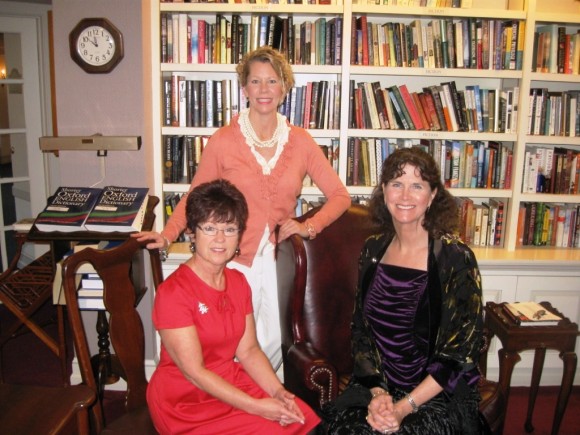
From left to right,  Essex Meadow’s senior staff: Angela Christie, Director of Resident Health; Susan Carpenter, Director of Marketing Services, and Kathleen Dess, Administrator of the Health Center, gather for a photo in the Residents’ library.

From left to right, Essex Meadow’s senior staff: Angela Christie, Director of Resident Health; Susan Carpenter, Director of Marketing Services, and Kathleen Dess, Administrator of the Health Center, gather for a photo in the Residents’ library.

8) What is the ownership structure of the Meadows?Essex Meadows is a family owned business incorporated in Iowa. The board of directors visits quarterly to meet with the residents and the management team. Essex Meadows is managed by LifeCare Services, LLC.

9) Who is the Executive Director of the Meadows?

Our Executive Director is Jennifer Rannestad. We also have management input from an active Resident’s Council and various resident committees.
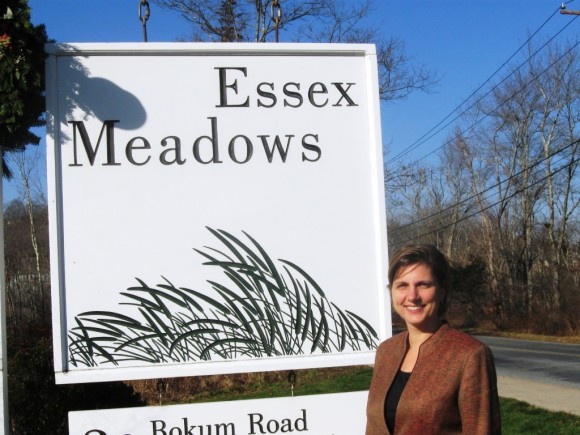
Jennifer Rannestad, Executive Director of Essex Meadows, at the entrance of Essex’s premier retirement community.

Jennifer Rannestad, Executive Director of Essex Meadows, at the entrance of Essex’s premier retirement community.

10) What are the cost arrangements at the Meadows for buying and selling the apartments and separate homes?In addition to payment for meals and necessity of life services, our popular Return-of-Capital plan has been offered at Essex Meadows since it opened its doors in 1988. Residents and/or their estates receive a large portion of their original Admission Payment back after their cottage or apartment has been resold.

11) Is there another ownership alternative for residents?

Yes, the Flex Plan is our newest financial option to maximize choice and flexibility, when it comes to retirement planning. For those who prefer a plan that demands less up front capital, the Flex Plan offers a reduced Admission Payment. While there is no return of capital to the estate, a resident has the ability to continue to control his or her assets and invest their savings as they wish.

12) What are the specifics of the cognitive test that applicants to the Meadows must take before they are accepted as residents?

Our health-evaluation process requires that paperwork be completed by an applicant’s physician as well as a meeting with our Director of Resident Health Services. In addition to asking an applicant about their general health and activities of daily living, we use standardized cognitive scales in our evaluation. The Mini Mental Status Exam and St. Louis University Mental Status Exam are two such examples commonly used by life-care communities and long term care insurance providers nationwide.

13) Is there a review process of the cognitive test results?

The results of this health-evaluation process are reviewed with the Essex Meadows Medical Director. The results of the interview will be considered along with the information that is provided by the applicant’s physician.

14) Who has the final say in accepting a new resident at the Meadows?

Each applicant must meet both medical and financial criteria for residency. It is the role of Executive Director to review both the medical and financial information for each applicant to make a decision for occupancy consistent with the admission policy established by our Board of Directors.

15) Who assumes the risk of paying for the long-term care of residents?

Because Essex Meadows is a life-care community, the financial risk of long-term care is a cost shared by the whole community. Therefore an individual resident does not have the financial exposure of having to pay the high costs of nursing home care should those services be needed. Some residents consider this an alternative to long term care insurance when planning for future health care costs.

16) What do you view are the unique aspects of Essex Meadows that average nursing homes might generally not provide?

The Essex Meadows provides a beautifully appointed residential atmosphere, a resident centered approach to care, and is well staffed. These are just a few of the reasons as to why Essex Meadows provides exceptional care, as well as specialized services in its adjoining Health Center.

17) Are there any other benefits to residents at Essex Meadows, which you feel deserve to be mentioned?

We believe that our residents are the most wonderful and unique part of our lifestyle benefits. Furthermore, residents have generously organized and administered a scholarship fund for Meadows’ employees and their children. To date, the scholarship fund has provided over 400 grants, totally more than $750,000.

18) Do Essex Meadows residents take an interest in the Town of Essex?

Our residents have a great love of the Essex community. They are lifelong learners, patrons of the arts, and protectors of the environment. Essex Meadows is involved in the general community creating partnerships and relationships with those organizations that our residents would also support as individuals.

Essex Meadows has also been a great corporate contributor and supporter of the Connecticut River Museum, the Community Music School, the Essex Winter Series, the Ivoryton Playhouse, the Essex Library, FISH, the Essex Garden Club, Essex Child & Family Services Agency, the Essex Fire Department, Ivoryton Illuminations, the Essex Rotary Club, Essex Land Trust, the Essex Historical Society, and many others.

19) Have there ever been any marriages between residents at the Meadows, or any other “human interest” stories at the facility.

There have been no marriages, but the creation of many deep and meaningful friendships. One of the most interesting aspects of the Meadows is that despite the geographical diversity of its residents before coming to the Meadows, many residents have social connections dating back to their childhood days, college years, summer camps, vacations, board memberships, private clubs and the like.

As for “human interest” stories, we have residents Art and Peg Howe, who engage in ice cutting on Squam Lake in winter, Jean Luberg and her tandem sky diving, published authors such as Nicole Prevost Logan and Jeanne West, and many very talented and successful people at Essex Meadows. They all have wonderful stories to tell, including two of our residents who celebrated their 105th birthdays this past year.

New Parking Fees at Saybrook Junction Cause Confusion, Concern

“I think it is lousy,” said a rushing commuter about the new system of having to pay for parking at the Old Saybrook railroad station, which was implemented on Nov. 1.  

She herself was avoiding paying by parking in a free spot well away from the station.

Another rushing morning commuter was Nancy Johnson of Old Saybrook.  As for the new fee for parking at the railroad station she said, “I am sad about it.  It’s awful.  What’s going to happen, when it snows?  It’s going to get worse.  People are going to get killed.”

“There are no lights in the parking lot,” she added.

Carolann McNeish of Old Saybrook was yet another critic of the new $5 a day parking fee at the station. “We need to encourage people to take the train,” she said.  “This discourages them.”

McNeish also said that she had called the town to complain about the new $5 fee to park at the station. However, she was doubtful that it would do any good.  As for the separate, free parking lot for Shoreline East commuters, she said despairingly, “It is always full.”

Even the new parking attendant, who has been hired to collect the $5 fees for parking at the station said, “A lot of people are complaining.”

What’s going on here?  

Well, it all began when David M. Adams, a partner of Saybrook Realty Partners, decided that it was time to charge for parking on the private property that his firm owns next to the railroad station.  This property, called, Saybrook Junction, encompasses both the parking spaces at the shopping plaza, as well as those next to the railroad station.

To put the new “pay for parking” scheme into effect, Adams hired a large professional firm called LAZ Parking, and LAZ in turn hired two parking attendants to collect $5 a day parking fees from frequently puzzled parkers.

One parking attendant is on duty from 5 a.m. to 1 p.m., and the second, works from 1 to 9 p.m.  Since there is no on-site booth for the attendants, they simply wander around the parking lot trying to get parkers to pay the $5 fee for parking, when appropriate.  When the attendants get cold, they sit in their cars to warm up.

In addition to putting into place a new “pay-to park” parking scheme, an attempt has also been made to provide free parking for train-bound passengers at two of the station’s “park-free” areas.  

One is an enclosed lot set aside for Shoreline East passengers, which faces North Main Street. On this lot there are 160 free parking spaces. However, the problem is that this Shoreline East lot is frequently full.

Also, there is a parking area reserved for Amtrak passengers. This area has 41 free spaces, and on busy days it too can be full.

Both of these free parking areas for train riders are well in the back of the Shoreline Junction’s parking spaces, so it is always something of a walk for Shoreline East commuters and Amtrak passengers to reach  the station.

Furthermore, Shoreline East and Amtrak riders are exempt from paying for parking, only when they are parking in their designated areas.  Even if a person has a train ticket in hand, and shows it to the attendant, that is not good enough.  They still have to pay for parking.

The parking spaces closest to the new $6 million railroad station building are those which are reserved exclusively for the patrons of the “Pizza Works, Pie and Suds” restaurant.  These Pizza Works’ parking spaces generally remain empty throughout the day.

Bob Kehayias of Pizza Works, while intent on preserving his restaurant’s privileged parking spaces, said in a recent interview that the solution to the parking problem at the station should be to build a new, freestanding parking garage, which would provide free parking for all.

Also, Kehayias said that at one time Amtrak owned the parking areas next to the railroad station, but then sold them to the private owner, which he feels was shortsighted.  As for the present parking situation at Sayrbook Junction, the pizza restaurant owner says, “Some people are upset and confused.”

Still, some commuters have taken the new parking charges in stride.  “It was a nice perk, while it lasted,” said one, referring to the days when parking was free.  When Pat Thompson of Essex on her way to the train was asked, if she was angry about having to pay for parking, she replied, “Not a bit.”

To end some of the confusion, here is a summary of our interpretation of when, “To pay, or not to pay,” for parking on Saybrook Junction’s property at the Old Saybrook railroad station.

  1. Any person who is doing business with one of Saybrook Junction’s tenants, or who is an employee at one of its tenant’s businesses, can park for free.
  2. Any person parking in the special area reserved for Shoreline East commuter parking can park for free if, of course, they can find a space.
  3. Any person parking in the designated spaces reserved for Amtrak passengers, which are indicated by painted yellow stripes and located in the back of the parking lot, can park for free, if they can find an empty space.
  4. Any person parking in the One Hour Parking row can park for free for one hour.
  5. Any person parking outside the parking lot, such as along North Main Street, can park for free.
  6. Any handicapped person can park for free in handicapped spaces at the Saybrook Junction parking lot at the station. However, the handicapped parking spaces in the Pizza Works restaurant area require eating at the restaurant at the time of their use.
  7. Any person that parks in Saybrook Junction’s  parking spaces, which do not fit one of the above “park free” categories, must pay $5 a day for parking. Furthermore, if a person, who is required to pay, wants to park for more than one day, they must pay in advance for the multiple days and display their daily receipts, so they can be seen by the attendants.
  8. As a general rule those persons parking in spaces that are bordered by white stripes are required to pay the $5 a day parking fee.

David Adams, the partner-owner of the Saybrook Junction, said in a recent interview that by instituting charges for parking, “We wanted to get the situation under control and to alleviate the pressure.”  

Asked about those people who were parking, but not paying when they should be, he said, ‘’If there is a ten percent slippage, so what.”

Even with the slippage, it appears that charging for parking on Saybrook Junction’s private property at the railroad station is making money.  “It’s profitable,” is the way Adams puts it.