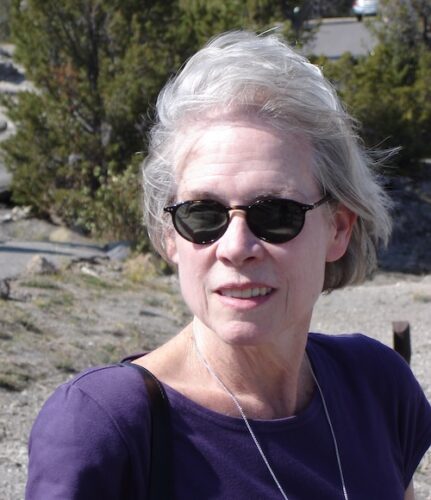
Death Announced of Judith Ellen Komoroske (née Roach), Formerly of Old Lyme

Judith Ellen Komoroske
Dec. 1, 1941 – Jan. 7, 2025

Judith Ellen Komoroske (née Roach) passed away peacefully on January 7, 2025 surrounded by family. Born December 1, 1941 (Hartford, CT), she was raised in Brighton-by-the-Sea, Old Lyme, the second child of Robert Nicholas and Frances Prendergast Roach. She graduated from Williams Memorial Institute in New London and the Duchesne Residence School (NYC). Her first employment was Time Inc., Photography Division. The Manhattan location of Duchesne enabled her to pursue academics alongside her interest in dance, moving from ballet to modern, in the style of Isadora Duncan and Doris Humphrey. She took classes in the studios of José Limón, Alwin Nikolais, Martha Graham, and others.

On November 16, 1963, she married US Navy Nuclear Submarine Officer, Alex B. Komoroske, Jr. Following life in the Navy, the couple settled in Menlo Park, CA where Judith took over a dance studio, expanded it to children and adults of all ages, and incorporated music and poetry representing a wide variety of genres. Judith’s classes left an indelible mark on her students—not least, youth in transition to adulthood (e.g., “Tuesday Girls”). At this time, she also formed the Creative Dance Workshop, a dance troupe of select students who regularly performed her choreographies in the Bay Area. In collaboration with close friend and Stanford Drama Department instructor, Marianne Crowder, the Creative Dance Workshop provided the principal dancers for a film documentary of previously unrecorded Renaissance court dances. For her numerous important contributions to the Bay Area art scene, Judith was named Silicon Valley Arts Laureate. She was a multi-faceted artist who also leaves behind a rich cache of poetry, paintings, and photography.

She is survived by her husband, Alex, two siblings, Susan Kelly (m. Peter Kelly) and Robert Roach Jr. (“Nick” m. Linda Roach [deceased] and Fran Gammell Roach); three daughters, Clare Rothschild (m. Douglas Rothschild), Kirsten Komoroske, and Jessica Solomon (m. Rob Solomon); and six grandchildren, Declan Schriever (m. Paulette McCroskey), Maxwell Rothschild, Luke Rothschild (m. Madison James), Samson Solomon, Joshua Solomon, and Sophia Solomon. A private funeral mass will be followed later this year by a celebration of life event. In lieu of flowers, please consider donations to the Dr. Betof Warner Research Fund at Stanford University or by check payable to Stanford University with “Dr. Betof Warner Research Fund in memory of Judith Komoroske” indicated on the memo line, mailed to Development Services, P.O. Box 20466, Stanford, CA 94309.
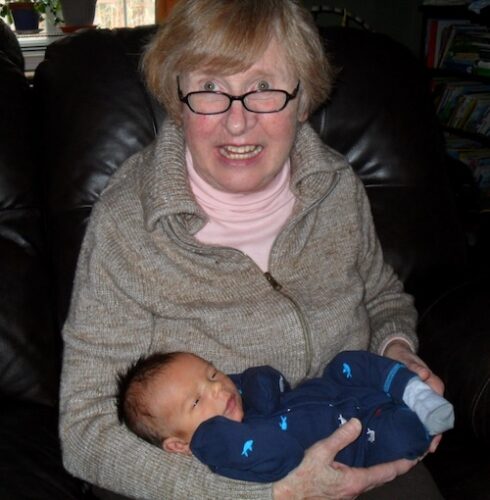
Death Announced of Clara (Claire) Maude Taylor, Mother of Craig Taylor of Old Lyme

Clara (Claire) Maude Taylor: Aug. 16, 1941—Jan. 18, 2025

Clara (Claire) Maude Taylor, formerly of Madison, passed away peacefully after a long battle with Alzheimer’s on January 18, 2025. Clara was born on August 16, 1941, in Staten Island, NY, and was the daughter of Albert H. And Eleanor T. Morrill. She was the widow of John Arthur Taylor, whom she adored and always cherished as her partner in life. She missed him dearly.

Clara is survived by her sons Eric Taylor of California, and Craig Taylor, wife Karen, and grandchildren Andrew and Weston Taylor of Old Lyme. Clara is also survived by her brother William Morrill and his wife Sue of Salisbury, CT and her sister-in-law Gill Faison of Mount Pleasant, SC.

Clara will be remembered for her infectious smile and her easy-going, simple attitude towards life. She loved cooking for her family, gardening at her home, and being outdoors whenever possible. But above all, she loved children. Clara’s school and work interests led her to a degree in elementary education from Wagner College, and her early adult years were spent teaching pre-school in the boroughs of New York City. She spent many years as a stay-at-home mother to her sons, Eric and Craig, before returning to work as a home health aide for the visiting nurse association of Madison, where her passion for helping others could continue. Clara’s last joys were her grandchildren, who she visited regularly despite her physical limitations. Nothing could stop her from spending time with the children she loved.

The family wishes to thank the many live-in-companions, doctors, and nursing staff who cared for her both at her home in Madison and at the health center at Essex Meadows in her later years. She adored you. We are truly grateful for your compassion and service.

The family will be holding a private service to celebrate her life. In lieu of flowers memorial contributions in her memory may be made to Friends of Hammonasset state park.

The Movie Man: ‘A Complete Unknown’ Draws You In, Keeps You There—Overall a Great Movie

I am generally wary of biopics, as I think they are simply made for Oscar bait.

Kevin Ganey is ‘The Movie Man.’

Your team could definitely catch the attention of the Academy of Motion Picture Arts and Sciences if you are seeking to re-create an aesthetic of a bygone era (be it costumes, set design, makeup, music, or even using production technology from any particular era to make it resemble films made in that time). This is on top of your actors’ working impressions of iconic public figures, hoping it be deemed more worthy of praise than creating a new character for audiences.

However, this is not the case with A Complete Unknown, which tells the story of the rise of music legend Bob Dylan. The first indication that I was enjoying this movie was that I was emotionally invested in the characters right from the start (a lesson I learned from the shortcomings of Gladiator II).

I never listened to Bob Dylan’s music, simply because I had no interest. But I was aware of his merit and influence on pop culture (after all, he was awarded the Nobel Prize for Literature in 2014). The title is seems appropriate for me, as this movie was the first time I listened to more than one song in one sitting. This was also my introduction to the debate surrounding Dylan’s controversial choice of using electric music at the 1965 Newport Folk Festival.

A Complete Unknown covers the rise of Dylan from his arrival in New York City in 1961 to said controversial performance. Dylan is depicted as possessing a genius beyond human capacity, which comes with the cost of social skills.

The theme woven throughout this picture is that Dylan is always seeking to be his own authentic self, and is willing to disrespect anyone, friends or business acquaintances alike, in order that he does not become a product of the music industry’s arsenal. Ironically, he will not share details about his background with anybody, even his girlfriend Suze Rotolo (renamed Sylvie Russo, at Dylan’s request, played by Elle Fanning).

While I did not think too much of Timothée Chalamet’s delivery of his lines (seems easy to imitate Bob Dylan’s nasal, high-pitched voice), my opinion changed when I learned he (and every other actor playing a musician in this movie) sang and played the instruments, himself. Upon learning this, my appreciation for his overall performance increased. It is one thing to imitate a historic figure’s speaking characteristics, but it is another to imitate their singing ability.

One particular performance that deserves praise is Edward Norton as Pete Seeger, who seemed to carry a wholesome and folksy vibe with him in every scene that put you at peace, even in the midst of a conflict. Norton’s performance, in my opinion, will be referenced in years to come as a metric for creating a character that is impossible to dislike.

We can also appreciate the little details in this movie (Easter Eggs, as we call them), as they reinforce the themes explored throughout its runtime. One I think of in particular is Dylan’s overgrown fingernails. That, alone, adds more depth to his character than extra dialogue, as it tells us that Dylan is non-traditional to his core.

Overall, this is a great movie worth the reader’s time and money. Compared to other movies I have reviewed, I do not consider it essential to screen it in a theater if there is the ability to stream it, as the reader could enjoy it from the comfort of their own living room if they simply wanted to stay in.

But I will reiterate that the best way to experience a movie is always in the theater. If you can, make screening A Complete Unknown an occasion that is worthy of getting out of the house and meeting up with friends. Doing so will give you more of an experience than just watching it at home.

About the Author: Having lived in Old Lyme and Lyme since the age of three, Kevin has always had a passion for movies that is beyond simply watching, but understanding the craft of cinema and and experiencing films as if they were a musical album. Kevin also has his own website devoted to movie analysis, CityOfCinema.com, and also co-hosts a podcast, Moviehouse Mystics, with Koda Uhl (available on Apple Podcasts, Spotify, and YouTube).

High Hopes in Old Lyme Launches Innovative, Equine-Assisted Services Program for People with Parkinson’s Disease

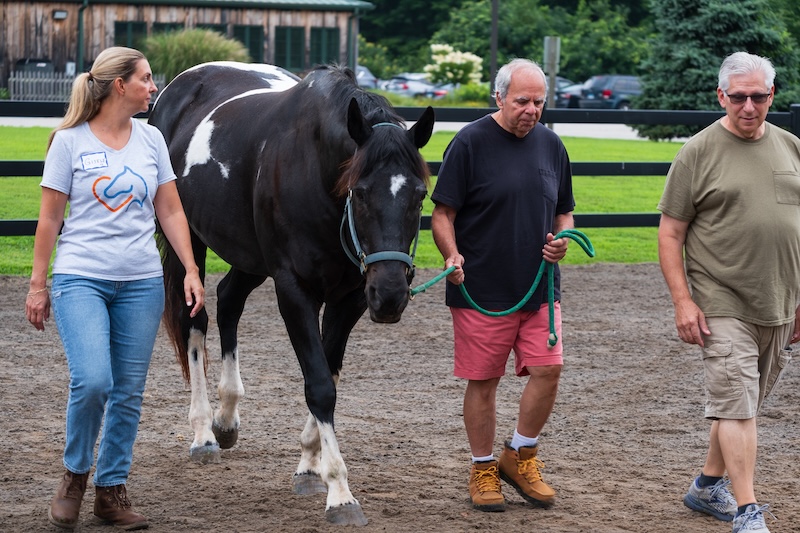
Parkinson’s program participants Michael Bigiarelli (second from right) and David Plat (right ) lead High Hopes horse Addie in the outdoor arena. High Hopes volunteer Gisele Kurns stands by for support.


Program Creates Pathways to Wellness, Relaxation, and Connection

OLD LYME—High Hopes Therapeutic Riding, Inc. has announced the continued success and expansion of its pioneering Equine-Assisted Services Program for people with Parkinson’s disease. What began as a pilot program just one year ago has blossomed into a transformative, life-changing initiative, helping participants experience improved movement, relaxation, and a unique connection with horses.

The program, which meets weekly on Tuesdays from 10:30 to 11:30 a.m., offers gentle stretching exercises, grooming, and leading of horses as part of a therapeutic regimen designed to encourage physical activity, relieve muscle tension, and promote relaxation. The natural, calming presence of the horses fosters a sense of mindfulness, helping participants to be fully present while they engage in each activity.

A year ago, a compassionate High Hopes volunteer and participant, Carol Merkt, recognized a growing need in the community for services tailored to people living with Parkinson’s disease. Merkt, whose deep connection with the High Hopes community led her to identify this gap, approached the center with the idea for a specialized program.

Her insight into and dedication to improving the lives of others has been instrumental in shaping this initiative. “I couldn’t be more impressed with the progress of this program,” says Merkt. “When I first brought the idea to High Hopes, I was hopeful, but what’s been created is better than I ever expected. The benefits for participants are truly remarkable.”

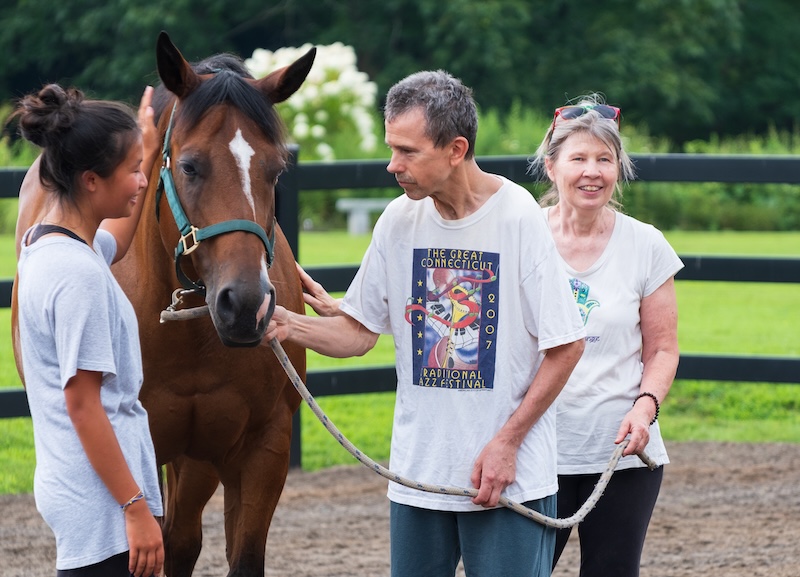
James Bendinzski, a program participant (second from right), praises his horse, Savannah, after completing an obstacle course. Bendinzski’s wife Karen Nichols (right) and High Hopes volunteer Danielle Liston greet both Bendinzski and Savannah at the finish line.

The Parkinson’s Program is facilitated by several High Hopes instructors, who are certified in ‘Equine Mental Health and Learning.’

One of the instructors, who co-facilitates the program, explains more about the program saying, “[It] is about more than physical benefits—it’s about building relationships and finding joy.” She continues, “Horses have an incredible ability to meet people where they are, offering connection and understanding that goes beyond words. Seeing participants light up during these sessions is what makes this work so rewarding.”

The High Hopes Parkinson’s Program is funded by the generous support of the Kitchings Family Foundation, whose contributions cover over 95 percent of the program’s costs through scholarships, ensuring accessibility for all participants regardless of financial circumstances. 

Another facilitator of the program comments, “We’re honored to help make this program possible. Our goal is to create a safe and supportive environment where participants feel empowered. The horses are truly the heart of what we do—they offer nonjudgmental companionship and help participants find moments of peace and accomplishment.”

The program is open to new participants at any time, welcoming individuals with Parkinson’s disease to join the classes and experience the benefits of equine-assisted services. For those who wish to reflect on their experience, there is an optional group “coffee session” following each class. 

“This program exemplifies the mission of High Hopes—to inspire, support, and transform through the power of horses,” says Missy Lamont, Executive Director of High Hopes, adding, “Thanks to the incredible support from the Kitchings Family Foundation, we’re able to provide life-changing experiences to individuals living with Parkinson’s disease.”

Lamont concludes, “At High Hopes, we believe in the power of horses to inspire, heal, and transform. Our equine-assisted services are designed to meet the diverse needs of our community, and we are excited to see how the program continues to grow, improving the lives of people with Parkinson’s disease.”

For more information on the program, visit High Hopes’ website or call High Hopes at (860) 434-1974.

Editor’s Note: This article is based on a press release issued by High Hopes Therapeutic Riding, Inc.

Old Lyme Zoning Commission to Review Applications for New Home on Smith Neck Rd., Halls Rd. Overlay District Tonight

OLD LYME—UPDATED 1/12 10:20PM with links to additional Letters to the Editor: On Monday, Jan. 13, at 6:30 p.m. in the Memorial Town Hall Meeting Room, the Old Lyme Zoning Commission will hold its next regular monthly meeting. The agenda features two topics that have been sparking interest in the community.

The first is 43 Smith Neck Rd. in the RU-40 Zone, which is the subject of both a Continued Public Hearing and an Old Business item. The applicants, Jeffrey and Emily Merriam, are seeking a Special Permit to replace and construct a new five-bedroom residence with an attached two-car garage.

Visit this link to read a Letter to the Editor that offers an opinion about the project.

Visit this link to read a Letter to the Editor that raises concerns about well water supplies after completion of the project.

The agenda also notes in another item that a Public Hearing will be opened into a Petition to Amend the Old Lyme Zoning Regulations, Section 5.15 to create a Halls Road Overlay District allowing, among other items, mixed zoning use along Halls Road and the entire C-30S Zoning District, with associated architectural design guidelines. The applicant in this case is the Halls Road Improvement Committee (HRIC.)

The HRIC suggests residents interested in the project should bring written thoughts to read and submit, and make a statement for the record. Visit this link to read a Letter to the Editor urging supporters of the proposal to attend the meeting.

Attorney William Sweeney will describe the details of this optional Overlay District and answer questions.

The HRIC believes approval of this addition to Old Lyme’s Zoning is a vital step supporting the future prosperity and livability of Old Lyme.

The HRIC submits that the key features of its proposal are that it:

  • Is totally optional; it allows but does not require change to any property.
  • Keeps the shopping area vital and focused on Old Lyme, not the highway.
  • Creates options for much needed apartment type housing.
  • Balances housing stock without covering the remaining open land.
  • Promotes creation of a safe, walkable, bike-able, mixed-use town center.
  • Guides (via the Design Review process) development to be “like Old Lyme.”
  • Promotes increased town revenues, reducing residents’ taxes.

The HRIC suggests readers visit this link for more information: https://www.oldlyme-ct.gov/343/Halls-Road-Improvements-Committee