OLD LYME/EAST LYME—On Saturday, Sept. 13, from 11 a.m. to 3 p.m., the Duck River Garden Club (DRGC) of Old Lyme and East Lyme will hold a Mum Sale at two locations — the Old Lyme Shopping Center at 19 Halls Rd., Old Lyme and the East Lyme Library at 39 Society Rd., Niantic.
Beautiful 9-inch mums in red, yellow, purple, orange, white and pink will be on sale for $10 apiece. Payment will be accepted by by cash or check only.
All proceeds will benefit DRGC beautification, educational programs and scholarships.
Chris Arelt displays the commissioned illustration of one of his own projects, which he received as the Grand Prize winner of a sketch challenge held at the recent AIA Conference on Architecture in Boston. Photo submitted.
BOSTON/OLD LYME — Architect Christopher Arelt of Nautilus Architects in Old Lyme, CT took home the top prize in a design competition at this year’s American Institute of Architects (AIA) Conference on Architecture.
Arelt participated in Blueprints & Brews, a sketch challenge hosted on the conference floor, where architects were invited to illustrate spontaneous prompts drawn from a spinning wheel.
Using a white pencil on a blue napkin, participants responded to ideas ranging from “a building shaped like a lobster” to “Fenway Park as a floating structure.”
Arelt’s winning drawing, based on the prompt “a door at the edge of the world,” depicted a flying car exiting through a VertiStack® Clear-style door into a galaxy of stars and planets. His sketch was selected as the Grand Prize winner from six rounds of entries displayed on what organizers called the “Wall of Wicked Smart Design.”
“It was an exhilarating experience and accomplishment,” Arelt said. “It quickly became the highlight of my day at the convention.”
For his prize, Arelt received a commissioned illustration of one of his own projects from freelance artist Ron Schiding. He chose the firm’s Greystone residence on the Connecticut shoreline, a contemporary home inspired by New England architectural traditions.
The illustration will be displayed at Nautilus Architects’ headquarters in Old Lyme.
The Blueprints & Brews event, sponsored by Clopay® Corporation, was designed to engage architects in a playful way while spotlighting creative approaches to design. Organizers said it also served as a chance to connect architects with manufacturers.
Editor’s Notes: i) Christopher Arelt is the founder of Nautilus Architects in Old Lyme, CT. He brings a collaborative and site-driven approach to residential design. His work blends Modernist influences with regional craftsmanship, emphasizing natural light and material authenticity. For more information, visit this link.
ii) Founded in 1964, Clopay® Corporation (“Clopay”) is the largest manufacturer and marketer of garage doors and rolling steel doors in North America. Clopay is headquartered in Mason, Ohio, and operates four manufacturing facilities and 57 distribution centers. For more information, visit this link.
OLD LYME — Alison Gleason’s Wildcat boys kicked off their first game of the season with a solid 4-2 win at home over Grasso Tech. Old Lyme v Grasso Tech
Goalscorers were Ian Maeby, who added an assist to his tally, Elliot Dunn-Sims, Menzi Mbele and Rowan McCormick.
Joseph Moore scored both goals for Grasso Tech.
Old Lyme goalie Sam Edmed made eight saves while his opposite number Ethan Dion made a remarkable 19.
Old Lyme’s overall record now stands at 1-0-0 and 0-0-0 in the Shoreline Conference.
Meanwhile, Caroline Wallace’s Wildcat girls faced traditionally tough opposition playing away at Cromwell. The team was defeated 4-0 with goalie Grace Osborne making three saves.
Goal-scorers for Cromwell were Lauren Carta, Hayden Vandersloot with two, and Taylor Ursin. Goalie Alexis Wiatrak made three saves.
Children’s author Alison Mitchell is seen here at StoneRidge Senior Living in Mystic with Cappie, one of the canine companions who helped inspire her second children’s book.
Mitchell Presents Story about Canine Adventurers and Their Senior Companionsat Old Lyme Church
MYSTIC, CT/OLD LYME—Author Alison Mitchell may be 92, she but isn’t letting age slow down her writing pursuits.
That’s according to a publicist for StoneRidge Senior Living, where Mitchell, formerly of Old Lyme, just released her second book in as many years. The children’s tale was illustrated by Old Lyme resident Edie Twining and edited by Twining’s sister, Kinny Kreiswirth.
Townsend: The Positive Dog of Mystic Senior Living is a week-in-the-life tale of “Townie,” a mutt, who resides at a senior living community.
The trio last year collaborated on Letters to Papa: Summers in Old Lyme to benefit the Old Lyme Historical Society.
The adventures of Townie and his friends were inspired by the busy lives of actual canine residents of StoneRidge Senior Living in Mystic, according to the press release.
“This was a fun group effort as I had plenty of StoneRidge friends suggesting names and activities for Townie to encounter,” said Mitchell.
The book was self-published by Twining Design of Old Lyme.
All profits from the sale of the book will be donated to the StoneRidge Scholarship Fund, which recognizes full-time employees and children of full-time employees, who are pursuing a post-secondary education.
This year, the committee granted awards totaling $211,000 to 23 students who were selected on the basis of financial need, academic achievement, scholastic potential, and their commitment to career goals.
Mitchell will give a presentation of the book on Tuesday, Sept. 9, at 1 p.m. in the First Congregational Church of Old Lyme, 4 Lyme Street.
A special presentation at StoneRidge Senior Living will be held at 4 p.m. on Aug. 22. Tickets are free but seating is limited and advanced reservations are required. Call 860-780-0741 for tickets.
Townsend: The Positive Dog of Mystic Senior Living is available for $16 and can be purchased at Bank Square Books (80 Stonington Road) or at the StoneRidge Country Store (186 Jerry Brown Road) in Mystic.
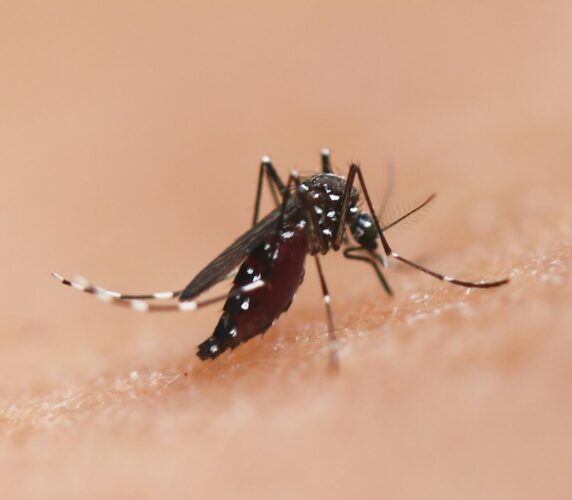
A mosquito prepares to bite. Image courtesy of the National Institute of Allergy and Infectious Diseases for Unsplash.
NEW HAVEN, CT – The State Mosquito Management Program is warning Connecticut residents about the risk of infection by West Nile virus (WNV) this season.
On Wednesday, Aug. 27, the Connecticut Agricultural Experiment Station (CAES) issued a press release stating that it has detected WNV-infected mosquitoes in 34 towns this season including Old Lyme.
The other 33 towns where WNV-infected mosquitoes have been found are Bethel, Bridgeport, Cheshire, Danbury, Darien, East Haven, Easton, Fairfield, Glastonbury, Greenwich, Groton, Guilford, Hamden, Hartford, Hebron, Manchester, Meriden, Milford, New Britain, New Haven, Newington, North Branford, North Stonington, Norwalk, Southington, Stafford, Stamford, Stratford, Wallingford, West Hartford, West Haven, Westport, and Wethersfield.
The CAES notes that no human cases of WNV have been reported so far this season but now is often the time of year when the first cases are reported to public health.
“We continue to detect West Nile virus in mosquitoes throughout Connecticut, with the highest levels of activity in Fairfield and New Haven counties and in the metropolitan Hartford area,” said John Shepard, Medical Entomologist at CAES. “This includes infection of mammalian-biting mosquitoes, which increases risk of human infection.”
“West Nile virus transmission is expected to continue until mosquito activity ceases in October,” said Dr. Philip Armstrong, Chief Scientist at CAES. “We encourage everyone to take simple measures to prevent mosquito bites.
This includes applying insect repellent and covering bare skin, especially in wooded areas and during dusk and dawn when biting mosquitoes are most active.”
To reduce the risk of being bitten by mosquitoes, residents should:
Minimize time spent outdoors between dusk and dawn when mosquitoes are most active.
When it is necessary to be outdoors, use mosquito repellents containing an EPA-registered active ingredient, including DEET, Picaridin, IR3535, oil of lemon eucalyptus, para-menthane-diol (PMD), or 2-undecanone. EPA registration of skin-applied repellent products indicates that they have been evaluated and approved for human safety and effectiveness when applied according to instructions on the label.
Wear shoes, socks, long pants, and a long-sleeved shirt when outdoors for long periods of time, or when mosquitoes are more active. Clothing should be light-colored and loose-fitting and made of tightly woven materials that keep mosquitoes away from the skin.
Wear clothing and gear treated with permethrin. Permethrin is an insecticide that kills or repels mosquitoes and ticks.
Be sure door and window screens are tight-fitting and in good repair.
When sleeping outdoors, use tents or mosquito netting in an unscreened structure. Treat camping gear with permethrin when possible.
Cover strollers and baby carriers with mosquito nets when outside.
West Nile virus is the most common mosquito-borne viral disease in the United States and occurs every summer in Connecticut. Most people infected with WNV do not experience any symptoms. However, about one in five develop West Nile fever, which includes symptoms such as fever, body aches, joint pain, headache, and rash. In rare cases—approximately one in 150—WNV can cause a severe illness that affects the central nervous system.
Of those severe cases, about one in 10 are fatal.
Adults over the age of 60 are at the highest risk of serious illness.
The response to mosquito-transmitted diseases in Connecticut is a collaborative inter-agency effort involving the Department of Energy and Environmental Protection (DEEP), the Connecticut Agricultural Experiment Station (CAES), the Department of Public Health (DPH), the Department of Agriculture, and the Connecticut Veterinary Medical Diagnostic Laboratory (CVMDL) at the University of Connecticut (UCONN). These agencies are responsible for monitoring mosquito populations and the potential public health threat of mosquito-borne diseases.
The CAES maintains a network of 108 mosquito-trapping stations in 88 municipalities throughout the state. Mosquito traps are set Monday – Thursday nights at each site every 10 days on a rotating basis and then at least once a week after detection of virus. Mosquitoes are grouped (pooled) for testing according to species, collection site, and date.
For information on WNV and eastern equine encephalitis (EEE) virus, how to prevent getting bitten by mosquitoes, and the latest mosquito test results, visit the Connecticut Mosquito Management Program website at https://portal.ct.gov/mosquito.