
Reading Uncertainly? ‘Sapiens: A Brief History of Humankind’ by Yuval Noah Harari

“I’m not trying to predict the future,” Yuval Harari argued in an Edge (an international group of the curious – see www.edge.org) discussion with Daniel Kahneman (March 5, 2015). “I’m trying to identify the horizon of possibilities that we are facing.”

Professor Harari, of the Hebrew University of Jerusalem and an Oxford PhD, wrote this incredibly imaginative alternate view of the entire 200,000-year history of our species, Homo sapiens, on this earth, a mammal with a uniquely large brain. He suggests we have survived and prospered, perhaps too much, through the use of myths: “large numbers of strangers can cooperate successfully by believing in common myths,” even though we now know, “there are no gods in the universe, no nations, no money, no human rights, no laws, and no justice outside the common imagination of human beings.”

Harari re-thinks just about every “myth” that confuses our practices as human beings.

This “history” challenges our numerous “misconceptions” by stepping back from all we thought we knew, separating the growth of human existence through three “revolutions” of human existence: the cognitive (when we learned to think and communicate), the agricultural (when we shifted from nomadic movement to a more sedentary life), and the scientific (when we began asking “why” and “how.”).

In doing so he manages to skewer, with both rational argument and good humor, most of our cherished beliefs. And how little we actually know about our predecessors, saying, “a curtain of silence shrouds tens of thousands of years of history,” simply because of our lack of language and surviving relics.

What about the disappearances of many earlier species? We’ve been taught that climatic conditions or perhaps asteroids were the causes. Harari argues that we, homo sapiens, are more likely responsible for their demise than crashes or dramatic climate changes (ice ages, he notes, have occurred about once every 100,000 years). Our earth’s climate “is in constant flux” and most species have been able to adapt.

But many could not adapt to us!

As a student of risk management, I was interested to learn that our Agricultural Revolution, beginning about 12,000 years ago also increased our concern about our future, linked with the new “fundamental uncertainty of agriculture.” That is when we constructed “an imagined order.” Harari cites both the Code of Hammurabi (circa 1776 BCE) and the American Declaration of Independence (1776) as “imagined orders” that enabled “us to cooperate effectively and forge a better society.”

Acceptance of these “imagined orders” became “ embedded in the natural world and shaped our desires.” They “existed within the community network linking the subjective consciousness of many individuals.” Imagined orders both free and imprison us …

They are, Harari argues, how humans “organized themselves into mass cooperative networks.”  They result in “imagined hierarchies” and “unjust discrimination” such as the Hindu caste system and the Babylonian separation of human beings into “superior men,” “commoners,” and “slaves.”

But, for example, do the “fundamental values” of equality and individual freedom (liberty) contradict each other? Harari suggests they do but that “this is no defect. Such contradictions are an inseparable part of every human culture. In fact, they are culture’s engines, responsible for the creativity and dynamism of our species.”

Money is also a shared myth. It is wholly imaginary but it does create healthy inter-dependence. Money is a “purely mental revolution” to “represent systemically the value of other things for the purpose of exchanging goods and services.”

Today, “more than 90 percent of all money – more than $50 trillion appearing in our accounts — exists only on computer servers.” Bitcoin, indeed! Money is the “apogee of human tolerance,” based on two “universal principles: convertibility and trust.”

Harari steps back and also studies religion, “a system of human norms and values founded on a belief in a superhuman order.” Religion moves from animism, to polytheism, to monotheism, to dualism, to socialist humanism, and, most recently, to evolutionary humanism. It appears to be a human construct.

Questions always remain: “Are we out of the global economic crisis, or is the worst yet to come? Will China continue growing until it becomes the leading superpower? Will the United States lose its hegemony? Is the upsurge of monotheistic fundamentalism the wave of the future or a local whirlpool of little long-term significance? Are we headed toward ecological disaster or technological paradise?”

Our most recent “revolution,” the Scientific, says Harari, began on July 16, 1945 at 05:29:53 with the explosion of the first atomic bomb. It also coincided with the explosion of population: 500 million in 1500 and 7.3 billion in 2015. One of the keys to our scientific progress has been “our willingness to admit ignorance,” leading to insatiable curiosity and constructive, mathematical observation. But we also have an “obsession with military technology.”

Is it time to “rethink the idea of continual progress?”

Are we obsessed with “growth?” Harari answers, “For better or worse, in sickness and in health, the modern economy has been growing like a hormone-soused teenager.”  But is perpetual growth an illusion or “will this idea burst like all bubbles?”

His reply: “When growth becomes a supreme good, unrestricted by any other ethical considerations, it can easily lead to catastrophe.” Or will “ecological turmoil endanger the survival of homo sapiens itself?” Will only rats and cockroaches survive our insanity, as also suggested by Elizabeth Kolbert in The Sixth Extinction?

And what about “the pursuit of happiness?” Harari suggests a biological approach to happiness, that our natural system releases serotonin and other organic compounds to produce “ephemeral eddys of good fortune,” but never long-lasting and always returning us to a median level of euphoria. “Happiness” is, to him, entirely subjective, despite the story of Huxley’s “soma.”

How will it all end? Will advancing technology produce cyborgs of all of us, enabling individuals to “live” for hundreds of years, or will we simply destroy our species, leaving smiling cockroaches?

Harari’s last questions are: “What do we want to become?” and “What do we want to want?” Unanswerable, of course, but we are innately curious and creative!

Editor’s Note: Sapiens: A Brief History of Humankind by Yuval Noah Harari is published by HarperCollins, New York 2015.
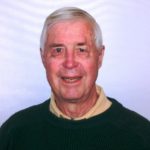
Felix Kloman

About the Author: Felix Kloman is a sailor, rower, husband, father, grandfather, retired management consultant and, above all, a curious reader and writer. He’s explored how we as human beings and organizations respond to ever-present uncertainty in two books, ‘Mumpsimus Revisited’ (2005) and ‘The Fantods of Risk’ (2008). A 20-year resident of Lyme, he now writes book reviews, mostly of non-fiction, which explores our minds, our behavior, our politics and our history. But he does throw in a novel here and there. For more than 50 years, he’s put together the 17 syllables that comprise haiku, the traditional Japanese poetry, and now serves as the self-appointed “poet laureate” of Ashlawn Farm Coffee, where he may be seen on Friday mornings. His late wife, Ann, was also a writer, but of mystery novels, all of which begin in a village in midcoast Maine, strangely reminiscent of the town she and her husband visited every summer.

Reading Uncertainly? ‘Why Homer Matters’ by Adam Nicolson

Our son, a teacher of English and a sailor, recommended this new study of the Homeric poems, the Iliad and the Odyssey. I had read them in the Robert Fagles translations, the first in 1996, the second a year later. Nicolson’s learned and lyrical commentary brings these 4,000-year-old stories into a fresh perspective of how memory, epic and history are important to us.

He argues that Homer “makes the distant past as immediate to us as our own lives.” In addition, the author is an accomplished sailor, adding to his understanding of Odysseus’s peregrinations throughout the Mediterranean.

These poems present a “plunging perspective into the ancient,” seeking “a form of reassurance that in the end there is some kind of understanding in the world … a braided stream of possibilities pouring into the present out of the past.” Nicolson adds, “no place for Homer is more filled with tragedy than the beach, ”a point of transition for the Greeks transforming themselves from a land-based horde to sea-faring seekers.”

But who was Homer?

Nicolson suggests, “there was no human being called Homer; his words are the descendants of memory and power, the offspring of the muse who had a beautiful voice.” Stories were created, then passed along from generation to generation through memory and song, always modified to fit more current conditions.

“Homer was an ancient inheritance in the eighth century BC … already a thousand years old … The Homeric poems, or at least versions of them, were written down … perhaps about 725 BC, or maybe as much as a century later.” And even then successive scribes often altered the written versions. “Homer is haunted by the threat of transience, by the way memory fails and meanings drift in the face of time.”

To Nicolson the Iliad is “ … a tapestry of sorrow, in which the noncity is set against the city, where the marginal and contingent confront the settled and the secure … the loved against the abused, the creative against the destructive forces of life.” And, yes, even today!

The Greeks attacking Troy were northerners, Indo-Europeans, “their roots in the steppelands of Eurasia … semi-nomadic pastoralists” exhibiting “the hero complex: maleness, heroic individuality and dominance.”  Their theme: “… we are all vagabonds on earth, nothing belongs to us, our lives have no consequence and our possessions are dross. We are wanderers, place shifters, the cosmic homeless.” The settled, affluent, and wealthy Trojans didn’t have a chance.

Much of this recurs in the Odyssey: “the heart of the poem is this contingency, the absence of any over-riding permanence,” the continuous search for meaning..

Nicolson’s frequent allusions to sailing are almost elegiac. Here is one about the Odyssey: “They won’t be wrecked on the illusions of nostalgia, the longing for that heroized, antique world, because . . . to live well in the world, nostalgia must be resisted; you must stay with your ship, stay tied to the present, remain mobile, keep adjusting the rig, work with the swells, watch for the wind-shift, watch as the boom swings over, engage, in other words, with the muddle and duplicity and difficulty of life. Don’t be tempted into the lovely simplicities that the heroic past seems to offer.”

Solid counsel for some of our politicians today!

While the Homeric poems illustrate the horrific mores of some 4000 years ago, “ . . . the usefulness of violence, the lack of regret at killing, the subjection and selling of women, the extinction of all men in a surrendering city or the sense that justice resides in personal revenge,” “what is valuable and essential in these poems is the opposite of that: the ability to regard all aspects of life with clarity, equanimity and sympathy, with a loving heart and an unclouded eye.”

Homer “provides no answers, ”… but simply illustrates, “the complexity of life, the bubbling vitality of a boat at sea, the resurgent energy, as he repeatedly says, of the bright wake starting to gleam behind you.”

To conclude: “So now, each time the wind fills in, and you roll your headsails out and get the main up, and you feel the boat starting to gather way, to pick up its skirts, unable to resist the pull of the wind, you will know something essential of the Homeric world. Here under the bow you can listen, like the Phaeacians carrying Odysseus home, to the water surge and fall, that repeated hoosssh-hoosssh of a hull at speed.

And here, as you make your way between the blue islands, the boat heeled far over and the curves of the headsails bellied out to leeward, you can begin to know and sense the power of possibility in the well-balanced, well-benched ship, equipped with all it needs, acquiring the world, stretching the idea of what it means to be alive, leading men to adventure, home or war.”

Isn’t it time to read Nicolson and reread the Iliad and the Odyssey?

Editor’s Note: ‘Why Homer Matters’ by Adam Nicolson was published by Henry Holt & Co., New York 2014.
Felix Kloman
About the Author: Felix Kloman is a sailor, rower, husband, father, grandfather, retired management consultant and, above all, a curious reader and writer. He’s explored how we as human beings and organizations respond to ever-present uncertainty in two books, ‘Mumpsimus Revisited’ (2005) and ‘The Fantods of Risk’ (2008). A 20-year resident of Lyme, he now writes book reviews, mostly of non-fiction, which explores our minds, our behavior, our politics and our history. But he does throw in a novel here and there. For more than 50 years, he’s put together the 17 syllables that comprise haiku, the traditional Japanese poetry, and now serves as the self-appointed “poet laureate” of Ashlawn Farm Coffee, where he may be seen on Friday mornings. His late wife, Ann, was also a writer, but of mystery novels, all of which begin in a village in midcoast Maine, strangely reminiscent of the town she and her husband visited every summer.

Reading Uncertainly: ‘The Dawn Watch: Joseph Conrad in a Global World’ by Maya Jasanoff

Having read all of Patrick O’Brian, plus his biography (see LymeLine, Feb. 22, 2018), and having read most of that other great author of sea stories in the 20th Century, Joseph Conrad, it was only natural to launch into this latest study of him by Harvard’s Maya Jasanoff.


Josef Teodor Konrad Korzeniowski was as compulsive a reader as O’Brian, but this Pole added global travel to his years. Born to Polish parents in the Ukraine in 1857, he followed his banished father to Nizhny Novgorod in Russia (this city was where Count Alexander Rostov ended in Amor Towles’s A Gentleman in Moscow: see my review in LymeLine, Dec. 17, 2017!), he returned to Poland, then went to sea from France and ended an English gentleman and author.

Jasanoff’s thesis is that, “Conrad watched the emergence of the globally interrelated world …” first from Eastern Europe, then from various sailing ships in the Far East and Africa, and finally from southern England. While early on he was “obsessed with becoming a sailor” he also found that, “in books he could travel the world.” For a life at sea, Conrad wrote “There’s rarely something to look at, there’s always something to see. People are always asleep, people are always awake. You’re never alone, you’re always isolated.”

Two delightful bits that recalled to me my few years at sea: (1) “Having matured in the surroundings and under the special conditions of sea life, I have a special piety toward that form of my past …” and (2) “For utter surrender to indolence you cannot beat a sailor ashore when that mood is on him, the mood of absolute irresponsibility tasted to the full.”

Jasanoff concludes thus with her linkage of Conrad to our increasingly interconnected world, “What Conrad had made me see, I realized, was a set of forces whose shapes may have changed but whose challenges have not. Today’s hearts of darkness are to be found in other places where civilizing missions serve as covers for exploitation. The heirs of Conrad’s technologically displaced sailors (steam replacing sail) are to be found in industries disrupted by digitization. The analogues to his anarchists are to be found in Internet chat rooms or terrorist cells. The material interests he centered in the United States emanate today as much from China.”

So perhaps it was only natural that I turned again to Conrad himself in A Personal Record, first published in 1908 when he was 50-years-old. Some jewels:
“It is better for mankind to be impressionable than reflective. Nothing humanly great—great, I mean as affecting a whole mass of lives—has come from reflection.”
“Only in men’s imagination does every truth find an effective and undeniable existence. Imagination, not invention, is the supreme master of art as of life. An imaginative and exact rendering of authentic memories may serve worthily that spirit of piety toward all things human which sanction the conceptions of a writer of tales, and the emotions of the man reviewing his own experience.”
And, of course …
“Books are an integral part of one’s life.”

Editor’s Note: ‘The Dawn Watch: Joseph Conrad in a Global World’ by Maya Jasanoff was published by Penguin Press, New York, 2017.

Felix Kloman

About the Author: Felix Kloman is a sailor, rower, husband, father, grandfather, retired management consultant and, above all, a curious reader and writer. He’s explored how we as human beings and organizations respond to ever-present uncertainty in two books, ‘Mumpsimus Revisited’ (2005) and ‘The Fantods of Risk’ (2008). A 20-year resident of Lyme, he now writes book reviews, mostly of non-fiction, which explores our minds, our behavior, our politics and our history. But he does throw in a novel here and there. For more than 50 years, he’s put together the 17 syllables that comprise haiku, the traditional Japanese poetry, and now serves as the self-appointed “poet laureate” of Ashlawn Farm Coffee, where he may be seen on Friday mornings. His late wife, Ann, was also a writer, but of mystery novels, all of which begin in a village in midcoast Maine, strangely reminiscent of the town she and her husband visited every summer.

Reading Uncertainly: ‘The Fifth Risk’ by Michael Lewis

Is our government too bloated, too intrusive, too expensive?

Is it a “swamp” that needs to be drained if we are to survive?

Michael Lewis, the author of such jewels as Liar’s Poker, Moneyball, The Big Short, Flash Boys (see my review of 12/15/2014) and The Undoing Project (see my review of 1/22/2018), has been stimulated by the election of Donald Trump and Trump’s “willful ignorance” and “subsequent incoherence” to step back and take a serious look at a few departments of our government.

Lewis has selected the work of the Departments of Energy (controlling nuclear waste), Commerce (predicting the weather), and Agriculture (assuring food safety), and using in-depth discussions with selected government servants illustrates what is seldom acknowledged – the long-term contributions of much of what goes on at the federal level.

Part of the problem in Lewis’ word is that we have ”two million federal employees taking orders from four thousand political appointees. Dysfunction is baked into the structure of the thing …”

He leads this analysis with the words of John MacWilliams, the Department of Energy’s “first ever chief risk officer.” MacWilliams offers his top four risks as the threat of nuclear disaster, North Korea, Iran, and protecting our electrical grid from cyber-terrorism.

But topping all four is the broader inadequacy of “project management” in the US. MacWilliams states, “managing risks (is) an act of the imagination. And the human imagination is a poor tool for judging risk … They (humans) are less good at imagining a crisis before it happens—and taking action to prevent it.”

Lewis goes on to explain, “ … the risk a society runs when it falls into the habit of responding to long-term risks with short-term solutions,” results in, “ … the innovation that never occurs, and the knowledge that is never created.” He concludes, “We need doubtful and forever curious students of possibilities.”

Lewis’ answer is that the long-term and continuing government work of managing the risks of nuclear waste, unusual weather, and food safety has been successful … if not exceptional.

But is this work threatened by the current administration?

To Lewis, “Trump’s budget … is powered by a perverse desire—to remain ignorant.” And that seems to have led to “a rift in American life … between the people who are in it for the mission and the people who (are) in it for the money.”

So what is “risk”?

Lewis quotes David Friedman, of the National Oceanic and Atmospheric Administration (NOAA), who says, “Risk is uncertainty about the outcome.” We can never be certain of what will occur, but we can certainly try to be.

And that leads to his final sentence, “It’s what you fail to imagine that kills you.”

A most provocative and coherent analysis.

Editor’s Note: ‘The Fifth Risk’ by Michael Lewis is published by W. W. Norton, New York 2018.

Felix Kloman

About the Author: Felix Kloman is a sailor, rower, husband, father, grandfather, retired management consultant and, above all, a curious reader and writer. He’s explored how we as human beings and organizations respond to ever-present uncertainty in two books, ‘Mumpsimus Revisited’ (2005) and ‘The Fantods of Risk’ (2008). A 20-year resident of Lyme, he now writes book reviews, mostly of non-fiction, which explores our minds, our behavior, our politics and our history. But he does throw in a novel here and there. For more than 50 years, he’s put together the 17 syllables that comprise haiku, the traditional Japanese poetry, and now serves as the self-appointed “poet laureate” of Ashlawn Farm Coffee, where he may be seen on Friday mornings. His late wife, Ann, was also a writer, but of mystery novels, all of which begin in a village in midcoast Maine, strangely reminiscent of the town she and her husband visited every summer.

Reading Uncertainly: ‘The Reluctant Fundamentalist’ by Mohsin Hamid

How would you respond to a bearded gentleman greeting you in Lahore, Pakistan, with these words: “Excuse me, sir, but may I be of assistance?” Followed by these, “Ah, I see I have alarmed you. Do not be frightened by my beard: I am a lover of America. I noticed that you were looking for something, more than looking, in fact you seemed to be on a mission, and since I am both a native of this city and a speaker of your language, I thought I might offer you my service.”

Mohsin Hamid, a native Pakistani, a graduate of Princeton University, and a former employee of a financial services firm in New York, serving clients in the Philippines, and Chile, who now lives and writes in Oxford, has created a character with similar experience to his own.  The character greets this American in his native city, wines and dines with him, all while delivering his life story.

We read only the words of Changez, the name of the narrator and guide, telling us of how his views of the United States and its inhabitants have been materially altered by events at the turn of the century. It is an increasingly critical analysis. What do we citizens of this country, protected by two oceans and enormous wealth, really know what others around this globe think of us?

Consider these quotes:

“ … my ability to function both respectfully and with self-respect in a hierarchical environment, something American youngsters – unlike their Pakistani counterparts – rarely seemed trained to do.”

 “I had always thought of America as a nation that looked forward; for the first time I was struck by its determination to look back …  What your fellow countrymen longed for was unclear to me – a time of unquestioned dominance?  Of safety?  Of moral certainty? I did not know — but that they were scrambling to don the costumes of another era was apparent.”

 “Yes, my musings were bleak indeed. I reflected that I had always resented the manner in which America conducted itself in the world; your country’s constant interference in the affairs of others was insufferable. Vietnam, Korea, the straits of Taiwan, the Middle East, and now Afghanistan: in each of the major conflicts and standoffs that ringed my mother continent of Asia, America played a central role … (and) finance was a primary means by which the American empire exercised its power.”

 “It seemed to me then … that America was engaged only in posturing. As a society, you were unwilling to reflect upon the shared pain that united you with those who attacked you. You retreated into myths of your own difference, assumptions of your own superiority. And you acted out these beliefs on the stage of the world. So that the entire planet was rocked by the repercussions of your tantrums … “

This is a compelling and enlightening one-sided conversation, leading to a 
stunning conclusion.

As the author himself comments in an addendum to this novel, “I believe that the core skill of the novelist is empathy: the ability to imagine what someone else might feel. And I believe that the world is suffering from a deficit of empathy at the moment …  We need to stop being so confused by the fear we are fed; a shared humanity should unite us with people we are encouraged to think of as enemies.”

Incidentally, Hamid has written a second novel, Exit West*, which received solid reviews here and in Europe. I’ve read it, but I consider The Reluctant Fundamentalist his jewel.

Challenge your thinking!

Editor’s Notes:  i) ‘The Reluctant Fundamentalist’ by Mohsin Hamid is published by Houghton Mifflin & Harcourt, New York 2007

ii) ‘Exit West’ by Mohsin Hamid was the Eastern Connecticut ‘One Book One Region’ selection for 2018.

Felix Kloman

About the Author: Felix Kloman is a sailor, rower, husband, father, grandfather, retired management consultant and, above all, a curious reader and writer. He’s explored how we as human beings and organizations respond to ever-present uncertainty in two books, ‘Mumpsimus Revisited’ (2005) and ‘The Fantods of Risk’ (2008). A 20-year resident of Lyme, he now writes book reviews, mostly of non-fiction that explores our minds, our behavior, our politics and our history. But he does throw in a novel here and there. For more than 50 years, he’s put together the 17 syllables that comprise haiku, the traditional Japanese poetry, and now serves as the self-appointed “poet laureate” of Ashlawn Farm Coffee, where he may be seen on Friday mornings. His late wife, Ann, was also a writer, but of mystery novels, all of which begin in a village in midcoast Maine, strangely reminiscent of the town she and her husband visited every summer.