SECoast, CT Trust for Historic Preservation Request 60-Day Extension to NRA Waiting Period

We have just received the text of a letter sent by SECoast and the Connecticut Trust for Historic Preservation to the Federal Railroad Administration (FRA) requesting an extension of the 30-day waiting period regarding the FRA’s Preferred High Speed Railroad Route Alternative to 60 days.

It reads as follows::

The Connecticut Trust for Historic Preservation and SECoast, our regional partner on high-speed rail planning issues, are writing to ask for your assistance to extend the current 30-day waiting period for the NEC Future Final Environmental Impact Statement by 60 days. Given the enormous size of the planning document, its release just one week before end-of-year holidays and the extreme concern for the preferred alternative route now expressed in communities throughout Connecticut (and additionally Rhode Island) we believe there is a strong argument that such an extension is in the public interest.

The current deadline of January 31, 2016 marks the end of the Tier 1 planning process for the Northeast Corridor (NEC), an early but critical step in the overall implementation of a master plan for the corridor. Finalization of this document will commit the plan to a single corridor through Connecticut rather than from the three corridors under study in the DEIS. Finalization of this document will replace the corridor’s current master plan, dating to 1978,  for rail travel and investment along the Northeast Corridor with a new Programmatic Environmental Impact Statement (P-EIS) with a 25-year horizon of 2040.

To be clear, we have a once-in-a-generation opportunity to get this right. Both the public and the NEC Future plan deserve the benefit of a thorough final public review and opportunity to comment. We believe an extended comment period would also offer the best opportunity to avoid unnecessary legal action by providing the Federal Railroad Administration an opportunity to correct evident errors in the planning process and resulting NEC Future plan.

Such an extension is both a commonsense and commonplace. Indeed, a similar extension was granted to review much less extensive plans for the “All Aboard Florida” high speed rail planning initiative in Florida. The Federal Railroad Administration has enjoyed flexible deadlines throughout the planning process, most recently missing an intended late summer/early fall release date of the Preferred Alternative and FEIS documentation. Surely, the people of Connecticut deserve an equivalent opportunity to provide informed and meaningful comment before this critical document is finalized.

We appreciate, in advance, your continuing efforts to advocate for communities in the state of Connecticut and for our joint efforts to develop rail-travel along the Northeast Corridor in a way that recognizes and respects the unique historical, cultural and environmental attributes of Connecticut communities.

More to come.

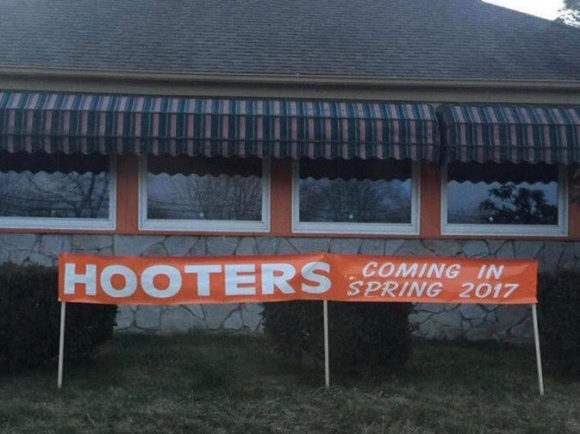
‘Hooters’ Hopes for Home in Old Lyme?


Life is strange, isn’t it?

Since this past Friday, the threat of a high speed rail route passing under, or perhaps, over our beloved little town has become very real, but astonishingly — in some ways — we have actually received more direct communications about the possibility of “Hooters” moving into town than reactions to the railroad proposal!

We asked Jane Cable, Chair of the Old Lyme Zoning Commission, about the ‘Hooters’ sign (pictured above), which was placed in front of the former Illiano’s on Boston Post Rd. on Friday, and she said categorically, “It’s a hoax,” adding, ” … the banner has been moved around Lyme and Old Lyme.”

So that’s it folks — no ‘Hooters’ in Old Lyme … for the moment anyway!  Now let’s move on to dealing with this train issue and remember we only have 30 days to respond.


Reemsnyder Responds to FRA Proposal to Route Train Through Old Lyme, Says It Will Not Happen

Old Lyme First Selectwoman Bonnie Reemsnyder

Old Lyme First Selectwoman Bonnie Reemsnyder has issued the following statement in response to today’s announcement by the Federal Rail Authority (FRA) that the FRA intends to pursue the Old Saybrook to Kenyon, R.I., option as their preferred route for the new high speed rail track between Boston and New York City with a tunnel taking the train under the Connecticut River and emerging to the east somewhere in Old Lyme:

“After months of waiting, petitioning the Federal Railroad Administration (FRA) on behalf of Old Lyme, and working with our Congressional representatives, local legislators and state leaders, the FRA has finally released its Tier 1 Environmental Impact Statement (EIS)–months later than promised and only one month before a new administration is sworn in.

We have made strenuous efforts to convince the FRA that selecting Alternative 1 in the draft Environmental Impact Statement, which incorporates a “bypass” from Old Saybrook, Connecticut to Kenyon, Rhode Island, would be a colossal mistake.  Not only is there substantial thinking that this southern route would not best serve the economic interests of our nation, state and the Northeast Corridor, there is enormous doubt that this bypass can be constructed in a cost-effective manner that avoids catastrophic damage to our environment and cultural heritage.

In summary, the current proposal is deficient in several ways vis-a-vis the environment

  • The report fails to demonstrate that the environmental impact of the preferred alternative is sound when compared to other possible alternatives.
  • The FRA failed to examine the possibility of creating new alternatives based on the concerns  for the environment as raised in comments on its Tier 1 alternatives.
  • The FRA proposal fails to persuade that the benefits of the route in question are economically practical and that the future cost of construction of this alternative outweigh the environmental risks, especially in light of the fact that its chief client, AMTRAK, prefers another route.
  • The proposal fails to address the effect on the circulation flow and sediment transport vital to the health of the Connecticut River estuary.
  • The proposal fails to identify the impact of such a massive infrastructure project  (both during the construction phase and upon completion) on the biodiversity of the estuary and its wetlands and the species that breed, spawn, fledge, inhabit and migrate to these wetlands.
  • The proposal fails to identify the impact this project will have on the estuary and its wetlands as climate continues to warm and tides rise and whether the construction of such a tunnel or aerial bridge will hasten the adverse effects of carbon emissions, tidal and temperature increases.
  • The report is silent on how the FRA proposes to acquire the property necessary for this expansion and the effect on the farmlands, fields, forests, open spaces and private property involved as well as whether this project will contribute to the existing problems of habitat loss and forest fragmentation.
  • The report is silent on how the construction phase of this proposed project will impact other transportation in the affected communities, particularly, traffic on Interstate 95  and CT Rte.9, as well as local roads.

In addition, while  these comments primarily address the effects on the Connecticut River Estuary, there are a number of other environmental issues and questions that remained unanswered including:

  • The effects of this project on air quality and water resources (including tributaries  in the watershed);
  • The effect on ground water resources and water quality, especially since the historic village of Old Lyme relies on wells;
  • There is little analysis of noise;
  • The  visual effect of a tunnel/bridge forever changing the landscape of the area and adversely affecting its economy which is reliant on tourism; and
  • The effect of a tunnel/bridge on the area’s geology and areas of archeological significance.

Although we acknowledge that this route may never be implemented, the uncertainty that attaches to this recommendation has caused, and will continue to cause, substantial economic and social distress along its route.  In the absence of solid scientific evidence that such a route is even feasible, it is unconscionable and purposeless to impose this harm on our state.  We therefore have exhorted the FRA to leave the determination of the new alignments unspecified in the EIS, pending future review by all interested parties.  Despite all our efforts, including a recent letter to the FRA Administrator, Sarah Feinberg, pointing out the economic damage that has already been felt in our community, the costly bypass from Old Saybrook to Kenyon is included in the recommendation.

It is deeply disturbing that the FRA appears to have completely disregarded the harm this plan is causing, and rejected the viable suggestion to leave all “lines on the map” blank, allowing the State of Connecticut and local leaders to determine how new alignments should be mapped through our state. Hundreds of individuals, experts, and stakeholders have tried to communicate their concerns with this bypass, but they apparently fell on deaf ears, as did the unwavering efforts of Congressman Courtney, Senator Blumenthal, and other state and local leaders.

But let me be clear – this new route will NOT go through Old Lyme. I am pleased to have the support of Governor Malloy, Commissioner Redeker, and others in saying that the STATE OF CONNECTICUT and local governments, not the FRA or the Federal Government, will ultimately determine the route high speed rail takes through Connecticut. We will stand united against this proposal and be prepared to fight the Goliath.”


FRA Endorses High Speed Rail Route Through Old Lyme, But With a Tunnel; Courtney, Malloy, Blumenthal, Murphy Express Strong Opposition to Plan

The Federal Rail Authority (FRA) today released the Tier 1 Final Environmental Impact Statement (Tier 1 Final EIS) for NEC FUTURE and it is now available for download at www.necfuture.com.

The preferred route includes the controversial Old Saybrook to Kenyon, R.I., by-pass which runs through Old Lyme, and a tunnel in the same area.

Congressman Joe Courtney (CT-02), Governor Dannel P. Malloy, Senator Richard Blumenthal (D-Conn.), and Senator Chris Murphy (D-Conn.) released the following statement after the Federal Railroad Administration (FRA) released their Tier 1 final environmental impact statement for the Northeast Corridors FUTURE plan:

“The FRA’s report released today continues to ignore strong and consistent concerns expressed by the State of Connecticut and local citizens about the eastern shoreline realignment plans. We specifically asked FRA to limit the NEC Future Tier 1 EIS to identify a service and investment strategy to achieve state-of- good repair and maximize the capacity, frequency and speed of existing rail lines.

By continuing to include plans to bypass the current route, the FRA has enflamed impacted communities stretching from Fairfield County to Stonington where the proposed alignment will eviscerate neighborhoods, historic landmarks, and real estate values.

As the FRA itself has confirmed, this new proposed alignment cannot ultimately receive the permits, rights of way and other critical elements without the support and approval of the State of Connecticut.

To this end, we will continue to do all we can to remove this bypass from the final FRA plan in order to provide our communities with the certainty they deserve. Should the FRA continue in its pursuit of its proposed alignment, we will work to ensure that Connecticut exercises every tool at its disposal at the state and federal levels to stop any effort to move forward with this misguided plan.”

A press conference will be held at 2 p.m. this afternoon at which Rep. Joe Courtney, Senator Richard Blumenthal, Connecticut Department of Transportation Commissioner James Redeker, and Old Lyme First Seletwoman Bonnie Reemsnyder will discuss the announcement by the FRA.

Greg Stroud, Executive Director of SECoast.org, has released the following statement:

“We have been working full-time on this issue since January, and we have yet to find a single resident, local, state or federal representative, or group, actively supporting the idea of a tunnel under the Connecticut river and Old Lyme.

Why? Even if a tunnel could better preserve the immediate historic downtown of Old Lyme,  it would no doubt be much worse for the environment, and would simply shift the historic and economic impacts onto the communities to the east, whether East Lyme, New London, Mystic, Stonington or Westerly. We find that unacceptable.

A tunnel does nothing to remedy the impacts to the broader region. And as was obvious at the August 31 meeting in Old Lyme, the entire region really is adamantly opposed to the Kenyon to Old Saybrook bypass. Every single town official from Old Saybrook to Westerly, Rhode Island is on record opposing the plan. That doesn’t happen very often.

At some point, you would hope that the federal government would realize this isn’t NIMBY, this is roughly 1/4 of a state, for good reason, refusing to bear the burdens of plan, without the benefits (if there are any to speak of). In the case of Old Lyme, this is a question of survival, and I believe that Mayor Passero in New London, feels almost as strongly.

On an environmental level, a tunnel would very likely require extensive “dewatering” given the routing, the extensive marshes, the lack of bedrock, and a local geology characterized by glacial drift.  In a community of wells, surrounded by marshes, at the mouth of the Connecticut river — one of the only major rivers in the hemisphere lacking an industrialized mouth and port — we believe a tunnel is a nonstarter.

And frankly, given past history, and private discussions with transportation officials, I’d go further and question the seriousness of the offer. When pressed in public and by the press, the Federal Railroad Administration (FRA) has repeatedly refused to rule out a return to a much-less-expensive bridge option through Old Lyme.

If you recall, the FRA was forced to issue three or so clarifications and retractions when questioned by the press on this issue just after the meeting on August 31 —
ctmirror.org/2016/08/31/federal-rail-official-no-elevated-track-in-old-lyme-spokesman-backpedals/

The FRA still hasn’t responded to straightforward Freedom of Information requests filed on April 4, 2016. The FRA claims that these requests are filled on a “first come first served” basis, and refuses to explain the delay. That’s no way to win support in the region for a tunnel, or any other plan.”

Don Stacom of The Hartford Courant published a piece titled, “Railroad Officials Full Speed Ahead on Controversial New Amtrak Northeast Corridor Bypass“a short time ago, in which he states, “Old Lyme is the center of opposition: Critics fear hulking, industrial-looking elevated tracks ruining the New England charm of their village. Museums, schools, environmentalists and historic preservationists all denounced the idea this summer.”