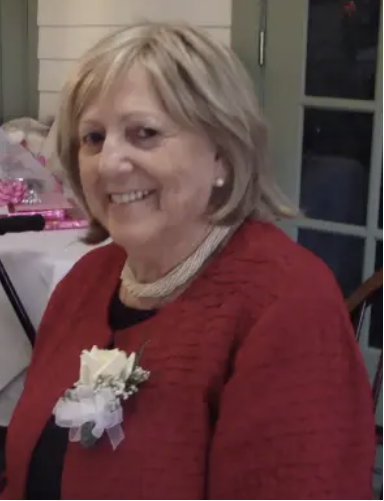
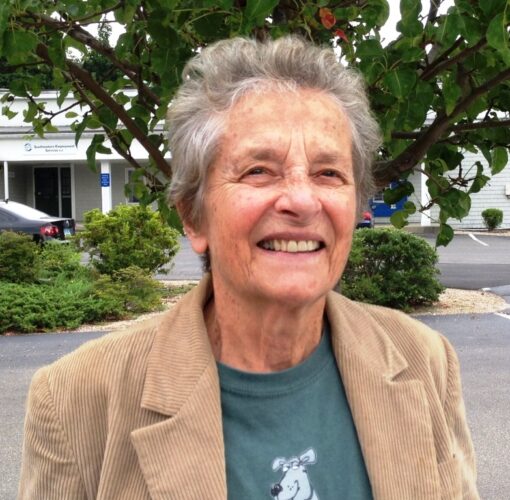
DANIELSON, CONN. – Roxanne Teguis Pappas, 92, a longtime resident of Killingly, passed away peacefully, surrounded by her family on Friday morning, July 12, 2024, at Westview Health Care Center. She was the loving wife of the late George Peter Pappas, and the daughter of the late Nick Peter and Irene (Karapanos) Teguis.
Roxanne was born in the former Yugoslavia and came to the United States when she was just three months old. She was a graduate of Tourtellotte High School and Annhurst College. On June 22, 1952, Roxanne and George were united in marriage at the Sts. Constantine and Helen Greek Orthodox Church in Webster, MA. She worked for many years for the Killingly Board of Education as an executive secretary to the Superintendent of schools.
Roxanne was very active in her community, and her love for her town and its government led her to take on many active roles. Most notably, Roxanne was a member and former Vice Chairman of the Democratic Town Committee, and she was elected as Chairwoman to the Killingly Town Council where she served for many years. She was chairperson to the Board of Directors for the Killingly Elderly Housing, and was a liaison for the Killingly Housing Authority. Roxanne was the Chairperson for the KELP subcommittee, which took major steps at the time to preserve the clean air quality for Killingly. In addition, she also served on the Council of Governments, Northeast Visitor’s Group, Quinebaug and Heritage Corridor. Roxanne was also a Justice of the Peace.
In 2013, Senator Blumenthal presented Roxanne a special recognition award for her service and dedication to the Democratic Party and she also received an award from the State of Connecticut General Assembly for her years of service to the Democratic Town Committee and the Killingly Town Council.
Roxanne’s love for the arts, led her to be on the Board of Director’s for Opera New England, and she was a patron of the Goodspeed Opera House, often going there with her late husband. She was artistic and creative, and she loved to paint and stencil on velvet canvases, often framing her pieces. She was an avid reader, and enjoyed keeping up with national issues. Roxanne enjoyed summers by going to the beach in Watch Hill, RI, sailing with her family on the boat “Roxanne” and playing tennis. She enjoyed spending time with her sisters’ Eleanor and Mary, and with the many longtime friends that she has had through the years.
Roxanne was a member of the Holy Trinity Greek Orthodox Church in Danielson and had a deep faith in God. She was proud of her Greek heritage and made the best Spanakopita and Koulourakia (Greek Easter cookies) rivaled only by her sister Mary.
Roxanne will be fondly remembered as a very loving and caring wife, mother, grandmother, sister and friend. She was very good at offering advice and wise words of wisdom to whom was ever in need. She could make you smile and laugh and was positive in her thoughts. Roxanne could be heard saying, “Make the most of each and every day.” She would always ask how you were doing, and she wanted to make sure you were doing okay, and would always put others first.
Roxanne is survived by her daughter, Althea Caulkins and her husband Richard and her son, Michael Pappas all of Old Lyme; her sisters, Mary Teguis Fatsi and Eleanor Teguis both of Thompson; and her grandchildren, Nicole Caulkins and her husband Chris Doyle of London, England, Micaela Caulkins of East Lyme, and Samantha Caulkins of Watertown, MA. She was predeceased by her sister Dorothy (Dina) A. Teguis.
Roxanne is also survived by a goddaughter, Roxanne P. Broulliard as well as numerous nieces, nephews, and cousins.
Relatives and friends are invited to visit with Roxanne’s family from 10:00 a.m. to 11:00 a.m. On Friday, July 19, 2024, in the Holy Trinity Greek Orthodox Church, 80 Water St., Danielson, CT 06239, followed by a funeral service at 11:00 a.m. Burial will follow in Westfield Cemetery, Danielson.
In lieu of flowers, Memorial donations may be made in Roxanne’s memory to the Holy Trinity Greek Orthodox Church, P.O. Box 236, Danielson, CT 06239. Funeral arrangements have been entrusted to the Gilman Funeral Home & Crematory, 104 Church St., Putnam, CT 06260. For memorial guestbook visit www.GilmanAndValade.com.
The family would like to thank Dr. Joseph Botta, her primary care physician, and Dr. David Candow as well as Westview Health Care Center for their exceptional care of Roxanne.
Editor’s Note: We are delighted to welcome Jen Petty Hilger back to LymeLine. She wrote a very popular ‘Literature in the Lymes’ column for us until 2014.
One could suppose this is the afterlife of a book reviewer. Welcome to review Number 101 … after a brief 10-year hiatus.
Sebastian Junger is a very smart man. He is a well-educated man. He is a brave man, a well traveled man. He is a man, who has questioned death many times and faced death a few times, but until the summer of 2020 he had never truly questioned its finality. The place where his very smart brain and his very real soul intersect is what fascinates me.
This book about his literal “time of dying” is remarkable for its ability to translate the experience. If you’ve read The Perfect Storm, you know how well he captures a tale. His investigative prowess, journalistic experience and sheer narrative skill weave a fast-moving powerhouse of a story.
This time it is his own near death experience. He barely, barely, survives a ruptured aneurysm. As a an atheist, he comes at his experience from a purely scientific angle and is astounded to encounter something inexplicably outside individual consciousness.
As the medical team at the Hyannis Hospital desperately, almost impossibly, tries to transfuse enough blood to keep him alive while locating the rupture, Junger slips almost away. He sees both his dead father above him and an abyss below him. Neither is comforting nor expected.
What Junger encounters is previously unfathomable to him and he tries to wrap his mind around it while explaining, quite rationally, the arguments for and against it. While telling us in great detail, the medical trauma unfolding, he presents scientific and philosophical ideas on the biology of the spirit. He references great mathematical minds like Einstein, Schrödinger, Leibniz, and others.
From the minutiae of quantum mechanics to the greatest expanses of the known galaxies, everything we discover leads to more we don’t know. We don’t know what we don’t know. Nothing interests me more than the opening of a mind; the moment when a light turns on and the room will never be as dark as it was before.
This experience forever changed the way Sebastian Junger looks at the world. He is the first to admit it. I look forward to his writing in the future and the impact this breadth of insight will have.
About the author: Jen Petty Hilger grew up in New York and London, England, but finds herself happily quiet living by the water in Old Lyme. She and her husband have six children between them and a myriad of rescued animals.
The elections to the European Parliament on June 9, 2024, raised more interest, but also more concern than ever because of the rise of the populist movement in the continent.
Every five years, the 720 Members of the European Parliament (MEPs) are elected by universal suffrage in a number proportional to the size of the states’ population, e.g., France is allotted 81 seats. The parties existing in each European Union (EU) country join the seven main political groups of the European Parliament, which can be described as follows:
The centrist EPP (European Popular Party) is the largest group with 186 members. The president of the Commission—incumbent and reelected Ursula von Leyen (who used to be the Minister of Defense in the cabinet of Angela Merkel)—belongs to the EPP. The nomination of the leaders of the main EU institutions (Commission, European Council, diplomatic services, etc.) have to be approved by the Parliament, hence the importance of this legislative body.
The second largest party—S & D (Social Democrats)—has 135 members. The right-left coalition with the EPP has dominated the Parliament’s history for a long time.
In third position comes the ID (Identity and Democracy) It is a far-right group, which has just been transformed into the “Patriots of Europe” on July 8, 2024. It is growing fast, attracting populists from several countries like Hungary, the Netherlands, Austria, the Czech Republic and a few others. It has 78 members.
Giorgia Meloni and her party, the “Brothers of Italy,” as well as AfD (Alternative for Democracy) in Germany, have been keeping away from the new Patriots party until now. For the time being, they they remain in the ECR group (European Conservatives and Reformists). Although a far right prime minister, Meloni is an Atlanticist and praises pluralism—she is gradually growing more pro-Europe and wants to assist Ukraine .
The results of the June 9 elections were grim.
In Western Europe, governments of some countries are trying to adjust and contain the populists. As an example, in the Netherlands, a coalition of four right-wing parties runs the government, but Dick Schoof—the Prime Minister—is a centrist. In Germany, the left-wing AfD obtained only 16 percent of the votes whereas the ruling coalition of three parties (FPD, CDU and Greens) received 30 percent on June 9.
In Eastern Europe, however, the populists seemed to be losing steam somewhat. Donald Tusk, the Polish prime minister is working hard at undoing the societal damages done by his predecessor in the PiS (Poland’s Law and Justice Party). The right-wing prime minister of Slovakia must govern with a strong opposition and so does Viktor Orban, who now has an opponent, Peter Magyar. A liberal is heading the Romanian government.
But the populist onslaught came mostly from France. In meteoric progress, Marine Le Pen’s party the RN (Rassemblement National or National Rally) increased its number of seats in the Assemblée Nationale, from 8 in 2017, to 89 in 2022 and then to 193 on June 30, 2024.The Cac40 (French stock market) plummeted by 6 percent on June 9.
It is interesting to note that In the new landscape of the European parliament, three strong women—Marine Le Pen, Giorgia Meloni and Estonian prime minister Kaja Kallas—cannot stand each other.
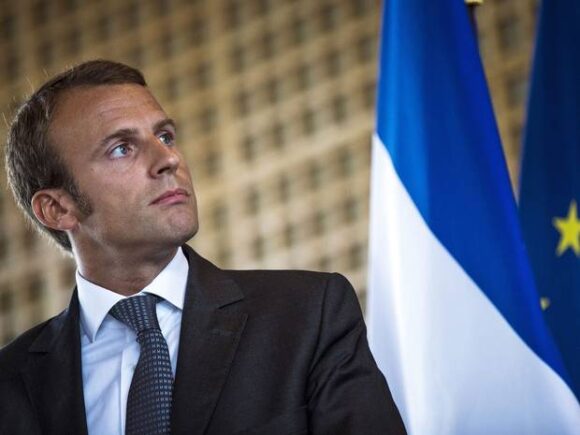
On the evening of June 9, President Emmanuel Macron of France made a decision, which took everybody by surprise, including his own prime minister Gabriel Attal. He dissolved the Assemblée, which was not supposed to happen until 2027 at the end of his term.
French President Emmanuel Macron.
Actually Macron had been thinking of doing just that for several months. He believed that this decision could achieve two goals—first, give the population a chance to express its opinions through a referendum and second, gamble on the hope that the new legislative body would function better within the Elysée.
Working sessions in the Assemblée had become a dysfunctional exercise with the two extreme parties—RN and LFI (La France Insoumise, or Unbowed France.) The latter is a far-left party headed by Jean Luc Mélanchon. Both these extreme parties became allies to hamper debates with the repeated use of motions de censure (votes of no confidence.) It was a dangerous decision for the president to dissolve Parliament, but whatever the outcome, he had nothing to lose.
When Roger Cohen, the New York Times correspondent in France, declared, “The Macron era is over, a chapter is closed,” he missed the complexity of French politics, and the ability of the people to rebound and emerge from chaos.
Actually “Macronism,” consisting of holding the center and acting as a magnet for moderates in both the right and the left, is still a force to reckon with, although it had been depleted by the loss of 100 seats since 2022. Given the visceral hostility of most French people toward the president, however, Macron’s name is best left unmentioned.
The two-round French elections to elect a new Assemblée were scheduled for June 30 and July 7. Those dates coincided with the beginning of the summer vacations. Families had made plans months in advance.
The problem was solved by creating more than three millions proxies and by people voting via the internet. There was a moment of panic but somehow the French got organized in record time. A swift electoral campaign got off the ground.
Participation in the voting process was impressive, reaching 69 percent—a number unsurpassed for 40 years .
The extraordinary rise of the RN in the first round of the French election with the electoral map turning bleu marine (navy blue)—an appropriate color for Marine Le Pen—seemed to give a jolt to the population and incite it to rise up to block the hard right in the second round.
Instructions were given to candidates running for a seat in the Assemblée to withdraw from the race in the case of “triangular elections” in order to beat the RN candidate. It was quite an unusual sight to see French politicians disciplined enough to follow instructions! Since there were more than 300 “triangular elections,” the result was astounding.
The RN came out in third place with 143 seats instead of the 220 seats for which they had hoped. The former Macron ‘s majority, called today Ensemble, was second with 163 seats and the NFP (Nouveau Front Populaire or New Popular front) was first with 182 seats .
Between the two rounds Jordan Bardella, 28, the chief of the RN and protégé of Le Pen, had been trained for four years by a communications specialist. He began to behave like a prime minister during his official appearances, obviously relishing the prospect of a future “co-habitation” with the president. He considered it a done deal that he would become prime minister.
He had set the bar very high, declaring that he would not accept that responsibility unless his party obtain the absolute majority. Bardella, acting effectively as a pure demagogue, made numerous promises and commitments which Marine Le Pen—a very seasoned politician—kept correcting and toning down.
One must note that the politicians during this intense time of post elections behaved with absolute correctness. No one questioned the validity of the elections’ results. In fact Prime Minister Gabriel Attal offered his resignation immediately on the very night of July 7.
Bardella said, “We have made mistakes and that includes myself.” They did not dwell on their disappointment but rather rebounded. Le Pen declared, “I have been a politician for too long to say that I was disappointed in the result.” Attal transitioned from being a prime minister to become the leader of the Renaissance party in the Assemblée.
Bardella turned his defeat in France into an advance in the European parliament. He now is the head of the new populist group called “Patriots for Europe” in Strasbourg. Unfortunately he will be even more dangerous there than in France by threatening to undermine the EU from within. Le Pen is placing herself in pole position for the 2027 presidential election.
For several days after the July 7 elections, the political scene in France has been rather confusing. It is going through labor pains to form a government. The left-wing NFP had been the driving force in the prior elections. They feel that they have a right to nominate the prime minister since their party came out as a winner on July 7—but they do not have the majority enabling them to decide.
Furthermore their alliance is fragile and made up of socialists and hard left politicians, who do not get along. Belgian neighbors advised the French people not to be too impatient. Belgium remained one whole year with a “technical government,” which just managed routine issues . Even Germany operated for two and a half months without a government.
None of the three French groups acquired the 289 seats needed to qualify for an “absolute majority.” In the future, whether they want it or not they will have to enter into alliances with other parties in order to govern. Otherwise, ironically, they will have to use the 49-3 (equivalent to Executive Orders) for which Macron has been so criticized in recent years.
The NFP has a program, which appeals strongly to the people—raise the minimum wages or smic, return to the retirement age to 60, reduce the tva (value-added tax.) But these measures will cost billions, which France can ill-afford. Besides, when the NFP declares that it wants to promote its own program and nothing else, and rejects compromises, it is a sure recipe for stalemates.
Today the Elysée Palace looks empty. The power has shifted to parliament.
France itself saved the day—at least for now. The results of the July 7 second round of French legislative elections were greeted almost across the board in Europe with a huge sigh of relief.
Editor’s Note:This is the opinion of Nicole Prévost Logan.
Nicole Prévost Logan
About the author: Nicole Prévost Logan divides her time between Essex and Paris, spending summers in the former and winters in the latter. She writes an occasional column for us from her Paris home where her topics will include politics, economy, social unrest — mostly in France — but also in other European countries. She also covers a variety of art exhibits and the performing arts in Europe. Logan is the author of ‘Forever on the Road: A Franco-American Family’s Thirty Years in the Foreign Service,’ an autobiography of her life as the wife of an overseas diplomat, who lived in 10 foreign countries on three continents. Her experiences during her foreign service life included being in Lebanon when civil war erupted, excavating a medieval city in Moscow and spending a week under house arrest in Guinea.
OLD LYME — Paul Francis Hugo Holt died at his home in Old Lyme, CT, on June 18th at age 78. He was the only son of Henry and Clara Holt (née Purslow), born in London, UK in 1946. He is survived by his beloved wife of 44 years, Linda; daughters Nicki Brown (George) and Melissa Rowles (Terry), and son Andrew Holt (Mary Grace); and grandchildren Chelsey, Benji, Lily and Hugo …
… He was dedicated to the Florence Griswold Museum in Old Lyme, serving as a trustee for many years … He was an equally dedicated compiler of histories: of his family, of the town of Old Lyme, and of his beloved Black Hall Golf Club.
… A celebration of his life will be held in Old Lyme in due course. In lieu of flowers, please consider a donation to the Florence Griswold Museum.
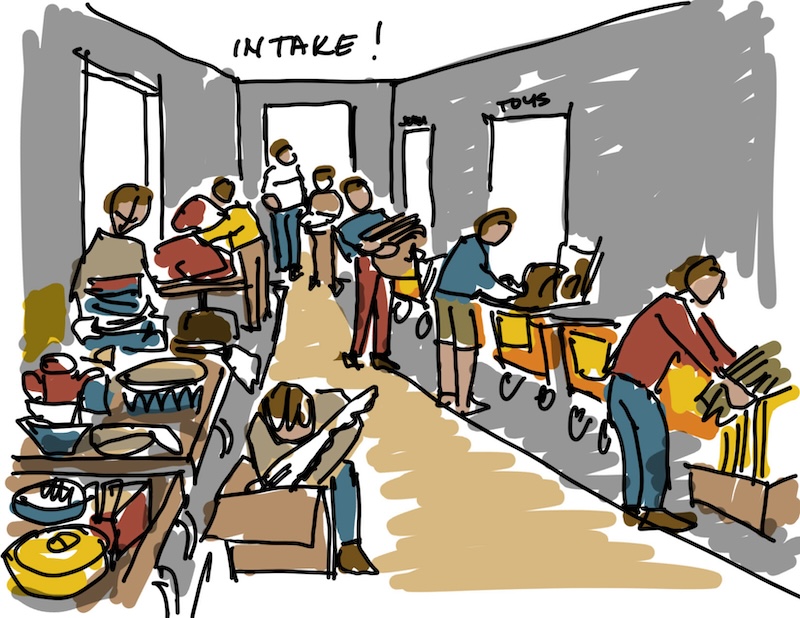
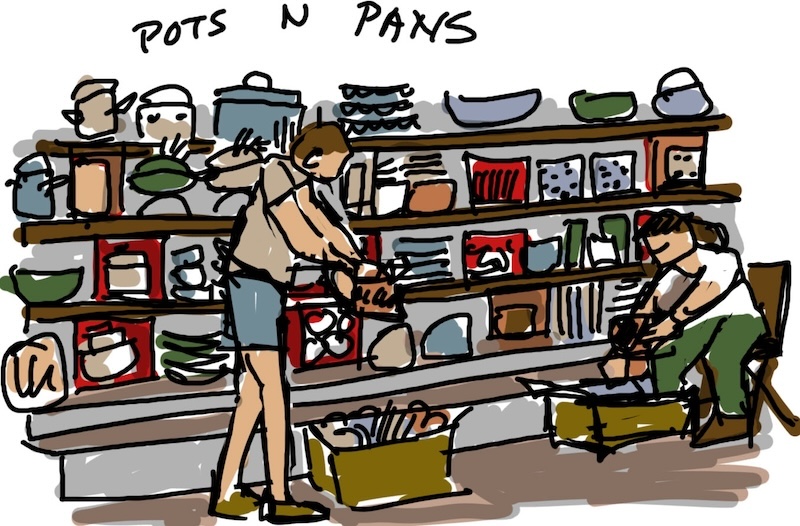
Editor’s Note: The First Congregational Church of Old Lyme’s 86th Annual White Elephant Sale is over. The results have not yet been finalized but we are hearing it was perhaps yet another record-breaking success. But how do the organizers pull it off year after year? We received this delightful series of cartoons from Edie Twining illustrating how the remarkably efficient sorting process is followed prior to the sale.She also sent a written description of the steps that are pursued with precision and expressed her thanks to all involved for welcoming her as one of the volunteers. Twining submitted the artwork and text as a ‘Comment’ but we have chosen to share them as our lead story today because, in our opinion, they offer such a pleasant way to start the week. OLD LYME—The volunteers at the White Elephant Sale are an amazing group of people from all denominations and all persuasions. We all work in our sections sorting miles and miles of donations.
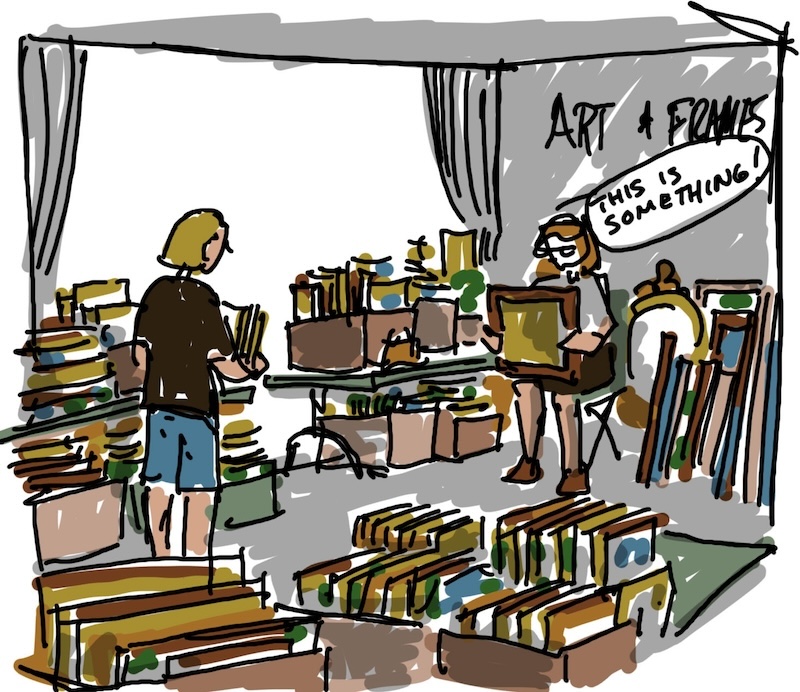
Art & Frames.
A typical morning of intake consists of a rush of ‘in-takers’ unloading vehicles and unpacking plastic crates, cardboard boxes and garbage bags.
Cleaning, sorting, tagging.
Each item is sorted into rows of shopping carts along one side of the hall and tables across from them. Big yellow signs indicate categories like: pots ‘n’ pans, appliances, books, music, men’s, kid’s, women’s clothes, toys, shoes, art, fine goods, kitchen, knick-knacks, linens, etc. …
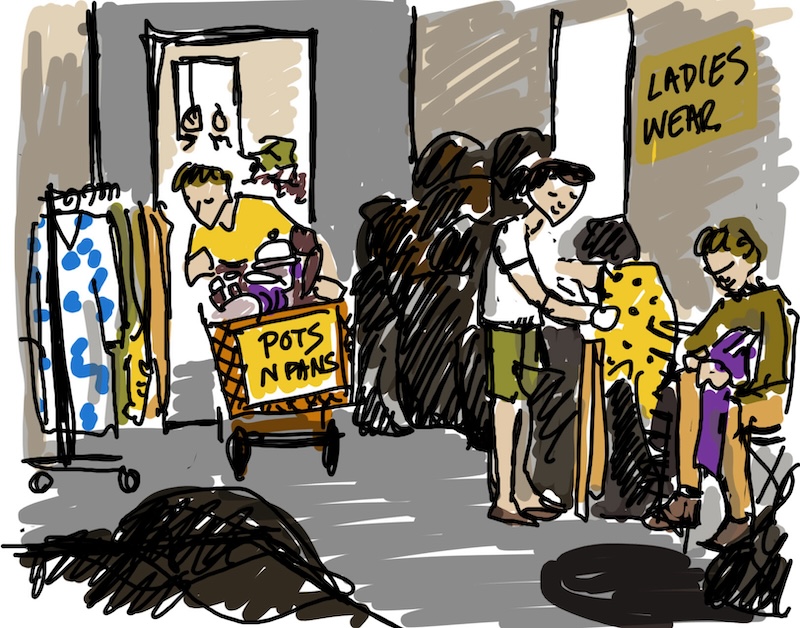
Pots ‘n’ Pans
The carts are rolled down to departments or the elevator and taken to Sunday School rooms in the basement where sorters clean, sort and tag every item. Bag after bag of clothing is distributed to Men’s, Kid’s and Women’s departments. Some days you can barely get by the piles of bags of women’s clothes. Helpers hang each item onto a rolling rack or place it into Accessories bins.