OLD LYME — On April 20, the local 911 office dispatched a call to Old Lyme Emergency Medical Services (OLEMS) with a report of someone experiencing chest pains.
Carlos Diaz was one of the OLEMS members to receive an award for their life-saving actions. He stands with his family after being presented with the AHA certificate.
The day-crew member, Emergency Medical Technician (EMT) Carlos Diaz, pictured above, left immediately in the Old Lyme ambulance.
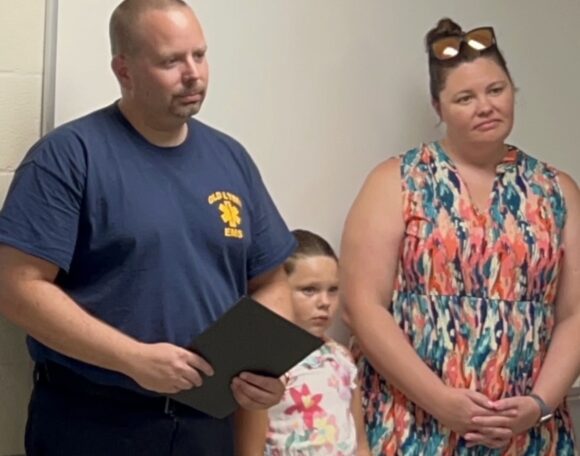
Old Lyme EMS Deputy Chief Dave Musto, who is an EMT, received an award.
Dave Musto, who is also an EMT as well as OLEMS Deputy Chief, and two other OL First Responders — Thomas Moore and Archer Evans, who were Lyme-Old Lyme High School (LOLHS) seniors at the time and have since graduated from LOLHS in June — also traveled to the incident location in their own vehicles.
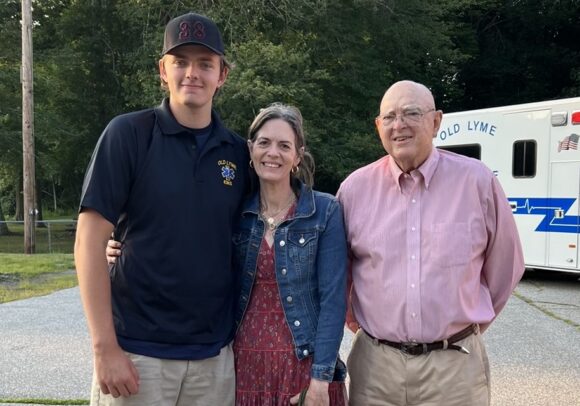
Thomas Moore, who was a senior at Lyme-Old Lyme High School at the time of the incident, stands with his mother and grandfather after receiving his award.
In addition, due to the nature of this call that required advanced life-saving support, Middlesex Health Paramedic Phil Coco was immediately dispatched by Valley Shore 911 to the patient’s home.
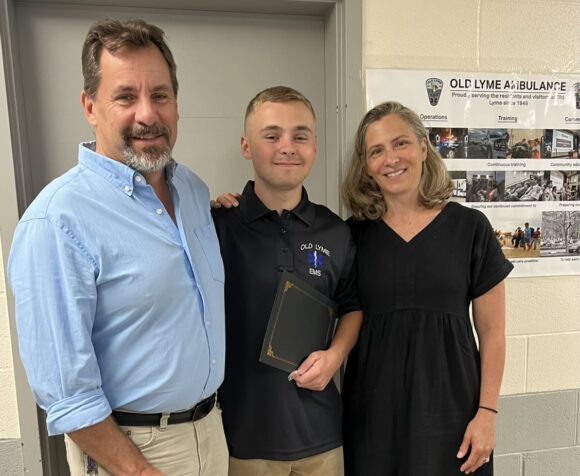
Archer Evans, who was also a senior at Lyme-Old Lyme High School at the time of the incident, stands with his parents after receiving his award.
In a matter of minutes, all these EMS responders from a variety of locations arrived at the patient’s home. This patient’s chest pain soon turned into a cardiac arrest and automated external defibrillation (AED) and cardiopulmonary resuscitation (CPR) were initiated.
Thankfully, the patient was successfully revived in his home.
However, during his transport to the Emergency Room (ER) at L & M Hospital, the patient went back into cardiac arrest, but this time the AED machine did not detect a shockable rhythm. The crew immediately started CPR again and continued it for the whole journey to the hospital, where the ER technicians continued lifesaving measures.
The patient was kept in the hospital for several days, and ultimately survived the heart attack/cardiac arrest.
At the OLEMS recent business meeting, the patient attended with his wife and presented the crew, who likely saved his life, with American Heart Association HeartSafe Awards. These were much appreciated by the recipients, who, in the case of the two LOLHS seniors, have been friends since their earliest school days.
Both students also volunteer for the Lyme and Old Lyme Fire Departments. Evans’s father, John, is a volunteer with the Lyme Fire Department as well. Archer Evans is taking a gap year before attending an engineering school in Boston. During the year, he will complete his Firefighter 1 training along with some additional training programs.
The patient wishes to remain anonymous.
Jane Bysko, who serves as OLEMS President, commented, “We are very proud of our young community members, who step up to the plate and volunteer their time [to the OLEMS]. They undertake continuous training under the guidance of our Training Officer Ray Belval, who is also the invaluable liaison with the Lyme-Old Lyme Schools.”
She added, “If you are interested in joining OLEMS, call 860-434-0089. No experience is needed, just an interest in helping people in your community. We will help find a course for you.”
Jennifer Pitman greets Kindergarten students arriving for their first day of school at Mile Creek. Pitman is the art teacher at Mile Creek School. All photos by LOL Schools except where indicated.
OLD LYME —UPDATED 8/25 with more photos: Thursday, Aug. 24, was the first day of school for students of Lyme-Old Lyme (LOL) Schools and all reports indicate that it has been a successful start to the new academic year.
Guess what I did today!
Asked that morning by e-mail how ‘Opening Day’ was going, LOL Schools Superintendent Ian Neviaser responded, “We are happy to have everyone back and to see their smiling faces.”
Smiles galore were everywhere to be seen.
And what are his thoughts on the upcoming school year? He said, “[It] looks to be another successful year in the Lyme-Old Lyme Schools as evidenced by another Top 10 ranking in state achievement scores.”
The sign says it all. Photo by M. Tackett.
We also inquired about the ongoing construction project at the schools and when ground is likely to be broken. Neviaser replied, “Our PK-8 Building Committee is working hard to move our renovation projects forward.”
Back in the groove, Lyme-Old Lyme Middle School students were already hard at work in their science class.
He added, “We expect construction to begin next summer.”
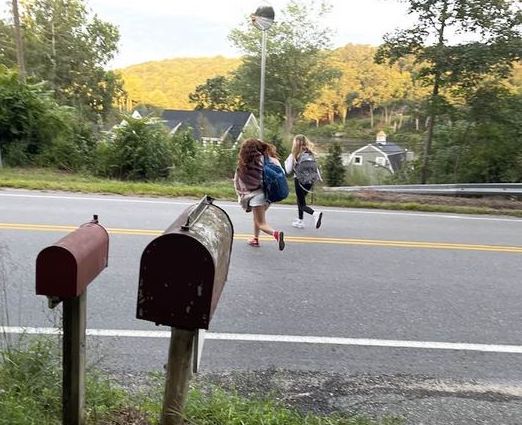
Beth (left) and Renee Viera dash for the school bus in Lyme this morning — they made it! Photo by K. Monson.
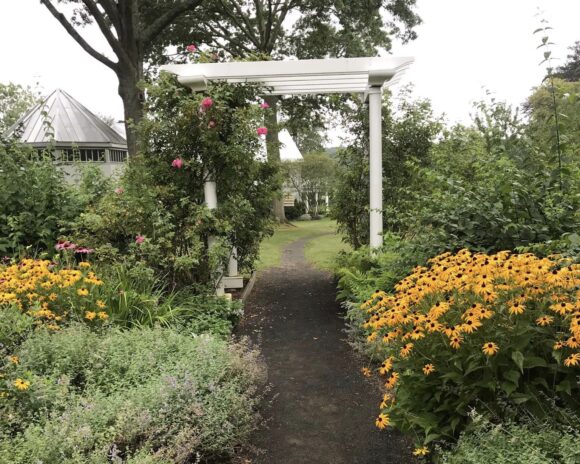
Beautiful borders can be seen at the Florence Griswold Museum in August.
August has always been one my least favorite months in the garden; but plentiful spring rain has resulted in bountiful fragrance, bloom and foliage. We have a relatively short growing season here in New England and to enjoy a healthy colorful border is so satisfying. However, by this time in the season, when early perennials have gone by, there are a few gaps to fill in with annuals or later blooming perennials.
Maureen Haseley-Jones is “The English Lady.”
Gardens are a constantly changing scene of beauty in motion and plantings that looked good last year, may be oversized, and in need of division or transplant. When the weather is cooler in September, transplanting can be tackled on some overgrown specimens, so that every plant has its own space with good air circulation and are able to perform at their best.
Divide those plants that have been in the soil for four years or more. You may have noticed that these plants are not blooming as profusely as they did when first planted. When you divide and set aside the divisions, as there are always fellow gardeners who will be grateful to receive some transplants.
Now, continue to keep up the deadheading; by doing so your garden will always appear fresh and perky. After the hot, dry days we have had of late, watering is of major importance. In this regard, make sure your garden receives at least one inch of water a week and that your containers receive a daily dose of water, in the early morning and early evening. Soaker hoses in the borders are a much more efficient method of watering; using this method, the water goes straight to the roots where it is needed. By using soaker hoses you will not lose 40 percent of moisture to evaporation and you are also preventing water from landing on plant foliage, which can result in disease and mildew.
When you cut back tired looking annuals, a new flush of bloom will appear in a few short weeks. On closer inspection some of you may notice that the borders are looking somewhat weary and need a bright boost of new specimens to perk things up. These specimens may be found right now as many garden centers are offering late season bargains. When the perennial Coreopsis and Spirea have finished blooming; cut off the dead bloom with the garden shears and enjoy the appearance of vibrant bright bloom shortly.
Roses
It is of the utmost importance to stop feeding roses now, in August. The reason for this is that roses require at least nine weeks to gently go into a slow healthy dormancy before the first frost. In my September tips, I will give you suggestions on partially pruning roses in early fall, followed by a second pruning the following April. This double pruning method produces the healthiest and most prolific bloom.
Containers
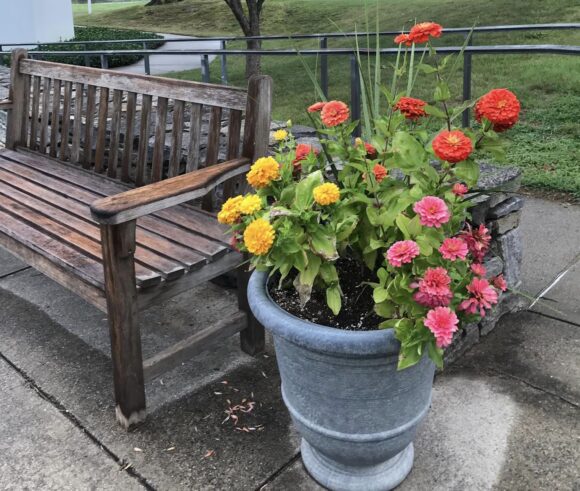
Containers always add color to any garden. Photo by L. Ahnert.
Every couple of weeks give your containers a little extra composted manure when watering which will keep these miniature gardens bright and cheerful into early fall. Add the manure on top of the natural brown mulch as both manure and mulch help retain moisture and help to retard weeds. In the morning if you do not have time to water the containers before you go to work or run errands, simply empty your ice trays into the containers, this will provide slow -release watering until you are able to add more when you return home.
With the high heat and humidity which we have been experiencing recently, powdery mildew may be appearing on certain species like Summer Phlox, Monarda and Hydrangeas. If you notice this problem, I suggest spraying my remedy of one gallon of water in a spray container, adding one tablespoon of baking soda and a dash of vegetable oil. Always spray in the morning before the temperature and humidity numbers combined together equal 160.
Continue adding more composted manure to vegetables each month, as vegetables, particularly annual vegetables are heavy feeders. To prevent animals from munching on your precious bounty, place an old sneaker or a piece of carpet that your dog had lain on in among the vegetables; these odors help keep furry marauders away.
Peonies
Place your orders for Peonies now so they can be delivered for September planting. Photo by Jaroslava Petrášová on Unsplash.
September is the month to transplant, divide or plant Peonies. Following the first hard frost in November cut any existing Peonies down to within six inches from the ground and add a little natural brown mulch around them to protect the pink-eyed roots, which are close to the soil surface. When planting Peonies or transplanting make sure that the ‘pink eyes’ on the roots are barely covered with soil, if the Peonies are planted any deeper, it is likely that you may not have bloom next year.
Begin compiling your list of spring bulbs now for the best choice of bulbs to be available for you. Please feel free to email me with any gardening questions to MaureenHaseleyJones@gmail.com. I look forward to seeing you in your garden in September, in the meantime enjoy being outdoors and remember to stretch, hydrate and take time to smell the bloom.
If you would like a garden consultation or conversation with my son Ian, of LandscapesbyIan.com, feel free to get in touch with him. As the saying goes ‘ the apple does not fall far from the tree’ and, in my estimation, Ian has outpaced me with regard to creativity and production!
About the author: Maureen Haseley-Jones is a member of a family of renowned horticultural artisans, whose landscaping heritage dates back to the 17th century. She is one of the founders, together with her son Ian, of, The English Lady Landscape and Home Company. Maureen and Ian are landscape designers and garden experts, who believe that everyone deserves to live in an eco-conscious environment and enjoy the pleasure that it brings. Maureen learned her design skills from both her mother and grandmother, and honed her horticultural and construction skills while working in the family nursery and landscape business in the U.K. Her formal horticultural training was undertaken at the Royal Botanic Gardens at Kew in Surrey.
LYME — Robert John “Bob” Chandler, 88, of Cove Road, Lyme, died Tuesday, Aug. 15, 2023, at his residence with his family by his side. Mr. Chandler was born Feb. 5, 1935, in New Jersey, the son of Alfred and Margaret Chandler.
Beloved by his wife, Patricia Chandler, his daughter Gerriann Jackson, son Jeff Chandler and grandchildren, Joshua Jackson, Maxwell Jackson, Sam Chandler and Tess Chandler, he is sorely missed …
Married just shy of 70 years, the devotion and love between them was something to behold. He appreciated life and all it had to offer, often saying his life was a banquet, while gazing at his wife …
To honor Mr. Chandler’s wishes, no services will be held at this time …
“You should not go to France. it is too dangerous.” My American friends expressed their concern when I flew out to France for a summer vacation in early July.
I must admit that the news coverage of what happened in that country in late June was pretty scary: riots for five days and nights, hundreds of burnt cars, carcasses of buses left on the streets, black débris remaining after the many acts of arson, smashed storefronts and bus stops, and plundered shops and supermarkets.
In Montreuil, a suburb east of Paris, the demonstrators had used fireworks as a shield of smoke against the police. Videos showed children as young as 12 taking part in this wild rampage, running away from looted stores loaded with clothes and other goods.
After I landed at Charles de Gaulle Airport in Paris, I expected to find widespread devastation with violence and vandalism still apparent.
But no, the country seemed normal, traffic was as heavy as usual, restaurants full, people were flocking to outdoor markets and golf fans were eager to play their 18 holes over the weekend.
The explosion of anger against the police is not new in France with recurrent complaints against alleged police brutality and racial profiling. But this time it reached an unprecedented intensity.
It all started when Nahel Merzouk was shot on June 27 after refusing to stop his car when summoned to do so by police officers. One month after the shooting, Le Monde published a description of what happened, based on the preliminary results of the inquiry.
The traffic police had been alerted that a Mercedes was speeding through Nanterre, a suburb west of Paris, and that it carried guns. The traffic police then started chasing the car, which entered the bus lane, ran red lights and crossed a junction without slowing down. Finally the police managed to stop the yellow Mercedes AM, as shown on a video. This particular model has an incredible acceleration capacity and can reach a speed of 100 km per hour within less than four seconds.
As the police officers, with blaring sirens, ordered Algerian-born Nahel Merzouk to pull over, the latter Instead made his vehicle surge away and attempted to flee. This is when the police shot the young man.
Apparently the Mercedes had been rented the day before from a place, which opened for business just three months prior. It seems odd that a 17-year old would rent such a fancy car, particularly when, in France, the age to get a driver’s license is 18.
Riots and pillaging occurred in cities all over France including in the capital city of Paris. File photo by Randy Colas on Unsplash
The atmosphere of hatred was also directed against any symbol of public authority vested in central or local governments, such as town halls and police barracks were sacked. Schools, gyms, social centers, and 300 bank branches were destroyed. Public buildings were damaged. In Nanterre, the rioters vandalized a memorial to the victims of the Holocaust. In Marseilles, the largest public library, named Alcazar, was also damaged.
After the violence abated, the population was left with a feeling of total paralysis. It was the middle class that had been primarily hit. Hundreds of shopkeepers saw their merchandise and also their stocks pillaged. Curfews and closures of public transport affected mostly the working population in poor suburbs.
Threat and insults were hurled at local elected officials among the 35,000 municipalities existing in France. The private home of the mayor of l’Hay-les-Roses, a small town south of Paris, went up in smoke and his family was attacked.
On June 30, President Macron had to cancel his official visit to Germany – the first time that has ever happened.
French police face protesters on a street blocked with garbage cans. Photo by Oscar Brouchot on Unsplash
The government deployed 45,000 police, including RAID ( Research, Assistance, Intervention, Dissuasion), which is an élite unit of the French police, and GIGN ( Groupe d’Intervention de la Gendarmerie Nationale). Since 2016, the law has authorized police to use firearms in cases of self-defense and to shoot a vehicle fleeing at traffic stops. More than 3,500 demonstrators were arrested. Macron threatened to cut off social networks at times of riots. He was he was accused of authoritarianism for saying that.
The financial sequels of the unrest are enormous. It is estimated at about one billion Euros, including the anticipated loss on future business. Who is going to pay? As usual, the taxpayers and mostly the little guy. The close to 1,000 shopkeepers, who suffered loss and damage, may get 10,000 Euros compensation paid by insurance . Financial aid will be provided by chambers of commerce and private associations. The cost of all this assistance will eventually be borne by the community.
The French population is deeply divided on the topic of police responsibility. Attempting a discussion is like entering a mine-field and you feel like you are walking on eggshells whenever you dare to express an opinion.
Conservatives and middle of the road people want law and order. They want scenes of violence in the street to be curbed. They admire the courage of police, who are so often exposed to angry mobs and to a society increasingly hostile. Hundreds of those police have been injured in recent years. The police should not be “above” the law but, at the same time, should not be “under” the law, they say. For the other segment of the population, police are the enemy with the presumption of culpability against them latent.
The two sides of public opinion are so irreconcilable that they create immense tension and the possibility that a clash may happen at any time.
Nicole Prévost Logan
About the author: Nicole Prévost Logan divides her time between Essex and Paris, spending summers in the former and winters in the latter. She writes an occasional column for us from her Paris home where her topics will include politics, economy, social unrest — mostly in France — but also in other European countries. She also covers a variety of art exhibits and the performing arts in Europe. Logan is the author of ‘Forever on the Road: A Franco-American Family’s Thirty Years in the Foreign Service,’ an autobiography of her life as the wife of an overseas diplomat, who lived in 10 foreign countries on three continents. Her experiences during her foreign service life included being in Lebanon when civil war erupted, excavating a medieval city in Moscow and spending a week under house arrest in Guinea.
Editor’s Note:This is the opinion of Nicole Prévost Logan.