LYME — Jane M. Palmer, a retired psychiatric social worker, devoted countless hours to one of her life’s greatest passions: composing hand-written, deeply personal cards. She wrote thousands over the decades, … She signed her cards “Love, Jane”, which became her family nickname. “Love Jane” died on February 14, 2023, at her Lyme farmhouse and only steps away from her writing desk …
She was widowed for 15 years when she met George H. Palmer, … They married in 1992, and in 1996 they found their idyll: a 1789 farmhouse in Lyme. The move introduced them to the natural beauty of the Upper Valley, new friends and rewarding volunteer jobs. Jane did counseling at Lyme Elementary School … those cards-filled with family news, observations, reportage on life in Lyme and often recipes and newspaper clippings-were legion.
Jane was predeceased by George Palmer, … She is survived by her three Moore children: Pamela (Charles Rose) of Belmont, Ma.; Douglas (Therese) of Minneapolis; Nicholas (Iru Wang) of Lyme; a brother, Richard “Dick” Tucker of Chestnut Hill, Ma.; …
Jane did not wish to have a funeral, and at this time, no service is planned. Her family is contemplating a memorial service for springtime, when her beautiful gardens begin blooming again. Your input is welcome; please write Nick Moore at 172 Baker Hill Rd., Lyme, NH, 03768.
If you would like to make a donation in Jane’s memory, please direct it to one of her favorite volunteer projects, a post-secondary scholarship fund for Lyme students. https://www.lymefoundation.org/donate. Or you may mail a check to: The Lyme Foundation, P.O. Box 292, Lyme, NH, 03768. Please note: in memory of Jane Palmer, for the Griffith’s Fund.
OLD LYME — The Old Lyme Land Trust (OLLT) is offering YEA! (Youth Environmental Action) grants of $100 to $600 to support worthy environmental projects. Applicants should be 11-21 years old and live in Lyme or Old Lyme.
The Trust is especially eager to fund original and independent projects that otherwise might not happen. It welcomes requests for support of any project with positive environmental impact in which the applicant plays a major role, including relevant student and volunteer work.
Projects may be proposed anywhere, including on OLLT properties.
The applicant can either commit to rolling up his/her sleeves to help the natural world in the best way possible or come up with a creative approach to tackle a neglected problem — in either case, OLLT would like to assist.
The YEA! grant program is in honor of Edward J. Sopneski, former Trustee and longtime OLLT volunteer. Ed died in 2022 at age 87 following decades of work caring for the environment.
Edward J. Sopneski
He installed osprey platforms, removed invasive plants from his beloved Watch Rock Preserve, and worked to boost declining numbers of pollinators.
Sopneski was also keenly interested in encouraging the next generation to live a life of action to protect our natural world. That goal inspires these grants.
Grants are awarded on a rolling basis with decisions made by the OLLT Board when it meets, typically on the third Thursday of every odd month (January, March, May, etc.), and notification to applicants in the following weeks.
Applications should be submitted at least 10 days ahead of a meeting to assure consideration.
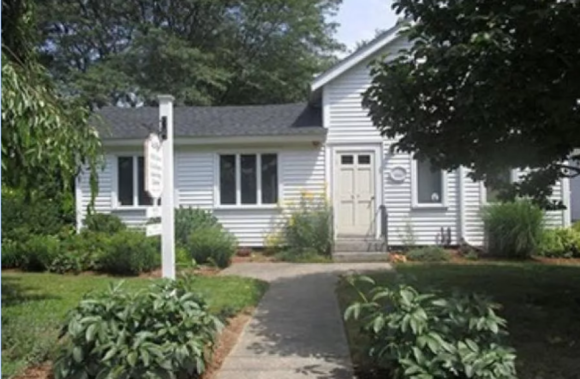
The Old Lyme Children’s Learning Center building at 57 Lyme Street has been closed and the decision taken to demolish it. Plans are underway to rebuild and reopen the property. File photo.
Center Hopes to Reopen in 2024, Plans Requires Approval From OL Historic District Commission, 12 Families Affected by Closure, Toddler and School Age Programs Not Affected by Decision
OLD LYME — 2/22 9amUPDATE (in italics): Kristen St. Germain, Old Lyme Children’s Learning Center (OLCLC) Board Chairman, has clarified today that no final decision has yet been taken on the proposed demolition as they are in early stages of their decision making.
She states by email, “The OLCLC Board believes at this point that it is the best course of action financially, but members recognize they still await key information. This includes the final costs of demolition and reconstruction, required permits and approvals from the Town of Old Lyme, and a decision from their insurance company regarding compensation.”
St. Germain adds, “Our priority has always been to provide an affordable childcare service to families and that we work hard to cover operational costs only. We do not have an endowment to draw from nor do we have a profit margin that allows us to be anything but fiscally responsible with this decision.”
2/20 8:32am: When a minor leak was discovered at the end of January inside the historic building owned by the Old Lyme Children’s Learning Center (OLCLC) at 57 Lyme St., the last thing anyone was expecting was that the building would end up being scheduled for demolition.
The OLCLC closed temporarily when the leak was discovered with the expectation that it would be repaired and the facility reopened by the middle of March. But as the work continued, one issue led to another and ultimately it was determined that a structural beam at the foot of the house was rotted to such an extent that the property was deemed irreparable and would need to be demolished.
Kristen St. Germain, who serves as the OLCLC Board Chair, explained to LymeLine by phone on Friday that the board intends to rebuild on the same site and reopen the Center sometime in 2024.
She explained, “Sadly 12 families in the Infants and Transition sections have had to find new daycare options,” and, “We had to let some staff go.” Fortunately, however, “The Toddler section takes place n the building behind the property [57 Lyme St.] and is unaffected,” Similarly, she noted the school-age programs of Before- and After-School Care are held in Center School and similarly not impacted by the decision.
St. Germain emphasized that the OLELC Board recognizes, “This is going to be hard.” She noted the Center has never had a mortgage as the building was bequeathed to the OLCLC Board by the late Connie Pike, and said, “The biggest obstacle is going to be financial. We are going to have to apply for a loan.”
Pointing out, “This couldn’t have come at a worse time. Our programs are thriving,” St. Germain noted a major fundraising effort would be launched when the project is closer to being fully underway. She also said that insurance options on the building are being investigated.
The Center was established in 1987 as Old Lyme Daycare and, according to the OLCLC website, “was shaped by the vision of Mrs. Connie Pike, a generous donor and supporter of the Center.”
Procedurally, the first thing the OLCLC Board has to do is submit an application to the Old Lyme Historic District Commission to demolish and rebuild the property.
Construction of the new property is anticipated to take 12 months.
St. Germain stressed that support through this challenging period has been extremely strong, noting, “Our parents have been awesome,” and adding positively, “By all giving our very best efforts, we will get through this.”
She concluded firmly, “if we’re going to do this [rebuild the Center], we ‘re going to do it right.”
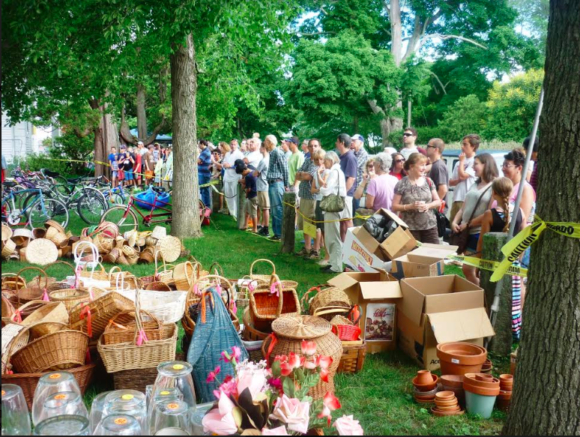
The annual White Elephant Sale will start this year on Friday, July 14, at the first strike of the church clock bell at 9 a.m.
OLD LYME — The First Congregational Church of Old Lyme has announced that the always popular White Elephant Sale will return again this year on Friday, July 14, and Saturday, July 15. The Sale is run by the church’s Ladies’ Benevolent Society.
The annual Sale was hosted continuously for 83 years prior to 2020, but then was cancelled in both 2020 and 2021 due to the COVID-19 pandemic. It was held last year and so this year’s sale is now the 85th!
Hours for the sale are 9 a.m. to 2 p.m. on Friday and 8 a.m. to 12 p.m. on Saturday.
Intake will take place for six days only beginning Thursday, June 29, and continuing through Saturday, July 1. Intake will then resume Wednesday, July 5, and continue through Friday, July 7.
Hours for Intake are 9 a.m. to 2 p.m. each day.
For more information on the sale and guidelines for intake, visit this link.
Volunteers are needed in every area of the sale. If you would like to volunteer, call the church office in June at 860-434-8686, select option 5, leave your name and phone number, and the organizers will respond promptly.
Paper-white narcissi have a beautiful and uplifting fragrance. Photo by Jonathan Diemel on Unsplash.
Maureen Haseley-Jones
This winter, as in other winters, when I need a blossom boost, I have enjoyed the fragrance of paper-white narcissus that I planted in tall glass vases. I surrounded the bulbs with seashells from White Sands Beach here in Old Lyme and kept them in a dark cool area keeping them moist as the roots developed. When the bulb foliage reached about six inches, I introduced the bulbs to indirect light.
The fragrance of this plant is so refreshing and each morning when entering my lounge, I inhaled it and felt immediately uplifted and ready for my day. I keep extra bulbs in a brown paper bag in the vegetable keeper in the refrigerator. These bulbs, I plant when the first blooms have gone by. With this method, I have a succession of bloom and fragrance in my home into spring.
In his annual appearance this year, the Groundhog let us know that we have six more weeks of winter. On that note, it’s a recognition for all gardeners that there is much to decide on and plan for this season in our gardens. The warm breath of Spring will be here before you know it and we will be filled with the anticipation that lives within all gardeners to get outdoors and plunge our hands into the soil.
For all of us gardeners, there is so much to look forward to and, to reiterate my modus operandi, I continue to stress the importance for you to garden organically. In this country and around the world, the results of pollution and chemicals are just some of the factors that are causing climate change.
We are in a crisis, with invaders that have already battered down the gates and invaded our gardens. These invaders are destroying Mother Nature and your health in the form of poisonous pesticides and herbicides. The main producers of these poisons are Monsanto, Bayer and other biological monsters, who have been decimating our planet, our soil, human health and doing all those monstrous crimes purely for selfish profit.
We have all been able to observe the result of the global warming in the colossal melting of the glaciers and how that has affected polar bear population, causing their demise in great numbers through starvation and disease. Here in the United States, we have seen the terrible floods and tornadoes and recently in California, the catastrophic flooding and mudslides.
Bees have been killed in the millions when our EPA under the Trump administration allowed the spraying of over 14 million acres of land, with poisonous chemicals. Bees pollinate 70 percent of the world’s food and their demise is our demise.
Last year was recorded as the hottest year on record. In this country, the drought in the west, that resulted in dry tinder conditions, caused devastating fires that brought death and destruction to many in California, Oregon and Colorado. Extreme weather patterns evident in the blizzards throughout this country and the deadly hurricanes are due to the rise of our oceans and the result of warming water. Climate has also had a tragic effect on earthquakes as we see in Turkey and Northern Syria.
Please do not listen to the naysayers who deny climate change, tell them to open their eyes to witness the results.
As gardeners, it is our task to help counteract these negative changes by using only organic methods of gardening on your own plot of land; what we do is in our own small patch of earth all contributes to healing the planet.
Over the span of over 20 years on my radio show WRCH 100.5 FM and through my Garden Earth lectures, I have received a commitment from thousands of people to discard all poisonous herbicides and pesticides and to garden organically. The response had been tremendously positive in the production of healthy gardens grown in healthy soil.
It begins by what you put into the soil for the growth of the plants, accomplished by adding liberal doses of my favorite stuff – manure. Manure either from the farm or in bags from the garden center. The following insert is from a book I am writing on gardening and the humus component.
In 1937, Franklin D Roosevelt said that ‘the nation that destroys its soil destroys itself.’
America has not heeded that warning. Precious soils in this country and around the world are being destroyed by dangerous practices in industrialized agriculture and poisonous chemicals, which completely disrupt our ecosystem and poison all living things.
In your own garden, you can build and retain a rich growing environment by building the Humus component. We are all carbon-based creatures as is all life on earth. Not only humans but also our soil microbes need carbon to flourish. And to attract carbon from the atmosphere into your soil you need to build the humus component.
How to Build the Humus Content
Do not till soil – tilling breaks up soil structure.
Step #1 Add composted manure three times each season –beginning in spring when the soil has reached a temperature of 50 degrees. If the soil has not reached that temperature, the soil organisms are not able to work with the bacteria in the manure to produce nutrients for the roots of the plants. Purchase a soil thermometer to check the soil’s temperature.
This year, following deep frosts the soil temperature may reach 50 degrees by the end of April to early May. Add the manure again in July to continue to nourish your growing plants and again in October to protect and nourish your plants through the winter. Manure is not a fertilizer; it builds soil structure and works with all the soil animals to keep a healthy disease-free growing environment.
Step #2 Add wood chips in the form of brown fine bark mulch or wood chips that you produce from your garden of aged wood chips with a combo of leaves, twigs and branches.
These two major steps build the humus component. If you do this in your garden – not only will you helping to heal the planet but also produce the healthiest of gardens.
A question I am often asked is, ‘Can I put manure over mulch for example in my July garden’? The answer is ‘yes’ – the manure together with nature’s moisture and your own irrigation enables the manure to find its way easily into the soil and the roots of your plants.
What Exactly Does Humus Do?
Humus is a critical ingredient in any garden.
Humus acts like a sponge and can hold 90 percent of its weight in water.
Because of its negative charge – plant nutrients stick to humus for nitrogen, calcium, phosphorus and other elements, which prevents these from washing away and acts as nature’s slow release fertilizer throughout the year.
Humus improves soil structure making it loose and friable, which helps a plant root in the soil with better access to nutrients, water and oxygen.
Humus also helps’ filter’ toxic chemicals from the soil, much like carbon-based water filtration systems that filter toxins from your water.
We cannot control industrialized agricultural practices, however, in your own garden you can make a difference. Feed the soil and it will feed the plants.
I have made statements about the humus component in tips, but I cannot over-stress its importance.
Now on to the next topic, this week I spoke with my friend Ann, who lives in Cheshire, in England, which is next door to my home county of Shropshire. Ann is an avid gardener and she told me that her daffodils are well above the soil and last week she started seeds in the greenhouse.
Seed-Planting in Connecticut
February 20th to March 20th is the time for serious indoor seed planting here. Check which garden centers are stocking organic seeds or go online for the organic varieties – one company that I use is “Botanical Interests”. Do not go overboard when buying packs of seeds as there are about 500 seeds in each packet. If you do purchase too many – have a seed sharing party with gardening friends.
Equipment to have on hand for seed planting– cheap envelopes, fresh sterilized potting soil mix, and sphagnum moss. Also seed trays, egg cartons and cardboard milk containers that are cut down also work well. Make sure all containers are scrupulously clean. Sphagnum moss works well as a planting medium; the moss can prevent a soil born fungus that causes “damping off” which causes seeds to rot before germination. I have, together with many gardening friends used this method for years and have lost no seeds to “damping off”.
For tiny seeds, I use the moss as the planting mix and for larger seeds, I install a topsoil base and a layer of the moss on top of the soil. I mix fine seeds with sand before I sow; this method helps to loosen them up. Soak the seeds overnight before planting and just before planting spray them with warm water, never cold as cold water can delay germination. When they have germinated, water gently.
The best method of watering seedlings is to water from the bottom. But, if you feel you must top water, just mist with a fine sprayer, otherwise you will drown the delicate seeds, washing them out of the planting mix. Use new sterilized soil when seeding and do not save any leftover soil, add leftover soil mix to houseplants or put it in the garden. Leftover soil from the previous year, can develop disease, which can ruin future seedling crops. If you are growing seedlings on a windowsill, place them on a south or west-facing sill; seedlings need light, not heat to thrive.
Winter Care of Houseplants
My houseplants lift my spirits, especially in winter when the landscape is rather monochromatic. I talk to my plants enjoying the blooming variety and the different foliage varieties and thank them for cleaning the air in a stuffy home environment.
Keep your houseplants away from draughts and direct heat. If you are able, have humidifiers and air purifiers in the rooms, which will benefit not only the plants but also your own health. Place pebble trays under the plants and keep the pebbles moist for additional humidity.
Spray houseplants every few days with lukewarm water and once every couple of weeks, put the plants in a sink or bathtub and allow water to run freely over the plant to remove dust from the leaves and clean salt residue from the soil. The exception to the spray or soak rule is African violets as they do not do well with wet leaves.
Houseplants can lift the spirits … especially in winter. Photo by Alena Ganzhela on Unsplash.
Aphids and white fly thrive indoors in winter and an organic sulphur solution called Safer works well to clean the soil of the insect eggs and from the foliage. Perhaps you are fortunate like me to have ladybugs in your home in winter; if so, allow these useful creatures to roam freely; the ladybug menu is aphids and white flies.
The best time to repot houseplants is from April through June but if a plant has become root-bound with no visible soil, then you can repot them in February. Water the plant to loosen the roots from the soil, turn it sideways on a newspaper and gently slide it from the pot.
Cut away any dead roots and repot in fresh potting soil in a clean pot that is only two inches larger than the original. With the plant firmly in place and the soil one inch from the rim, water it gently and do not fertilize with an organic fertilizer until April. Plants need this dormant period to recharge.
A few suggestions for trouble-free foliage plants in the home are Rubber plants, Spider plants, Ivy, Philodendron, Monstera and Spaphyllum. If you have a sunny window Aloes, Succulents and Cacti do great and offer trouble free variety.
Blooming plants sitting side by side with foliage plants, enjoying one another’s company, give one an impression of a miniature garden.
A few suggestions of bloomers are Cyclamen, African Violets, Kalanchoe, Primulas and Paper white narcissus. To prevent pets from chewing on the plants, add some cayenne pepper to the water whenwatering. I enjoy using my herbal plants, which sit in a sunny window. My favorites are Rosemary, Basil and Parsley, which are great additions to any recipe.
Power Tools
Gheck any power tools that require maintenance or repair. February or March is the time to get them into the repair shop, because as soon as the weather breaks the shops get busy and you may not get your lawn mower back until August.
Check all tools and implements in the garage or shed. If you did not clean them off at the end of last season, plunge the shovels and spades into a bucket of sand; sand is an abrasive and will clean off any leftover soil and manure residue. Oil the wooden handles of tools with Linseed oil or some inexpensive vegetable oil; oil feeds the wood and keeps the handles splinter free. At the same time, check your hoses and fittings that may have sprung leaks since last year.
Make a shopping list of new tools that are needed – there are lots of sales in late winter for you to get a good deal. However, I suggest that you buy only quality tools and hoses; as the saying goes, “you get what you pay for.” Also check that there are sufficient twine, bamboo rods, and wire ties or nails, bags of manure and peat on hand.
Making a Shopping List& Other Reminders
In March or early April when soil and manure are available purchase bags of composted manure from the garden center. On the other hand, if you have a farm close by sells aged manure, acquire a small truck to acquire a load. If you decide on that method, ask the farmer for manure from the bottom of the pile – aged stuff. Manure needs to be at least six months old before applied to your soil, as fresh manure will burn your plants.
Check the paintwork on your wooden fences, arbors, decks and any other outdoor wooden structures. Then, purchase paint supplies so that on a dry day in March for painting, everything will be on hand.
Don’t forget to put paintbrushes on your list – I have a feeling you forgot to clean your old brushes last season, which means they are ‘stiff as a poker’, also remember sandpaper, brush cleaner and if possible, buy eco conscious paint. If you are painting benches and garden seats on a dry day, put them under cover before sundown.
White walls in the greenhouse reflect light so any areas that need retouching, use white paint. It’s so rewarding to see how much lighter and brighter the greenhouse is after a touch of paint and the glass is cleaned. However meticulously clean and tidy your greenhouse, you may find that white fly, greenfly and scale insects have found their way inside the greenhouse for warmth and so it may be necessary to spray with an organic spray. I mix an organic spray of orange peels in white vinegar and allow it to sit for two weeks before spraying – this works well and is very economical.
Walking around a garden that looks good and feels good in mid-winter is a real pick-me-up. Patterns emerge created by paths, walls and hedges. As you walk, enjoy the shapes of shrubs, the shadows of evergreens and the strong silhouettes of tree trunks and enjoy their shape and bark without foliage.
Keep the bird feeders full. I love to watch the birds in their quick flights across the garden to alight on the feeders, and their sudden bursts of song when the sun peaks through. It is so much fun to watch the “pecking” order and see the blue jays, who can be bullies and red cardinals, who like the blue jays can be rather territorial. Bringing up the rear, come the finches and house sparrows. And sometimes a bird appears arrives that I do not recognize and out comes my binoculars and Peterson bird book.
Watching birds on a bird-feeder is always a winter joy. Photo by elvis bueno on Unsplash.
If you notice squirrels swarming the bird feeders, add some cayenne pepper to the birdseed; if that occurs, do not be concerned as the heat from the cayenne does not affect birds. Choose a spot away from the feeders to sprinkle cayenne-free birdseed on the ground so the squirrels can also enjoy a meal.
Winter has its own distinctive fragrance, the fog, in the morning when the air is very heavy, thick and damp – a damp that is even more bone-chilling than rain. I can deal with that for a while and know in about six weeks I will be inhaling the healthy, nose-clearing fragrance of the soil, rich and brown, well-manured or covered with wood mulch, shredded leaves or salt hay. Winter fragrances are a potpourri, one moment sharp and cold like the north wind, and spring’s flavors are light and sweet.
If you find you have spent year after year throwing good money after bad, it may be time to get a professional design, if that is so, don’t hesitate; if you want work to begin in the spring, a design takes time to complete. You may want to contact my son Ian, whose company LandscapesbyIan.com shows his creations and Ian will work with you and your budget.
Have a great month and I’ll see you in your garden in March. If you have any gardening questions, feel free to email me at MaureenHaseleyJones@gmail.com
About the author: Maureen Haseley-Jones is a member of a family of renowned horticultural artisans, whose landscaping heritage dates back to the 17th century. She is one of the founders, together with her son Ian, of, The English Lady Landscape and Home Company. Maureen and Ian are landscape designers and garden experts, who believe that everyone deserves to live in an eco-conscious environment and enjoy the pleasure that it brings. Maureen learned her design skills from both her mother and grandmother, and honed her horticultural and construction skills while working in the family nursery and landscape business in the U.K. Her formal horticultural training was undertaken at the Royal Botanic Gardens at Kew in Surrey.