LTR from Isaac law Office re Interim Report (02484223xA119E)
Report Solicited by Old Lyme Town Attorneys Suisman Shapiro Regarding Tantummaheag Landing From Isaac Law Offices LLC
Reply
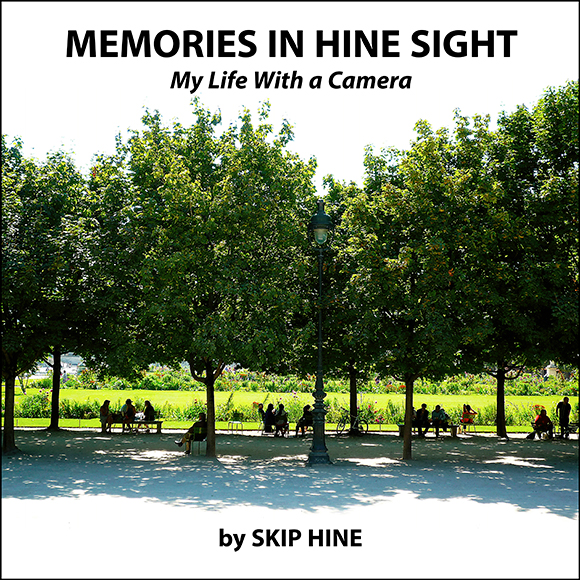
This cover of Skip Hine’s book, above, depicts his photo of the Tuileries Gardens in Paris. All the photos in this article are by Hine and included in the book. They are published with his permission.
LYME — Every picture tells a story ….
Thumb through Skip Hine’s wonderful book cleverly titled Memories In Hine Sight, subtitled My Life With a Camera, and Rod Stewart’s immortal words will immediately come to mind.
Hine is an authentic, engaging, charismatic guy — I chatted with him on the phone for around an hour and a half and thoroughly enjoyed every minute. We would probably still have been talking hours later if regular life had not interceded.
The book is a fascinating insight into the life of a professional photographer over the past 50 years. Hine notes, “People don’t appreciate or understand how many people are involved in a shoot,” deftly describing the latter as, “The magic behind the curtain.”

Hine’s photo of a model named Andes was used by both Estee Lauder and Manpower.
Hine says the book has, “No real beginning or end.” You can start reading it, put it down, dip back into it.” And that is true — it does not have to be read sequentially, though the first chapter titled, The Journey Begins definitely helps set the scene.
Stressing “It is not a ‘How to’ book, but rather a ‘How I did it’ book,” Hine says with intense feeling, “It is about my life.” He hopes that as people read the book, they “Feel as though I am there chatting to them at the kitchen counter,” and in my opinion, he absolutely achieves that aim.
He did not have an easy childhood losing both his parents at a young age. Subsequently cared for by family members, he soon was sent to boarding school and interestingly, regards that time as critical to his later success as a photographer. Hine notes that going away to school, “Opened up a whole new world for me — I had to grow up fast.”
Not only did he make “friends for life,” during his boarding school days, but also his love affair with the camera started at Pomfret School in northeastern Connecticut.

Hine shares in his book a wonderful backstory about this photo of TV personality Dick Cavett.
So how did an intrinsically shy man end up photographing presidents and TV personalities, movie stars and CEO’s, supermodels and sports icons, actors and politicians — to name but a few — in locations all across the globe? Did he have a golden key that simply opened doors when he left Rochester Institute of Technology as a shy young man with a BFA in hand that majored in Photographic Illustration?
The short answer is no.
He grafted for many years in New York City, in his words, “Always chasing the next job,” and taking some jobs for which he, “Barely got paid at all.” All the while, however, he focused on honing his craft, and offering both complete flexibility and absolute reliability.
Hine’s first job was working as an assistant for Klaus Lucka — a job he was given for a day, which turned into 18 months. He credits Lucka with being the single most important influence in his career. Hine explains, “It was just him and me. He instructed me to take notes and record the lighting of every shoot. He taught me design,” adding pointedly, ” He really made me passionate about what I was doing.”
As a photographer’s assistant, Hine’s responsibilities involved going with Lucka wherever his boss went, working all day, and then ending up every evening in the studio processing film so that the photos were ready for the client by 9 a.m. He continued working in this capacity for a number of other photographers until he made the leap to set up his own business.
After he went out on his own, Hine says he started calling art directors to let them know he was available for jobs. In his words, “Naively, I expected them to call.”
He then states pragmatically, but with a chuckle, “… they didn’t.”
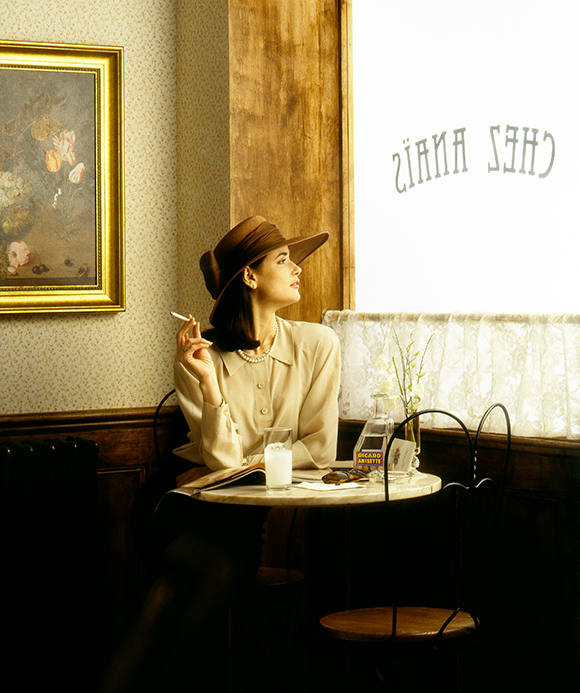
It is hard to believe that the set for this photo was created in Hine’s studio. He explains how and why that was done in his book.
On the one hand Hine admits, “I have been really, really fortunate,” but, on the other, I would add it is clear he has worked incredibly hard to achieve such major success in his career. When work did not come to him in those early days, a friend suggested he should try doing the photography for corporate annual reports. He laughs and then says, “At that time, I had never seen an annual report!” but he worked through Yellow Pages and finally secured a contract.
His corporate accounts have included Pfizer, Newsweek, the Rockefeller Group, Sports Illustrated, and the US Olympic Committee and his advertising accounts feature names like the National Football League, Johnson & Johnson, Radio City Music Hall, American Express and Colgate Palmolive. The full list of his clients over his career is too extensive to print even in the book.
He clearly loved the world of photography, sometimes taking a solo role, other times working as part of a team with art directors, hairdressers, fashion designers and more, all on set at the same time, and sharing their thoughts. He says ebulliently, “I loved the camaraderie … everybody had input,” but his often challenging role was “Trying to put it all together.”
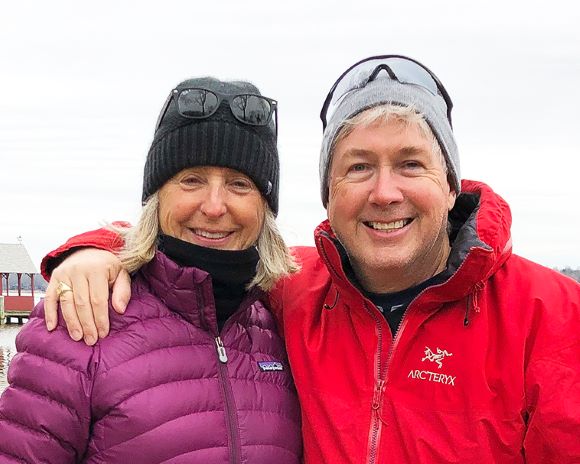
Skip and Deb Hine have lived in Lyme, Conn. for some 30 years.
Hine has owned a house in Lyme, Conn. for some 40 years, which he shares with his wife Deb, who is both his biggest fan and maybe his harshest critic. She worked closely with him on the book and he commented cheerfully that their discussions about the text were always “spirited.”
In his book, Hine shows photo after photo but tells a story about each one. He talks variously about the photo’s location, how he came to be given the contract for it, some of the obstacles he face in obtaining the image, details of the lighting on occasion, and includes often amusing and sometimes deeply personal side notes. He sums up his vast array of photos with the words, “I’m a picture-maker not a picture-taker.”

This evocative photo appears in the ‘Personal Work’ section of Hine’s book.
He tells an endearing story about how he had spent a day photographing President Gerald Ford and then in the evening found himself “standing in line for a regular piece of $2 pizza.” The juxtaposition of those two events clearly made him smile. Perhaps it also reminded him that his father had sold insurance all his life in Hartford, Conn., whereas he (Hine) had ended up taking photos and traveling the world.
On Wednesday, Sept. 14, Hine will discuss his book at the Old Lyme-Phoebe Griffin Noyes Library at an author presentation starting at 6:30 p.m. There is no charge to attend but registration at this link is encouraged for planning purposes. During the talk, Hine will share many more tales from behind the camera and insights into the glamorous (… and not always quite so glamorous!) world of photography in which he has been immersed for more than 50 years.
That world has changed dramatically in recent years with the arrival of Photoshop, LightRoom and other such software programs, which facilitate post-processing of photos in a way that Hine could never have conceived when he set out on his career.
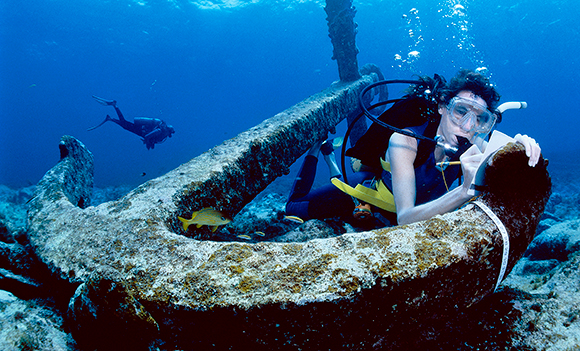
Taking this photo for Bausch and Lomb’s Renu advertising campaign set many challenges for Hine, including finding a wreck in less than 33 ft. of water. The office of famed oceanographer Robert Ballard, who also lives in Lyme, assisted with that problem and helped find one in the Cayman Islands.
Asked what his advice would be right now to someone wishing to pursue a career similar to his, Hine says surprisingly, “Don’t be a photographer!” He goes on to explain what he means, saying, “Learn how to design. Learn your fonts. Ad[vertising] agencies want one-stop shopping these days. Make yourself as versatile as you can.” He concludes, “Photography is a part of the business these days … [it is] not the business.”
Apart from sheer hard work, determination, and remarkable skill, perhaps versatility is the key to Hine’s own exceptional career. He has moved with the times, believed in himself, and simply kept doing what he does best — and his book encapsulates that story in a truly wonderful way.
It is a delight to read … and a joy to view.

Lee White
Editor’s Note: While Lee White is taking a short break, we are republishing some of her previous columns. This one is from September 2019.
Many years ago we moved from Massachusetts to Connecticut, having found an old house with land in Canterbury.That beautiful old house took years to make it gorgeous (thanks to my husband, who worked nights and weekends inside and outside that 1750 center-chimney colonial).
The kitchen barely existed when we moved in. It took months before the work was done. I washed dishes in the downstairs tub (I hated paper towels and plastic or paper glasses and cups even 25 year s ago).
I learned what I could make in a microwave (not much).
We were on a budget, so once a week, since I was writing restaurant reviews for The Day, the newspaper paid for us to eat pretty well.
There were few good restaurants within both our budget and 10 miles of our house. One restaurant in Willimantic, long gone and whose name I forgot, had for dessert a two-crust pear pie, the pears nestled in a soft, cream-cheese pillow.
I love pears and pies and autumn, but I never got that recipe. I would love if someone knew what that filling was, but here is a recipe I love.
The crust was Deb Jensen’s, who had a couple of incredibly good restaurants in Stonington until she died a few years ago. I have been using that recipe ever sense she shared it with me. The pear recipe I make with cinnamon or sometimes vanilla, since some people do not like cinnamon.

Deb Jensen’s Perfect Pie Crust
Makes enough for two, two-crust, nine-inch pies (what is not used can be frozen)
4 cups all-purpose flour
1 3/4 cups solid shortening (1 cup Crisco, 3/4 cup unsalted butter)
2 teaspoons salt
2 teaspoons sugar
1 tablespoon white vinegar
1/2 cup ice water
1 egg
Combine dry ingredients. Cut shortening into dry ingredients. Add egg to ice water, beat, then add vinegar. Stir into dry ingredients with a fork. Form into four balls, place individually in plastic wrap or small plastic bags and chill. Bring back to room temperature before rolling out.* Dough keeps one month in refrigerator and longer in the freezer.
*My biggest problem with pie crust is the rolling out. I use a floured pastry cloth and a well-floured “mitten” on my rolling pin. When it’s the right size, I roll the crust up on my rolling pin and gently “roll it out” over the pie plate.
Pear Pie Filling
Preheat oven to 425 degrees and place a large sheet pan into the oven.
2 and one-half pounds (about 5 cups) Anjou or Bartlett pears, cored, peeled and cut into one-quarter inch slices
1 teaspoon fresh lemon juice
One-third cup all-purpose flour
One-half cup granulated sugar
1 teaspoon cinnamon (or 1 teaspoon pure vanilla extract)
2 tablespoons butter
Toss the pears in a large bowl with lemon juice and allow to macerate for half an hour. Mix the flour, sugar and cinnamon (or vanilla),, then toss with the pears.
Add the pear mixture into the bottom crust, then dot with pieces of butter.
Add the second crust and crimp the edges. Use a knife to put a few vents onto the crust. I also place thin pieces of aluminum foil on the edges of the crust so they don’t blacken before the pie is ready.
Put the pie on the hot sheet pan for 15 minutes.
Then turn oven to 350 degrees, and cook until fruit is bubbling, about 45 minutes more. (I take the foil pieces off around 15 minutes for the pie is ready.
About the author: Lee White has been writing about restaurants and cooking since 1976 and has been extensively published in the Worcester (Mass.) Magazine, The Day, Norwich Bulletin, and Hartford Courant. She currently writes Nibbles and a cooking column called A La Carte for LymeLine.com and the Shore Publishing and the Times newspapers, both of which are owned by The Day. She was a resident of Old Lyme for many years but now lives in Groton, Conn. Contact Lee at leeawhite@aol.com.
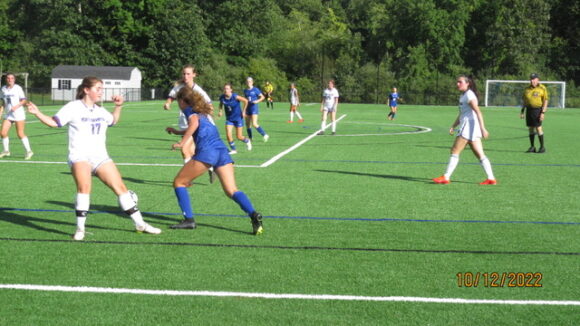
Beatrice Hunt (center) heads towards the goal.
LYME/OLD LYME — Old Lyme stormed to a 4-0 victory over North Branford (NB)/Hale Ray on Saturday. All the Wildcat goals were scored in the first half.
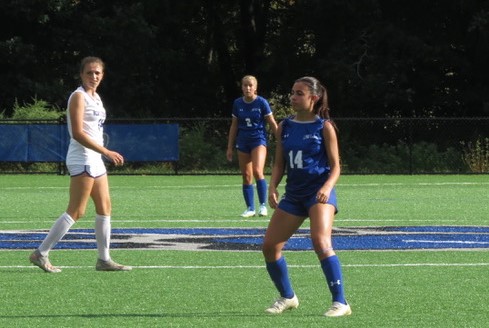
Junior Alexis Frascarelli (#14) scored the third goal for Old Lyme.
Old Lyme’s first goal was scored by junior Sydney Goulding with a penalty kick following a trip in the box and senior Alexis Fenton put in the second one with an assist by Goulding. Fenton also scored another goal but it was subsequently disallowed.
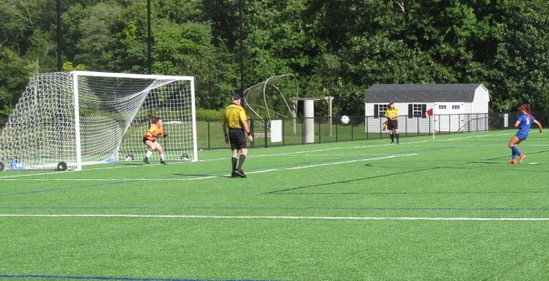
Junior Sydney Cowling scored the first goal from the penalty spot.
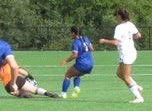
Alexis Fenton scored the second Wildcat goal.
The third goal was put in by junior Alexis Frascarelli assisted by Kayla O’Leary and the final one was unassisted by sophomore Beatrice Hunt.
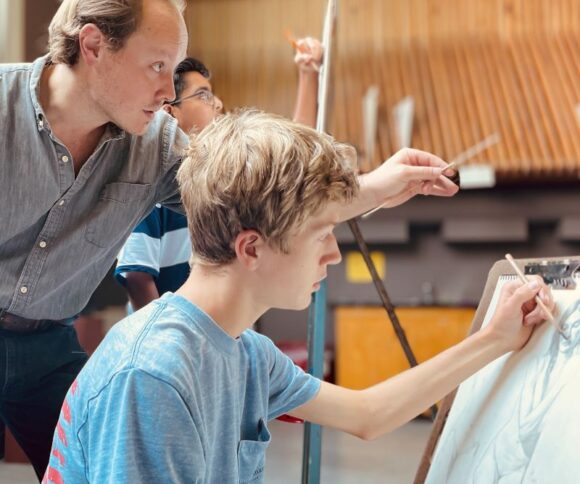
Rick Lacey, Director of Youth Programs at Lyme Academy, teaches a new program of youth drawing classes. Photo by Jordan Sokol.
OLD LYME — Beginning this month, the Lyme Academy of Fine Arts will offer a Young Masters Afterschool Program for students ages 12 and up. Students will be fully immersed in a professional studio environment, working directly with the instructor as they learn the skills necessary to achieve excellence in the fine arts, and their individual artistic goals.
Classes focus on observational drawing, painting, and sculpture, building on a progression of increasingly complex assignments first initiated in the art Academies of Europe, and designed to engage and challenge, while also developing students’ confidence in their abilities.
The Young Masters program is led by the new Director of Youth Programs, Rick Lacey. Originally from Evergreen, Colo., Lacey has spent most of his life in Lyme, Conn. After graduation from Lyme-Old Lyme High School in 2007, he graduated from the Lyme Academy College of Fine Arts in 2011, with a BFA in painting.
Lacey is a recipient of the American Visions Award as well as the John Stobart Fellowship Award. He has been featured in several national magazines, including both American Artist and Art of the West.
Lacey currently works at Lyme Academy teaching highly popular classes in drawing and painting.
“Our Afterschool Program offers an unparalleled opportunity for young artists to learn the traditional techniques of observational drawing, painting, and sculpture, in a contemporary studio environment. I look forward to offering the Lyme Academy experience to a new generation of artists” comments Lacey.
In keeping with traditional academic practices that date to the Renaissance period, first-year students will follow a drawing curriculum; students continuing on to a second year will focus on painting or sculpture.
The Young Masters After-School Program is offered over two semesters each year and is designed to follow the Region 18 K-12 academic calendar.
The Fall and Spring semester sessions meet on Tuesdays and Thursdays from 3 to 5 p.m. Students can opt for one or two program days per week. Students can join at any time, subject to space availability.
The fall semester runs through Dec. 22, 2022. The program costs are $550 for one day a week, $1,100 for two days per week.
Visit this link for more information and registration details.
The mission of the Lyme Academy of Fine Arts is to teach the foundational skills of drawing, painting, and sculpture in the figurative tradition. By its commitment to training students in these skills and an engagement with contemporary discourse, the Academy will empower a new generation of artists.
Through its programs, the Academy is committed to enriching the cultural life of the community.
As an extension of programming, the Academy has recently announced the opening of de Gerenday’s Fine Art Materials and Curiosities, a new shop offering fine art materials and giftable objects from around the globe.
Learn more by visiting www.lymeacademy.edu.