Letter from Old Lyme Open Space Commission to OL Planning Commission Regarding Proposed Development at16 Neck Rd.
Reply


Lee White
It is with deep sadness that we have learned that Lee White passed away at the end of last week at the age of 79. On a personal note, I am devastated on so many levels by this news.
Lee has been contributing columns to LymeLine for more years than I can remember. Each one was a true original and her back stories to the recipes she shared were always informative with often a nice splash of humor. They were an extremely popular feature of LymeLine, drawing multiple readers week after week.
What readers did not see, however, were the covering notes that Lee sent to me and another editor with whom Lee shared the same column, which brought at minimum a smile, sometimes a chuckle, and, on occasions, a full-throated, out-loud laugh! Lee always had a tale to tell and she told it with minimum words to maximum effect.
Lee certainly did not mince words nor did she suffer fools gladly, but at the same time she was generous to a fault and one of the most caring people I have ever met. She was full of passion about food (obviously) but also causes in which she believed. She not only served on the Groton Board of Education, but fed its members on occasions along with her family, friends, neighbors, fellow ‘foodies’, former colleagues, election workers … the list is endless.
When she lived in Old Lyme and was my near-neighbor, she hosted parties — sometimes for causes and sometimes for fun — as if it were her job. She was the quintessential host and just a wonderful, vibrant personality to have in the neighborhood.
We will miss her so much here at LymeLine. At this point, I am not sure what we will do about a food column, but in the meantime, we will likely run some of her older columns to honor her memory.
We will publish her official obituary as soon as we receive it.
Visit this link to read a lovely tribute by her friend and the Community Editor of The Day, Lee Howard.
Dear Lee, rest in peace. A bright light in the world of food may have been extinguished but the joy and knowledge it shared will be everlasting.

The leaves are beginning to turn and soon we will be enjoying the full glory of fall. Photo by Faye Cornish on Unsplash.

Maureen Haseley-Jones is “The English Lady.”
Rain through August has been extremely sparse, that said, our gardens need rain as do our reservoirs.
In the meantime, if you are planting evergreens, this month of September is the best time to plant evergreens in our zone. Evergreens planted now can begin to establish strong roots before winter and giving them adequate water is essential.
I suggest making a hole in the soil with an iron stake or other piercing instrument and feeding the hose into the hole and allowing water to reach the roots in a slow manner for at least a half hour on planting and a few times a week until the ground freezes in November. Cover the earth around the plants with a light layer of composted manure and mulch, but do not mulch right up to the bark of the plants as this encourages rodents to nest and gnaw on the bark of the plants.
HYDRANGEAS

How should you prune to achieve hydrangeas that flower like this? Maureen has the answers. hydrangeas. Photo by Gemma Evans on Unsplash.
I often get questions on pruning of Hydrangeas, with fellow gardeners asking me ‘Maureen, why did my Hydrangeas not bloom this year’? The reason that Hydrangeas do not bloom is that gardeners prune them at the wrong time. If you feel that your Hydrangea macrophylla has become too large and require pruning;
On another note, Hydrangeas do not like to be transplanted; transplanting them can result in little to no bloom for many seasons. For that reason, I suggest when planting new Hydrangeas, make sure they are at least 5 ft. apart, so they have room to grow, receive adequate ventilation and will never need to be transplanted.
This fall, as you contemplate your landscape, think on the past season as to what worked for you and what you will never try again.

Unfortunately, mint has taken over the border beneath my Franklinia tree. Many years ago, my friend Roz, was kindly lending a hand in the garden and planted mint in the garden instead of a large container that I placed for that very purpose. I was busy with other garden chores at that moment, so by the time I noticed the error six months later, the mint was running rampant among the blue myrtle edging the borders. So folks, please take note that mint is extremely invasive and should only be planted in containers where its wayward habits can be controlled.
‘It is said that ‘a gardener’s work is never done’, but now with the season’s hard labor behind you, take a break. Sit outside and inhale the late garden fragrances and allow Mother Nature to anchor and relax you.
In the early morning I enjoy sitting on my patio near the herb garden, inhaling the fragrance of the sage, which I will snip later to take indoors for drying and use in my recipes. I will also gather extra sage and lavender, which I will tie with string into small bunches to hang in my closets, which is a natural moth repellent. Some of the Lavender bunches I tuck into my drawers to keep moths from devouring my woolens; this works so well as insects do not like fragrance.
In your vegetable garden, sow spinach for spring harvest and sow a cover crop like winter rye, which can be dug in next spring together with composted manure as green manure. Green manure produces a rich growing environment for next year’s vegetables.
Now is the time to get your fall compost pile cooking with the last of the grass clippings, spent perennials, leaves and small woody twigs.
Now is also the time to dig up, divide and replant overgrown perennials. Follow this method every three to four years to ensure vibrant bloom from these plants. Never plant or transplant any division deeper in the soil than it is now or any deeper than the plant sits in the pot.
In the less hectic pace of fall, early autumn is the time to re-think your gardens. The garden’s pre-winter grooming will wait for a few weeks. Or you may feel that you would like to have a professional design as you have noticed that your borders are not up to your expectations.
If that is so, then contact someone that you trust to create a plan in the fall and winter, which can be phased in beginning next spring. Engage someone who will listen to your thoughts and stay within your budget. I am giving you a suggestion for a plantsman, who is my son Ian whose company and website is LandscapesbyIan.com. I know you would enjoy speaking with him and the saying goes ’the apple does not fall far from the tree’ and I feel that Ian’s creative talents are well worth checking out.
PEONIES
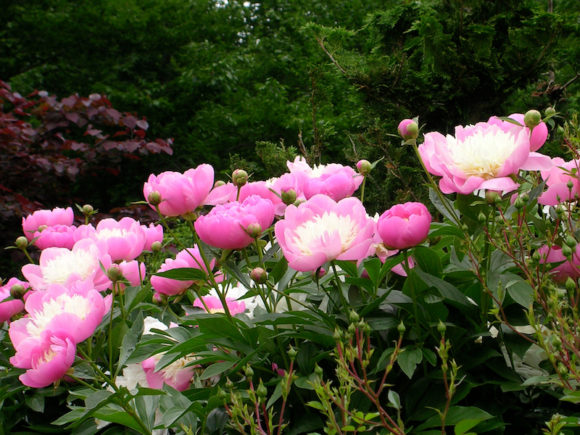
Peonies need careful attention at this time of year to create a stunning display like this next year.
September is the month to plant and transplant Peonies. Do not plant them deeply or they will not bloom, that means have just enough soil to hold them erect with the ‘pink eyes’ on the roots barely covered. Plant them with a light application of composted manure around the plant. Then in November, following the first hard frost, cut down the Peony foliage to about four inches from the ground.
In a few weeks, the bright vibrancy of autumn color will appear on the maples. Fall’s brilliant autumn finery is the last hurrah, before winter sets in. Climbing up the red milk shed near the barn, the buds on the autumn clematis are beginning to unfurl and in the herb garden, autumn crocus, asters and sedum will take their curtain calls.
For your soil to remain healthy, add a light layer of composted manure to all the borders now or in early October, together with a two-inch layer of fine bark mulch around to all newly-planted and transplanted perennials and shrubs. With the application of the manure and mulch, you are continuing to build the humus component, which will ensure a rich growing environment for spring and protect the plants from winter’s harsh conditions.
I do not cut down my spent perennials but leave them up for the birds; the ripened seed heads are a delicious treat for them to peck at. Following the vibrancy of summer bloom, I enjoy the softer, subtle colors of gray, brown and yellow of spent perennials and ornamental grasses blending naturally with the muted winter landscape, which to me offer a resting of the senses.
Early to mid-October is a great time to be planting. The benefits of fall planting for trees, shrubs and perennials gives them a head start with root development over those planted in the spring. This is especially so when we experience a late spring when planting cannot begin until late April. In New England’s fall, the cooler temperatures and still warm soil encourages the plants to direct their energy into producing strong roots.
The following trees are not good candidates for fall planting:
These trees have fleshy roots and their feeder roots are not large when young and take time to establish and are susceptible to frost heave.
Some perennials that do not like to be planted in fall are Artemisia, Lambs Ears, Foxglove, Penstemon, Anemone, Campanula, Kniphofia, Lupines, Scabiosa, Ferns and Grasses.

Now is the time to plant garlic. Photo by Lobo Studio on Unsplash.
Plant garlic this month for harvest next June – garlic is the antibiotic of the garden. Plant it under fruit trees to avoid scab and root disease, near to ponds or standing water to control mosquito larvae or pour garlic water into ponds, bird baths and fountains to deter adult mosquitoes.
BARGAINS
This is a good time to pick up end-of-season plant bargains. Most nurseries and garden centers have lowered their prices so they do not have to winter plants over in the nursery. However, with the low reservoirs you may decide to hold off until spring. But if you do purchase a few plants, keep your eyes open for the following problems:
With all the above-mentioned plants – always add composted manure around the plant and do not plant any deeper than it is in its pot or burlap wrapping. Always wear gloves when working with manure; there is bacteria in the manure – great for the soil but not healthy for you.
Above all, note that the bargain you get is often not worth the discount price.
NEW LAWN OR PATCH SEEDING
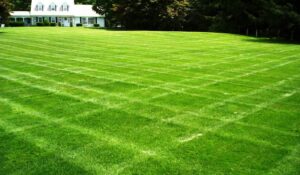
September is an excellent time to plant new grass, the young grass plants will have the advantage over weeds. Do not buy cheap seed, you reap what you sow …
Gently de-thatch the areas that you wish to overseed or patch. Do not use the large thatching machines, which can damage existing grass. Add some composted manure to the area, broadcast the seed and cover the newly-seeded grass area with salt hay (free from weed seed). Do not allow the soil surface to dry out, keep it moist. Water gently, and do not saturate the area or the seed will wash away.
When the grass appears, stay off it, do not mow and leave the salt hay to rot. Next spring, a healthy lawn will emerge and if there are a few bare patches in April, you can fill in the bare spots.
I hope your spring bulb orders are in by now. Be adventurous this year and go for masses of a single color for the greatest impact. No matter how small your planting area, it is the intensity that counts, with two or three dozen red Tulips or a hundred Daffodils planted on your woodland edge.
Buying daffodils in large numbers is less expensive, the bulbs are usually smaller – this is not a problem as daffodil bulbs grow larger each year. Even though many say the spacing between these larger bulbs should be six inches, there is no reason they cannot touch.
Put some composted manure or bulb food on the soil where the bulbs are planted. Make sure you plant the Daffodils eight inches below the frost line, with the pointed end up. Wear gloves when you plant bulbs as they have a skin irritant, which may cause a rash.
If you cannot plant your bulbs when you receive them, store them in a cool, dry place in paper bags. The best time to plant spring bulbs in the Northeast is the end of October to the middle of November.
Lily of the Valley can be transplanted this month but wear gloves because there is toxicity in this plant.
Dig up your gladioli corms, Calla bulbs, Elephant ear bulbs and Dahlia tubers when the foliage turns yellow. Lay them in the sun to “cure” and store them in a cool, dry dark place. When you dig the Dahlia tubers, do not pull them, pulling can break the tubers.
In early September after their summer sojourn outdoors, take your houseplants indoors and wash the foliage gently and repot with new potting soil into a clean container. Repot those plants that have outgrown their pots to a clean container that is only one size larger.
Fall and early winter is a great time to do stonework – dry-laid paths, walls and patios. As well as repairing fences, arbors and pergolas and build decks. Paint wooden outdoor furniture with eco conscious paint before putting them undercover for winter.
September is a gardener’s paradise; the air is cooler, the soil easy to work and you will not overheat with the effort. Stay awhile in your garden; enjoy the comforting fragrance of fall.
I’ll see you in your garden next time.
Email me with gardening questions at MaureenHaseleyJones@gmail.com.
About the author: Maureen Haseley-Jones is a member of a family of renowned horticultural artisans, whose landscaping heritage dates back to the 17th century. She is one of the founders, together with her son Ian, of, The English Lady Landscape and Home Company. Maureen and Ian are landscape designers and garden experts, who believe that everyone deserves to live in an eco-conscious environment and enjoy the pleasure that it brings. Maureen learned her design skills from both her mother and grandmother, and honed her horticultural and construction skills while working in the family nursery and landscape business in the U.K. Her formal horticultural training was undertaken at the Royal Botanic Gardens at Kew in Surrey.
 OLD LYME — Is it possible to reduce childhood anxiety, stress, and the race for perfection?
On Wednesday, Sept. 28, at 7 p.m., Lymes’ Youth Service Bureau (LYSB) presents a ‘Community Screening (via Zoom) and Discussion’ of the award-winning documentary, Chasing Childhood.
Join LYSB and Lyme-Old Lyme Schools Parent-Teacher Organizations for a virtual screening of the movie followed by a discussion with well-known psychologist Alicia Farrell.
Register at this link to receive the Zoom information in order to view the documentary and join the post-movie discussion. All are welcome.
For more information, call 860-434-7208.
 LYME/OLD LYME — In partnership with the Old Lyme Visiting Nurse Association (VNA) and the Lymes’ Senior Center, Ledge Light Health District will host a COVID-19 Bivalent Vaccine Booster Clinic today, Tuesday, Sept. 27, from 12 to 2 p.m. at the Lymes’ Senior Center.
Only the Moderna vaccine (primary series and booster) will be available at this clinic, which is for individuals 18 years or older.
The updated booster from Moderna is designed to help protect against multiple COVID-19 variants. Everyone 18 and up is eligible to receive the updated Moderna booster as long as it has been two months since your last COVID vaccination.
The clinic is free; no appointment is necessary. No insurance or ID is necessary. Bring your CDC vaccination card if you have one.
Visit www.LLHD.org or follow @LedgeLightHD on Facebook, Twitter, and Instagram for additional clinic announcements, including for pediatric clinics.
Ledge Light Health District serves as the local health department for East Lyme, Groton, Ledyard, Lyme, New London, North Stonington, Old Lyme, Stonington and Waterford, Connecticut. As a health district, formed under Connecticut General Statutes Section 19a-241, LLHD is a special unit of government, allowing member municipalities to provide comprehensive public health services to residents in a more efficient manner by consolidating the services within one organization.
Ledge Light Health District ’s mission statement – to prevent disease, illness and injury; to protect and nurture our environment; and to promote improved health and prosperity for all residents – describes in more detail their slogan of “promoting healthy communities.”